Digital Sovereignty & Cyber Security
7.2K views | +13 today
Follow
 
Scooped by Philippe J DEWOST
onto Digital Sovereignty & Cyber Security
October 5, 2018 3:24 AM
Scoop.it!

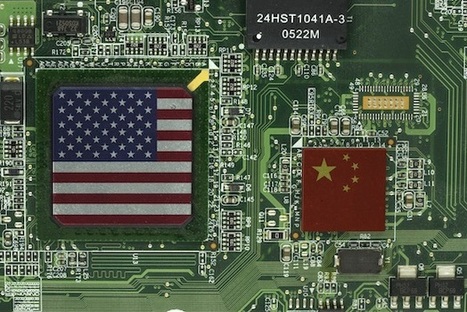
Supermicro stock fell 50 percent after a bombshell Bloomberg report on How China Used a Tiny Chip to Infiltrate nearly 30 U.S. Companies

Supermicro stock fell 50 percent after a bombshell Bloomberg report on How China Used a Tiny Chip to Infiltrate nearly 30 U.S. Companies | Digital Sovereignty & Cyber Security | Scoop.it

The attack by Chinese spies reached almost 30 U.S. companies, including Amazon and Apple, by compromising America’s technology supply chain, according to extensive interviews with government and corporate sources.

(from Bloomberg Business Week through Clément Epié)

-----------How the Hack Worked, According to U.S. Officials

① A Chinese military unit designed and manufactured microchips as small as a sharpened pencil tip. Some of the chips were built to look like signal conditioning couplers, and they incorporated memory, networking capability, and sufficient processing power for an attack.

② The microchips were inserted at Chinese factories that supplied Supermicro, one of the world’s biggest sellers of server motherboards.

③ The compromised motherboards were built into servers assembled by Supermicro.

④ The sabotaged servers made their way inside data centers operated by dozens of companies.

⑤ When a server was installed and switched on, the microchip altered the operating system’s core so it could accept modifications. The chip could also contact computers controlled by the attackers in search of further instructions and code.
-------------------------------------------

"In 2015, Amazon.com Inc. began quietly evaluating a startup called Elemental Technologies, a potential acquisition to help with a major expansion of its streaming video service, known today as Amazon Prime Video. Based in Portland, Ore., Elemental made software for compressing massive video files and formatting them for different devices. Its technology had helped stream the Olympic Games online, communicate with the International Space Station, and funnel drone footage to the Central Intelligence Agency. Elemental’s national security contracts weren’t the main reason for the proposed acquisition, but they fit nicely with Amazon’s government businesses, such as the highly secure cloud that Amazon Web Services (AWS) was building for the CIA.

To help with due diligence, AWS, which was overseeing the prospective acquisition, hired a third-party company to scrutinize Elemental’s security, according to one person familiar with the process. The first pass uncovered troubling issues, prompting AWS to take a closer look at Elemental’s main product: the expensive servers that customers installed in their networks to handle the video compression. These servers were assembled for Elemental by Super Micro Computer Inc., a San Jose-based company (commonly known as Supermicro) that’s also one of the world’s biggest suppliers of server motherboards, the fiberglass-mounted clusters of chips and capacitors that act as the neurons of data centers large and small. In late spring of 2015, Elemental’s staff boxed up several servers and sent them to Ontario, Canada, for the third-party security company to test, the person says.

Nested on the servers’ motherboards, the testers found a tiny microchip, not much bigger than a grain of rice, that wasn’t part of the boards’ original design. Amazon reported the discovery to U.S. authorities, sending a shudder through the intelligence community. Elemental’s servers could be found in Department of Defense data centers, the CIA’s drone operations, and the onboard networks of Navy warships. And Elemental was just one of hundreds of Supermicro customers.

During the ensuing top-secret probe, which remains open more than three years later, investigators determined that the chips allowed the attackers to create a stealth doorway into any network that included the altered machines. Multiple people familiar with the matter say investigators found that the chips had been inserted at factories run by manufacturing subcontractors in China.

This attack was something graver than the software-based incidents the world has grown accustomed to seeing. Hardware hacks are more difficult to pull off and potentially more devastating, promising the kind of long-term, stealth access that spy agencies are willing to invest millions of dollars and many years to get.

There are two ways for spies to alter the guts of computer equipment. One, known as interdiction, consists of manipulating devices as they’re in transit from manufacturer to customer. This approach is favored by U.S. spy agencies, according to documents leaked by former National Security Agency contractor Edward Snowden. The other method involves seeding changes from the very beginning.

One country in particular has an advantage executing this kind of attack: China, which by some estimates makes 75 percent of the world’s mobile phones and 90 percent of its PCs. Still, to actually accomplish a seeding attack would mean developing a deep understanding of a product’s design, manipulating components at the factory, and ensuring that the doctored devices made it through the global logistics chain to the desired location—a feat akin to throwing a stick in the Yangtze River upstream from Shanghai and ensuring that it washes ashore in Seattle. “Having a well-done, nation-state-level hardware implant surface would be like witnessing a unicorn jumping over a rainbow,” says Joe Grand, a hardware hacker and the founder of Grand Idea Studio Inc. “Hardware is just so far off the radar, it’s almost treated like black magic.”

But that’s just what U.S. investigators found: The chips had been inserted during the manufacturing process, two officials say, by operatives from a unit of the People’s Liberation Army. In Supermicro, China’s spies appear to have found a perfect conduit for what U.S. officials now describe as the most significant supply chain attack known to have been carried out against American companies.

One official says investigators found that it eventually affected almost 30 companies, including a major bank, government contractors, and the world’s most valuable company, Apple Inc. Apple was an important Supermicro customer and had planned to order more than 30,000 of its servers in two years for a new global network of data centers. Three senior insiders at Apple say that in the summer of 2015, it, too, found malicious chips on Supermicro motherboards. Apple severed ties with Supermicro the following year, for what it described as unrelated reasons.

In emailed statements, Amazon (which announced its acquisition of Elemental in September 2015), Apple, and Supermicro disputed summaries of Bloomberg Businessweek’s reporting. “It’s untrue that AWS knew about a supply chain compromise, an issue with malicious chips, or hardware modifications when acquiring Elemental,” Amazon wrote. “On this we can be very clear: Apple has never found malicious chips, ‘hardware manipulations’ or vulnerabilities purposely planted in any server,” Apple wrote. “We remain unaware of any such investigation,” wrote a spokesman for Supermicro, Perry Hayes. The Chinese government didn’t directly address questions about manipulation of Supermicro servers, issuing a statement that read, in part, “Supply chain safety in cyberspace is an issue of common concern, and China is also a victim.” The FBI and the Office of the Director of National Intelligence, representing the CIA and NSA, declined to comment.

The companies’ denials are countered by six current and former senior national security officials, who—in conversations that began during the Obama administration and continued under the Trump administration—detailed the discovery of the chips and the government’s investigation. One of those officials and two people inside AWS provided extensive information on how the attack played out at Elemental and Amazon; the official and one of the insiders also described Amazon’s cooperation with the government investigation. In addition to the three Apple insiders, four of the six U.S. officials confirmed that Apple was a victim. In all, 17 people confirmed the manipulation of Supermicro’s hardware and other elements of the attacks. The sources were granted anonymity because of the sensitive, and in some cases classified, nature of the information.

One government official says China’s goal was long-term access to high-value corporate secrets and sensitive government networks. No consumer data is known to have been stolen.

The ramifications of the attack continue to play out. The Trump administration has made computer and networking hardware, including motherboards, a focus of its latest round of trade sanctions against China, and White House officials have made it clear they think companies will begin shifting their supply chains to other countries as a result. Such a shift might assuage officials who have been warning for years about the security of the supply chain—even though they’ve never disclosed a major reason for their concerns.

Back in 2006, three engineers in Oregon had a clever idea. Demand for mobile video was about to explode, and they predicted that broadcasters would be desperate to transform programs designed to fit TV screens into the various formats needed for viewing on smartphones, laptops, and other devices. To meet the anticipated demand, the engineers started Elemental Technologies, assembling what one former adviser to the company calls a genius team to write code that would adapt the superfast graphics chips being produced for high-end video-gaming machines. The resulting software dramatically reduced the time it took to process large video files. Elemental then loaded the software onto custom-built servers emblazoned with its leprechaun-green logos.

Elemental servers sold for as much as $100,000 each, at profit margins of as high as 70 percent, according to a former adviser to the company. Two of Elemental’s biggest early clients were the Mormon church, which used the technology to beam sermons to congregations around the world, and the adult film industry, which did not.

Elemental also started working with American spy agencies. In 2009 the company announced a development partnership with In-Q-Tel Inc., the CIA’s investment arm, a deal that paved the way for Elemental servers to be used in national security missions across the U.S. government. Public documents, including the company’s own promotional materials, show that the servers have been used inside Department of Defense data centers to process drone and surveillance-camera footage, on Navy warships to transmit feeds of airborne missions, and inside government buildings to enable secure videoconferencing. NASA, both houses of Congress, and the Department of Homeland Security have also been customers. This portfolio made Elemental a target for foreign adversaries.

Supermicro had been an obvious choice to build Elemental’s servers. Headquartered north of San Jose’s airport, up a smoggy stretch of Interstate 880, the company was founded by Charles Liang, a Taiwanese engineer who attended graduate school in Texas and then moved west to start Supermicro with his wife in 1993. Silicon Valley was then embracing outsourcing, forging a pathway from Taiwanese, and later Chinese, factories to American consumers, and Liang added a comforting advantage: Supermicro’s motherboards would be engineered mostly in San Jose, close to the company’s biggest clients, even if the products were manufactured overseas.

Today, Supermicro sells more server motherboards than almost anyone else. It also dominates the $1 billion market for boards used in special-purpose computers, from MRI machines to weapons systems. Its motherboards can be found in made-to-order server setups at banks, hedge funds, cloud computing providers, and web-hosting services, among other places. Supermicro has assembly facilities in California, the Netherlands, and Taiwan, but its motherboards—its core product—are nearly all manufactured by contractors in China.

The company’s pitch to customers hinges on unmatched customization, made possible by hundreds of full-time engineers and a catalog encompassing more than 600 designs. The majority of its workforce in San Jose is Taiwanese or Chinese, and Mandarin is the preferred language, with hanzi filling the whiteboards, according to six former employees. Chinese pastries are delivered every week, and many routine calls are done twice, once for English-only workers and again in Mandarin. The latter are more productive, according to people who’ve been on both. These overseas ties, especially the widespread use of Mandarin, would have made it easier for China to gain an understanding of Supermicro’s operations and potentially to infiltrate the company. (A U.S. official says the government’s probe is still examining whether spies were planted inside Supermicro or other American companies to aid the attack.)

With more than 900 customers in 100 countries by 2015, Supermicro offered inroads to a bountiful collection of sensitive targets. “Think of Supermicro as the Microsoft of the hardware world,” says a former U.S. intelligence official who’s studied Supermicro and its business model. “Attacking Supermicro motherboards is like attacking Windows. It’s like attacking the whole world.”

Well before evidence of the attack surfaced inside the networks of U.S. companies, American intelligence sources were reporting that China’s spies had plans to introduce malicious microchips into the supply chain. The sources weren’t specific, according to a person familiar with the information they provided, and millions of motherboards are shipped into the U.S. annually. But in the first half of 2014, a different person briefed on high-level discussions says, intelligence officials went to the White House with something more concrete: China’s military was preparing to insert the chips into Supermicro motherboards bound for U.S. companies.

The specificity of the information was remarkable, but so were the challenges it posed. Issuing a broad warning to Supermicro’s customers could have crippled the company, a major American hardware maker, and it wasn’t clear from the intelligence whom the operation was targeting or what its ultimate aims were. Plus, without confirmation that anyone had been attacked, the FBI was limited in how it could respond. The White House requested periodic updates as information came in, the person familiar with the discussions says.

Apple made its discovery of suspicious chips inside Supermicro servers around May 2015, after detecting odd network activity and firmware problems, according to a person familiar with the timeline. Two of the senior Apple insiders say the company reported the incident to the FBI but kept details about what it had detected tightly held, even internally. Government investigators were still chasing clues on their own when Amazon made its discovery and gave them access to sabotaged hardware, according to one U.S. official. This created an invaluable opportunity for intelligence agencies and the FBI—by then running a full investigation led by its cyber- and counterintelligence teams—to see what the chips looked like and how they worked.

The chips on Elemental servers were designed to be as inconspicuous as possible, according to one person who saw a detailed report prepared for Amazon by its third-party security contractor, as well as a second person who saw digital photos and X-ray images of the chips incorporated into a later report prepared by Amazon’s security team. Gray or off-white in color, they looked more like signal conditioning couplers, another common motherboard component, than microchips, and so they were unlikely to be detectable without specialized equipment. Depending on the board model, the chips varied slightly in size, suggesting that the attackers had supplied different factories with different batches.

Officials familiar with the investigation say the primary role of implants such as these is to open doors that other attackers can go through. “Hardware attacks are about access,” as one former senior official puts it. In simplified terms, the implants on Supermicro hardware manipulated the core operating instructions that tell the server what to do as data move across a motherboard, two people familiar with the chips’ operation say. This happened at a crucial moment, as small bits of the operating system were being stored in the board’s temporary memory en route to the server’s central processor, the CPU. The implant was placed on the board in a way that allowed it to effectively edit this information queue, injecting its own code or altering the order of the instructions the CPU was meant to follow. Deviously small changes could create disastrous effects.

Since the implants were small, the amount of code they contained was small as well. But they were capable of doing two very important things: telling the device to communicate with one of several anonymous computers elsewhere on the internet that were loaded with more complex code; and preparing the device’s operating system to accept this new code. The illicit chips could do all this because they were connected to the baseboard management controller, a kind of superchip that administrators use to remotely log in to problematic servers, giving them access to the most sensitive code even on machines that have crashed or are turned off.

This system could let the attackers alter how the device functioned, line by line, however they wanted, leaving no one the wiser. To understand the power that would give them, take this hypothetical example: Somewhere in the Linux operating system, which runs in many servers, is code that authorizes a user by verifying a typed password against a stored encrypted one. An implanted chip can alter part of that code so the server won’t check for a password—and presto! A secure machine is open to any and all users. A chip can also steal encryption keys for secure communications, block security updates that would neutralize the attack, and open up new pathways to the internet. Should some anomaly be noticed, it would likely be cast as an unexplained oddity. “The hardware opens whatever door it wants,” says Joe FitzPatrick, founder of Hardware Security Resources LLC, a company that trains cybersecurity professionals in hardware hacking techniques.

U.S. officials had caught China experimenting with hardware tampering before, but they’d never seen anything of this scale and ambition. The security of the global technology supply chain had been compromised, even if consumers and most companies didn’t know it yet. What remained for investigators to learn was how the attackers had so thoroughly infiltrated Supermicro’s production process—and how many doors they’d opened into American targets.

Unlike software-based hacks, hardware manipulation creates a real-world trail. Components leave a wake of shipping manifests and invoices. Boards have serial numbers that trace to specific factories. To track the corrupted chips to their source, U.S. intelligence agencies began following Supermicro’s serpentine supply chain in reverse, a person briefed on evidence gathered during the probe says.

As recently as 2016, according to DigiTimes, a news site specializing in supply chain research, Supermicro had three primary manufacturers constructing its motherboards, two headquartered in Taiwan and one in Shanghai. When such suppliers are choked with big orders, they sometimes parcel out work to subcontractors. In order to get further down the trail, U.S. spy agencies drew on the prodigious tools at their disposal. They sifted through communications intercepts, tapped informants in Taiwan and China, even tracked key individuals through their phones, according to the person briefed on evidence gathered during the probe. Eventually, that person says, they traced the malicious chips to four subcontracting factories that had been building Supermicro motherboards for at least two years.

As the agents monitored interactions among Chinese officials, motherboard manufacturers, and middlemen, they glimpsed how the seeding process worked. In some cases, plant managers were approached by people who claimed to represent Supermicro or who held positions suggesting a connection to the government. The middlemen would request changes to the motherboards’ original designs, initially offering bribes in conjunction with their unusual requests. If that didn’t work, they threatened factory managers with inspections that could shut down their plants. Once arrangements were in place, the middlemen would organize delivery of the chips to the factories.

The investigators concluded that this intricate scheme was the work of a People’s Liberation Army unit specializing in hardware attacks, according to two people briefed on its activities. The existence of this group has never been revealed before, but one official says, “We’ve been tracking these guys for longer than we’d like to admit.” The unit is believed to focus on high-priority targets, including advanced commercial technology and the computers of rival militaries. In past attacks, it targeted the designs for high-performance computer chips and computing systems of large U.S. internet providers.

Provided details of Businessweek’s reporting, China’s Ministry of Foreign Affairs sent a statement that said “China is a resolute defender of cybersecurity.” The ministry added that in 2011, China proposed international guarantees on hardware security along with other members of the Shanghai Cooperation Organization, a regional security body. The statement concluded, “We hope parties make less gratuitous accusations and suspicions but conduct more constructive talk and collaboration so that we can work together in building a peaceful, safe, open, cooperative and orderly cyberspace.”

The Supermicro attack was on another order entirely from earlier episodes attributed to the PLA. It threatened to have reached a dizzying array of end users, with some vital ones in the mix. Apple, for its part, has used Supermicro hardware in its data centers sporadically for years, but the relationship intensified after 2013, when Apple acquired a startup called Topsy Labs, which created superfast technology for indexing and searching vast troves of internet content. By 2014, the startup was put to work building small data centers in or near major global cities. This project, known internally as Ledbelly, was designed to make the search function for Apple’s voice assistant, Siri, faster, according to the three senior Apple insiders.

Documents seen by Businessweek show that in 2014, Apple planned to order more than 6,000 Supermicro servers for installation in 17 locations, including Amsterdam, Chicago, Hong Kong, Los Angeles, New York, San Jose, Singapore, and Tokyo, plus 4,000 servers for its existing North Carolina and Oregon data centers. Those orders were supposed to double, to 20,000, by 2015. Ledbelly made Apple an important Supermicro customer at the exact same time the PLA was found to be manipulating the vendor’s hardware.

Project delays and early performance problems meant that around 7,000 Supermicro servers were humming in Apple’s network by the time the company’s security team found the added chips. Because Apple didn’t, according to a U.S. official, provide government investigators with access to its facilities or the tampered hardware, the extent of the attack there remained outside their view.

American investigators eventually figured out who else had been hit. Since the implanted chips were designed to ping anonymous computers on the internet for further instructions, operatives could hack those computers to identify others who’d been affected. Although the investigators couldn’t be sure they’d found every victim, a person familiar with the U.S. probe says they ultimately concluded that the number was almost 30 companies.

That left the question of whom to notify and how. U.S. officials had been warning for years that hardware made by two Chinese telecommunications giants, Huawei Corp. and ZTE Corp., was subject to Chinese government manipulation. (Both Huawei and ZTE have said no such tampering has occurred.) But a similar public alert regarding a U.S. company was out of the question. Instead, officials reached out to a small number of important Supermicro customers. One executive of a large web-hosting company says the message he took away from the exchange was clear: Supermicro’s hardware couldn’t be trusted. “That’s been the nudge to everyone—get that crap out,” the person says.

Amazon, for its part, began acquisition talks with an Elemental competitor, but according to one person familiar with Amazon’s deliberations, it reversed course in the summer of 2015 after learning that Elemental’s board was nearing a deal with another buyer. Amazon announced its acquisition of Elemental in September 2015, in a transaction whose value one person familiar with the deal places at $350 million. Multiple sources say that Amazon intended to move Elemental’s software to AWS’s cloud, whose chips, motherboards, and servers are typically designed in-house and built by factories that Amazon contracts from directly.

A notable exception was AWS’s data centers inside China, which were filled with Supermicro-built servers, according to two people with knowledge of AWS’s operations there. Mindful of the Elemental findings, Amazon’s security team conducted its own investigation into AWS’s Beijing facilities and found altered motherboards there as well, including more sophisticated designs than they’d previously encountered. In one case, the malicious chips were thin enough that they’d been embedded between the layers of fiberglass onto which the other components were attached, according to one person who saw pictures of the chips. That generation of chips was smaller than a sharpened pencil tip, the person says. (Amazon denies that AWS knew of servers found in China containing malicious chips.)

China has long been known to monitor banks, manufacturers, and ordinary citizens on its own soil, and the main customers of AWS’s China cloud were domestic companies or foreign entities with operations there. Still, the fact that the country appeared to be conducting those operations inside Amazon’s cloud presented the company with a Gordian knot. Its security team determined that it would be difficult to quietly remove the equipment and that, even if they could devise a way, doing so would alert the attackers that the chips had been found, according to a person familiar with the company’s probe. Instead, the team developed a method of monitoring the chips. In the ensuing months, they detected brief check-in communications between the attackers and the sabotaged servers but didn’t see any attempts to remove data. That likely meant either that the attackers were saving the chips for a later operation or that they’d infiltrated other parts of the network before the monitoring began. Neither possibility was reassuring.

When in 2016 the Chinese government was about to pass a new cybersecurity law—seen by many outside the country as a pretext to give authorities wider access to sensitive data—Amazon decided to act, the person familiar with the company’s probe says. In August it transferred operational control of its Beijing data center to its local partner, Beijing Sinnet, a move the companies said was needed to comply with the incoming law. The following November, Amazon sold the entire infrastructure to Beijing Sinnet for about $300 million. The person familiar with Amazon’s probe casts the sale as a choice to “hack off the diseased limb.”

As for Apple, one of the three senior insiders says that in the summer of 2015, a few weeks after it identified the malicious chips, the company started removing all Supermicro servers from its data centers, a process Apple referred to internally as “going to zero.” Every Supermicro server, all 7,000 or so, was replaced in a matter of weeks, the senior insider says. (Apple denies that any servers were removed.) In 2016, Apple informed Supermicro that it was severing their relationship entirely—a decision a spokesman for Apple ascribed in response to Businessweek’s questions to an unrelated and relatively minor security incident.

That August, Supermicro’s CEO, Liang, revealed that the company had lost two major customers. Although he didn’t name them, one was later identified in news reports as Apple. He blamed competition, but his explanation was vague. “When customers asked for lower price, our people did not respond quickly enough,” he said on a conference call with analysts. Hayes, the Supermicro spokesman, says the company has never been notified of the existence of malicious chips on its motherboards by either customers or U.S. law enforcement.

Concurrent with the illicit chips’ discovery in 2015 and the unfolding investigation, Supermicro has been plagued by an accounting problem, which the company characterizes as an issue related to the timing of certain revenue recognition. After missing two deadlines to file quarterly and annual reports required by regulators, Supermicro was delisted from the Nasdaq on Aug. 23 of this year. It marked an extraordinary stumble for a company whose annual revenue had risen sharply in the previous four years, from a reported $1.5 billion in 2014 to a projected $3.2 billion this year.

One Friday in late September 2015, President Barack Obama and Chinese President Xi Jinping appeared together at the White House for an hourlong press conference headlined by a landmark deal on cybersecurity. After months of negotiations, the U.S. had extracted from China a grand promise: It would no longer support the theft by hackers of U.S. intellectual property to benefit Chinese companies. Left out of those pronouncements, according to a person familiar with discussions among senior officials across the U.S. government, was the White House’s deep concern that China was willing to offer this concession because it was already developing far more advanced and surreptitious forms of hacking founded on its near monopoly of the technology supply chain.

In the weeks after the agreement was announced, the U.S. government quietly raised the alarm with several dozen tech executives and investors at a small, invite-only meeting in McLean, Va., organized by the Pentagon. According to someone who was present, Defense Department officials briefed the technologists on a recent attack and asked them to think about creating commercial products that could detect hardware implants. Attendees weren’t told the name of the hardware maker involved, but it was clear to at least some in the room that it was Supermicro, the person says.

The problem under discussion wasn’t just technological. It spoke to decisions made decades ago to send advanced production work to Southeast Asia. In the intervening years, low-cost Chinese manufacturing had come to underpin the business models of many of America’s largest technology companies. Early on, Apple, for instance, made many of its most sophisticated electronics domestically. Then in 1992, it closed a state-of-the-art plant for motherboard and computer assembly in Fremont, Calif., and sent much of that work overseas.

Over the decades, the security of the supply chain became an article of faith despite repeated warnings by Western officials. A belief formed that China was unlikely to jeopardize its position as workshop to the world by letting its spies meddle in its factories. That left the decision about where to build commercial systems resting largely on where capacity was greatest and cheapest. “You end up with a classic Satan’s bargain,” one former U.S. official says. “You can have less supply than you want and guarantee it’s secure, or you can have the supply you need, but there will be risk. Every organization has accepted the second proposition.”

In the three years since the briefing in McLean, no commercially viable way to detect attacks like the one on Supermicro’s motherboards has emerged—or has looked likely to emerge. Few companies have the resources of Apple and Amazon, and it took some luck even for them to spot the problem. “This stuff is at the cutting edge of the cutting edge, and there is no easy technological solution,” one of the people present in McLean says. “You have to invest in things that the world wants. You cannot invest in things that the world is not ready to accept yet.”

Bloomberg LP has been a Supermicro customer. According to a Bloomberg LP spokesperson, the company has found no evidence to suggest that it has been affected by the hardware issues raised in the article."

Philippe J DEWOST's insight:

Though the story is apparently still developing, a few conclusions may already be drawned :


1/ We (re)discover that China makes 90% of the world's PC

2/ As they learn fast and well, they gain not only understanding on how what they manufacture works, but also how to make it work differently by designing their own components (including processors in order to lower their dependency to Intel and US Tech)

3/ This revalidates that hardware design is a core industrial sovereignty constituent

4/ Europe has retreated very early from the field so we have absolutely no clue about what the technology we import actually does (beyond what it is supposed to do)


The only way out is to open source hardware and firmware excactly as it happened to Operating Systems. The proof that such option is viable came from Europe ; we need a Linus for hardware ! 

Philippe J DEWOST's curator insight, October 5, 2018 3:25 AM

Though the story is apparently still developing, a few conclusions may already be drawned :


1/ We (re)discover that China makes 90% of the world's PC

2/ As they learn fast and well, they gain not only understanding on how what they manufacture works, but also how to make it work differently by designing their own components (including processors in order to lower their dependency to Intel and US Tech)

3/ This revalidates that hardware design is a core industrial sovereignty constituent

4/ Europe has retreated very early from the field so we have absolutely no clue about what the technology we import actually does (beyond what it is supposed to do)


The only way out is to open source hardware and firmware excactly as it happened to Operating Systems. The proof that such option is viable came from Europe ; we need a Linus for hardware !

Digital Sovereignty & Cyber Security
From cyberwar to digital encryption, security issues to state sovereignty
Your new post is loading...

Scooped by Philippe J DEWOST
November 30, 2022 7:21 AM
Scoop.it!

First 3-axis quantum inertial sensor: an important step towards drift-free navigation systems

First 3-axis quantum inertial sensor: an important step towards drift-free navigation systems | Digital Sovereignty & Cyber Security | Scoop.it
Exail, formerly iXblue, announced the demonstration of the 3-axis quantum inertial sensor developed within the iXAtom joint laboratory, a research team shared with the LP2N lab1 in Bordeaux.
Philippe J DEWOST's insight:
Quantum leap
No comment yet.
Scooped by Philippe J DEWOST
October 19, 2021 12:06 PM
Scoop.it!

LinkedOut of China

LinkedOut of China | Digital Sovereignty & Cyber Security | Scoop.it

Microsoft plans to shut down LinkedIn in China due to increased operating environment challenges and compliance requirements. In June, some academics in China had their LinkedIn accounts blocked due to "prohibited content."

  • In September, U.S. journalists in China lost access to their accounts in the local version of LinkedIn, which the platform cited as prohibited content.
  • LinkedIn plans to replace the local version of the platform with a job board without social media features.
Philippe J DEWOST's insight:

L'annonce du départ de LinkedIn est-elle l'amorce du retrait de Microsoft de Chine ? Le découplage entre l'Oncle Sam et l'Empire du Milieu semble de plus en plus prononcé alors que le retrait de LinkedIn marque le départ du dernier géant des réseaux sociaux américains dans le pays.

Jonathan Bourguignon avait raison dans les derniers chapitres d'Internet Année Zéro.

No comment yet.
Rescooped by Philippe J DEWOST from Marketing, Innovation, Sécurité & IoT
April 26, 2021 11:30 AM
Scoop.it!

Signal détruit la réputation de l'entreprise de piratage de smartphone Cellebrite

Signal détruit la réputation de l'entreprise de piratage de smartphone Cellebrite | Digital Sovereignty & Cyber Security | Scoop.it
C'est un comble : la machine de Cellebrite destinée à hacker les smartphones n'est, elle même, que très peu sécurisée, affirme Signal. Résultat, il serait facile de la corrompre intégralement avec une simple app piégée.

Via Thierry Evangelista
realestatenearme's comment, April 26, 2021 2:41 PM
awww
realestatenearme's comment, April 26, 2021 2:41 PM
awww
Scooped by Philippe J DEWOST
February 3, 2021 12:51 PM
Scoop.it!

China Stockpiles Chips, Chip-Making Machines to Resist U.S.

China Stockpiles Chips, Chip-Making Machines to Resist U.S. | Digital Sovereignty & Cyber Security | Scoop.it

Chinese businesses have collectively acquired ~$32B worth of chip manufacturing equipment over the last year, reports Bloomberg; an analysis of trade data shows firms increased spending by ~20 percent when compared with 2019; China also imported $380B worth of chips in 2020, equal to ~18 percent of the country’s total product imports for the year.

Philippe J DEWOST's insight:

At the negotiation table, US and China are now seated. Europe is still on the menu.

Philippe J DEWOST's curator insight, February 3, 2021 12:53 PM

Europe is right in the middle of a widening Silicon Rift.

Rescooped by Philippe J DEWOST from cross pond high tech
January 13, 2021 2:38 AM
Scoop.it!

Secure Messaging Apps Comparison

Secure Messaging Apps Comparison | Digital Sovereignty & Cyber Security | Scoop.it

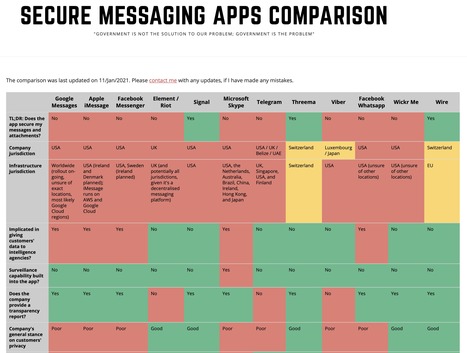
This site compares secure messaging apps from a security & privacy point of view. These include Facebook Messenger, iMessage, Skype, Signal, Google Allo, Threema, Riot, Wire, Telegram, and Wickr. The best secure messaging app?

Philippe J DEWOST's insight:

En plein #WhatsAppGate, Telegram annonce 25 millions de nouveaux inscrits en 72h et franchit la barre du demi-milliard d'utilisateurs actifs.

Au delà des comparaisons simplistes qui ont fait le buzz dans le Kommentariat, laissant accroire qu'il n'y aurait que l'alternative iMessage, Telegram ou Signal, l'offre est nettement plus abondante. D'ailleurs Skype ou Viber ne sont pas nés de la dernière pluie.

D'autres acteurs ne figurent pas encore dans ce tableau, comme #FireChat (qui fonctionne de proche en proche en mode décentralisé), le français Skred de Pierre Bellanger, Olvid, ou encore la messagerie sécurisée #Tchap développée sur base Riot par les pouvoirs publics.

Au delà du #RGPD se pose la vraie question de l'interopérabilité : après tout, une grande partie de ces apps sont parties du protocole open source #XMPPissu de Jabber (et donc d'Orange).

La simplicité est l'autre enjeu, et WhatsApp garde ici un avantage énorme tant il est facile de monter un groupe qu'il soit familial, projet, ou circonstanciel et d'y partager photos et propos.

Mais la simplicité c'est aussi ne pas avoir à se souvenir de l'application sur laquelle avait lieu ma dernière conversation avec vous !

Philippe J DEWOST's curator insight, January 13, 2021 2:37 AM

In the midst of #WhatsAppGate, @Telegram announced 25 million new registrations in the past 72 hours, and more than half a billion active users.


Beyond simplistic comparisons buzzing through the #Kommentariat, the offer is much more abundant. Besides, Skype or Viber were not born out of the last rain.


While solutions seems to focus on #privacy enforcement, the question of interoperability is another possible avenue : after all, a large number of these apps are based on the open source #XMPP protocol from Jabber (and therefore Orange). Why not enforce some level of interconnection ?


Simplicity is the other issue, and there WhatsApp has a huge advantage, given how easy it is to set up a group, whether for a family, project, or circumstantial powwow, and share photos and comments.


But simplicity also means not having to remember the application I was using in my last conversation with you !

Philippe J DEWOST's curator insight, January 16, 2021 9:50 AM

WhatsApp and Facebook bend the knee following customer backlash. #WhatsAppGate

https://techcrunch.com/2021/01/15/whatsapp-delays-new-data-sharing-policy-enforcement-to-may-15/

Scooped by Philippe J DEWOST
September 30, 2020 12:45 PM
Scoop.it!

EU is selling surveillance tech to China, says rights group

EU is selling surveillance tech to China, says rights group | Digital Sovereignty & Cyber Security | Scoop.it

European tech companies are selling digital surveillance technology to China, according to rights group Amnesty International.

Amnesty's findings, published Monday, come ahead of negotiations this week in Brussels on European surveillance export rules, known as Recast Dual Use Regulation.


The research found that three companies in France, Sweden and the Netherlands sold surveillance tools including facial recognition technology and network cameras to Chinese security agencies.

In some cases, European technology is used in China’s indiscriminate mass surveillance programs, and may also be deployed to suppress Uighurs and other vulnerable minorities, according to the human rights group.

Philippe J DEWOST's insight:

Temptation to ban vs temptation to sell

No comment yet.
Scooped by Philippe J DEWOST
May 26, 2020 4:31 PM
Scoop.it!

There's a Jailbreak Out for all Versions of iOS from 11 to 13.5, the current release.

There's a Jailbreak Out for all Versions of iOS from 11 to 13.5, the current release. | Digital Sovereignty & Cyber Security | Scoop.it

Over the years, Apple has made it prohibitively difficult to install unapproved software on its locked-down devices. But on Saturday, a hacker group called Unc0ver released a tool that will "jailbreak" all versions of iOS from 11 to 13.5. It's been years since a jailbreak has been available for a current version of iOS for more than a few days—making this yet another knock on Apple's faltering security image.

Unc0ver says that its jailbreak, which you can install using the longtime jailbreaking platforms AltStore and Cydia (but maybe don't unless you're absolutely sure you know what you're doing), is stable and doesn't drain battery life or prevent use of Apple services like iCloud, Apple Pay, or iMessage. And the group claims that it preserves Apple's user data protections and doesn't undermine iOS' sandbox security, which keeps programs running separately so they can't access data they shouldn't.

"This jailbreak basically just adds exceptions to the existing rules," Unc0ver's lead developer, who goes by Pwn20wnd, told WIRED. "It only enables reading new jailbreak files and parts of the file system that contain no user data."

Philippe J DEWOST's insight:

Impressive exploit given Apple's increased fortress walls thickness. Yet (why) should you jailbreak ?

Philippe J DEWOST's curator insight, May 26, 2020 4:34 PM

The cat and mouse game around Apple's iOS closed garden has resumed and this time it means something again.

Scooped by Philippe J DEWOST
March 4, 2020 12:54 AM
Scoop.it!

China suppressed Covid-19 with AI and big data

China suppressed Covid-19 with AI and big data | Digital Sovereignty & Cyber Security | Scoop.it

China used locational and other data from hundreds of millions of smartphones to contain the spread of Covid-19, according to Chinese sources familiar with the program.

In addition to draconian quarantine procedures, which kept more than 150 million Chinese in place at the February peak of the coronavirus epidemic, China used sophisticated computational methods on a scale never attempted in the West.

With more than 80,000 cases registered, China reported only 126 new cases yesterday, compared to 851 in South Korea and 835 in Iran, out of a total of 1,969 new cases worldwide. Chinese sources emphasize that the artificial intelligence initiative supplemented basic public health measures, which centered on quarantines and aggressive efforts to convince Chinese citizens to change their behavior.

Chinese government algorithms can estimate the probability that a given neighborhood or even an individual has exposure to Covid-19 by matching the location of smartphones to known locations of infected individuals or groups. The authorities use this information to use limited medical resources more efficiently by, for example, directing tests for the virus to high-risk subjects identified by the artificial intelligence algorithm.

All smartphones with enabled GPS give telecom providers a precise record of the user’s itinerary. Smartphone users in the United States and Europe can access their own data, but privacy laws prevent the government from collecting this data. China has no such privacy constraints, and telecom providers have used locational data for years for advertising.

A Chinese bank executive reports that his company purchases locational data from telecom providers. “If you have walked by an auto dealership three times in the last few weeks, we send you a text advertising an auto loan,” the executive said. “We wouldn’t be allowed to do that in the West.

Philippe J DEWOST's insight:

Safety has a price. Freedom too.

No comment yet.
Scooped by Philippe J DEWOST
February 13, 2020 12:47 AM
Scoop.it!

Macron veut une souveraineté nationale, Photonis bientôt rachetée par un américain

Macron veut une souveraineté nationale, Photonis bientôt rachetée par un américain | Digital Sovereignty & Cyber Security | Scoop.it
Vendue par le fonds français Ardian, la PME Photonis va très certainement être rachetée par un groupe américain. L’incapacité de la France à protéger ses pépites "offre aux autres puissances la possibilité de nous affaiblir", a rappelé vendredi à l'Ecole de Guerre Emmanuel Macron.
No comment yet.
Scooped by Philippe J DEWOST
December 9, 2019 4:58 AM
Scoop.it!

China tells government offices to remove all foreign computer equipment

China tells government offices to remove all foreign computer equipment | Digital Sovereignty & Cyber Security | Scoop.it

According to The Guardian, "China has ordered that all foreign computer equipment and software be removed from government offices and public institutions within three years, the Financial Times reports.

The government directive is likely to be a blow to US multinational companies like HP, Dell and Microsoft and mirrors attempts by Washington to limit the use of Chinese technology, as the trade war between the countries turns into a tech cold war.

The Trump administration banned US companies from doing business with Chinese Chinese telecommunications company Huawei earlier this year and in May, Google, Intel and Qualcomm announced they would freeze cooperation with Huawei.

By excluding China from western know-how, the Trump administration has made it clear that the real battle is about which of the two economic superpowers has the technological edge for the next two decades.

This is the first known public directive from Beijing setting specific targets limiting China’s use of foreign technology, though it is part a wider move within China to increase its reliance on domestic technology.

The FT reported that the directive would result in an estimated 20m- to 30m pieces of hardware needing to be replaced and that this work would begin in 2020. Analysts told the FT that 30% of substitutions would take place in 2020, 50% in 2021 and 20% in 2022."

Philippe J DEWOST's insight:

This development is fascinating as it shows that China now feels autonomous enough in the Tech field, going full stack from chips to cloud and Operating Systems.

What is more worrying is that this will lead the world to an autistic duopoly spying on an controlling all other players. Including Europe.

No comment yet.
Rescooped by Philippe J DEWOST from cross pond high tech
December 2, 2019 1:42 PM
Scoop.it!

Hyderabad based Fireflies.ai, founded by MIT & Microsoft alumni, raises $5m to put a voice assistant in every meeting

Hyderabad based Fireflies.ai, founded by MIT & Microsoft alumni, raises $5m to put a voice assistant in every meeting | Digital Sovereignty & Cyber Security | Scoop.it

How Fireflies.ai works? ​Users can connect their Google or Outlook calendars with Fireflies and have our AI system capture meetings in real-time across more than a dozen different web-conferencing platforms like Zoom, Google Meet, Skype, GoToMeeting, Webex, and many ​more ​systems. These meetings are then indexed, transcribed, and made searchable inside the Fireflies dashboard. You can comment, annotate key moments, and automatically extract relevant information around numerous topics like the next steps, questions, and red flags.

Instead of spending time frantically taking notes in meetings, Fireflies users take comfort knowing that shortly after a meeting they are provided with a transcript of the conversation and an easy way to collaborate on the project going forward.

Fireflies can also sync all this vital information back into the places where you already work thanks to robust integrations with Slack, Salesforce, Hubspot, and other platforms.

Fireflies.ai is the bridge that helps data flow seamlessly from your communication systems to your system of records.

This approach is possible today because of major technological changes over the last 5 years in the field of machine learning. Fireflies leverage recent enhancements in Automatic Speech Recognition (ASR), natural language processing (NLP), and neural nets to create a seamless way for users to record, annotate, search, and share important moments from their meetings.

Who is Fireflies for? ​The beauty of Fireflies is that it’s been adopted by people in different roles across organizations big and small:

  • Sales managers​ use Fireflies to review their reps’ calls at lightning speed and provide on the spot coaching
  • Marketers ​create key customer soundbites from calls to use in their campaigns.
  • Recruiters ​no longer worry about taking hasty notes and instead spend more time paying attention to candidates during interviews.
  • Engineers ​refer back to specific parts of calls using our smart search capabilities to make everyone aware of the decisions that were finalized.
  • Product managers and executives​ rely on Fireflies to document knowledge and important initiatives that are discussed during all-hands and product planning meetings on how to get access ​Fireflies have a free tier for individuals and teams to easily get started. For more advanced capabilities like augmented call search, more storage, and admin controls, we offer different tiers for growing teams and enterprises. You can learn more about our pricing and tiers by going to fireflies.ai/pricing.


Philippe J DEWOST's insight:

What if meeting notes were automatically generated and made available shortly after the conference call ? What if action items were assigned too ?

No more need for post processing, nor in meeting typing pollution : here is #AI (read "automated pattern detection and in context recognition") 's promised made by Firefly.

History reminds us how cautiously we shall face the longstanding fantasy of voice dictation (not speaking here of voice assistants) : Dragon Dictate in the 1990's never lived up to the promise, not did 

SpinVox in 2009 (it ended in tears). Now with growing concerns on the privacy vs. convenience balance, war is still not over.

Philippe J DEWOST's curator insight, December 2, 2019 3:18 AM

Et si le compte-rendu d'une réunion était automatique ? Et si la distribution des décisions prises et leur suivi l'étaient aussi ?

Plus besoin de taper sur son clavier et de polluer le meeting, plus besoin d'y passer un temp précieux...

C'est la promesse de cette nouvelle application à base d'Intelligence artificielle (lire : de reconnaissance automatisée de contenu et de contexte).

Restons cependant prudents ; la dictée vocale est un fantasme régulièrement déçu depuis les années 1990 et Dragon Dictate sur PC, puis les années 2009 et le scandale SpinVox sur mobile. Désormais les réserves se porteront plus sur l'arbitrage entre vie privée et efficacité, et la partie n'est pas nécessairement gagnée.

On peut au moins reconnaître à Firefly.ai le mérite de s'attaquer de nouveau à la reconnaissance vocale...

Scooped by Philippe J DEWOST
October 13, 2019 1:44 PM
Scoop.it!

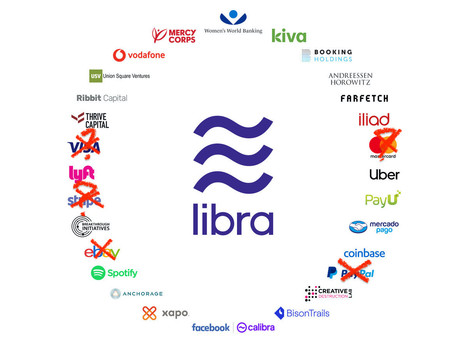
EBay, Visa, Mastercard, Stripe abandon Facebook's libra cryptocurrency

EBay, Visa, Mastercard, Stripe abandon Facebook's libra cryptocurrency | Digital Sovereignty & Cyber Security | Scoop.it

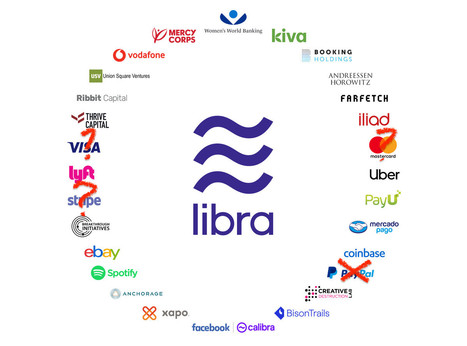
EBay, Stripe, Mastercard and Visa are all dropping out of Facebook’s libra cryptocurrency project, the companies announced Friday. The news comes one week after PayPal announced its withdrawal as government regulators continue to scrutinize the plans.

In statements following the news, the companies said they respect and see potential in the project, but have chosen to focus on other efforts. A Stripe spokesperson said in a statement that the company “is supportive of projects that aim to make online commerce more accessible for people around the world.” Stripe will “remain open to working with the Libra Association at a later stage,” the spokesperson said.

A Visa spokesperson said the company “will continue to evaluate and our ultimate decision will be determined by a number of factors, including the Association’s ability to fully satisfy all requisite regulatory expectations. Visa’s continued interest in Libra stems from our belief that well-regulated blockchain-based networks could extend the value of secure digital payments to a greater number of people and places, particularly in emerging and developing markets.”

The original coalition of 28 corporate backers of the libra cryptocurrency seems to be dwindling as lawmakers continue to question how it will impact sovereign currencies and how the project’s leaders can ensure consumers’ protection. Mercadopago and PayU are now the only two payments companies continuing to back the cryptocurrency as of Friday afternoon. Original backers Uber and Lyft told CNBC there has been no change to their involvement in the project.

The backers abandoning the project may have found safety in numbers after PayPal announced its exit last week. News that eBay, Stripe and Mastercard were each dropping out quickly followed one another Friday afternoon, indicating all three had likely been thinking about leaving during the same period. The decisions come ahead of a planned Libra Association Council meeting on Oct. 14. A week later, libra’s cryptocurrency project will take center stage in front of U.S. lawmakers once again when Facebook CEO Mark Zuckerberg testifies in front of the House Financial Services Committee later this month.

David Marcus, who leads the libra project and was previously the president of PayPal, weighed in on Twitter hours after the announcements. He cautioned “against reading the fate of Libra into this update.”

Philippe J DEWOST's insight:

3 partners decided to jump ship after "reconsidering"  for a week, and a fourth one joined the fray. Will libra resist pressure ?

No comment yet.
Rescooped by Philippe J DEWOST from cross pond high tech
September 25, 2019 12:47 AM
Scoop.it!

Huawei’s new 4K Vision TV claims voice, facial recognition, and tracking among a long list of AI powers

Huawei’s new 4K Vision TV claims voice, facial recognition, and tracking among a long list of AI powers | Digital Sovereignty & Cyber Security | Scoop.it

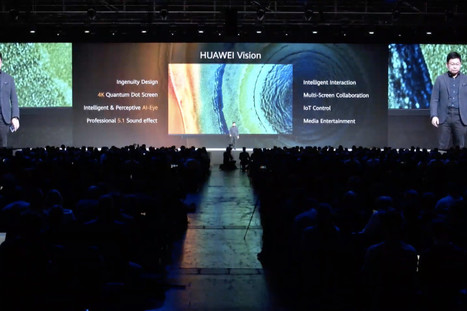
Huawei announced its own 4K television, the Huawei Vision, during the Mate 30 Pro event today. Like the Honor Vision and Vision Pro TVs that were announced back in August, Huawei’s self-branded TV runs the company’s brand-new Harmony OS software as its foundation.

Huawei will offer 65-inch and 75-inch models to start, with 55-inch and 85-inch models coming later. The Huawei TV features quantum dot color, thin metal bezels, and a pop-up camera for video conferencing that lowers into the television when not in use. On TVs, Harmony OS is able to serve as a hub for smart home devices that support the HiLink platform.

Huawei is also touting the TV’s AI capabilities, likening it to a “smart speaker with a big screen.” The TV supports voice commands and includes facial recognition and tracking capabilities. Apparently, there’s some AI mode that helps protect the eyes of young viewers — presumably by filtering blue light. The Vision also allows “one-hop projection” from a Huawei smartphone. The TV’s remote has a touchpad and charges over USB-C.

Philippe J DEWOST's insight:

Still think YOU are watching TV ?

Philippe J DEWOST's curator insight, September 25, 2019 12:46 AM

TV is now watching you watching TV : is this smart ?

Scooped by Philippe J DEWOST
October 20, 2021 12:23 PM
Scoop.it!

Hacker steals government ID database for Argentina's entire population

Hacker steals government ID database for Argentina's entire population | Digital Sovereignty & Cyber Security | Scoop.it
A hacker has breached the Argentinian government's IT network and stolen ID card details for the country's entire population, data that is now being sold in private circles.
Philippe J DEWOST's insight:
Citizens are being deprived of their identity.
No comment yet.
Scooped by Philippe J DEWOST
October 14, 2021 8:27 AM
Scoop.it!

Taiwan – at the Center of a Worldwide Go Game Between China and the US

Taiwan – at the Center of a Worldwide Go Game Between China and the US | Digital Sovereignty & Cyber Security | Scoop.it
Silicon Geopolitics
Philippe J DEWOST's insight:
A must read paper on how Taiwan’s fate could impact western Tech in the next decade
No comment yet.
Scooped by Philippe J DEWOST
March 22, 2021 10:43 AM
Scoop.it!

Microsoft email server flaws exploited to hack at least 30,000 US organizations

Chinese state-sponsored group Hafnium reportedly used four zero-day flaws in Microsoft Exchange Server to infiltrate at least 30,000 organizations in the US.

No comment yet.
Scooped by Philippe J DEWOST
January 27, 2021 3:29 AM
Scoop.it!

Telegram Bot sells 533 million Facebook Users' Phone Numbers for $20 a piece

Telegram Bot sells 533 million Facebook Users' Phone Numbers for $20 a piece | Digital Sovereignty & Cyber Security | Scoop.it

A user of a low-level cybercriminal forum is selling access to a database of phone numbers belonging to Facebook users, and conveniently letting customers look up those numbers by using an automated Telegram bot.

Although the data is several years old, it still presents a cybersecurity and privacy risk to those whose phone numbers may be exposed—one person advertising the service says it contains data on 500 million users. Facebook told Motherboard the data relates to a vulnerability the company fixed in August 2019.

"It is very worrying to see a database of that size being sold in cybercrime communities, it harms our privacy severely and will certainly be used for smishing and other fraudulent activities by bad actors," Alon Gal, co-founder and CTO of cybersecurity firm Hudson Rock, and who first alerted Motherboard about the bot, said.

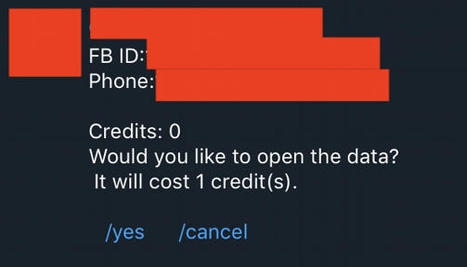
Upon launch, the Telegram bot says "The bot helps to find out the cellular phone numbers of Facebook users," according to Motherboard's tests. The bot lets users enter either a phone number to receive the corresponding user's Facebook ID, or visa versa. The initial results from the bot are redacted, but users can buy credits to reveal the full phone number. One credit is $20, with prices stretching up to $5,000 for 10,000 credits. The bot claims to contain information on Facebook users from the U.S., Canada, the U.K., Australia, and 15 other countries.


Philippe J DEWOST's insight:

The ultimate phone book business model

Philippe J DEWOST's curator insight, January 27, 2021 3:39 AM

A new phonebook business model ?

Rescooped by Philippe J DEWOST from cross pond high tech
November 25, 2020 10:30 AM
Scoop.it!

Huawei's 5G Tech Advantage Has Roots In The '40s and a Turkish Man Who Conquered Noise

Huawei's 5G Tech Advantage Has Roots In The '40s and a Turkish Man Who Conquered Noise | Digital Sovereignty & Cyber Security | Scoop.it

The US ban on Chinese tech giant Huawei and its 5G technology has sparked a heated debate on the future of information flows and their control.

Until now, however, that debate has largely overlooked how Huawei arrived at its position of tech prowess.

The Five Eyes intelligence group (United States, Canada, Australia, New Zealand and the United Kingdom) insist that Huawei 5G technology represents a huge intelligence risk.

Huawei flatly denies the accusation. Meanwhile, trillions of dollars in 5G revenue are at stake. Shutting down Huawei also has an extra benefit for the US — it temporarily halts Chinese progress in this extremely lucrative sector.

But how did Huawei get so far ahead in the first place? Well, according to a piece in Wired and carried by androidcentral, it all comes down to a theory crafted in 1948 and recently revived by a Turkish professor.

Philippe J DEWOST's insight:

Fascinating

Philippe J DEWOST's curator insight, November 25, 2020 10:16 AM

Fascinating story about signal theory, IP acquisition, and how Qualcomm and the US missed an opportunity that now vastly benefits Huawei as a 5G Equipment leader.

Scooped by Philippe J DEWOST
May 27, 2020 2:58 AM
Scoop.it!

Sharing intelligence - Maximator, a 1976 European spy pact to rival the Five Eyes, comes to light

Sharing intelligence - Maximator, a 1976 European spy pact to rival the Five Eyes, comes to light | Digital Sovereignty & Cyber Security | Scoop.it

A DANE, A Swede, a German and a Dutchman walk into a bar. It is 1979 and spooks from the four countries are conferring in Munich over dark and malty lagers. For years, they had co-operated in the business of signals intelligence, or SIGINT—intercepting messages and cracking codes—and wanted a name for their budding spy pact. “They looked at their glasses, filled with Doppelbock beer of the local brand Maximator,” writes Bart Jacobs, a Dutch computer-science professor, “and reached a decision”.


In a paper published last month, Mr Jacobs publicly revealed the existence of the Maximator alliance for the first time, to the considerable irritation of those who had kept it under wraps for decades. The group was formed in 1976, when Denmark joined forces with Germany and Sweden to intercept and decipher messages sent by satellites, a burgeoning method of communication. The Netherlands joined two years later, bringing its intercept stations in the Carribean to the table, and France in 1985. The group is alive and well today.


Maximator’s history is a fine illustration of the layers of chicanery involved in good cryptology. As well as plucking signals out of the ether, the group would swap details of weaknesses in cipher machines which encrypted diplomatic and military messages. Luckily for them, says Mr Jacobs, the companies that made those machines “were mostly controlled by Western intelligence organisations.” Crypto AG, a Swiss firm that dominated the global market, turns out to have been jointly owned by the CIA and its German counterpart, the BND. They would sell rigged machines to friends and enemies alike, including several NATO countries.

 
Philippe J DEWOST's insight:

There is a European Five Eyes Raven and it is named after a German Beer

Philippe J DEWOST's curator insight, May 27, 2020 3:07 AM

Depuis 1976, un pacte d'espionnage lie 5 pays européens, qui porte le nom d'une bière munichoise.


Un fascinant article de The Economist dévoilant ce pacte qui fut créé en réponse aux "Five Eyes" anglo-saxon


On y découvre les liens étranges entre le Suisse CryptoAG, fabriquant des "Enigma" modernes et deux de ses actionnaires curieux de déchiffrer les messages "à la source"


#Cryptographie #Espionnage #Renseignement #Souveraineté #CIA

Rescooped by Philippe J DEWOST from pixels and pictures
April 23, 2020 9:30 AM
Scoop.it!

Chicago-made glasses can block facial recognition tech

Chicago-made glasses can block facial recognition tech | Digital Sovereignty & Cyber Security | Scoop.it

As facial recognition technology gets cheaper, faster and more popular, people are looking for ways to subvert it. Reflectacles, a Chicago-based company, makes glasses that can thwart the technology.


The chunky, thick-framed glasses Scott Urban makes in his Humboldt Park workshop look like normal eyeglasses, but when viewed on a security camera, the wearer’s face becomes a shining orb.


Reflectacles, as the glasses are called, are among a growing number of devices developed to protect individual privacy as facial recognition technology becomes cheaper, faster and more commonplace.

Philippe J DEWOST's insight:

Sauf si la loi interdit l'usage de maquillages et d'accessoires permettant de confondre les caméras. Après tout, masquer son visage sur la voie publique est bien interdit...

Philippe J DEWOST's curator insight, April 23, 2020 9:28 AM

Until they are forbidden by law ?

Scooped by Philippe J DEWOST
February 24, 2020 12:26 AM
Scoop.it!

Verizon bails on RSA cybersecurity conference over coronavirus fears

Verizon bails on RSA cybersecurity conference over coronavirus fears | Digital Sovereignty & Cyber Security | Scoop.it
It would seem that the corporate sponsors of the RSA security conference are no match for IRL viruses. Conference organizers announced Friday that Verizon has joined the growing ranks of companies bailing on the annual San Francisco cybersecurity event, which is slated to begin on Feb. 24. Following IBM and AT&T, Verizon is the latest company to pull out at the last minute, and, according to the RSA, the blame lies on the coronavirus — officially dubbed COVID-19. "We learned today that Verizon has decided to no longer participate in RSA Conference 2020 as a Gold Sponsor," reads the statement. "We understand and respect their decision."
Philippe J DEWOST's insight:
When IRL viruses take over cyber viruses
No comment yet.
Rescooped by Philippe J DEWOST from cross pond high tech
December 9, 2019 12:53 PM
Scoop.it!

AWS launches its custom Inferentia AI chips

AWS launches its custom Inferentia AI chips | Digital Sovereignty & Cyber Security | Scoop.it

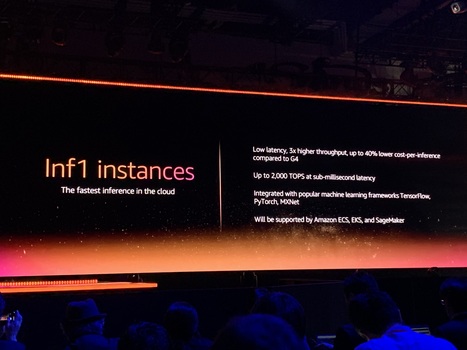
At its re:Invent conference, AWS today announced the launch of its Inferentia chips, which it initially announced last year. These new chips promise to make inferencing, that is, using the machine learning models you pre-trained earlier, significantly faster and cost effective.

As AWS CEO Andy Jassy noted, a lot of companies are focusing on custom chips that let you train models (though Google and others would surely disagree there). Inferencing tends to work well on regular CPUs, but custom chips are obviously going to be faster. With Inferentia, AWS offers lower latency and three times the throughput at 40% lower cost per inference compared to a regular G4 instance on EC4.

The new Inf1 instances promise up to 2,000 TOPS and feature integrations with TensorFlow, PyTorch and MXNet, as well as the ONNX format for moving models between frameworks. For now, it’s only available in the EC2 compute service, but it will come to AWS’s container services and its SageMaker machine learning service soon, too.

Philippe J DEWOST's insight:

La puissance de calcul est un des leviers de la puissance tout court - suite : même les libraires se mettent au design propriétaire de processeurs (et celui-ci est dédié à l'IA). On attend toujours le processeur de la FNAC ou le GPU de Cdiscount ... 

Philippe J DEWOST's curator insight, December 9, 2019 3:53 AM

Amazon continues going vertical with custom AI chip design made available in its cloud offerings.

Scooped by Philippe J DEWOST
December 3, 2019 6:22 AM
Scoop.it!

1913: When Hitler, Trotsky, Tito, Freud and Stalin all lived in the same place

1913: When Hitler, Trotsky, Tito, Freud and Stalin all lived in the same place | Digital Sovereignty & Cyber Security | Scoop.it

A century ago, a single square mile in the capital of the then Austro-Hungarian Empire was home to some of the most remarkable men of the 20th Century, as it played host to Adolf Hitler, Leon Trotsky, Joseph Tito, Sigmund Freud and Joseph Stalin.

The BBC telles us that "in January 1913, a man whose passport bore the name Stavros Papadopoulos disembarked from the Krakow train at Vienna's North Terminal station.

Of dark complexion, he sported a large peasant's moustache and carried a very basic wooden suitcase.

"I was sitting at the table," wrote the man he had come to meet, years later, "when the door opened with a knock and an unknown man entered.

"He was short... thin... his greyish-brown skin covered in pockmarks... I saw nothing in his eyes that resembled friendliness."

The writer of these lines was a dissident Russian intellectual, the editor of a radical newspaper called Pravda (Truth). His name was Leon Trotsky.


The man he described was not, in fact, Papadopoulos.

He had been born Iosif Vissarionovich Dzhugashvili, was known to his friends as Koba and is now remembered as Joseph Stalin.

Trotsky and Stalin were just two of a number of men who lived in central Vienna in 1913 and whose lives were destined to mould, indeed to shatter, much of the 20th century.

It was a disparate group. The two revolutionaries, Stalin and Trotsky, were on the run. Sigmund Freud was already well established.

The psychoanalyst, exalted by followers as the man who opened up the secrets of the mind, lived and practised on the city's Berggasse.

The young Josip Broz, later to find fame as Yugoslavia's leader Marshal Tito, worked at the Daimler automobile factory in Wiener Neustadt, a town south of Vienna, and sought employment, money and good times.

Then there was the 24-year-old from the north-west of Austria whose dreams of studying painting at the Vienna Academy of Fine Arts had been twice dashed and who now lodged in a doss-house in Meldermannstrasse near the Danube, one Adolf Hitler."

Philippe J DEWOST's insight:

Would such a coexistence have been detected with surveillance cameras and AI ? #MinorityReport

No comment yet.
Scooped by Philippe J DEWOST
October 30, 2019 2:19 PM
Scoop.it!

WhatsApp blames — and sues — mobile spyware maker NSO Group over its zero-day calling exploit

WhatsApp blames — and sues — mobile spyware maker NSO Group over its zero-day calling exploit | Digital Sovereignty & Cyber Security | Scoop.it

WhatsApp has filed a suit in federal court accusing Israeli mobile surveillance maker NSO Group of creating an exploit that was used hundreds of times to hack into target’s phone.

The lawsuit, filed in a California federal court, said the mobile surveillance outfit “developed their malware in order to access messages and other communications after they were decrypted” on target devices.

The attack worked by exploiting an audio-calling vulnerability in WhatsApp. Users may  appear to get an ordinary call, but the malware would quietly infect the device with spyware, giving the attackers full access to the device.

In some cases it happened so quickly, the target’s phone may not have rung at all.

Because WhatsApp is end-to-end encrypted, it’s near-impossible to access the messages as they traverse the internet. But in recent years, governments and mobile spyware companies have begun targeting the devices where the messages were sent or received. The logic goes that if you hack the device, you can obtain its data.

That’s what WhatsApp says happened.

WhatsApp, owned by Facebook, quickly patched the vulnerability. Although blame fell fast on NSO Group, WhatsApp did not publicly accuse the company at the time — until now.

In an op-ed posted shortly after the suit was filed, WhatsApp head Will Cathcart said the messaging giant “learned that the attackers used servers and Internet-hosting services that were previously associated” with NSO Group, and that certain WhatsApp accounts used during the attacks were traced back to the company.

“While their attack was highly sophisticated, their attempts to cover their tracks were not entirely successful,” said Cathcart.

The attack involved disguising the malicious code as call settings, allowing the surveillance outfit to deliver the code as if it came from WhatsApp’s signaling servers. Once the malicious calls were delivered to the target’s phone, they “injected the malicious code into the memory of the target device — even when the target did not answer the call,” the complaint read. When the code was run, it sent a request to the surveillance company’s servers, and downloaded additional malware to the target’s device.

In total, some 1,400 targeted devices were affected by the exploit, the lawsuit said.

Most people were unaffected by the WhatsApp exploit. But WhatsApp said that more than 100 human rights defenders, journalists and “other members of civil society” were targeted by the attack.

Other targets included government officials and diplomats.

In a statement, NSO Group said: “In the strongest possible terms, we dispute today’s allegations and will vigorously fight them.”

Philippe J DEWOST's insight:

Nobody will never trust Facebook's WhatsApp privacy promise. Unless the endpoint code is open source.

No comment yet.
Scooped by Philippe J DEWOST
October 7, 2019 6:08 AM
Scoop.it!

PayPal withdraws from Libra as others now "reconsider"

PayPal withdraws from Libra as others now "reconsider" | Digital Sovereignty & Cyber Security | Scoop.it

PayPal is withdrawing from Facebook’s Libra Association, the company announced Friday.

“PayPal has made the decision to forgo further participation in the Libra Association at this time and to continue to focus on advancing our existing mission and business priorities as we strive to democratize access to financial services for underserved populations,” PayPal said in a statement.

David Marcus, who leads the project at Facebook, was previously the president of PayPal. PayPal said it is still “supportive of Libra’s aspirations” and that it will continue to partner with Facebook in the future.

Dante Disparte, head of policy and communications for the Libra Association, said in an emailed statement, “We recognize that change is hard, and that each organization that started this journey will have to make its own assessment of risks and rewards of being committed to seeing through the change that Libra promises.”

Libra was greeted with widespread criticism after the cryptocurrency was announced in June. Facebook’s involvement caught the attention of senior congressional finance committee members, global regulators, former lawmakers and industry insiders who questioned Facebook’s motives.

Federal Reserve Chairman Jerome Powell said this summer that libra raises “serious concerns regarding privacy, money laundering, consumer protection, financial stability” and the Fed had launched a working group to examine it.

Rep. Maxine Waters, D-Calif., chairwoman of the House Financial Services Committee, told CNBC in June that “it’s very important for them to stop right now what they’re doing so that we can get a handle on this” and Congress would “move aggressively” to deal with it.

Facebook has tried to mitigate lawmakers’ fears of libra in part by assuring them that Facebook would not have unilateral control of the currency.

The Libra Association had been made up of 28 corporate backers, including Facebook, who are meant to help govern libra. All founding members were expected to invest a minimum of $10 million to fund the operating costs of the association and launch an incentive program to drive adoption, according to Facebook’s initial announcement of the project, but those investments had not yet been made.

PayPal’s public defection could indicate the alliance is starting to fray.

On Wednesday, The Wall Street Journal reported that Visa, Mastercard and other financial partners that signed on are “reconsidering” involvement following a backlash from government officials.

Rep. Sylvia Garcia, D-Tex., a member of the House Financial Services Committee, said on a call with reporters Friday that PayPal’s decision to back out is “a clear indication that something’s amiss.” Garcia said she already had concerns about the members of the association, since Facebook seemed to be able to select its founding members.

“If I’m doing the inviting, then that’s controlling the entire agenda,” she said.

Lawmakers in the House Financial Services Committee are now seeking to bring Facebook’s top executives back to Capitol Hill to testify on libra, CNBC reported Friday. Two sources familiar with the situation told CNBC that the committee has been in talks with Facebook about bringing COO Sheryl Sandberg to testify this month, but that the hearing would be contingent on CEO Mark Zuckerberg’s agreement to appear before the committee.

Philippe J DEWOST's insight:

Anyone next ?

No comment yet.