Robin Good: I have recently caught futurist Ross Dawson in transit through Rome, and thanks to his generous kindness, I have been able to ask him a few questions on curation and to record them in video.
What is curation? Does it really help or is it adding more noise to the soundwave of information already coming at us?
Where do you draw the line between social sharing, personal expression and true curation?
How do you recognize curation from personal sharing ?
These essentially my questions, and here in video, his spontaneous, unreharsed answers to them.
Full interview: http://www.masternewmedia.org/curation-a-view-from-the-future/ ;
Master Curator Robin Good interviews Futurist Ross Dawson. Here is an excerpt from article:
"Robin asked him:
a) what he suggests to people who want to "make sense of the world", when bombarded by such large amounts of information. How do you make sense of how things are?
b) What is "curation"?
c) Is there any difference between personal, serendipitous social sharing and content curation?
d) What is the key discriminator between the two?
Ross Dawson answers:
a) One of the best ways to make sense of the world is scenario planning or scenarios, where you build a number of worlds for what might happen and that's relevant to you and to use these as filters...
As you look at that and see new things, that's an enormously valuable filter around what is interesting, what is useful, what I need to pay attention to, and what I don't...
b) Curation is selecting what is relevant, selecting what is interesting... ...and this is now becoming almost overwhelming in terms of how many people are doing that.
Ultimately, [the goal is to reach a point] where I can wake up in the morning and I can say I know I have seen the most interesting and relevant things for me.
We're a long way away from that.
c) Sometimes, they can overlap, but [a curator] is usually [someone] saying, "I'm in a particular area. I am the expert. I know what there is. I'm doing that for people who are interested that topic, people I want to demonstrate my expertise too."
d) There's three, perhaps, [types of] intent.
1) One is to contribute to others, to give.
2) Another is to develop your own expertise. I think that's one of the ways to be able to search for and share things actually does make you know more, and I think that's very valid.
3) [The third one, which] is equally valid, though perhaps a little too overdone at the moment, is just people curating so that people look at them..."
"Over the last couple of years, I’ve come to think of my role as a teacher as that of a curator of ideas" says Corinne Weisgerber who teaches Social Media and Communication at St Edwards Unniversity in Austin, TX (if you haven't yet, check out her great prez here).
As she explained in this post, the Curation Project was about getting her students "to set up a network of online mentors using social media tools" and "to identify experts in their field and connect with them in order to build a personal learning network (PLN)."
The idea behing the PLN is to help them discover valuable information through social search that they wouldn't have discovered otherwise.
Interesting project and read.
And great work by the students who used various curation platforms for the project, including Storify and Scoop.it (links in the post)
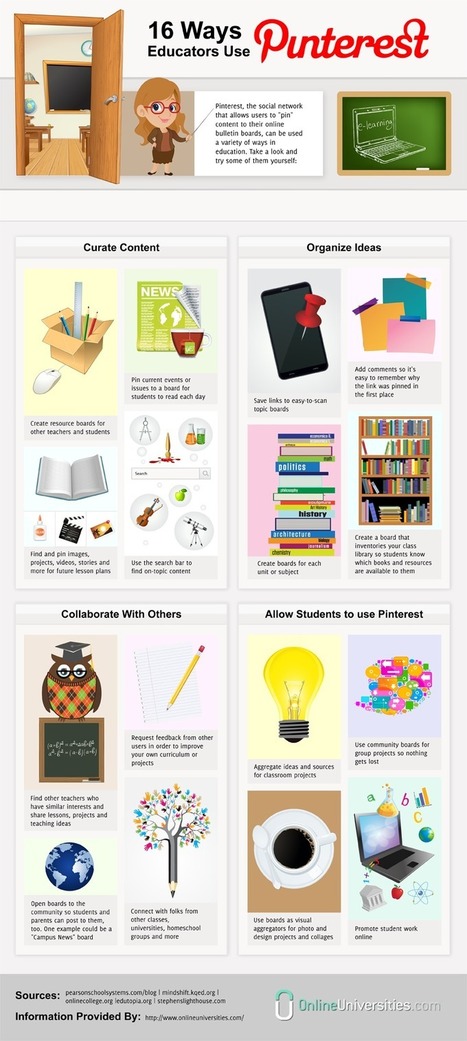
The Pinterest mothership continues to attract more and more users. As we mentioned a couple months back, teachers have figured out ways to integrate the boards into their curriculum. Here's an infographic that presents more ideas.
Robin Good: Course Hero is a platform which allows the creation and delivery of online video courses curated from the best existing published content on that topic.
There are already ready-made courses to access or you can submit a topic that you would like to video-curate into a course.
"You can learn just about anything from YouTube...if you're willing to dig through millions of videos."
From Techcrunch: "Luckily, Course Hero has done the work for you, offering coherent classes by hosting collections of the best educational YouTube videos and other content.
The newly launched courses section of the eduTech startup’s site now has classes in entrepreneurship, business plan development, and programming in a variety of languages.
...
By drawing from YouTube and other openly available education, Course Hero plans to set up courses for anything it, or you, can think of.
...
Each course breaks down into roughly 6 chapters of 6 concept YouTube videos, Justin.tv videos, articles, and more. Unlike Udemy‘s one-teacher-per-class approach, Course Hero courses are compiled from content by many teachers.
Rather than put you at the mercy of long-winded professors, Course Hero trims videos and articles down to their most important teachings.
Along the way you’ll answer quiz questions, take tests to complete chapters, and face a final exam to finish a course and earn proficiency badges..."
Dreve is a digital media/analytics company with the goal of simplifying, customizing, and connecting all the web content YOU care about.
We use a proprietary technology called Adaptive Dynamic Analytics to allow your web activity, social interactions, locations, and personal preferences to create the worlds most personalized online experience.
Robin Good: In the age of global, collective and crowdsourced interaction, many among us are starting to play the role of "connectors". We help like-minded people find each other, or good and complementary ideas to meet halfway.
Here is an interesting take from Nick Kellet on the possible different types of "connectors" out there, among which he identifies also a "solution connector", or someone able to pull together different information, resources and ideas to tell a story or to cover an issue/topic like a museum curator would do.
From the original article: "Are you an Solution Connector? > CURATIVE THINKER
...A solution connector isn't someone who create new ideas per se, being curative is just a different kind of creative.
They think a little more like a museum curator – they tell a story.
Their special skill is deciding which bits to keep and which to remove. They put together a Solution or an Exhibit. They let the whole idea tell a story. They assemble.
...Another metaphor is standing on the shoulders of giants. I watched this done brilliantly by Dave Kellogg whilst at Business Objects. Dave is a master of assembling ideas from across the gene pool and then crafting a wonderful story.
For me I’ve learned that Curation is far more effective and far more scalable than Creative Thinking.
From MacStories: "After four years, the App Store has become more than “a grand slam” — it has ignited an app revolution that created a new economy that supports over 210,000 jobs in the U.S. alone.
But Apple should do more with its “curation” process, and with the annual WWDC approaching, developers hope the company has been listening.
“A movie recommendation from Roger Ebert means a lot more to me than a computer generated ranking based on reviewer scores”, ...I think it’s the personal touch that’s missing”.
Excerpted from the original article: "The topic of curation on the App Store isn’t new to developers and observers of Apple’s ecosystem.
...Gassée believes that alongside the 600,000 apps available on the App Store, an Apple-made, curated “App Guide” with reviews and opinions would “give app seekers more than today’s skimpy categories and unreliable user reviews”.
A better selection of apps would, in return, further showcase the amazing capabilities of iOS devices, which is where Apple makes a profit.
...
I want Apple to tell me why they think the app is great. And I want to be able to find these recommended apps later on ...
In a way, the “curated App Store” lacks an editorializing process that goes beyond simply selecting and organizing apps in custom sections, but that also explains why a specific app should be worth of attention.
...
Last week, TouchArcade released its first iPhone app, combining the website’s editorial process with an app discovery system directly linked to the App Store, and enhanced with videos, screenshots, and recommendations. “...It’s heavily curated by experts, trusted by users, and has a ton of great features like watch lists and videos”, Brichter said.
Ultimately, it comes down to trusting the people who recommend apps to buy.
Hockenberry noted how “customers trust sites like Macworld, MacStories, or Daring Fireball to find them the best apps”, and admits that doing “curation” along these lines would change the whole dynamic for developers."
Pinterest has rolled out a newsletter that emails users curated content.
Mimicking the website’s pinboard style, each pin or board in the email is linked to the website, but users are unable to re-pin or like a post directly from the newsletter. The newsletter lists a few popular boards, pins from friends that might be of interest and a useful feature for brands especially: your most popular pins of the week.
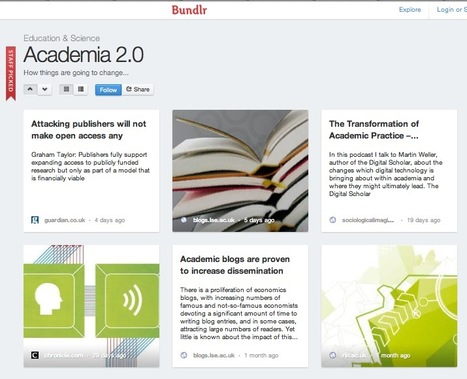
From Journalism.co.uk: "The content curation website Bundlr has just announced a new version of its service which allows for embedding of content from a wide range of sources.
By partnering with Embedly the site now supports over 200 sources of content, including Storify, Pinterest and Amazon, for users to add to their bundles.
Embedly is the service that the new version of Twitter uses to embed photographs and articles in your Twitter stream and is used by a host of other sites such as Reddit and Bitly and comes as a WordPress plugin.
While Bundlr was originally seen as an alternative to sites like Storify, which can be used to create stories from curated links and content, Bundlr's focus is now on creating a top-level resource for curated content around a story or topic."
Robin Good: If curation is all about finding and sharing great content, what's the difference with what so many bloggers have been doing until now?
The difference, according to Deanna Dahlsad at Kitsch-Slapped, is in the focus. While bloggers often cover just about anything that intercepts their online wanderings, curators are characterized by a strong focus on a specific topic.
Here is a key passage from her article: "Many bloggers spend their time selecting what they consider the best of what other people have created on the web and post it at their own sites, just like a magazine or newspaper.
Or they provide a mix of this along with writing or otherwise creating their own content. Not to split hairs, but curation involves less creation and more searching and sifting; curation’s more a matter of focused filtering than it is writing.
Because content curation is expected to be based on such focused filtering, it begins far more based on topic selection.
This is much different from blogging, where bloggers are often advised to “just begin” and let their voice and interests accumulate over time to eventually reveal a primary theme.
...
Some collectors just collect what they like as they stumble into it. …Sometimes, collectors just keep piling up stuff, no matter what it is. Even if this isn’t hoarding, it’s not-so-much of a purposeful pursuit.
But professional curators, those who manage collections for museums or other organizations, and serious collectors, they maintain a specific focus.
And rather than stumbling into items, they continually seek for specific items.
The definition dictates the curation — and everything from funding to their continued employment is based on how well their collection meets the collection’s definition.
While blogging success may be thought of in many different ways, the success of content curation lies in how well you define, search/research, and stick to your subject."
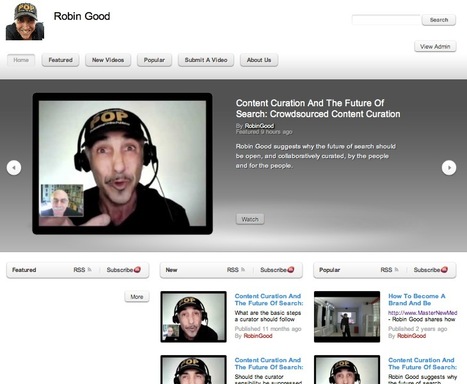
Robin Good: MiroCommunity is a video publishing and curation platform which allows you to create a video web site where you aggregate and publish any number of video clips (up to 500 for free) while being able to sort and organizing them in several ways.
MiroCommunity allows you to import video clips into your dedicated video site (xxxxx.mirocommunity.org) by either providing a specific URL or by inputing a YouTube specific username URL, or video RSS feed.
The Premium version allows you to map the newly created site to your own domain and to add a lot more clips.
Outside of some minor issues with the interface organization, small bugs and the non-existent support infrastructure (you can write but nobody answers) this is a super-solution, like no other, to create a compelling and professional looking video site on just about any topic you want.
I would highly recommend it.
Key benefits:
-> Works with your existing video hosting setup and workflow - no need to re-post videos.
-> Lets you bring together videos from a wide-variety of hosts and sources, into one curated experience.
-> Automatically imports and publishes RSS feeds of videos from any source.
- > Generates multiple RSS feeds for your curated sections and categories
-> Provides for the easy creation of video playslists
To create in less than a minute a beautiful Storyboard with awesome content curated by you and others.
Storination lets you create online communities called a Nation, where people share social stories on the same topic. After opening your Nation, you organize your Storyboard, a virtual space where anybody can contribute by adding his own Storify story.
Robin Good: MentorMob is a content curation platform which makes it easy to create "learning paths" by assembling sequences of web content pages on a specific topic.
From PandoDaily: "MentorMob is one company looking to turn content experts into teachers.
The Web app created by college friends Kris Chinosorn and Vince Leung lets you curate collections of information within a playlist that conveys a lesson plan around a single topic.
...
MentorMob divides its playlists into 12 subject categories including technology, health, and art.
They provide playlists for teachers, as well as standard school subjects such as math, science, and social studies.
More specific topics, called “mobs,” covered within the subjects, range from learning Photoshop to home brewing beer, to entrepreneurship.
Content is contributed by volunteer editors, who tend to be hobbyists and enthusiasts."
Keemix allows you to gather loved content from the web, mix it into your own custom-designed pages, and share it to inspire your friends and colleagues.
Keemix makes curation fun and accessible to everybody.
Just click on the bookmarklet, select the object you want to mix, add your thoughts and voila !
Become an editor-in-chief ! For each of your passions, create a dedicated page, design it as you want and showcase your favorite topics with editorialized content.
Standing for journalism, strengthening democracy | Journalism training, media news & how to's...
If you mashed up Tumblr, Pinterest, Paper.li and Storify, you’d get something close to RebelMouse.
The new Web service, whose namesake mascot could be the mutinous younger brother of Mighty Mouse, uses the links and photos you share on Twitter or Facebook to populate a Web page.
As an article in the Silicon Valley Watcher states, “…curation online also has to demonstrate: mastery, passion, knowledge and expertise. Without such additional layers, a curated collection of links is just a collection of links.”
The great challenge for us, and the web, going forward is no longer breaking down the barriers to creation, it’s finding our way through the huge amounts of creativity that’s resulted.
"Copying and pasting is something we all do. Sometimes it’s for ourselves, but when we’re on the web we’re probably copying and pasting things to share with friends. Links, photos, and text get copied and pasted every day into emails, IM’s, Twitter, Facebook, and more.
Clipboard, a web app created by Gary Flake, previously founded Microsoft’s Live Labs, Yahoo Research, and Overture Research. It’s safe to say that Clipboard is built based on the needs of web surfers everywhere.
To get content containing either thought or leadership enter:
To get content containing both thought and leadership enter:
To get content containing the expression thought leadership enter:
You can enter several keywords and you can refine them whenever you want. Our suggestion engine uses more signals but entering a few keywords here will rapidly give you great content to curate.


 Your new post is loading...