


|
Rescooped by
Kim Flintoff
from Digital Curation for Teachers
September 10, 2012 10:11 PM
|


No comment yet.
Sign up to comment

 Your new post is loading...
 Scoop.it! No comment yet.
Sign up to comment
Scoop.it!

Here’s some more evidence that curation is crucial for researchers, whether you choose to be a curator or you choose to follow curators.
Become a content curator in three steps:
(1) Handbook of social media for researchers and supervisors (http://goo.gl/eA0vL) Image credit to Flickr user estherase (http://goo.gl/FrFQ7)
[Paula] Via Paula Silva

Tom George's comment,
September 8, 2012 7:36 AM
Great Scoop Paula, I shared this on Internet Billboards we are building a community of content curators who all use Scoop.it If you like you can also post your curation here as well. Very easy to set up and do, just a few clicks. http://www.internetbillboards.net let me know if you are interested. Thanks for sharing this today.
Scoop.it!
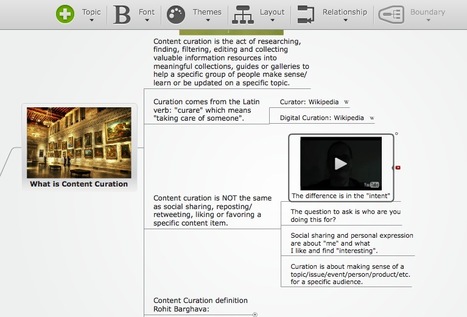
Robin Good: If you are looking for a content curation, mindmapping and presentation tool rolled into one, I strongly suggest you give a good road test to Mindomo.
But with time, and the increased size of my collections, I have been searching for valid alternatives which provided greater speed, better ways to display and view the mapped info and more options to extract value from my collections.
Mindomo, which I have been heavy-testing for the last six-months, is my new reference tool not just for mindmapping but for a) curating large collections of information into a navigable cohesive whole, b) creating prezi-like presentations without needing to become an engineer.
Specifically, Mindomo integrates lots of unique and very valuable features to the basic mindmapping toolset, including:
- Capture content via browser bookmarklet - Navigate and zoom in-out easily - Search and embed video clips - Search and embed audio clips - Automatically credit all media sources utilized - Customize look of maps in many ways - Create presentations from your mindmaps - Import and export to different formats + embed - Works and syncs on iPad and Android - Collaborative editing - Cross-platform offline desktop app - Custom URLs for your mindmaps - just to name a few.
Here's a good example of what I have been able to "curate" with Mindomo:
1) http://bit.ly/ContentCurationUniverse a very large collection of content curation tools
2) www.mindomo.com/mindmap/content-curation-for-education-98ccaad217074a07b9bff8b76effab8e ; a navigable "presentation-map"
MindMeister and other mindmapping tools still provide good value, but in my humble opinion Mindomo, with its own limits and idiosyncracies, has earned my trust as being the most effective, powerful and feature-rich visual curation tool.
Give it a try and let me know what you think.
Pricing plans: http://www.mindomo.com/pricing.htm
Find out more: http://www.mindomo.com/
Via Robin Good

Beth Kanter's comment,
September 7, 2012 11:57 AM
Robin, on the second map, I'm not able to see the whole map in one view - only each section .. is that a settings thing?
One thing I don't like about Prezi and the presentation in Mindomo is the zoom in and zoom out - it gives me vertigo .. maybe I'm just old school .. (LOL) .. but I imagine it gives you different transition effects. 
Robin Good's comment,
September 7, 2012 12:26 PM
Great Beth, superhappy to have been of help. I really like what you can do with Mindomo. Let me know what you think once you have explored it.
Scoop.it!

Robin Good: Mood boards are a way to visually convery a type of "look", feeling and atmosphere for a marketing campaign, a brand identity design effort or for an event project.
Mood boards are created by curating a set of images gathered from different sources, but which - together - convey the type of style, design, colors and "character" that one wants to achieve.
In this guide to creating effective mood boards, Paul Wyat provides some good tips, examples and references to tools that can help you create effective "mood boards".
"When trying to convey a design idea, moods, feelings and fluffy stuff like that are hard to communicate. So professional designers will often use a mood board: a collection of textures, images and text related to a design theme as a reference point."
Interesting. Useful. 8/10
Full article: http://www.creativebloq.com/graphic-design/mood-boards-812470
Via Robin Good
Scoop.it!

Robin Good: If you are interested in understanding how "content curation" differentiates itself from simple re-sharing and re-blogging here is a great article by Chris DeLine.
Great advice for anyone wanting to become an effective content curator: “Whether in tweets, in blog posts, in podcasts, or in newsletters, be ruthless with your attention. ...
Some adopt a strategy of blanket-curation, throwing everything new or fresh or remotely interesting online and letting other consumers make their own value distinctions.
Others assume the role of tastemaker, selectively making the decisions themselves.
Both have their place, but the former contributes to what Jonathan Haidt calls “the paradox of abundance,” which he says “undermines the quality of our engagement.”
... Thoughtful, honest, and caring curation isn’t entirely different than creation.
After all, the topics you choose to research, to blog about, and to discuss with friends all begin with the process of sifting through the media abyss yourself and singling out worthwhile information."
What really counts is to create content that is useful, meaningful and helpful for others, whether from direct hand authorship, or by curating the best existing resources.
Insightful. 8/10
http://chrisdeline.com/curation
(Image credit: Shutterstock)
Via Robin Good
Scoop.it!

This was the meme I, @josemota, and @etutoria prepared for The PLE Conference 2012 (1). Memes of this sort are supposed to be fun - that’s what we tried to achieve through the choice of images.
I see myself as a wannabe content curator, someone who has to work hard, never mind the reasons.
What about you? How do people see you as a curator? How do you see others as content curators?
Curate and have fun too!
(1) http://pleconf.org/program/sessions/a10/ The meme was created here: http://uthinkido.com/ [Paula] Via Paula Silva
Scoop.it!

What is good curation versus bad curation? The image is a remix of a presentation entitled ”Link Building by Imitation” and authored by link building expert Ross Hudgens — and explains the skill set pretty well. Via pru
Scoop.it!

If you search and pay attention to the concept of “content curation”, you reach the conclusion that some users refer to “content curation” as “digital curation” - something which is likely to lead to confusion.
Digital Curation is the management and preservation of digital material to ensure accessibility over the long-term (1). It’s a discipline with embedded practice and research (2). Wikipedia displays a similar definition: “the process of establishing and developing long term repositories of digital assets for current and future reference by researchers, scientists, historians, and scholars.”
If you want to refer to: “the act of researching, finding, filtering, editing and collecting, valuable information resources into meaningful collections, guides or galleries to help a specific group of people make sense/learn or be updated on a specific topic” (3) then what you mean is Content Curation. That’s what you can do on Scoop.it - you curate or you aggregate (which is a step prior to content curation).
Time to ask: “Who curates those who curate the curators”? Are you aware of the difference between Digital Curation and Content Curation or do you use the concepts interchangeably? Your feedback will be welcome.
(1) Abbott, D. (2008). What is Digital Curation? http://www.dcc.ac.uk/resources/briefing-papers/introduction-curation/what-digital-curation (2) Higgins, S. (2011). The International Journal of Digital Curation Digital Curation : The Emergence of a New Discipline, 6(2), 78–88. (3) Robin Good’s mindmap on Content Curation For Education And Learning (http://www.mindomo.com/mindmap/content-curation-for-education-and-learning-robin-good-emerge2012-98ccaad217074a07b9bff8b76effab8e)
Via Paula Silva, catspyjamasnz
Scoop.it!

Robin Good: If you would like to create visual collections of web services and tools belonging to a special category, application or industry, Only2clicks, provides a very effective, simple and straightforward free tool to do so.
With Only2clicks you can create multiple pages containing the screenshots of as many web pages you decide, organized and sorted as you prefer and accompanied to your own descriptions.
Only2clicks provides also a standard bookmarklet which can be used to grab any web page or service as you navigate the web and to add it instantly to one of your Only2clicks pages tabs.
Last but not least, you can publish your curated visual collections on your own customized URL.
Among all of the visual bookmarkers available online (there are over 15 of these - see my tools map here: http://bit.ly/ContentCurationUniverse) this is the one that I prefer.
iPhone interface: http://www.only2clicks.com/iphone
Tour: http://www.only2clicks.com/tour.php
Features: http://www.only2clicks.com/features.php
Try it out now: http://www.only2clicks.com/
Via Robin Good
Scoop.it!
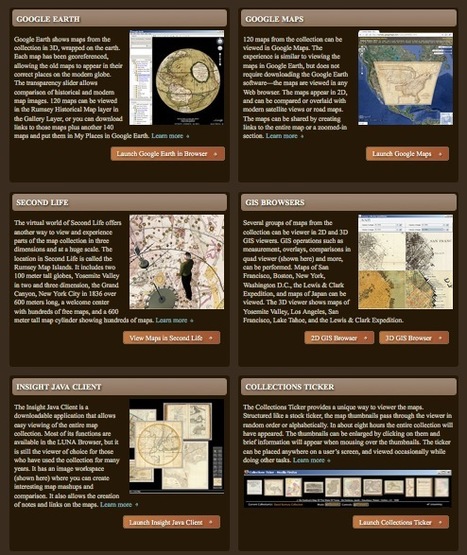
Robin Good: The David Ramsey Map Collection is an historical collection of thousands of beautiful maps and atlases organized and made freely accessible to the public online in unique and unprecedented ways.
This online collection offers in fact no less than 12 different ways to navigate its contents by providing dedicated browsers and visual imaging tools ranging from 2D-GIS to SecondLife and virtual QTR panoramas. For example, with the Google Earth visualization, any map in the collection can be seen perfectly mapped on the globe, or by using the Luna Browser one can create collections, save and download images, annotate maps or even create embeddable presentations. This is truly a spectacular collection with marvellous maps and atlases enriched by complementary data, visualization tools and a formidable array of navigation devices.
Possibly the best online curated collection I have seen so far.
Must-see. 10/10
About page: http://www.davidrumsey.com/about
Collection and Tools to navigate it: http://www.davidrumsey.com/view
Home page: http://www.davidrumsey.com/
Via Robin Good
Scoop.it!
Robin Good: Participatory culture writer and book author Henry Jenkins interviews cyberculture pioneer Howard Rheingold (Net Smart, 2012) by asking him to explain some of the concepts that have helped him become a paladin of the and "new literacies" so essential for survival in the always-on information-world we live in today.
This is part three of a long and in-depth interview (Part 2, Part 1) covering key concepts and ideas as the value of "community" and "networks", the architecture of participation, affinity working spaces, and curation.
Howard Rheingold: "...at the fundamental level, curation depends on individuals making mindful and informed decisions in a publicly detectable way.
Certainly just clicking on a link, “liking” or “plussing” an item online, adding a tag to a photograph is a lightweight element that can be aggregated in valuable ways (ask Facebook).
But the kind of curation that is already mining the mountains of Internet ore for useful and trustworthy nuggets of knowledge, and the kind that will come in the future, has a strong literacy element.
Curators don’t just add good-looking resources to lists, or add their vote through a link or like, they summarize and contextualize in their own words, explicitly explain why the resource is worthy of attention, choose relevant excerpts, tag thoughtfully, group resources and clearly describe the grouping criteria."
In other words, "curators" are the ones creating the metadata needed to empower our emerging collective intelligence.
Curation Is The Social Choice About What Is Worth Paying Attention To.
Good stuff. In-depth. Insightful. 8/10
Full interview: http://henryjenkins.org/2012/08/how-did-howard-rheingold-get-so-net-smart-an-interview-part-three.html
Via Robin Good

Shaz J's comment,
September 3, 2012 3:20 AM
You're welcome :)
It's interesting interesting that you mention POV and stance, as that is not something I had explicitly articulated for myself, but naturally it must be implicitly true. In that sense, it reminds me (again) that curation forces self-reflection in order to present the content better, and that can only be a good thing. 
Liz Renshaw's comment,
September 8, 2012 9:57 PM
Agree with posts about curation guiding self reflection. This interview in particular is top value and two of my fav people indeed.

Andrew McRobert's curator insight,
August 19, 2014 8:43 AM
8. This links a series of three interviews quite lengthy but there is some insightful information for the novice in the digital information age. There is video links within the article, including a great question and answer with Robin Good on curation. The video brings a balance to this inclusion.
Scoop.it!

Robin Good: Chronological and time-bound sequences have been the overwhelming approach to organize content on the web, just like newspapers had been doing for a long time. Look at blogs, Facebook and Twitter to see how pervasive this type of chronological organization has become.
But as more content becomes available more rapidly, chronological organization doesn't work anymore.
What we need is the option to navigate, quality content, through topic-based structures, maps and collections, where time is only one among other factors helping me slice and dice what I want to see.
"There's simply too much content to consume nowadays, so the great challenge of online publishing is to organize it better. Topic pages are the solution."
From the original article: "The time for topic pages has come.
Chronological and real-time consumption of content just doesn't work anymore.
Right on track. 8/10
Full article: http://www.readwriteweb.com/archives/why-topic-pages-are-the-next-big-thing.php
Via Tom George, Robin Good
Scoop.it!
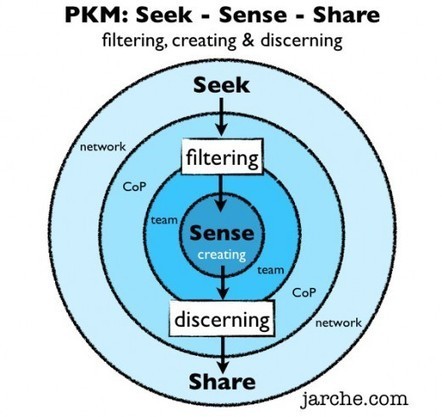
One of the important elements of the tripartite model of content curation is sharing. It assumes the value which is determined by the purpose and the objectives set by the topic curator(s). Sharing may, for example, follow a marketing strategy or may be moved by the spontaneity of the curator (or the user/follower). With regard to Personal Knowledge Management (PKM), Harold Jarche highlights a significant aspect to guide sharing: discernment, i.e., when sharing you must be aware of the following aspects: when, with whom and how. Sharing can be done openly, through a blog, or it can be targeted to a particular community or network. Like PKM, when you are curating, a discerning sharing also contributes to build trust. If a curator sets himself as a reliable node for a community or network, his intervention will have a greater value and impact.
Image credit:Harold Jarche http://www.jarche.com/2012/08/sharing-with-discernment/ Via Paula Silva, Nancy White

Terry Elliott's comment,
October 5, 2012 11:32 AM
I really am drawn by the graphic and the abstraction, discernment, is full of resonants, aftertones, undertones, and tones yet to be heard but imminent. Discernment changes daily. I think this is a reminder that we need to approach curation with a 'prayer' of focus. For example, in curation-ed I need to invoke a hope to find words, minds, and text that will help us all seek/filter/create sense/discern/and share.
|
Scoop.it!
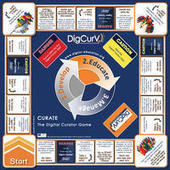
The CURATE game is designed to be used as an exercise that prompts players to put themselves into digital project scenarios in order to address issues and challenges that arise when institutions engage with digital curation and preservation.
Scoop.it!

Pinterest use is booming among people age 25-34 with annual salaries of $100,000 or more (Huffington Post Tech, 21 March, 2012). Via Mark Smithers
Scoop.it!

Following the rapid rise of curation tools & practices...
A newspaper byJoyce Seitzinger
Scoop.it!

Robin Good: FingerPDF is a free Mac app which allows you to collect and organize your PDF document library, to search instantaneously and to analyze, read, and summarize content easily.
FingerPDF can also collect and store any web page (via a dedicated bookmarklet) or Mac document as a PDF inside your library making it available for indexing and future use.
Stored PDFs can be organized in folders, and can be easily tagged.
From the official site: "FingerPDF is a Mac PDF Organizer which allows you to quickly find and organize your PDFs. It is well suited for people that need frequent and rapid access to their books, articles and manuals.
Preview your PDF files, highlight sentences and take notes. Review and export your comments."
Check out this video demo: http://youtu.be/jVfnWH9BlN0
Features: http://www.fingerpdf.com/pdf-organizer-fingerpdf
Download: http://www.fingerpdf.com/betarequest.html
More info: http://www.fingerpdf.com/
Via Robin Good
Scoop.it!

Under that provocative title, Justin P Lambert actually does a great favor to Curators by outlining a key point between plagiarism, social sharing and curation.
While blog plagiarism has been as old as blog platforms - Justin shares his own story - he defines the clear line that exists between: 1. blog users who copy/paste entire articles 2. social media users who share randomly without having their "audience’s needs or desires in mind" 3. curators who - he says - "put their audience first"
Curation done right "involves figuring out what your audience wants and needs to know about and then sifting through the overwhelming amount of information out there to hand-pick specific items that you know they will benefit from." This is a pretty good definition of Curation in my opinion and one of its direct consequences is that Curation works better in a topic-centric model.
Defining a topic and making your editorial line clear is a great first step to develop an audience with their interests in mind.
<- curators do a public service... Via Guillaume Decugis, catspyjamasnz

Guillaume Decugis's comment,
August 31, 2012 2:54 PM
Thanks Gilbert for the comment. I of course agree (but I think Justin too: he actually defended the value curators bring and listed Scoop.it in the tools he loves :-). And you're right to point out Curation is an old habit which is just changing with technology and new platforms like ours. Thanks for the praise on Scoop.it!
Shaz J's comment,
September 2, 2012 3:35 AM
I like the idea of the "set it and forget it" value of Scoop.it. But then that is definitely a dimension of the tool that one would have to consider - is that what you want from your curation? Does that match your audience?
I find this to be a very important point, especially for me personally. Thank you.
Scoop.it!

Posted by Jeff Dunn
"If you haven’t heard of Learnist yet, you’re going to see the name around a whole lot more as of 11am today. That’s because Learnist just launched its new iPad and iPhone apps. Edudemic got a hands-on view of these apps and they are quite remarkable. Not just because they’re fancy apps that look nice, but because of what they signal to the larger world of education technology.
"These apps are going to be the yardstick by which future edtech apps are judged."
Via Jim Lerman
Scoop.it!
As both a consumer and curator of information, I spend a great deal of time thinking about the architecture of knowledge. Over the past year, I’ve grown increasingly concerned about a fundamental disconnect in the “information economy”: In an age of information overload, information discovery — the service of bringing to the public’s attention that which is interesting, meaningful, important, and otherwise worthy of our time and thought — is a form of creative and intellectual labor, and one of increasing importance and urgency. A form of authorship, if you will. Yet we don’t have a standardized system for honoring discovery the way we honor other forms of authorship and other modalities of creative and intellectual investment, from literary citations to Creative Commons image rights.
Scoop.it!
Get Learnist on the App Store. See screenshots and ratings, and read customer reviews.
Scoop.it!

Excerpted from review article on ReadWriteWeb: "As streams of information become more popular on the Web, we need better ways to consume and manage them. Apps that allow you to aggregate content from different sources - Twitter, Facebook, blogs, news websites and more - may become very popular: State is trying it.
State is currently in private beta. At first glance, it looks part FriendFeed, part TweetDeck, part iGoogle, and part something wholly new.
Co-founder Joshua Lewis said: "what the future of the web looks like when you replace static content with streams of data. ...State is "a general purpose tool to manipulate, filter and publish streams of data."
How State Works: You can add streams of content from up to four services (so far): Twitter, App.net, Instagram and Dropbox. This is the part that reminds me of a start page, like early Netvibes or iGoogle, because you end up with panels of content across the web page. You can also connect to Instapaper, enabling you to save content for later reading.
Then, like TweetDeck, you're able to view various aspects of the stream. For Twitter, you can select to view content by home timeline, mentions, user, place, tag, search and list. The same principle applies to content from App.net and Instagram.
While State only connects to five services so far, you can imagine it eventually hooking into many more.
One feature I really like in State is the ability to "follow" a page of streams that someone else has created. Each page - or "workspace" to use the service's parlance - is made up of many different streams of content. There is limited ability to filter - for example, you can select to view only images from a stream. But I imagine more filtering options will be added over time.
By default your pages are private, but you can choose to share or make them public..."
Read full original article here: http://www.readwriteweb.com/archives/first-look-state-a-streams-app-of-the-future.php
Check it out here: https://www.sharingstate.com
Request an invite: https://www.sharingstate.com/signup
Check out demo: https://www.sharingstate.com/demo/Home Via Giuseppe Mauriello
Robin Good's comment,
August 29, 2012 2:57 AM
Pino your title is pretty unambiguous to me: "Curate, Filter And Publish Your Streams Of Information With State". I read "curate" as the first word.
You can check yourself. :-) 
Giuseppe Mauriello's comment,
August 29, 2012 3:04 AM
Hello Robin,
Co-founder Joshua Lewis said: ....State is "a general purpose tool to manipulate, filter and publish streams of data." Manipulate is not similar to curate?
Robin Good's comment,
August 29, 2012 3:52 AM
Pino: Manipulation has nothing to do with curation.
I think that we should not mislead readers or sell a tool for what it is not. Credibility is everything in this realm. Re Joshua Lewis: if he wanted to say "curate" he would have. But he didn't. The choice to put "Curate" as the opening word in the title above was yours, not his. If it was my post, I'd revise the title as I wouldn't want to lose any of the trust I have earned from those who read me. To be credible for me is much more important than being first, or popular. My two cents. :-) (Best of all would be for you to test it and to write for us what it does and whether you consider that curation or not). :-) My two cents.
Scoop.it!

Redefining the Value of Data...
Big data is just that…it’s big. While the profusion of information today can lead to analysis paralysis, by listening with intent, organizations can tune into the signals that will direct opportunities to adapt to and lead this new era of connected consumerism. This is about innovation—inside and out. Those who don’t plug in and invest in technology’s human counterparts are in turn making an investment toward potential irrelevance.
Is your organization exploring the human algorithm? How are you making sense of big data?
Scoop.it!
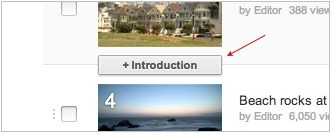
Robin Good: YouTube has just introduced a great, valuable feature to its playlist service, by allowing playlist authors to add short video clips at the beginning, end and in between any clip, to contextualize, introduce or explain what has been seen or is coming up next.
From the original article on TheNextWeb: "YouTube decided to help out the community a bit by releasing a new intro and outro feature that lets you insert professional clips in between your videos easily.
YouTube Engineer Eric Lundberg said: "You can choose from a variety of styles for text introductions and even add royalty-free music tracks. Interstitials will appear as unlisted videos in your account, and are eligible for monetization if they are at least 15 seconds long."
These particular features allow video creators to tell a full story in a series of videos. Even if you’re not making your own videos, creating a playlist is a way of providing a valuable service to the community."
This is a great addition for video curators who can now add their viewpoint, comments and context to any video compilation they decide to assemble.
N.B.: You can choose from a variety of styles for text introductions and even add royalty-free music tracks. Interstitials will appear as unlisted videos in your account, and are eligible for monetization if they are at least 15 seconds long.
The interstitial video clips can be recorded directly from you webcam.
If you have never created a playlist check this: How To Create a Playlist in YouTube: http://support.google.com/youtube/bin/answer.py?hl=en&amp;answer=57792
More info: http://youtubecreator.blogspot.co.uk/2012/08/new-feature-easily-create-video-intros.html
Via Giuseppe Mauriello, Robin Good
Scoop.it!
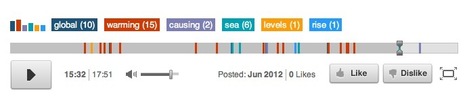
Robin Good: Mobento is a hub of curated educational video clips integrating a special search engine capable of finding any word spoken inside the video collection and of visualizing where the words were spoken on a timeline.
From the official site: "This is a library and a library has librarians. That’s us. We’ll be rigorous in only uploading high quality, fascinating videos from established academic institutions and learning organizations."
FAQ: http://www.mobento.com/faq
Try it out now: http://www.mobento.com/
Via Robin Good, Gust MEES
|






