


These two videos provide examples of evaluating websites and articles using the C.R.A.P. test (Currency, Reliability, Authority, and Purpose/Point of view).

 Your new post is loading...
 Scoop.it! These two videos provide examples of evaluating websites and articles using the C.R.A.P. test (Currency, Reliability, Authority, and Purpose/Point of view). 
Scoop.it!

Two universities have found image sharing site Pinterest useful in very different ways—one in documenting a political convention, the other in sharing objects from its library archives. Both have succeeded in engaging students.
Scoop.it!


Beth Kanter's comment,
December 11, 2012 11:01 AM
I prefer Robin's Good mindmap of all the curation tools because it better organized into a taxonomy of what the tools do. http://www.mindomo.com/view?m=2bbb4d3b0995449e9160de4455ad4f2b

Duncan Cole's curator insight,
April 2, 2013 10:58 AM
A helpful list of the various tools available for teachers for content curation.

Audrey Nay's curator insight,
April 23, 2013 7:03 AM
Select the most useful to introduce to students...too many at once is too confusing.
Scoop.it!
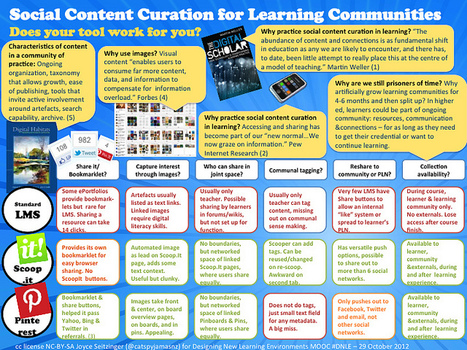
An infographic I created for a MOOC at Stanford: Designing New Learning Environments. Made with too little space, too little skills, too little time and too little research. Lots of fun though. Via catspyjamasnz

Kirsten Wilson's curator insight,
June 19, 2013 11:26 AM
Interesting take on a few forms of curation that can be used. Infographic is, as the creator remarked, a little crowded, however the information is useful. 
Begoña Iturgaitz's curator insight,
June 19, 2013 12:22 PM
do we know the actual size of what we're traying to make?
Scoop.it!

Symbaloo Turns 5 Today! October 30th, 2012 • events, press ……………………………………………………………………………
Yay! Today marks our 5th year anniversary and to celebrate we’d like to share some of our major moments that have helped us to make it to this year: 2007- Symbaloo was born 2009- Launch of Symbaloo in the United States 2010- Launch of Symbaloo 2.0 2011- Launch of SymbalooEDU and #symchat 2012- Symbaloo reaches 1M users and Symbaloo launches mobile app for iOS and Android
Scoop.it!
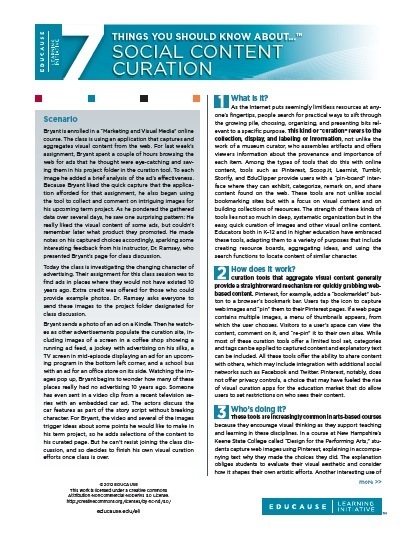
Robin Good: "7 Things You Should Know About Social Content Curation" is a technology brief from Educause which aims to introduce, explain and illustrate the emerging social curation trend and why it is relevant to teaching and learning.
From the official abstract: "An emerging class of online tools, including Pinterest, Scoop.it, EduClipper, and others, allows users to quickly and easily gather, organize, and share collections of online resources, particularly visual content.
These applications make it easy to collect and post disparate bits of content, providing visual groupings at a glance that can reveal important patterns.
In academic settings, they can facilitate more visual thinking and discussion among students while providing a means to share collections of online content."
ePUB: http://www.educause.edu/ir/library/epub/ELI7089.epub
PDF: http://www.educause.edu/ir/library/pdf/ELI7089.pdf
Via Robin Good, Andreas Kuswara
Scoop.it!

Content curation has been a topic of interest lately but there is a fine line that you should not cross! Discover the difference between curating and plagiarizing information! Via catspyjamasnz
Scoop.it!

Content curation is a growing trend, helping those who are time poor to stay abreast of specific topics. Curators are an unrealised resource for workplace learning.
Curators who critique information provide an additional service to simply gathering RSS feeds of reputable websites. Such curators do well with a blog platform to journal their reflections and opinions. Via catspyjamasnz
Scoop.it!
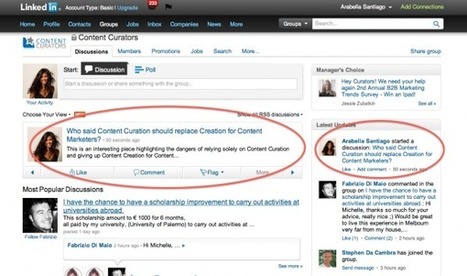
I\'ve read recent news on how LinkedIn has become seriously interested in content launching new features that encourage their users to rate each other on skills and expertise as well as engage with business visionaries...Here at Scoop.it, we\'ve k...
Scoop.it!

Robin Good: If you are looking for ways to improve your content curation efforts, Joshua Merritt has published five useful guidelines to follow.
These include abandoning high frequency / high-volume practices, integrating your opinion whenever possible, researching deeper, citing sources and treating curation like original content production.
Joshua writes: "If two different people curate and distribute the same content (which happens every day times thousands), what makes the experience of your followers more valuable? The answer doesn’t have to lie in a single piece of content, but it must lie in the story arch of the greater body of work, and the more you treat each item you curate as a diamond in the rough that needs some extra cutting and polishing to be ready for your audience, the better your content will perform and the more loyalty you will drive in your followers."
Rightful. 7/10
Via Robin Good

Ken Morrison's comment,
October 1, 2012 11:23 PM
Hello Avivajazz thank you for the rescoop. Best of luck to you.
Ken Morrison's comment,
October 1, 2012 11:23 PM
Hello Avivajazz thank you for the rescoop. Best of luck to you.Ken
Scoop.it!

Like it or not, the curators are coming. And I'm not talking about the kind that work with Art.sy.
<- article says do not dismiss the curation trend, just because some of new-fangled curators are #doingitwrong (JS) Via catspyjamasnz
Scoop.it!

You need curation. Web curators aren't writers, because they are more concerned with locating, selecting, and presenting information than writing original works. Curators do, however, write text that frames, explains, contrasts ... Via Judy O'Connell, Carli Spina, Cynthia Garrety
Scoop.it!

Robin Good: A curated collection of Pinterest-like web sites, in perfect Pinterest-like style.
"Pinterest Pinterest Pinterest. It’s spread like a hot, juicy rumor over Twitter, infecting (or improving, depending on how you look at it) the way we use the Internet. Think of it as the Pinterest-ifictation of the Web. If Tumblr were designed today it might look like Pinterest. All Pinterest did was take the Tumblr feed — a mishmash of uploaded, reblogged and remixed words and images — and make it easier to skim. Rather than scroll endlessly through a single feed of content, Pinterest displays it in as many columns as your browser width can handle..."
You can submit your own here: http://pinteresti.st/submit
RSS feed: http://pinteresti.st/rss
(Thanks to Guillaume DeCugis for discovering this)
Via Robin Good
|
Scoop.it!

We are proud to present in collaboration with TED a curated series of talks plus specially commissioned educational support materials
Scoop.it!

With over 10 million users, Pinterest has rocketed to pop-culture fame since its launch in beta in March 2010.
Via Mark Smithers, catspyjamasnz

Stephen Bright's comment,
November 20, 2012 6:45 PM
Joyce any comment on the copyright implications of Pinterest? My understanding is that they can allow a user to be sued for use of an image and they specifically take nil responsibility for the use of images on their website...
Scoop.it!

The one place to organize, present and share knowledge...
Scoop.it!
Drucker’s Knowledge Worker in the Age of Social Media: Content Curation for Professional Development
"Over half a century ago, management guru Peter Drucker presented the concept of the knowledge worker. Compared to the manual laborer, the knowledge worker focused on quality over quantity and worked more independently as problem solvers."
Over the many applications of Social Content Curation, Professional Development has been a strong trend. We keep observing it on Scoop.it but it's also been reported by Social Media influencers.
As more and more of us become Knowledge Worker, it should be no suprise that Content takes a growing importance on our Professional lives. So here's our take on it and why we announced this new integration with LinkedIn earlier today. Via Guillaume Decugis

ben bernard's comment,
January 9, 2013 11:56 PM
thanks ! http://www.scoop.it/t/direct-marketing-services my newly made scoop.it :)
Scoop.it!

Content curation has driven many of the social interactions among and between individuals for years now. Pinterest, Tumblr, Twitter and even Facebook allow and encourage users to post media and links that they did not create. Via catspyjamasnz
Scoop.it!

How about you? What are your favorite online curation tools? Alternately, when has one of your classes encountered an unexpected obstacle, and how did you maneuver around it? Please share in the comments.
Scoop.it!
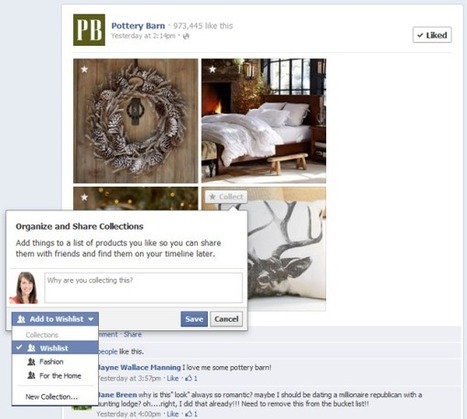
Robin Good: Facebook has introduced a new curation feature designed to allow its users to collect and organize their favorite "products" into so-called "Collections".
According to Hubspot "the new feature called 'Collections,' allows marketers to add “Want” or “Collect” buttons to news feed posts about products."
The new FB "Collections" is publicly available to everyone, and it is being tested "with 7 retail partners -- Pottery Barn, Wayfair, Victoria’s Secret, Michael Kors, Neiman Marcus, Smith Optics, and Fab.com." (you need to go to those FB brad pages to test it).
It also seems that the feature can be activated in at least three different ways by one of these three upcoming action buttons:
a) "Want": adds the product to a Timeline section of a user's profile called “Wishlist”
b) "Collect": adds the item to a Collection called “Products”
c) "Like": a special version of the standard "Like" button that also adds the item to “Products”
N.B.: While Collections are free for business pages to use, they're only visible to the page's fans. You have to "Like" the page in order to see these types of posts.
Find out more here: http://blog.hubspot.com/blog/tabid/6307/bid/33698/Facebook-Tests-Pinterest-Style-Feature-Called-Collections.aspx
and here: http://techcrunch.com/2012/10/08/facebook-collections/
Via Robin Good
Scoop.it!

By Paul Paradis
There is a lot to like about Learnist, the new social learning tool launched by Grockit. Paradis, who functions in the corporate training sector, analyzes what he sees as of some its more attractive qualities. Learnist is growing in popularity very rapidly and I received my user account only this week. Yet, I can see why people are getting excited. It certainly appears to have great potential. -JL Via Jim Lerman
Scoop.it!

From Official Website: "Spundge is the end-to-end tool for today's power curator. Connect with the best content creators on the web. Collaboratively curate the web and create relevant, influential content.
- Discover and Filter: Create a Spundge Notebook to stay on top of a topic, person, company or interest. Spundge Notebooks deliver a stream of relevant content from news sources, Twitter, Facebook, YouTube, Instagram and Flickr. Filter and then save the best of what you discover.
- Curate and Collaborate: Invite friends and colleagues to collaborate on Notebooks and discover and save new items. Collaborators receive notifications when new content is saved, and can add comments to Notebook items. Collaborative Curation enables you to track information, while instantly sharing with friends and colleagues.
- Stream and Publish: Transform your Notebook into a real-time stream you can embed anywhere on the web. Share what you’re reading, or curate a real-time newswire about a breaking event or topic of interest.
- Get Spundge PRO: it enables teams and individuals to collaboratively create content and instantly publish to a CMS, email newsletter and social accounts. Writing in Spundge lets you drag and drop images, tweets and videos into any story, effortlessly add attribution, and easily embed and track content."
From review article on Nieman Journalism Lab: "The problem is today’s journalist has to use too many products and applications to do their job, and very few of these were actually built with newsrooms or journalistic workflow in mind...
Spundge is a platform that’s built to take a journalist from information discovery and tracking all the way to publishing, regardless of whatever internal systems they have to contend with...
The software is free, but an optional $9 monthly fee adds premium features, including the ability to share notebooks with collaborators, who can also add to the notebook and see changes in real time..."
Read more on Nieman Journalism Lab here:
Check out Spundge here: http://www.spundge.com
Via Giuseppe Mauriello

Giuseppe Mauriello's comment,
September 23, 2012 11:41 AM
@Steven...Thank you for appreciation about my post.
Scoop.it!

For those of you who haven't heard of the new(ish) startup Citelighter, take note: it's a pretty awesome tool. I've been playing around with it and chatted with founders of the company last week and am thoroughly impressed. Via Daniel Tan
Scoop.it!

Curation is already becoming an overused word but it's an increasingly important one. Not least because the way in which we discover content that we like or find useful, and how it gets in front of us or gets our attention, is changing radically. With an explosion of choice and noise, and attention becoming the new scarcity, how we choose to curate what gets that attention (or, as below, how it is curated for us) is hugely important to anyone in the business of creating content. And let's face it, that's now everybody. So here's my take on the three pillars of content curation that will increasingly (and already actively) shape the future of content consumption and distribution: Via Judy O'Connell, Carli Spina, Cynthia Garrety
Scoop.it!
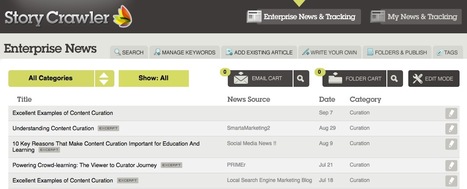
Robin Good: StoryCrawler is an upcoming news and content curation platform which allows you to easily track an unlimited number of topics / keywords and to curate selected ones for publication, both on the web, via RSS feed or email.
Selected news stories can be, tagged, categorized and fully edited in each and every aspect before being published.
Inside the Storycrawler backend, a curator can configure and save an unlimited number of persistent searches monitoring online mentions of events, people, brands inside specific types of content sources (e.g.: social media, news, blogs, etc.).
Storycrawler makes your curated news stream available as a RSS feed, as an embeddable javaScript or iFrame code snippet, besides publishing your content directly on your account pages and providing direct sharing options for Facebook and Twitter.
From my own limited experience in testing an "unofficial" early Beta version of Storycrawler, it looks like the basics features are all in place while the UI, usability and final output formatting options still having some work to do.
P.S.: The platform seems to be targeted at medium to large size, enterprise companies and does not provide for now indications of its pricing plans. You can contact a StoryCrawler representative here: http://www.storycrawler.com/contact/
Promising.
Find out more: http://www.storycrawler.com/ ;
Via Robin Good
|







Pure gold!