"Curation is everywhere these days. If you have not heard, it’s made a mark in almost every area of the online world." By Pawan Deshpande On February 14, 2013

 Your new post is loading...
 Scoop.it! "Curation is everywhere these days. If you have not heard, it’s made a mark in almost every area of the online world." By Pawan Deshpande On February 14, 2013 
No comment yet.
Sign up to comment
Scoop.it!
Scoop.it!

"My 2013 prediction warned of the continued fall in the value of online content which would lead to the production of ever more content as media companies tried to maintain ad revenues. You can think of it as a towering tsunami of content, or as a massive bubble of content inflation. Just as inflation devalues currencies, content inflation is devaluing content." Via Guillaume Decugis, catspyjamasnz

Guillaume Decugis's comment,
February 19, 2013 7:00 PM
I think I do but I'm not sure of the connexion you make with content inflation/dilution?

Tagmotion's comment,
March 3, 2013 10:59 PM
If we look at content inflation through the lens of making money, it's clear that in terms of monetization through advertising, the internet is the first medium in history where ad inventory grows exponentially every year. Broadcasters are only making real money from iconic TV programs that attract big audiences on the web, for which advertisers will pay a premium to reach. Curating iconic programs - so that relevant segments show up as search results - turns content inflation on its head. Now you have content that's tagged, curated & discoverable at a granular level. And that specificity translates to more highly-targeted advertising which, of course, commands a premium.
Scoop.it!

I’m not an active user of Pinterest myself, but I recently noticed a source that claimed that Pinterest is #36 in educational tools in the UK. In this review, I will explore Pinterest and other dig... Via Aust Digital Futures

Aust Digital Futures's curator insight,
February 3, 2013 6:46 PM
This blog post draws on out 2012 ascilite paper, "Engaging higher education students via digital curation".
Scoop.it!

Pinterest accounts are everywhere - which ones are worth your time to follow and what can you learn from them? We examine Pinterest power users to find some Pinterest best practices. Via catspyjamasnz
Scoop.it!

The Ultimate List of Content Curation Tools and Platforms on technologies for integrated elearning curated by dakinane (The Ultimate List of Content Curation Tools and Platforms | @scoopit via @catspyjamasnz http://t.co/9A5W8uGZ)... Via Mark Smithers
Scoop.it!

Here are a few scary stats: —250 million photos are uploaded to Facebook everyday.
This all makes curation an important, even essential, part of journalism. The world is awash in meaningless data. Readers are hungry for clarity and understanding. And Journalists are trained to find meaning and assemble facts into coherence. They’re rewarded with enlightened readers, engaged audiences, and a revitalized role in the new world where anyone can be a creator’ of information, but quality curation, within a journalistic context, is a wonderful thing.
Scoop.it!

These three points synthetically define the disciplinary and operative context of this project and point out its main objective – to coordinate the stakeholders' specific curatorial needs in the production and management of Built Environment related digital products to support the creation of a coherent information body maintained along its lifecycle and across its application contexts through agreed procedures and requirements.
Scoop.it!

We already know that the best tools of any kind (technological or otherwise) are they ones that you're able to use and are appropriate for the task at hand. Via catspyjamasnz
Scoop.it!
There’s a new curating tool out in beta called Edcanvas. And it’s free. Here’s a short screen cast on how to use it.
Scoop.it!
Scoop.it!

Content curation is a highly effective inbound marketing strategy and because of this there has been a rise of content curation tools and platforms. So we did what we typically do, we tried to get a good handle on all the options that exist in the market. What follows is our best collection of tools that allow you to easily curate content.
If we missed any tools please leave a comment down below and we will add it to the list.

Jim Doyle's curator insight,
December 22, 2012 5:29 AM
The Ultimate List of Content Curation Tools and Platforms
Scoop.it!

From
sco

While there are a ton of essential skills that today's students need in order to succeed in tomorrow's world, learning to efficiently manage -- and to evaluate the reliability of -- the information that they stumble across online HAS to land...
Via catspyjamasnz
|
Scoop.it!

The most common and fundamental questions that come up whenever I talk about content curation (especially in the context of content marketing) is how “How can you use other people’s content? How does that work with copyright, fair use and more generally ethics?” This is a topic that I have covered before in two earlier blog posts, but since it’s central to curation, it is worth revisiting once again.

Nwoha Chidinma M's comment,
March 27, 2013 7:17 AM
Pls I would love to know more about content curation. pls help us out at www.portal.unn.edu.ng
Nwoha Chidinma M's comment,
March 27, 2013 7:19 AM
i would really love to know more about this since its a vital topic in the information department in UNN. our website is www.unn.edu.ng. thanks
Scoop.it!

Algorithms can help, but more fundamentally, we need to figure out what we want a diverse pool of information to look like. Via catspyjamasnz
Scoop.it!
My Top 10 Web Curation Tools as A Teacher ~ Educational Technology and Mobile Learning on eLanguages curated by KiwiBelma (My Top 10 Web Curation Tools as A Teacher ~ Educational Technology and Mobile Learning | @scoopit via @mark_arthur Via Dr. Susan Bainbridge

Gert Van Der Westhuizen's curator insight,
February 18, 2013 5:44 AM
in professional learning knowledge is key, ie how it is collected, maintained, presented, shared, renewed, ie curated!
Scoop.it!

Robin Good: Must-read article on ClutterMuseum.com by Leslie M-B, exploring in depth the opportunity to have students master their selected topics by "curating" them, rather than by reading and memorizing facts about them.
"Critical and creative thinking should be prioritized over remembering content"
"That students should learn to think for themselves may seem like a no-brainer to many readers, but if you look at the textbook packages put out by publishers, you’ll find that the texts and accompanying materials (for both teachers and students) assume students are expected to read and retain content—and then be tested on it.
Instead, between middle school (if not earlier) and college graduation, students should practice—if not master—how to question, critique, research, and construct an argument like an historian."
This is indeed the critical point. Moving education from an effort to memorize things on which then to be tested, to a collaborative exercise in creating new knowledge and value by pulling and editing together individual pieces of content, resources and tools that allow the explanation/illustration of a topic from a specific viewpoint/for a specific need.
And I can't avoid to rejoice and second her next proposition: "What if we shifted the standards’ primary emphasis from content, and not to just the development of traditional skills—basic knowledge recall, document interpretation, research, and essay-writing—but to the cultivation of skills that challenge students to make unconventional connections, skills that are essential for thriving in the 21st century?"
What are these skills, you may ask. Here is a good reference where to look them up: http://www.p21.org/storage/documents/P21_Framework_Definitions.pdf (put together by the Partnership for 21st Century Skills)
Recommended. Good stuff. 9/10
Full article: www.cluttermuseum.com/make-students-curators/
(Image credit: Behance.net)
Via Robin Good, João Greno Brogueira, Amanda McAndrew, THE OFFICIAL ANDREASCY, LaiaJoana, Rui Guimarães Lima, Ramon Aragon, Paulo Simões

Sample Student's curator insight,
May 5, 2015 10:14 PM
We often ask our students to create annotated bibliographies, and this focuses on their capacity to evaluate and make decisions about the validity, reliability and relevance of sources they have found. using Scoop.it, we can ask them to do much the same thing, but they will publish their ideas for an audience, and will also be able to provide and use peer feedback to enhance and tighten up their thinking. This is relevant to any curriculum area. Of course it is dependent on schools being able to access any social media, but rather than thinking about what is impossible, perhaps we could start thinking about what is possible and lobbying for change.
Sample Student's curator insight,
May 5, 2015 10:18 PM
We often ask our students to create annotated bibliographies, and this focuses on their capacity to evaluate and make decisions about the validity, reliability and relevance of sources they have found. Using Scoop.it, we can ask them to do much the same thing. But they will publish their ideas for an audience, and will also be able to provide and use peer feedback to enhance and tighten up their thinking. This is relevant to any age, and any curriculum area. Of course it is dependent on schools being able to access social media. But rather than thinking about what is impossible, perhaps we should start thinking about what is possible, and lobbying for change. Could you use a Scoop.it collection as an assessment task?
Scoop.it!

Aggregate-then-Curate: how digital learning champions help communities nurture online content Via catspyjamasnz, dakinane, Mark Smithers
Scoop.it!

Abstract
Informational resources are essential for communities, rooting them in their own history, helping them learn and solve problems, giving them a voice in decisionmaking and so on. For digital inclusion and inclusion in the informational and democratic processes of society more generally it is essential that communities retain the skills, awareness and motivation to create and manage their own informational resources. This article explores a model for the creation of online content that incorporates the different ways in which the quality and relevance of information can be assured. This model, ‘‘Aggregate-then-Curate’’ (A/C), was developed from earlier work concerning digital inclusion in UK online centres, models of informal e-learning and ecologies of resources. A/C shows how creating online content can be viewed as a 7-step process, initiated by individuals but bringing in ‘‘digital learning champions’’, other community members and formal educational institutions at different stages. A/C can be used to design training to help build the capacity to manage community informational resources in an inclusive way. The article then discusses and evaluates MOSI-ALONG, a Joint Information Systems Committee (JISC) funded project founded on these ideas, which illustrates how A/C can be used to design training to help build the capacity to manage community informational resources in an inclusive way. This conclusion is supported by evaluations of the work done so far in MOSI-ALONG.
Scoop.it!

Everyone's a curator!
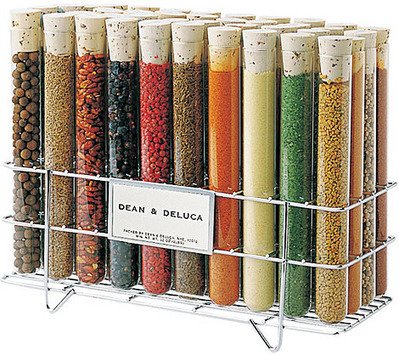
“Let’s curate our spice rack!” is kind-of the art school equivalent of nerd humor (“There are 10 types of people in the world: those who think in binary and those who don’t”). But it’s also an essentially defensive tactic. Maybe we don’t need to be so defensive. Maybe we could put more energy into making things happen, and less into constructing and institutionalizing hierarchies around the words we use to describe them. Or maybe I’m just being defensive?
Scoop.it!

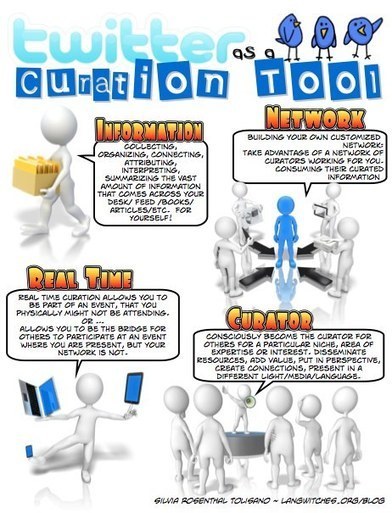
With all the demands of academia, becoming an active curator on Twitter may sound appealing but just too onerous a task. To help ease such anxiety, Allan Johnson shares his own Twitter workflow and suggests several tools and apps, such as Pocket and Buffer, to help academics make the most of their valuable time in contributing and curating content.
Scoop.it!
Learning Futures's insight:
A nice comment on how companies can utilise the power of customer generated content to keep their social media hubs fresh.
Scoop.it!

While there are a ton of essential skills that today's students need in order to succeed in tomorrow's world, learning to efficiently manage -- and to evaluate the reliability of -- the information that they stumble across online HAS to land somewhere near the top of the "Muy Importante" list.
Each decision was a mini-learning lesson, forcing my students to practice evaluative skills that are essential for success in an information-soaked world.
They see their page of resources as a public service -- a place that others can turn if they want to quickly learn more about a topic that matters.
Scoop.it!

"Content curation" is one of those phrases that gets repeated ad naseum without much thought into what it actually means or what role it should play in our digital marketing strategies.
Via catspyjamasnz

Randy Rebman's curator insight,
January 16, 2013 12:35 AM
This is a critical look at the termonology of "content curation." |