Tentez de faire partie des 8 start-up sélectionnées pour présenter votre projet lors du start-up contest du vendredi 18 novembre prochain au Hub Bpifrance.
Enjeu : intégrer la promotion 2016-2017 de l'Institut Multi-Média qui vous donnera accès à des cycles de conférences de très haut-niveau, à un voyage d'études en Israël, et à un réseau d'anciens de l'IMM extrêmement riche et varié en termes de profils et de métiers.
There are many ways to rank universities, but one that’s rarely considered is how many of their graduates make extraordinary contributions to society. A new analysis does just that, ranking institutions by the proportion of their undergraduates that go on to win a Nobel prize.
Two schools dominate the rankings: École Normale Supérieure (ENS) in Paris and the California Institute of Technology (Caltech) in Pasadena. These small, elite institutions each admit fewer than 250 undergraduate students per year, yet their per capita production of Nobelists outstrips some larger world-class universities by factors of hundreds.
“This is a way to identify colleges that have a history of producing major impact,” says Jonathan Wai, a psychologist at Duke University in Durham, North Carolina, and a co-author of the unpublished study. “It gives us a new way of thinking about and evaluating what makes an undergraduate institution great.”
Wai and Stephen Hsu, a physicist at Michigan State University in East Lansing, examined the 81 institutions worldwide with at least three alumni who have received Nobel prizes in chemistry, physiology or medicine, physics and economics between 1901 and 2015. To meaningfully compare schools, which have widely varying alumni populations, the team divided the number of Nobel laureates at a school by its estimated number of undergraduate alumni.
Small but mighty
Many of the top Nobel-producing schools are private, and have significant financial resources. Among the more surprising high performers were several very small US liberal-arts colleges, such as Swarthmore College in Pennsylvania (ranked at number 4) and Amherst College in Massachusetts (number 9).
RankSchoolCountryNobelists per capita1École Normale SupérieureFrance0.001352California Institute of TechnologyUS0.000673Harvard UniversityUS0.000324Swarthmore CollegeUS0.000275Cambridge UniversityUK0.000256École PolytechniqueFrance0.000257Massachusetts Institute of TechnologyUS0.000258Columbia UniversityUS0.000219Amherst CollegeUS0.0001910University of ChicagoUS0.00017
Source: Jonathan Wai & Stephen Hsu
“What these smaller schools are doing might serve as important undergraduate models to follow in terms of selection and training,” says Wai, who adds that, although admission to one of the colleges on the list is no guarantee of important achievements later in life, the probability is much higher for these select matriculates.
To gauge trends over time, Wai cut the sample of 870 laureates into 20-year bands. US universities, which now make up almost half of the top 50 list, began to dominate after the Second World War. Whereas French representation in the Nobel ranks has declined over time, top-ranked ENS has remained steady in its output.
Hsu and Wai had previously performed two similar, but broader, analyses of the rate at which US universities produce winners of the Nobel prize, Fields Medal (in mathematics) or Turing Award (in computer science), as well as members of the US National Academies of Sciences, Engineering, and Medicine. These studies produced rankings of US institutions that are similar to the new, global Nobel rankings.
Surprised not to see "ESPCI" in the list. This ranking echoes the Fields Medal / capita ratio that also puts France totally ahead and off charts. Question is, how will we stand in 20 years from now given current policies and their impact on children demographics and education ?
Let me put that in perspective. The cost of electricity from a new natural gas powerplant in the US is now estimated at 5.6 cents / kwh. (pdf link) That is with historically low natural gas prices in the US, which are far lower than the price of natural gas in the rest of the world.
This new bid in Abu Dhabi is less than half the price of electricity from a new natural gas plant.
What’s more, it’s less than the cost of the fuel burned in a natural gas plant to make electricity – without even considering the cost of building the plant in the first place.
The solar bid in Abu Dhabi is not just the cheapest solar power contract ever signed – it’s the cheapest contract for electricity ever signed, anywhere on planet earth, using any technology.
Looks like solar energy is really following an exponential path similar to tech's Moore's Law. The shift in once oil addicted Middle East is indeed impressive.
If you handle a lot of 4K video, you'll know that most available SD cards will struggle to handle all of your high-quality footage. The two-year old SanDisk 512GB SD card might take the edge off somewhat, but that isn't all that Western Digital, owner of the SanDisk brand, has got to offer. Today, the storage giant unveiled what it calls the "world's first" 1TB SD card. It's only a prototype, but already the company is touting the card's ability to adequately handle 4K, 8K, VR and 360-degree video when it officially becomes available.
Venture capitalists who are serious about turning their firms into more than one-fund wonders may want to have their associates actually start and run a company for a year.
Running a company is distinctly different from simply having operating experience (working in business development, sales or marketing). None of that can compare with being the CEO of a startup facing a rapidly diminishing bank account, your best engineer quitting, working until 10 p.m. then rushing to the airport to catch a redeye to close a deal with a customer, with your board demanding you do it faster.
Today, you can start a web-mobile-cloud startup for $500,000 and have money left over. Every potential early-stage venture capitalist should take a year and do it before he or she makes partner.
Here’s why.
Venture capital as a profession is less than half a century old. It is still very much a “craft” business.
Over time, venture firms realized that the firm’s partners need a variety of skills:
Deal-picking skills (recognizing the right combination of founder and market opportunity).
Rolodex-deal flow (deal-sourcing ability to make connections for the portfolio).
People skills (recognizing patterns of success in individuals and teams).
Some of these skills are learned in school (finance), some are innate aptitudes (people skills), some are learned pattern-recognition skills (shadowing experienced partners, hard-won success and failures of their own), and some are learned by having operating experience. But none of them are substitutes for having started and run a company.
How to Become a VC . Early-stage venture-capital firms grow their partnerships in different ways, some hire:
Partners from other firms.
Associates and put them on a career path that makes becoming a VC a profession not just a craft.
Venture-operating partners to get them into new industries.
An executive who had startup “operating experience.”
Google is running its own ride-sharing service in San Francisco, The Wall Street Journal reports. The move would put Google in direct, immediate competition with Uber, which helps explain even further the recent departure of Alphabet executive David Drummond from Uber’s board. Google’s new offering piloted in May, according to the WSJ, and uses the Google-owned Waze app to connect commuters for shared carpooling.
The plan is apparently to open up said program to all San Francisco residents starting this fall, with an eye toward expanding it further provided that works out. And unlike Uber, this is more of a matchmaking service, which brings together riders with drivers headed in the same direction. Fees are going to be low, too — the report says Google is intentionally keeping them low to keep this a peer-to-peer co-driving arrangement, rather than something that professional drivers will want to use in a dedicated capacity, like Uber and Lyft.
Waze’s operational model to date has focused on connecting drivers via crowdsourced navigation information. Users report things like accidents, roadside obstacles, storms and traffic jams, and these are immediately available to other drivers. Shortly after Google acquired Waze in 2013, it started using its crowdsourced navigation data in the primary Google Maps app, as well.
It was just four days after Christmas 2014, and for Chinese smartphone company Xiaomi, the presents kept on coming as it announced a funding round of $1.1 billion (£850 million) at a valuation of $45bn. Just 18 months on from Xiaomi's last funding round, new analysis of its business suggests it is worth less than $4 billion. So what happened to the world's once most valuable startup?
Today, ARM Holdings is a $1.5B company with +15% year-to-year growth, nice financials (such as 96.7% Gross Margin), and a 46.7% Operating Margin. (For all the details — perhaps too many — see this 2015 presentation.)
15B ARM-based chips for $1.5B revenue means that, on average, ARM gets a licensing revenue of 10 cents per chip, and spends a little less than of half of that, 4.7 cents, to generate such revenue. It sure beats today’s Windows PC business and its measly 5% to 7% Operating Margins in the best of cases.
ARM Holdings is doing well by any measure, but the price paid for an asset is supposed to reflect expectations of future gains. If we compound ARM’s 15% revenue growth over ten years we come up with $6B, a 4x revenue increase…so why is SoftBank willing to pay $32B, more than 20 times current revenue?
Masayoshi (Masa) Son, SoftBank’s founder, isn’t a wide-eyed, newly-rich entrepreneur looking to make — or lose — a quick buck. Having built a large PC software business, he diversified into telecoms in Japan and the US (SoftBank owns 80% of Sprint). He also holds a piece of Yahoo! which, if this weekend’s rumors are true, is soon to be rolled into Verizon.
Having survived the 2000 dot-com bubble and the 2008 financial crisis with a personal fortune estimated at $17B, Son isn’t shy about criticizing the short-term views of US investors and their fixation on “shareholder value” at the expense of other longer-term metrics and societal contributions.
With his accomplishments and maverick attitudes in mind, we must conclude that Son sees many more ARM-based chips in our future, some with a revenue-per-unit that’s higher than today’s 10 cents.
Sometimes it helps looking backwards to understand where all of this might be going. So here is another Cambridge (UK) tech behemoth on the leave #ARMxit and as often, Jean-Louis Gassée very clearly sets the stage to understand the mechanics and feel the $ (sorry ¥) at work.
IMHO we in Europe should be looking at the consequences and go back (again) to the RISC world and discover how fast RISC-V is rising and maybe jump horses. Looks doable judging by the russian attempts on Baikal and the chinese success on LongSoon.
The French startup ecosystem is booming. Its exponential growth started about 5 years ago, and now attracts more and more of the young talent. See this.France was not historically seen as a startup country, and it wasn't. But things have changed. It is now the second largest startup ecosystem in Europe (after UK, but ahead of Germany), and may be about to become the first.There are some amazing initiatives like Ecole 42, which just launched in Silicon Valley as well.It is becoming recognised in Silicon Valley. As an example, John Chambers has on numerous occasions mentioned that he saw huge potential in the French startup ecosystem; for example, in a Fortune article.I expect that we will see the spirit of startup go beyond tech, and enter other industries where France has real knowledge, like food and fashion.
Great interview of Scality CEO by TheRegister. Jérôme Lecat has been a first hour supporter of La French Tech and very clearly explains how to articulate your startup between France and the US, debunking a few myths underway...
Japan’s SoftBank is buying U.K.-based chip design firm ARM Holdings for about $32 billion, according to the FT.
Why? Everything is a computer now, and ARM has been one of the winners of the mobile revolution.
ARM designs chips — but doesn’t actually make them — for a huge variety of devices. It dominates the market for smartphones — Apple is a big client, as is Samsung — and its chips shows up in other consumer gadgets, as well as more-industrial-like devices and “internet of things” sensors.
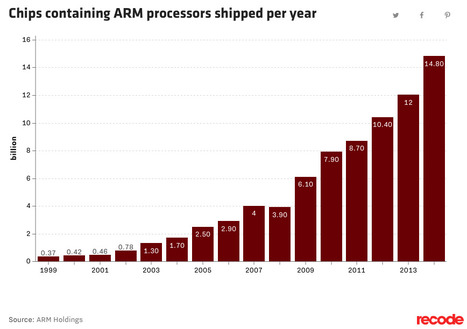
The number of chips containing ARM processors reached almost 15 billion in 2015, up from about 6 billion in 2010.
The move is a big one for SoftBank CEO Masa Son after his would-be successor, former Google executive Nikesh Arora, stepped away from the company last month. (Talks presumably started while Arora was still there.)
One key question is whether other firms will let SoftBank purchase ARM or if there will be a bidding war. Apple, arguably ARM’s most important client, and Intel, which lost the mobile chip war to ARM, are both potential buyers.
The offer is already a generous multiple. As the FT notes, it’s some 70 times ARM’s net income last year. That’s around the same price-to-earnings ratio as Facebook stock.
As Brexit has removed ARM from Europe, will it be left as the impotent witness of what we shall call an ARM's race ?
This news echoes the announcement of World's new #1 Supercomputer, that is chinese again, but more interestingly no longer features any Intel processor inside but domestic LongSoon chips.
The Silicon race is on its way to a US - Asia bipolar configuration, with Europe being left alone due to the combined effect of Brexit and ARMXit : time for investi(gati)ng (in) open source hardware architectures such as RISC-V ...
While it's good that there's a tangible product, there are still doubts swirling around its feasibility. Ringing Bells' CEO admits that his company is taking a loss on every phone right now -- it's hoping to make up for that through sheer volume. As it stands, the firm is still reluctant to offer hands-on time to the media despite a release just days away.If this gamble pays off, though, it could change the local phone market. Even the most affordable smartphones on the market right now still represent a huge expense for some Indians, particularly rural dwellers who rarely enjoy middle class incomes. At $4, the Freedom 251 is inexpensive enough that it'd be far more attainable and help close a technological divide. The main mystery is whether or not the phone is any good. A terrible experience (say, through unreliable hardware) might sour people on the whole concept, no matter how tempting the price might be.
Apple, Google and Facebook are widely regarded as being more innovative than Apple when it comes to developments in the coveted field of artificial intelligence (AI) - hailed as the next major area for computing.While Google and Facebook have developed self-learning AI agents that can learn and master complex games like Go, Apple has remained relatively silent - offering little more than a personal assistant known as Siri.Facebook has also shown off Chatbots, while Microsoft made a regrettable foray of its own into the world of bots with Tay, a controversial Twitter bot that ended up being highly offensive (as a result of humans).But Apple made a series of practical product updates at its Worldwide Developers Conference (WWDC) on Monday that show it is not ready to be left behind just yet. Among other things, the Cupertino-headquartered company announced:• iPhone voicemail transcription;• Facial recognition features within Apple Photo;• keyboard recommendations based on text message conversation.Each of these features relies heavily on AI. They employ software that analyses what's going on (be it in a message thread, or a photo library) and then makes or suggests an action based on the information it is presented with.
Now it becomes interesting... Same focus, but different approach. Wondering how Apple will keep up with the strong privacy protection they have been advocating for long.Wondering how Snips will react :-)
Where there’s smoke it is said there’s fire, and the rumours that Apple will ditch the headphone jack (starting with the iPhone 7) refuse to go away. In fact having first started 18 months ago, this week the rumours have intensified as new leaks build a compelling case for a headphone jack-less Apple world…Both The Verge and AppleInsider note multiple sources at Japan’s Portable Audio Festival are reporting Apple is in discussions to add high resolution streaming audio to Apple Music in 2016. The reports claim Apple wants to implement 96kHz / 24-bit music streaming and is in deep discussions with headphone makers – and here’s the interesting part: the high res audio is specifically designed for use with headphones featuring Lightning connectors.And now you’re ahead of me: Apple would be in its familiar position of being able to take something away (the jack) by giving something more (high res audio). Apple loves this tactic. A focus on FireWire allowed it to dump the floppy disk and this year a focus on USB Type-C gave it (perhaps dubious) grounds to remove every other port type on the 12-inch MacBook.
Depuis l’explosion en 2013 (vérifiée sur Google Trend) de la vague des « transformations digitales », il nous a semblé important d’analyser ce qui pouvait nous distinguer de toutes les sociétés de conseil et de service qui aujourd’hui prétendent toutes, et à l’unisson, faire de la « transformation digitale ». En cherchant cette singularité d’OCTO qui nous pousse à toujours chercher a better way, nous avons produit des grilles d’interprétation du phénomène digital que nous avons souhaitées partager dans cet ouvrage.
Pourquoi OCTO, une entreprise fortement marquée par l’expertise technologique, est-elle de plus en plus sollicitée sur des questions qui ne relèvent pas a priori de son domaine de compétence ? Pourquoi sommes-nous consultés sur des questions non seulement méthodologiques, mais aussi sur l’évolution des modes de management, sur la culture des entreprises, ou encore sur l’évolution des modèles d’affaires ?
Le cadre d’interprétation que nous vous proposons ici nous permettra dans les prochaines livraisons de revisiter certaines thématiques charriées par le digital qui sont particulièrement d’actualité dans les organisations, qui doivent définir et mettre en œuvre leurs stratégies de transformation digitale.
10 axes pour comprendre le digital
L'Accélération
De la sélection naturelle à la sélection artificielle
La dimension sociale et collective
Le statut de la technologie
Les régimes d'individuation
La spécificité de la transformation digitale
Les barbares de la disruption digitale
Le solutionnisme technologique de la Silicon Valley
Lecture remarquable tant sur le fond que sur la forme. A lire et relire absolument pour prendre du recul sur la transformation en cours et changer de posture.
What the heck is an IoT computer? It is a Linux computer designed specifically for building connected hardware applications. It combines the tiny form factor and power-efficiency of the Arduino, with the power and flexibilities of the Raspberry Pi.
The Omega2 is simple, even for people who are just getting started with building hardware.
The Omega2 is affordable, starting at just $5.
With the Omega2, we want to lower the barrier of entry, and allow everyone to take the leap into hardware development.
We made the Omega2 tiny so that it can easily fit into your DIY project or commercial product. It is less than 1/4 the size of the Raspberry Pi, and less than 1/3 the size of the Arduino Uno.
The Omega2 has integrated Wi-Fi and on-board flash storage. This means that it springs to life the moment you power it on. You don't have to worry about buying Wi-Fi dongles or installing operating system images onto external SD cards.
Using the Omega2 is just like using a desktop computer. We've built simple and intuitive apps for you to interact with the Omega2. We also have an App Store where you can discover even more apps!For the more adventurous, you can even build apps with our SDK and publish them on the Onion App Store to share with the world :)
Don't be fooled by its size, the Omega2 is a full computer running Linux, the same operating system that powers some of the world's most mission-critical infrastructure. You can think of the Omega2 as a tiny Linux server with Wi-Fi. (Yes, it even runs Apache!)
For the BSD fans out there, the Omega2 also runs FreeBSD!
An important benefit of running Linux is that the Omega2 can be programmed with whatever language you want. Save time by using languages and libraries you are already familiar with.
The Omega2 is designed for connectivity. It has Wi-Fi built in, and we have built expansions so that you can easily add Bluetooth, Cellular, and GPS to your projects.
The project is still in its experimental phase, but AT&T says it's bursting with potential. AirGig's relay stations may sit on top of telephone poles, but it doesn't actually need to tap into the pole's power source -- it doesn't send signals over the lines either, opting instead to regenerate millimeter wave signals from station to station. Because the stations are designed with to use affordable plastic antennas and make use of existing infrastructure, it offers a potential way to bring high-speed connections to new areas without laying down new cable. Not only does that save a ton of money, it also means the new system could be deployed faster.
At 2AM, in the dark morning hours of June 28th, Mark Zuckerberg woke up and got on a plane. He was traveling to an aviation testing facility in Yuma, AZ, where a small Facebook team had been working on a secret project. Their mission: to design, build, and launch a high-altitude solar-powered plane, in the hopes that one day a fleet of the aircraft would deliver internet access around the world.Zuckerberg arrived at the Yuma Proving Ground before dawn. “A lot of the team was really nervous about me coming,” Zuckerberg said in an interview with The Verge. A core group of roughly two dozen people work on the drone, named Aquila (uh-KEY-luh), in locations from Southern California to the United Kingdom. For months, they had been working in rotations in Yuma, a small desert city in southwestern Arizona known primarily for its brutal summer temperatures.On this day, Aquila would have its first functional test flight: the goal consisted of taking off safely, stabilizing in the air, and flying for at least 30 minutes before landing. “I just felt this is such an important milestone for the company, and for connecting the world, that I have to be there,” Zuckerberg says.
This should be a serious wake-up call for Digital Europe : why not trust european talent and dive in this open race (thinking OpenRiscV) while it is still time ?
The manufacturing hub for the electronics industry, Kunshan, in Jiangsu province, is seeking a drastic reduction in labour costs as it undergoes a makeover after an industrial explosion killed 146 people in 2014.
The county, one-seventh the size of neighbouring Shanghai and the mainland’s first county to achieve US$4,000 per capita income, was adjudged the best county for its economic performance by Forbes for seven years in a row.
However, the blaze, blamed on poor safety standards and haphazard industrialisation, dented Kunshan’s pride.
More than a year on, the county, which attracts much of its investment from Taiwan, is trying to reinvent its growth strategy. It is accelerating growth by replacing humans with robots and encouraging start-ups.
Thirty-five Taiwanese companies, including Apple’s supplier Foxconn, spent a total of 4 billion yuan (HK$4.74 billion) on artificial intelligence last year, according to the Kunshan government’s publicity department.
“The Foxconn factory has reduced its employee strength from 110,000 to 50,000, thanks to the introduction of robots. It has tasted success in reduction of labour costs,” said the department’s head Xu Yulian.
“More companies are likely to follow suit.”
As many as 600 major companies in Kunshan have similar plans, according to a government survey.
The job cuts do not augur well for Kunshan, which had a population of more than 2.5 million at the end of 2014, two-thirds of whom were migrant workers.
Factories and other buildings cover about 46 per cent of the land – a figure which is far higher than the cap set by the central government.
This is where Facebook will prototype its solar drones, Internet-beaming lasers, VR headsets, and next-gen servers.The problem with moving faster than most companies is that Facebook was plagued by delays whenever it had to outsource prototyping and testing of its gadgets and gizmos. With so much hardware on its 10-year roadmap, and quarter after quarter of profits stacking up, it made sense to build a dedicated laboratory within its Menlo Park headquarters.
The internet provides information, opportunity and human connection, yet less than half the world has access. We’re proud to announce the successful first test flight of Aquila, the solar airplane we designed to bring internet access to people living in remote locations. This innovative plane has the wingspan of an airliner but weighs less than a small car and flies on roughly the power of three blow dryers
Solar Impulse, meet AI. Facebook's Aquila looks extremely promising and progressing quite fast. Besides, it confirms how serious its Building 8 Division is about leveraging and reinventing hardware to close the loop with software and services.
The French startup ecosystem is booming. Its exponential growth started about 5 years ago, and now attracts more and more of the young talent. See this.France was not historically seen as a startup country, and it wasn't. But things have changed. It is now the second largest startup ecosystem in Europe (after UK, but ahead of Germany), and may be about to become the first.There are some amazing initiatives like Ecole 42, which just launched in Silicon Valley as well.It is becoming recognised in Silicon Valley. As an example, John Chambers has on numerous occasions mentioned that he saw huge potential in the French startup ecosystem; for example, in a Fortune article.I expect that we will see the spirit of startup go beyond tech, and enter other industries where France has real knowledge, like food and fashion.
Great interview of Scality CEO by TheRegister. Jérôme Lecat has been a first hour supporter of La French Tech and very clearly explains how to articulate your startup between France and the US, debunking a few myths underway...
While it's good that there's a tangible product, there are still doubts swirling around its feasibility. Ringing Bells' CEO admits that his company is taking a loss on every phone right now -- it's hoping to make up for that through sheer volume. As it stands, the firm is still reluctant to offer hands-on time to the media despite a release just days away.If this gamble pays off, though, it could change the local phone market. Even the most affordable smartphones on the market right now still represent a huge expense for some Indians, particularly rural dwellers who rarely enjoy middle class incomes. At $4, the Freedom 251 is inexpensive enough that it'd be far more attainable and help close a technological divide. The main mystery is whether or not the phone is any good. A terrible experience (say, through unreliable hardware) might sour people on the whole concept, no matter how tempting the price might be.
Yesterday, Apple launched its Worldwide Developer’s Conference (WWDC) and had its public keynote address. While many new things were announced, the one thing that caught my eye was the dramatic expansion of Apple’s use of artificial intelligence (AI) tools. I talked a bit about AI with Hilary Parker on the latest Not So Standard Deviations, particularly in the context of Amazon’s Echo/Alexa, and I think it’s definitely going to be an area of intense competition between the major tech companies.Pretty much every major tech player is involved in AI–Google, Facebook, Amazon, Apple, Microsoft–the list goes on. Recently, a some commentators have suggested that Apple in particular will never catch up with the likes of Google with respect to AI because of Apple’s strict stance on privacy and unwillingness to gather/aggregate data from all its users. However, yesterday at WWDC, Apple revealed a few clues about what it was up to in the AI world.First, Apple mentioned deep learning more than a few times, including specifically calling out its use of LSTM in its Messages app and facial recognition in its Photos app. Previously, Apple had been rumored to be applying deep learning to its Siri assistant and its fingerprint sensor. At WWDC, Craig Federighi stressed Apple’s continued focus on privacy and how Apple does not need to develop “user profiles” server-side, but rather does most computation on-device (in this case, on the iPhone).However, it can’t be that Apple does all its deep learning computation on the iPhone. These models tend to be enormous and take advantage of reams of data that can only be reasonablly processed server-side. Unfortunately, because most companies (Apple in particular) release few details about what they do, we may never how this works. But we can definitely speculate!Apple vs. GoogleI think the Apple/Google dichotomy provides an interesting opportunity to talk about how models can be learned using data in different ways. There are two approaches being represented here by Apple and Google:Google way - Collect lots of data from users and store them on a server in the Googleplex somewhere. Then use that data to fit an enormous model that can predict when you’ve taken a picture of a cat. As users generate more data, bring that data back to the Googleplex and update/refine the model.Apple way - Build a “starter model” in the Apple Mothership. As users generate data on their phones, bring the model to the phone and update the model using just their data. Bring the updated model back to the Apple Mothership and leave the user’s data on the phone.
For anybody interested in #AI, here is a clear must-read piece detailing the difference in approach between Google and Apple, by using a "Google mean" vs "Apple mean" illustrated metaphor. And here, "mean" is to be understood mathematically, not morally #DontDoEvil ...
announced a deal to pay $26.2 billion to acquire business social network, LinkedIn. It fails the four tests of a successful acquisition.While the deal certainly rescues LinkedIn from a huge growth problem that slashed the value of its shares in February, it is unclear how Microsoft will generate a return on that $26 billion investment.Microsoft will pay “$196 per share in an all-cash transaction, including LinkedIn’s net cash, a 49.5% premium to LinkedIn’s closing price on June 10. The offer values LinkedIn about 91 times earnings before interest, taxes, depreciation and amortization (EBITDA),” according to Bloomberg.Why would Microsoft do that? CEO Satya Nadella said “the acquisition could drive growth for LinkedIn as well as Microsoft’s Office 365 and Dynamics services,” according to Bloomberg.LinkedIn CEO Jeffrey Weiner — who will stay on as CEO after Microsoft completes the deal — said in a statement, “Just as we have changed the way the world connects to opportunity, this relationship with Microsoft, and the combination of their cloud and LinkedIn’s network, now gives us a chance to also change the way the world works.”I believe this is a flimsy justification for spending $26.2 billion.But to understand why it happened, a good place to start is to look what happened to LinkedIn’s shares after the stock market opened on February 6, 2016.That was the day investors hacked 44% from LinkedIn’s market capitalization.The reason was easy to understand, yet difficult to remedy. LinkedIn lowered its expectations for the year’s growth in revenue (from 35% to 20%) and adjusted earnings (from 41% to 7%) — well below what analysts expected.This slashed a cool $1 billion from the net worth of LinkedIn’s founder, Reid Hoffman, and forced Weiner to ponder important questions that needed to be answered before investors could hope to recoup what they lost.The questions were:Where would faster growth come from?Could it be spurred by improving LinkedIn’s offerings?By selling its current products to new customers, or in new geographies? By inventing new products for its existing customers?By adding entirely new classes of products, or creating a new growth culture?Now that Microsoft is buying LinkedIn, whether or not Weiner can answer these questions will not matter as much as it once did.But the deal still begs the question — Does the Microsoft/LinkedIn deal pass the four tests of a successful acquisition?
Interesting contrarian analysis requiring a full read on what remains the boldest move of this month if not this semester.While it values my LinkedIn profile at approx $60, it still does not trigger any need to upgrade to Premium...What I can expect from M$FT however is a better LinkedIn mobile app experience as Redmond had really been impressive on the mobile UX front especially on iOS.Any comments / reactions ?
To get content containing either thought or leadership enter:
To get content containing both thought and leadership enter:
To get content containing the expression thought leadership enter:
You can enter several keywords and you can refine them whenever you want. Our suggestion engine uses more signals but entering a few keywords here will rapidly give you great content to curate.


 Your new post is loading...












Vous êtes une startup et souhaitez accélérer ? Participez au Startup Contest 2016 de l'Institut Multi-Médias !