 Your new post is loading...

|
Scooped by
Philippe J DEWOST
June 6, 2016 12:21 AM
|
The absence of official numbers for the Apple Watch leads to speculation that the device is a flop — why else would Apple hide the numbers? But the company’s penchant for secrecy shouldn’t prevent us from looking at a few facts, and from thinking about the company’s long game.
|
|
Scooped by
Philippe J DEWOST
May 19, 2016 11:00 AM
|
Now that you are giving up on check-ins and sharing your location with your friends, a French startup is coming up with better technology and new use cases to make location cool again. Zenly has been quietly working on location for years, and teenagers are now getting addicted to this app. SoLoMo is back.Zenly couldn’t be more straightforward. When you open the app, you see a giant map with your location and your friends’ location. You can tap on a friend’s picture and see exactly where they are. Or you can just aimlessly swap through your friends and jump around the map. This is Zenly’s core feature.When I first heard about this pitch, I wasn’t convinced by the idea. What if you could share your location with your close friends and family? This question doesn’t sound compelling at all. It sounds a lot like Apple’s Find My Friends, a bit like Foursquare, and it’s also very reminiscent of dozens of failed startups (R.I.P. Sam Altman’s Loopt, Gowalla, BrightKite, Highlight…).And I’ve also never been a fan of constant location sharing. First, I care about my privacy. Second, background location apps kill my phone’s battery. Third, why would I even use something like this anyway?But I gave it a serious shot and liked it a lot. Zenly is a well-designed, addictive app. I tend to open it every now and then just because it’s so different from everything out there. This isn’t another messaging app. This isn’t a social network. This isn’t a utility. It’s something that sits between all of these areas. And I keep opening the app.
|
|
Scooped by
Philippe J DEWOST
May 19, 2016 5:25 AM
|
Deuxième édition pour le rendez-vous Big up 4 startup, organisé par le French Tech Montpellier et le cluster régional FrenchSouth Digital. Après avoir réuni en 2015 lors de sa première édition huit grands groupes et 150 start-up régionales, dont les rencontres ont abouti à une quinzaine de contrats, le rendez-vous passe la seconde. En 2016, ce sont quatorze groupes (dont Cisco, Société Générale, Caisse des Dépôts, Orange, La Poste, EDF, Engie et Midi Libre) qui devraient accueillir une soixantaine de jeunes pousses.Répondre aux besoins d'innovation des groupesComme l'an dernier, les start-up auront pour mission de proposer des réponses aux besoins d'innovation exprimés par les groupes dans des appels à projets disponibles en ligne. Des présentations et des rendez-vous individuels seront organisés les 19 et 20 mai prochains
|
|
Scooped by
Philippe J DEWOST
May 15, 2016 9:33 AM
|
How widely and how quickly will autonomous cars be accepted? As hard as it might be for an urbanite to imagine, many people love their cars. And if early autonomous vehicles cause a few well-publicized accidents, fear of the unknown could slow the trend, even to a halt.
Is owning a car factory an advantage or a disadvantage? In the minds of many from Silicon Valley, "Detroit" is a euphemism for inept. They believe the most important part of a car is its software, and they're probably right. But isn’t a century’s worth of expertise worth something? And don’t get carried away about Tesla: Last year it delivered 50,580 cars, approximately one-quarter of one percent of Detroit's output.
Is ride-sharing a commodity product? In Brooklyn, I can use a car-hailing app to get Uber, Lyft, Juno, or a taxi. I don’t see any significant difference between any of the services, each of which arrive quickly, charge similar fares, and offer clean cars and knowledgeable drivers. Selling a commodity tends to be a pretty awful business.
How long can ride-sharing companies like Uber and Lyft take a loss on many of the rides they provide, in their race to garner riders and drivers? "There’s never been a market as subsidized as this," one venture capitalist told me. "We’ll only know the winners and losers after that settles down."
Will governmental regulations slow or speed this transition? The environmental benefits of electric vehicles and fewer cars on the road are clear. Yet cities like New York, Austin, Berlin, and Paris have at different times threatened to strangle car-sharing with regulations. Look at the airline business: governments like regulating travel, for better or for worse.
What kind of "driver" or "passenger" insurance will be required? The average American driver now pays a bit less than $1000 per year for auto insurance. But who is responsible when driverless cars collide?
Will we continue to personally own cars, or will we instead have monthly subscriptions to companies that will provide all the rides we need? Subscription services seem likely, but if my current subscriptions—to companies like Time Warner Cable and Verizon—are any model, quality suffers and prices creep up.
Why is it so difficult to design a driver-friendly dashboard? Mapping services and accurate engine diagnostics are welcome additions to the information a driver can see, but more data has resulted in cluttered screens using interactive controls designed for phones or laptops. Steve Jobs understood that the user interface was the most important part of any consumer technology. Can Apple solve this problem?
Are Uber and Lyft drivers employees or contractors? This is an issue of short-term importance, but is caught up in a broader societal concern: How to define those who participate in the so-called ‘gig economy.’
Who has the most important leverage? The company that designs a car's software? The manufacturer? Or is it Uber, whose app is used by so many consumers? As with any nascent transition, it's hard to know what will emerge as the most important bottleneck.
Can any ride-sharing company become a truly international brand, or will local services trump those ambitions? Uber is losing billions of dollars trying to snare a leading market share in Asian countries. No one know exactly how much resistance it will face from governments that prefer local providers.
How strong are the network effects that Uber gains by being such a well-funded first mover? Benchmark VC Bill Gurley likes to point to this tweet as a key reason that Uber will continue to thrive. But if car-sharing has as much subsidization and government interference as the airline industry, will those network effects hold true?
|
|
Scooped by
Philippe J DEWOST
April 28, 2016 5:36 AM
|
French startup Drivy has raised another $35 million (€31 million) from Cathay Innovation, Nokia Growth Partners and existing investors Bpifrance, Via-ID and Index Ventures. If you don’t already know Drivy, the company wants to rethink the way car rental works today.If you have a car, chances are you don’t use it every day. Sometimes you can even spend long periods of time without using it thanks to public transportation. Instead of having a useless car, you can rent it to someone else. In other words, you become a sort of car rental company for your own car.On the other side of the equation, if you live in a big city, chances are you don’t need a car. Having a car could even slow you down. But sometimes, you want to go on vacation and a car would be useful. Sure, you could rent a car from any of the existing car rental company. But Drivy lets you rent a car from someone else for less.This way, you could find big cars, small cars, give back your car on a Sunday and more. Drivy wants to be more flexible than your average car rental company.
|
|
Scooped by
Philippe J DEWOST
April 26, 2016 5:10 AM
|
Nokia is buying digital health and wearables company Withings for €170 million (£131 million).The deal, which Nokia said would be the start of "a new chapter" for the company, will create a digital health business within Nokia, headed by Withings CEO Cédric Hutchings."We have said consistently that digital health was an area of strategic interest to Nokia, and we are now taking concrete action to tap the opportunity in this large and important market," Rajeev Suri, Nokia's president, said in a statement.Founded in 2008 Withings, based in France, has 200 staff in Paris and Massachusetts and Hong Kong.The company produces a range of health and lifestyle products, including smartwatches, air monitors for houses, smart thermometers, and an Aura sensor that tracks your movements while you sleep
|
|
Scooped by
Philippe J DEWOST
April 25, 2016 1:05 AM
|
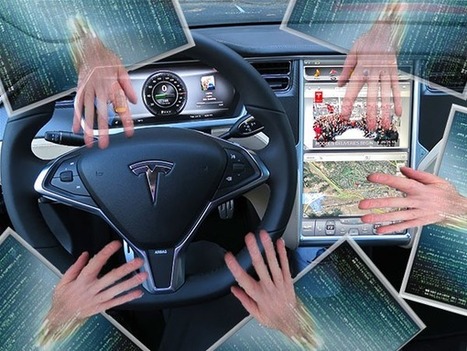
Cars are no longer what they seem to be. On-board computers and their algorithms have invaded all organs, making cars better, but also more susceptible to hacks and invasions of privacy. Having driven Route 85 between Cupertino and Mountain View a few thousand times, I’m familiar with every rift and gap in the concrete, every subtle camber shift as I follow an habitual, gradual arc through curves and lane changes. Some early Chevrolet episodes aside, I’m behind the wheel of a European vehicle, silent, good lungs, surefooted, precise, the kind of car that translates the driver’s steering motion into a smooth trajectory, no ifs or buts, no need for correction as the suspension takes its time to settle. After 31 years of driving this pleasant road, the feeling doesn’t get old. A few weeks ago, I drove the familiar route in a new vehicle freshly delivered from Sindelfingen. Something is wrong: The first curve line is “dirty”, it lacks Germanic rigor. At the next curve the steering wheel argues with me, politely but clearly demanding a different trajectory. When I get back home I look around the dashboard and notice two red indicators that had been hidden by the steering wheel while I was driving. The walkthrough tech at the dealership had set the vessel to autopilot. In retrospect, I should have seen the argumentative steering coming: I had ordered the autopilot and other geeky features that were unknown when I bought my previous chariot just five years ago. On the road, the autopilot had interpreted my steering ‘optimizations’ as daydreaming lane drift and had stepped in to keep me in line. I disconnect the autopilot and go for a drive; the familiar pleasant feeling returns. In a 1957 essay about the Citroën DS (pronounced “Déesse”, goddess) Roland Barthes hailed the modern car as… “…the exact equivalent of the great Gothic cathedrals: I mean the supreme creation of an era, conceived with passion by unknown artists…it excites interest less by its substance than by the junction of its components. ” The striving, energetic copulation of the arts and technologies, the ‘junction of components’ has continued. Cars are now nearly completely penetrated by automation and algorithms.
|
|
Scooped by
Philippe J DEWOST
April 20, 2016 1:50 AM
|
About the time Swift was going open source, representatives for three major brands — Google, Facebook and Uber — were at a meeting in London discussing the new language. Sources tell The Next Web that Google is considering making Swift a “first class” language for Android, while Facebook and Uber are also looking to make Swift more central to their operations.Google’s Android operating system currently supports Java as its first-class language, and sources say Swift is not meant to replace Java, at least initially. While the ongoing litigation with Oracle is likely cause for concern, sources say Google considers Swift to have a broader “upside” than Java.
|
|
Scooped by
Philippe J DEWOST
April 7, 2016 6:54 AM
|
‘Platoon’ of wireless-linked trucks arrives in Netherlands port city of Rotterdam, giving a glimpse of the future of road haulage
|
|
Scooped by
Philippe J DEWOST
April 5, 2016 5:08 AM
|
The collaboration allows Sigfox customers to use Microsoft Azure IoT for real-time analytics and automation of operations, while also utilizing Sigfox’s low-power, wide area communications network (LPWAN) to make an IoT system affordable and reliable.“Integration with Microsoft Azure IoT Hub in Sigfox’s Cloud is a key step in the evolution of the IoT, providing customers with a great alternative to investing large amounts of resources to develop and manage data storage and management themselves,” said Stuart Lodge, Sigfox executive vice president of global sales and partners to Business Wire.Sigfox already provides its dedicated network to 14 countries, including Britain, France, and the United States. It installs small base stations to connect IoT devices to its network, and uses the 900 MHz band to send tiny bits of data at 100 bits per second. The low-power ensures that IoT devices can run for years on a single set of batteries, lowering the long term costs. Sigfox is banking on this low-energy approach winning businesses that don’t want to spend hundreds of thousands on an IoT system.“Our collaboration with Sigfox enables Microsoft Azure IoT customers to more easily integrate devices connected to the Sigfox network in their existing solutions,” said Steve Guggenheimer, Microsoft’s corporate vice president of developer platform.
|
|
Scooped by
Philippe J DEWOST
March 28, 2016 9:27 AM
|
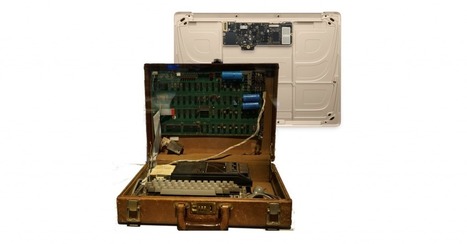
In the past 40 years our personal computers have, of course, become immensely more powerful and convenient, but the roots of our interest in personal computing haven’t changed. And, against many odds Apple, has become a giant, world-spanning, immensely rich company. In retrospect, we can see three Apple eras. Apple 1.0 was a turbulent period: The rise of the Apple ][, its loss to the IBM PC and Microsoft; the hope and trouble with the Macintosh; Jobs forced out followed by a succession of “professional” CEOs and progressively deteriorating finances. In retrospect, Jobs’ departure from Apple was one of the best things that happened to him and the company he co-founded. If hadn’t left for an outside tour, the Pixar success and the NeXT technical achievements and business challenges, he wouldn’t have been able to return and jump start the company’s next phase. Apple 2.0 began in late 1996 when Jobs managed what turned out to be a reverse acquisition of Apple. We owe much gratitude to then-CEO Gil Amelio who unwittingly saved the company hiring Steve to “advise” him. Jobs’ advice? Show Amelio the door and install himself as “interim” CEO. Jobs then made an historic deal with Bill Gates which gave him time to let his team of NeXT engineers completely rebuild the Mac OS on a modern Unix foundation. Steve also rummaged through the company and found Jony Ive who gave us the colorful iMacs, the first of a series of admired designs. What followed is recognized as the most striking turnaround story in any industry, one that has been misunderstood and pronounced as doomed at almost every turn. The list of Jobs’ “mistakes” includes killing the Macintosh clone program by canceling Mac OS licenses; getting rid of floppies and, later, CD/DVD-ROMs (mostly); entering the crowded MP3 player field; introducing iTunes and the micropayment system; the overpriced, underpowered $500 iPhone; the stylus-free iPad (ahem)… We’ve seen the punishment for these mistakes: Apple sells approximately $250B worth of iPhones every year, that’s six phones every second manufactured and delivered to more than 130 countries. Despite it’s enormous size and influence, Apple’s business remains simple to understand. The company makes personal computers, as illustrated in this telling line-up: Personal computers, small, medium and large. Everything else Apple does — from iTunes to iCloud storage, apps and accessories — has one and only one raison d’être: Push up the volumes and margins of the company’s personal computers. Steve Jobs left us in early October 2011, Too Soon, as I wrote in my heartfelt homage to the once unmanageable co-founder who turned into a manager extraordinaire, captain of industry, and editor-in-chief of a team of designers, engineers, supply-chain managers, and finance experts. We’re now in the Apple 3.0 era, under Tim Cook’s leadership.
|
|
Scooped by
Philippe J DEWOST
March 22, 2016 1:30 AM
|
SANTA CLARA, Calif, March 21, 2016 – Intel announced that the company’s former CEO and Chairman Andrew S. Grove passed away today at the age of 79.
|
|
Scooped by
Philippe J DEWOST
March 18, 2016 3:14 AM
|
Over the past years, I have found AppleScript very efficient when it comes to manipulate and process Contact or Agenda information on a Mac, either to detect and process duplicates, as well as for updating dozens of contacts when corporate mail domaine changes, building and maintaining mailing lists through specific tags in the "Notes" field, or processing boucing emails "en masse" to clean up address book after season's greetings. ics-file-cleaner is An AppleScript designed to process and trim (organizers, attendees, requests) .ics files sent from Outlook before importing them in iCal. This is the only way to avoid iCal resending or confirming invites via Outlook, or canceling an invent and notifying attendees while you just removed it from iCal. The following AppleScript is triggered by a mail rule and process the .ics file content before opening it with iCal/Calendar app - which results in an import. It has been posted on GitHub so it can be forked and improved beyond my basic and remnant AppleScript skills.
|
|
|
Scooped by
Philippe J DEWOST
May 20, 2016 4:10 AM
|
Voici, en replay, via le service de streaming live de Plush, startup Montpelliéraine, la série des reverse pitchs des grands groupes donnés hier après-midi dans le cadre de #Big4Start . L'intervention du Groupe Caisse Des Dépôts, qui représentait les besoins d'ICADE et de Transdev, démarre à 59 min.
|
|
Scooped by
Philippe J DEWOST
May 19, 2016 6:44 AM
|
French startup Shift Technology just raised a $10 million Series A round from Accel, with existing investors Elaia Partners and Iris Capital also participating. Shift Technology uses big data and machine learning to detect patterns of fraudulent insurance claims. This way, insurance companies can save money.Shift Technology uses a Software-as-a-Service approach so that its tools get better over time. All the data the company collects from all its clients can educate its algorithms.Insurance fraud is a big market as insurance companies have a lot of money and are always looking for way to optimize claims. Anything that lets these companies save money is worth doing. So Shift Technology’s platform looks like an easy sell.
|
|
Scooped by
Philippe J DEWOST
May 15, 2016 1:49 PM
|
People are focusing on the wrong thing when analyzing Apple's path forward in the face of slowing iPhone sales. Instead of debating how much Apple will try to monetize the iPhone user base with services (not as much as consensus thinks), the company is instead planning its largest pivot yet. There are only a handful of logical explanations for Apple's current R&D expense trajectory, and all of them result in a radically different Apple. In a few years, we are no longer going to refer to Apple as the iPhone company.
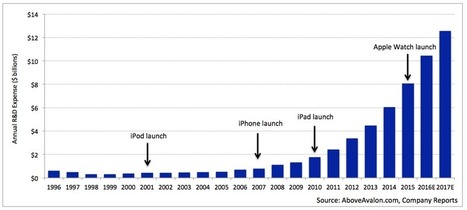
As I pointed out last May, Apple's R&D expense saw a significant bump up beginning in mid-2014. It was clear Apple was up to something big. However, after looking at Apple's 2Q16 results, it appears I underestimated the situation. As depicted in Exhibit 1, Apple is now on track to spend more than $10 billion on R&D in 2016, up nearly 30% from 2015 and ahead of even my aggressive estimate. This is a remarkable feat considering that Apple was spending a little over $3 billion per year on R&D just four years ago.
One of the more interesting aspects of Apple's R&D expense trajectory in recent years is that the increase has been outpacing revenue growth. As seen in Exhibit 2, given my current iPhone sales expectations for FY16 and FY17, Apple is on track to approach a multi-decade record in terms of amount spent on R&D as a percent of revenue.
Unusual R&D Perceptions
The most shocking aspect about the amount of money Apple is spending on R&D is how little attention it has garnered in Silicon Valley and on Wall Street. Other than my R&D post last year, there is rarely any mention of Apple's R&D, and this doesn't seem to make much sense.
I suspect most of this has been due to the fact that Apple does not draw attention to its product pipeline and long-term strategy, choosing instead to embrace secrecy and mystery. Now compare this to Mark Zuckerberg laying out his 10-year plan for Facebook. It is easy and natural for people to then label Facebook as innovative and focused on the future. The same principle applies to Larry Page reorganizing Google to make it easier for investors to see how much is being spent on various moonshot projects. Jeff Bezos is famous for his attitude towards failing often and in public view, giving Amazon an aura of being a place of curiosity and boldness when it comes to future projects and risk taking.
Meanwhile, Tim Cook has remained very tight-lipped about Apple's future, which gives the impression that Apple isn't working on ground-breaking ideas or products that can move the company beyond the iPhone. Instead of labeling this as a mistake or misstep, Apple's product secrecy is a key ingredient of its success. People like to be surprised. Another reason Apple takes a much different approach to product secrecy and R&D is its business model. Being open about future product plans will likely have a negative impact on near-term Apple hardware sales. Companies like Facebook and Google don't suffer from a similar risk. The end result is that there is a legitimate disconnect between Apple's R&D trends and the consensus view of the company's product pipeline. Apple is telling us that they are working on something very big, and yet no one seems to notice or care. I find that intriguing.
Logical Explanations for Apple R&D
Even though Apple remains tight-lipped about its dramatic increase in R&D expense, there are three logical explanations for what may be happening.
1) Apple's expanded product line requires additional R&D. This theory represents the most straightforward explanation. Essentially, because Apple has grown significantly over the years, the company needs to spend more on R&D just to keep up with its more expansive product line and greater competition. The company is now invested in four hardware categories (iPhone, iPad, Mac and Apple Watch), not to mention various software and services initiatives.
2) Apple plans on doing more. Keeping with another simple explanation, Apple's increased R&D spend could signal that the company is willing to try its hand at more things. The expectation would be that Apple will begin releasing a greater number of products in terms of hardware, software and services.
3) Apple is looking to pivot. Apple is ramping up R&D because they have a few big bets that require a massive increase in investment. The two most logical areas for these bets are wearables and personal transport initiatives. In both cases, Apple is moving well beyond its comfort zone of selling pieces of glass that can be held in one's hand. Instead, Apple is literally building a new company with additional capabilities and strengths.
|
|
Scooped by
Philippe J DEWOST
May 11, 2016 3:18 AM
|
L'année dernière, Carlos Diaz, un entrepreneur limougeaud habitant à San Francisco depuis sept ans, a reçu en tête-à-tête les PDG de 113 start-up hexagonales. Identifié par les entrepreneurs comme une figure française de la Silicon Valley depuis sa participation au mouvement des « pigeons » en 2012, il s'est retrouvé bombardé d'e-mails de jeunes créateurs d'entreprise, avides de conseils sur l'installation de ce côté-ci de l'Atlantique. Il s'est dit qu'il existait sûrement une manière plus efficace de les aider que d'enchaîner les cafés… Avec deux autres chefs d'entreprise de la Vallée, Géraldine Le Meur, cofondatrice du festival LeWeb, et Pierre Gaubil, un autre serial entrepreneur, ils ont décidé de lancer un accélérateur de start-up françaises basé à San Francisco. Baptisé « The Refiners », il accueillera 12 à 15 start-up n'ayant pas encore réalisé de levée de fonds, pendant trois mois, deux fois par an. La première promotion commencera en septembre. Des modèles américains L'accélérateur prendra 3 à 7 % de leur capital, en échange d'un chèque de 50.000 dollars pour les aider à démarrer. Un modèle inspiré des fameux accélérateurs Y Combinator et 500 Startups, d'où sont sortis Airbnb, Twitch ou Makerbot, mais qui prendra en compte « le fossé culturel, un élément trop souvent négligé », explique Carlos Diaz. « Pendant les trois premières semaines, on fermera les portes et les fenêtres car ils ne seront pas "montrables" et on leur apprendra comment agir ici », détaille-t-il. Au programme, quelques éléments clefs de la culture de la Silicon Valley, comme la différence entre les fonds de capital-risquefrançais et américains, ces derniers « ne demandant pas des tableurs et des business plans à trois ans », explique Pierre Gaubil. Ou encore la différence de relation avec les grandes entreprises : « dans la Silicon Valley, les grands comptes ne sont pas un élément de destruction des produits des start-up mais des partenaires qui les distribuent ». Doté de 6 millions de dollars, le fonds est abondé à 60 % par une centaine de partners, moitié américains, moitié français, qui endossent également le rôle de mentors. Les 40 % restants sont apportés par bpifrance. Des licornes plutôt que des poneys
|
|
Scooped by
Philippe J DEWOST
April 28, 2016 5:20 AM
|
Google is great and all, but it has some limitations, when you stop to think about it. It's fabulous at searching the whole web at once — there's nobody better at trawling humankind's vast combined storehouse of knowledge to quickly tell you how to make a hamburger.But it's less great at searching within any individual website or app. Sure, you can use Google to search within a site, but really it's just going back out to Google's master index, and then back to you.It's slower than it has to be, and it's not really applicable to searching inside, say, your own text messages on your own phone.Enter Algolia, a San Francisco-based startup that gives developers and businesses the tools to build their own search experience, their own way, for their own sites and apps.So far, Algolia has raised $21 million from investors including Accel Partners, the Y Combinator and 500 Startups accelerator programs, and Docker founder Solomon Hykes. And customers like Medium, Twitter's Periscope, and Microsoft's soon-to-be-discarded calendar app Sunrise are using Algolia's tech to power search in their own services.Today, Algolia announces that Kendall Collins, the former CEO of Salesforce Cloud and current CMO of $1.9 billion startup AppDynamics, has signed on to its board to guide the company towards the future and help bring the product to bigger businesses
|
|
Scooped by
Philippe J DEWOST
April 25, 2016 2:03 AM
|
In February of last year, Fortune magazine writers Erin Griffith and Dan Primack declared 2015 “The Age of the Unicorns” noting — “Fortune counts more than 80 startups that have been valued at $1 billion or more by venture capitalists.” By January of 2016, that number had ballooned to 229. One key to this population growth has been the remarkable ease of the Unicorn fundraising process: Pick a new valuation well above your last one, put together a presentation deck, solicit offers, and watch the hundreds of million of dollars flow into your bank account. Twelve to eighteen months later, you hit the road and do it again — super simple. While not obvious on the surface, there has been a fundamental sea-change in the investment community that has made the incremental Unicorn investment a substantially more dangerous and complicated practice. All Unicorn participants — founders, company employees, venture investors and their limited partners (LPs) — are seeing their fortunes put at risk from the very nature of the Unicorn phenomenon itself. The pressures of lofty paper valuations, massive burn rates (and the subsequent need for more cash), and unprecedented low levels of IPOs and M&A, have created a complex and unique circumstance that many Unicorn CEOs and investors are ill-prepared to navigate. Many have noted that the aggregate shareholder value created by all of the Unicorns will vastly overshadow the losses from the inevitable failed unicorns. This likely truism is driven by the clear success of this generation’s transformational companies (AirBNB, Slack, Snapchat, Uber, etc). While this could provide some sense of comfort, most are not exposed to a Unicorn basket, and there is no index you can buy. Rather, most participants in the ecosystem have exposure to and responsibility for specific company performance, which is exactly why the changing landscape is important to understand. Perhaps the seminal bubble-popping event was John Carreyrou’s October 16th investigative analysis of Theranos in the Wall Street Journal. John was the first to uncover that just because a company can raise money from a handful of investors at a very high price, it does not guarantee (i) everything is going well at the company, or (ii) those shares are permanently worth the last round valuation. Ironically, Carreyou is not a Silicon Valley-focused reporter, and the success of the piece served as a wake-up call for other journalists who may have been struck by Unicorn fever. Next came Rolfe Winkler’s deep dive “Highly Valued Startup Zenefits Runs Into Turbulence.” We should expect more of these in the future. In late 2015, many public technology companies saw a significant retrenchment in their share prices primarily as a result of a reduction in valuation multiples. A high performing, high-growth SAAS company that may have been worth 10 or more times revenue was suddenly worth 4-7 times revenue. The same thing happened to many Internet stocks. These broad-based multiple contractions have an immediate impact on what investors are willing to pay for the more mature private companies. Late 2015 also brought the arrival of “mutual fund markdowns.” Many Unicorns had taken private fundraising dollars from mutual funds. These mutual funds “mark-to-market” every day, and fund managers are compensated periodically on this performance. As a result, most firms have independent internal groups that periodically analyze valuations. With the public markets down, these groups began writing down Unicorn valuations. Once more, the fantasy began to come apart. The last round is not the permanent price, and being private does not mean you get a free pass on scrutiny.
|
|
Scooped by
Philippe J DEWOST
April 21, 2016 4:19 AM
|
The cloud will not be housed in data center containers.Google has taken the container route for building out data center capacity in the past but eventually decided against it. Now, Microsoft has also found that containers just aren’t the best way for it to scale.The Redmond, Washington-based giant went through multiple generations of data center containers, from standard shipping containers it stacked two-high at its Chicago data center years ago to custom-designed ITPACs, which it had been deploying in data centers from Quincy, Washington, to Boydton, Virginia, since 2010.But because it has placed so much focus on growing its cloud services in recent years, Microsoft has had to expand data center capacity around the world at a pace that couldn’t be achieved with containers, Kushagra Vaid, general manager for hardware infrastructure at the company’s cloud and enterprise division, said in an interview.Amazon also has used data center containers to host its cloud infrastructure. In a conference presentation in 2011, one of its top infrastructure engineers James Hamilton showed a picture of two containers, one stacked on top of the other. The presentation was a rare look inside the cloud giant’s computing platform. The company is extremely secretive about its infrastructure strategy, and it’s unclear whether that strategy still includes containers.About two years ago, Microsoft’s infrastructure team made a radical change to its hardware approach, going from different product teams making their own hardware decisions to standardizing on a handful of server designs that took cues from server specs Facebook open sourced through its Open Compute Project initiative.
|
|
Scooped by
Philippe J DEWOST
April 13, 2016 11:03 AM
|
A team of Chinese scientists did an impossible-sounding thing. They created electricity simply by dragging a droplet of saltwater across a layer of graphene. No big fires, no greenhouse gases, no fuss. They created energy with just a miracle material and one of the most plentiful substances on Earth.The science behind the effect is actually quite simple. When the droplets of saltwater sat static on the graphene, they carried an equal charge on both sides. But, when moved across the surface of the graphene, the electrons in the saltwater were desorbed on one end of the graphene and absorbed on the other, generating a measurable voltage along the way. The faster the water moves, the higher the voltage it generates—although the total voltage was still pretty low, about 30 millivolts. A standard AA battery, by comparison, produces about 1.5 volts. It helps that graphene is insanely conductive.
|
|
Scooped by
Philippe J DEWOST
April 6, 2016 6:06 AM
|
How Machines Destroy (And Create!) Jobs, In 4 GraphsFor hundreds of years, people have been talking about machines taking jobs from people. Less often discussed: machines creating new jobs.In the first part of the 20th century, agricultural technology — the tractor, chemical fertilizers — meant a single farmer could suddenly grow much more food. So we didn't need as many farmers. Technology destroyed a huge number of farming jobs.But that technology also made food cheaper, so people had more money to spend on other things, like TVs and radios and newly invented appliances. Factory jobs boomed. Other sectors grew as well; the midcentury economy had lots of midskill white-collar jobs like secretary and bookkeeper.The next wave of major technological change came in the latter part of the 20th century. Robots in factories and computers in offices automated away many of the jobs that earlier technologies had created in the earlier part of the century. You can see the rise and fall of these sectors in the graph below.In the past several decades, as factories became more automated, manufactured goods got cheaper. That left many Americans with more money to spend on services — eating out more, spending more on health care and education. These sectors are still labor-intensive and have continued to add jobs. But that may change as computers get smarter and more ubiquitous.
|
|
Scooped by
Philippe J DEWOST
March 30, 2016 4:08 AM
|
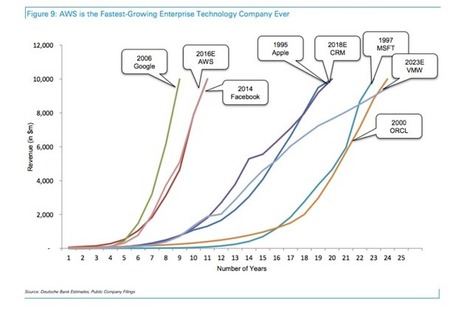
Most people think of Amazon as an online shopping store, but it's actually much more than that. Over the past 22 years, Amazon has turned itself into a $275 billion juggernaut that sells everything from cloud-computing services to its own hardware gadgets. It will even be making approx $10 Bn in revenue this year from its cloud computing enterprise services. These 17 charts show just how scary its business really is.
|
|
Scooped by
Philippe J DEWOST
March 23, 2016 1:33 AM
|
International cable group Altice has unveiled plans to use the network technology developed by Sigfox to support a range of Internet of Things (IoT) services in France and other markets. The strategic alliance promises to pit Altice against French rivals Orange (NYSE: FTE) and Bouygues Telecom in France's fast-developing IoT sector. (See Orange Hails LoRa Breakthrough as Bouygues Ups IoT Game .) Both Orange and Bouygues have announced IoT plans based around the use of LoRa, a rival to Sigfox in the market for so-called low-power, wide-area (or LPWA) network technologies. Owned by French-Israeli billionaire Patrick Drahi, Altice controls Numericable-SFR , France's second-biggest operator, as well as Portugal Telecom SGPS SA (NYSE: PT), US cable operator Suddenlink Communications and businesses in several smaller markets. It is also trying to finalize a $10 billion takeover of Cablevision Systems Corp. (NYSE: CVC), another US cable company. Altice initially appears to be focused on IoT opportunities in France, where Sigfox already claims to cover about 92% of the population with its network, but says it will ultimately bring Sigfox services to all of its markets, including Portugal, the US and Israel. Boasting that its 4G network was available to 64% of the French population at the end of 2015, Numericable-SFR is positioning Sigfox as a low-bandwidth "complement" to connectivity services based on 4G and WiFi technologies. Like LoRa, Sigfox is designed to support IoT services that require small amounts of bandwidth and more energy-efficient solutions. Market leader Orange claims that LoRa is about 15 times as energy-efficient as cellular technologies and that special LoRa lamps it has developed for use inside buildings are able to carry signals over a distance of one kilometer in rural settings. (See LoRa May Not Be for Long Haul at Orange.)
|
|
Scooped by
Philippe J DEWOST
March 18, 2016 5:08 AM
|
On the face of it, Orange has made a pretty strong commitment to LoRa, one of a crop of low-power, wide-area (or LPWA) network technologies designed to support more rudimentary Internet of Things (IoT) services. In November, the French incumbent revealed it was building a LoRa network in 17 of France's biggest cities and would gradually roll out the network on a nationwide basis thereafter. A few months earlier, its venture capital arm, Orange Digital Ventures, stumped up $3 million of the $25 million in funding then raised by Actility, a French company developing OSS and BSS functionality for LoRa deployments. (See Telcos Invest in IoT Tech Startup.) Yet Orange (NYSE: FTE) has acknowledged that LoRa is far from ideal. As an "open" technology, it holds strong attractions for the service provider over Sigfox, another LPWA technology that is fully proprietary. But this openness combined with LPWA's reliance on unlicensed spectrum is also problematic, admits Luc Bretones, the executive vice president of Orange's Technocentre-named product and design facilities.
|





















You better Watch this enjoyable JL Gassée feature :-)