
U.S. District Judge Stanwood Duval spoke for South Louisiana residents last week when he expressed frustration that there is no way to hold the Army Corps of Engineers legally accountable for levee failures during Hurricane Katrina.

 Your new post is loading...
 Your new post is loading...
Your new post is loading...
 Scoop.it!
U.S. District Judge Stanwood Duval spoke for South Louisiana residents last week when he expressed frustration that there is no way to hold the Army Corps of Engineers legally accountable for levee failures during Hurricane Katrina. 
No comment yet.
Sign up to comment
Scoop.it!
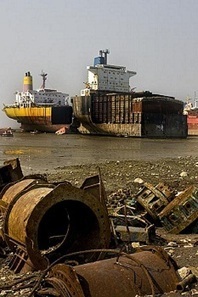
Plans to clean up the scrapping of old ships and ensure the materials are recycled in EU-approved facilities worldwide were backed by Parliament on Thursday.
PIRatE Lab's insight:
The EU failed to get this off the ground, but 299 to 292 votes, with 21 abstensions. I wonder who got paid to stay home that day?
Scoop.it!

UK - The Director-General of DG Mare, European Commission has revealed economists within the EC are finally winning the argument that policy decisions affecting European fisheries need to be based as much on economic evidence as they are on...
PIRatE Lab's insight:
Sustainable approaches to management go beyond ecology (although this should be the foundation).
Scoop.it!
PIRatE Lab's insight:
South Africa’s sub-Antarctic territory, the Prince Edward Islands, has had an enormous MPA declared.
Scoop.it!
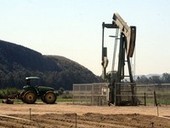
Anticipating that new drilling techniques will make it possible to tap vast oil reserves thought to be unrecoverable, a Los Angeles-based oil company has been aggressively securing mineral rights beneath thousands of acres of Ventura County land.
PIRatE Lab's insight:
Silly restrictions on tidal and wind energy production in coastal California have restricted what we can do for energy production from those sectors. But good old hydrocarbons are cranking ahead full steam. Excellent!
Scoop.it!
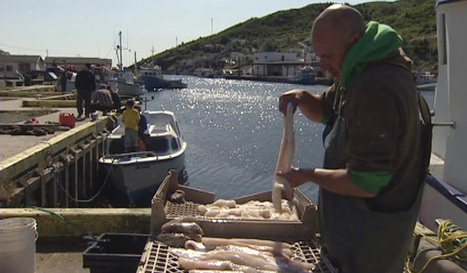
The recovery of overexploited fish populations such as cod has been slower than expected and many depleted stocks may never be able to bounce back, a new study says.
The study, to be published Friday in the journal Science, was compiled by researchers who examined 153 fish and invertebrate stocks from around the world.
Most fish species are resilient enough to recover within a decade if swift action is taken to reduce pressure on depleted stocks, the researchers say.
"But when you don't take action rapidly ... not only does it result in a much longer potential recovery time, but the uncertainty as to whether recovery will happen at all increases exponentially," said Jeff Hutchings, a professor of biology at Dalhousie University and one of the authors of the study.
Hutchings said that may explain why cod hasn't bounced back more than 20 years after Ottawa declared a moratorium on the commercial cod fishery, a once thriving Atlantic Canadian industry.
"Here we are two decades after enormous depletion of cod stocks... and people are still wondering about the prospects of recovery," said Hutchings. "Our study really suggests that recovery is quite unlikely now for cod because of our failure to act when we could have."
Hutchings said the federal government needs to set a population threshold that would determine when action must be taken to reduce pressure on a fishery.
He said legislation is needed to allow for depleted stocks to recover, as they have in the United States.
There, when a commercial stock is overfished, fishing ceases immediately and a plan must be put in place within two years to rebuild the stock within a decade, he said.
"Canada currently has no such requirements for recovery or rebuilding plans and we also do not have a legislatively required trigger for such action," he said.
"I would like to think that this kind of work would provide even more scientific incentive ... to come up with target reference points and rebuilding targets for all of our depleted fisheries."
Hutchings said this would not only be beneficial from a biological standpoint, but would also ensure food security and employment in the fishing industry.
Since the early 1960s, cod populations off the northeast coast of Newfoundland and Labrador have declined by more than 97 per cent and are now at historically low levels, according to the Department of Fisheries and Oceans.
The study looked at fish species including herring and yellowtail flounder whose populations had declined below their maximum sustainable yield, which is set by the United Nations Convention on the Law of the Sea.

Jessica Martel's curator insight,
April 25, 2013 8:48 PM
Creating bigger laws on the fisheries and creating bigger fishing restrictions in Canada, this may more effectivly solve the cod problem. Much like htey do in alaska with the salmon, if not enough salmon have returned from spawning they shut off fishing entirely to be sure the fish count stays at a safe level.
Scoop.it!
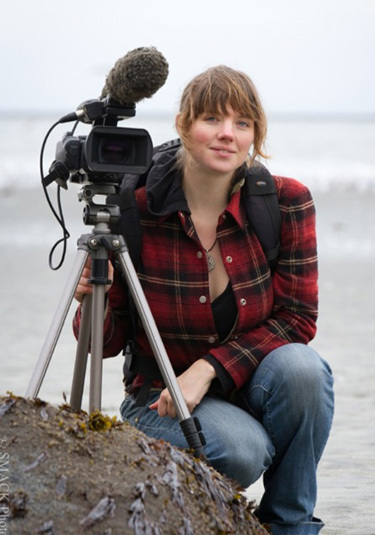
Biologist Alexandra Morton and filmmaker Twyla Roscovich are touring BC to promote their new film, Salmon Confidential.
The pair will bring their film to Tofino's Clayoquot Sound Community Theatre on Wednesday, April 17, at 7:30 pm.
Clayoquot Action is hosting the event and both Morton and Roscovich will be on hand to field questions from their audience.
In the film, Morton finds a connection between salmon farming and dangerous European viruses hitting BC's wild salmon population and struggles to bring this information to the public as the government tries to suppress the findings.
"It is critical that people hear what is happening to this essential fish and why. We don't have to be helpless bystanders as government tries to bury the evidence," Morton says through a recent media release.
"The careers of all who research these European viruses in BC are under attack, but disease in salmon cannot be a federal secret any longer if we want wild salmon to be here for our children,"
Throughout the film, Morton tracks viruses and circulates through BC courtrooms to remote rivers, to grocery stores and sushi restaurants on the Mainland.
The film's release lands with poignant timing in BC with a provincial election on the horizon.
"This whole nightmare could be over tomorrow and we could have the wild fish back if the next provincial leader commits to removing salmon feedlots from the wild salmon migration routes," says Roscovich.
"The people of BC should understand what we documented in this film and then they can let candidates know they will be taking wild salmon to the polls."
Morton says Tofino was included on the tour's schedule because it is a place of great natural beauty but also a salmon feedlot industry.
"It's very important, I think, for people in Tofino to know what they're hosting in their waters with this industry," she tells the Westerly News.
"I don't think people know the true extent of the damage and that's what my work is about; to let people really know what the facts are."
She says the film tour has been "amazing" with large audiences expressing concern and surprise over the seriousness of the situation.
reporter@Westerlynews.ca
Scoop.it!

The Cook Islands Ministry of Marine Resources is planning to introduce a self-imposed total allowable catch on tuna caught from longline fishing after the biggest haul on record was made last year.
At least 11,000 tonnes of tuna was caught in Cook Islands waters in 2012 and the secretary of Marine Resources, Ben Ponia, says the ministry is now in a position where it can move towards getting more value from the catches.
Mr Ponia says it plans to start issuing licences that limit vessels to a certain quota, which also must be within the framework of what is set as a total allowable catch.
“We’re only foreshadowing the trend that’s about to emerge and I think a number of countries are beginning to think about their own zone based allocations and so the fishing fleets will have to starting thinking quite seriously about how they are going to fit into that framework.”
Ben Ponia says future fishing quotas imposed by the Ministry will be implemented first in the bigeye tuna fishery.
He says the Ministry is also seeking a Memorandum of Understanding to enter a partnership with the Parties to the Nauru Agreement, which sets out rules for tuna purse seine fishing in the region.
News Content © Radio New Zealand International
Scoop.it!

Baku will host the 33rd meeting of the Commission on Sea bioresources of the Caspian Sea on April 24-25, Ecology and Natural Resources Ministry spokesman Irada Ibrahimova said on Friday.
The meeting will be held at the level of the heads of the ministries and committees of fisheries.
According to the agenda, the participants consider the embezzlement of fishing quotas, work done on artificial fish-breeding and protection of fish resources in 2011-2012, submit reports on the current status of fish stocks as a result of marine expeditions and scientific-researches, consider total allowable catch of aquatic bioresources in the Caspian Sea and its national distribution.
There are about 141 fish species registered in the Caspian Sea, and the main fishery in the region, the sturgeon fishery, is operated only with the Caspian Sea resources. Some 90 percent of the popular black and red caviar sold all over the world comes from the Caspian Sea.
According to the Iranian international scientific research institute, sturgeon fish stock, which is characteristic only for the Caspian Sea, has shrunk by 25-30 percent and if the situation does not change the population of sturgeon will perish in 2021.
In 2010, the presidents of the Caspian Sea states inked an agreement to stop fishing up sturgeon in the sea for a period of five years.
Sturgeon fishing in the Caspian Sea was allowed only for scientific research purposes in 2012. The decision was passed at a meeting of the water and biological resources commission with the participation of representatives Azerbaijan, Kazakhstan, Russia, Turkmenistan and Iran.
It is planned to construct a sturgeon breeding farm on the Caspian Sea shore with the subsequent processing and obtaining caviar in Turkmenistan by February 2015 official Turkmen source reported in January 2013.
The annual production capacity of the complex is expected to increase to 100 tons of sturgeon meat, two tons of sturgeon caviar, 40 tons of smoked fish and 10 million pieces of various kinds of canned fish.
The Framework Convention adopted in the Iranian capital in 2003 was the first legally binding regional agreement signed by all the five Caspian littoral states, laying out general requirements and an institutional mechanism for environmental protection in the resource-rich Caspian region.
Scoop.it!
The UN's International Court of Justice sets dates for public hearings on Australia's challenge against Japan's whaling programme in Antartica.
Scoop.it!
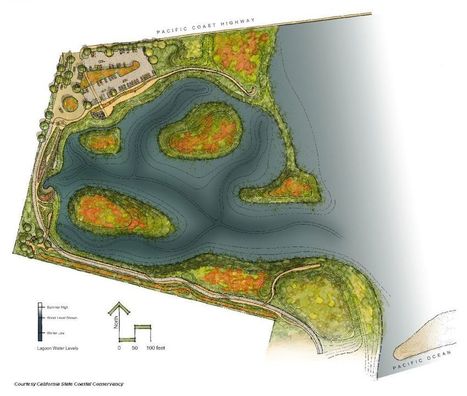
This page is primarily devoted to scenery at the lagoon, focusing on the 2012 Malibu Lagoon reconfiguration project and highlighting the process of change. SMBAS supports the project, but rather ...
PIRatE Lab's insight:
The official ribbon-cutting opening ceremony is free to the public on Friday, May 3 at 11am.
|
Scoop.it!
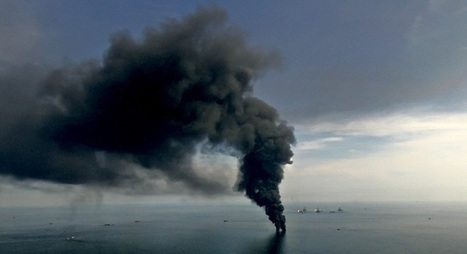
On April 20, 2010, a massive explosion and fire aboard the Deepwater Horizon oil drilling rig in the Gulf of Mexico, approximately 50 miles off the Louisiana coast, killed 11 people and prompted the largest offshore oil spill in American history.
PIRatE Lab's insight:
Be sure to check out the video at the top of the page. There is some "everything is okay" here, and lack of really dealing with the overall stressors of coastal erosion, an economy built on a non-renewable extractive resrouce, etc. But it is worth watching (and the insect videos) in any event.
Scoop.it!
The White House released a plan on Tuesday aimed at protecting oceans, coastal and Great Lakes environments around the United States while safeguarding related businesses that support more than 44 million jobs.
Scoop.it!
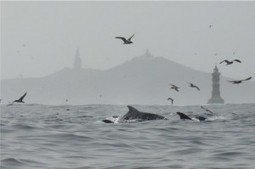
The coastal area of West Africa is historically known to be highly important for seabirds and migratory birds.
PIRatE Lab's insight:
It is key to make sure we conserve the entirety of the habitat needs of cirtters, not just their nesting/breeding grounds.
Scoop.it!
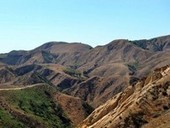
The Barnard family, which has owned land in Ventura County for six generations, is finding that the fruit they grow might not be as valuable as what is under the ground.
PIRatE Lab's insight:
"...criticism over fracking does not concern him. He is confident Vintage and other companies are taking every precaution..."
Scoop.it!
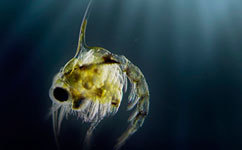
A sudden switch from herring to sardines in the English Channel in the 1930s was due to a long-term ocean cycle called the Atlantic Multidecadal Oscillation (AMO), an international study shows.
This is the first evidence linking the AMO to trends in important European fisheries.
The AMO is a 60- to 80-year cycle between warm and cold sea surface temperatures in the North Atlantic. There were warm periods from 1860-1890 and 1930-1960, and we are currently in another one that started in 1995.
"It's an important natural oscillation that's not always fully taken into account in climate models," says Professor Martin Edwards of the Sir Alister Hardy Foundation for Ocean Science in Plymouth, who led the study. "The AMO alternately masks and exaggerates the long-term rise in temperatures due to global warming, and helps to explain how the North Atlantic is warming faster than the global average in some areas."
The study, funded by the governments of the UK, Canada, Norway, the USA and Germany, compared data on sea-surface temperatures with measurements of plankton concentrations in the ocean since 1948, and historical records of sardine egg abundance and herring catches in the western English Channel and Norwegian Atlantic dating back to the 16th century.
They showed that the AMO was the second most important factor influencing the distribution of plankton in the North Atlantic, after the man-made global warming trend, and the most important factor affecting sardine and herring stocks to the west and north of the UK and Norway.
The English Channel represents the boundary between sardines, which prefer warm water, and herring, which prefer cold. In warm periods, the boundary shifts northwards, and in cool periods it retreats southwards.
The AMO's effects on herring, sardine and other fish are dramatic. During the 1930-1960 warm period, the weight of herring spawning in Norwegian seas increased by a factor of ten, while the herring fishery in the English Channel collapsed and was replaced a few years later by sardines.
At the same time, the cod fishery extended northwards by an extra 1000km along the coast of Greenland. During the subsequent cool period in the 1970s, the herring population in the Norwegian Sea fell from 16 million tons to just 50,000, but since the start of the next warming period in the 1990s it has recovered to 1960 levels.
"We were surprised to find such a strong effect," says Edwards. "We thought that global warming would override these other natural signals – although we do expect the global warming effect to dominate over the next 20-30 years." The results should help to improve the accuracy of climate models. It is difficult to disentangle the effects of the oscillation from the impacts of overfishing, though, because fishery statistics are poor, particularly from the past.
The AMO has important implications not just for fish and other marine life, but also for hurricane formation, the frequency of droughts in Africa and North America, and winter temperatures in Europe. The warm phase from 1930-1960 was associated with the Dustbowl drought in the mid-west USA, for example. Twice as many tropical storms mature into hurricanes during AMO warm phases.
The research team now plan to study the underlying mechanism driving the AMO, which may be linked to east-west movements of a cold-water current around Greenland and North America called the sub-polar gyre. They will study how the climate of northern Europe changes as the sub-polar gyre shifts.
Scoop.it!
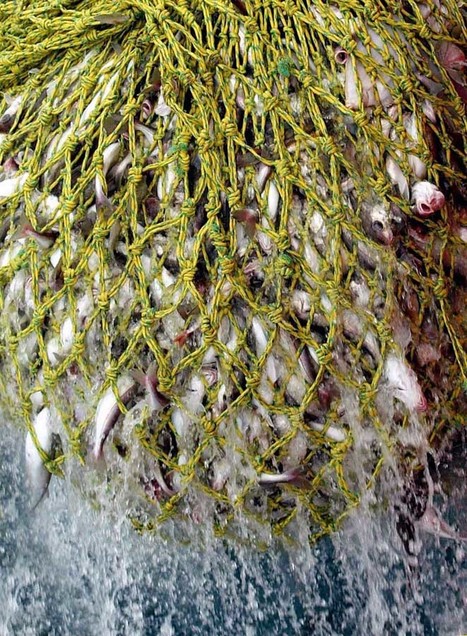
MEPs voted on Tuesday to adopt a ban on discarding unwanted fish of 35 species caught in the Skagerrak (between the North Sea and the Baltic). The ban, to take effect gradually between 2014 and 2016, would be enforced with a remote electronic monitoring system.
"On 1 November 2012 Norway denounced the international fisheries agreement of 1986 with the EU for the Skagerrak. Since Norway has a landing obligation for all catches, we need these new rules - but we also need them because the practice of discards is irresponsible," said Werner Kuhn (EPP, DE) after the vote.
Under the discard ban, fishing vessels would be obliged to land all caught fish in order to halt "discards" – the practice of throwing fish back into the sea, usually because they are of an unwanted species or size. Most discarded fish die, which is wasteful and aggravates overfishing.
Remote monitoring by CCTV
To enforce the discard ban, member states would be required to set up a remote electronic monitoring system to supervise fishing in the Skagerrak, which is bound by Denmark, Sweden and Norway.
For the system to work, boats over 12 metres long would have to be equipped with closed circuit TV (CCTV), GPS and transmitting equipment.
Financial aid for this should be granted from the European Maritime and Fisheries Fund, say MEPs, who also insist that the system should be automated and use image recognition software for better data protection.
Pilot scheme
Plans to ban discards in all EU waters were backed by Parliament in a vote on the new Common Fisheries Policy in February. Experience in the Skagerrak should provide useful lessons for this.
As a previous international agreement on fishing in the Skagerrak no longer applies, boats must abide by the rules of the state in whose territorial waters they are fishing. Harmonising the relevant EU and Norwegian laws should facilitate compliance.
The new measures will apply to all EU member states which have fishing rights in the EU part of the Skagerrak, i.e. boats from Germany, Belgium and the Netherlands, as well as Denmark, Sweden and Norway.
Next steps
European Parliament negotiators will now discuss the proposal with the member states in order to reach an agreement.
Procedure: Co-decision (Ordinary Legislative Procedure), 1st reading
REF. : 20130416IPR07335
Scoop.it!
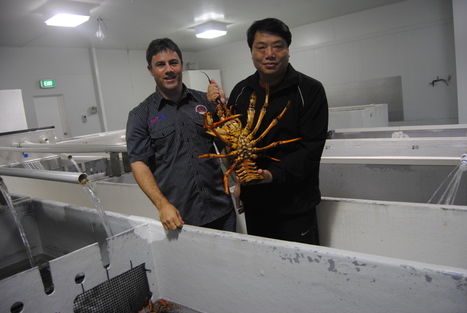
A GROUP of more than 20 business leaders from China visited Port Lincoln on Friday on a state-wide food buying trip worth more than $1 million.
The group visited Southern Water Marine Products and toured the factory, getting a taste of how southern bluefin tuna, rock lobster and prawns are processed before taking a look at Clean Seas' kingfish cages and meeting with various representatives from local fishing groups.
Primary Industries and Regions SA seafood account manager Glen Ingham said the delegation was interested in buying South Australian seafood for Chinese consumers in the Fujian Province.
He said a vision of the future was the construction of a five-star hotel in the Fujian Province that specialised in South Australian food and wine.
Deputy delegation leader Chen Xingfu said the group was very interested in Port Lincoln seafood because it came from a natural and clean environment.
"There is a high demand for seafood in China and to have it grown 100 per cent natural is very rare," he said.
"The main purpose of the delegation is to see what the product is and seeing the trading environment."
He said the delegation was particularly interested in Port Lincoln's southern bluefin tuna.
"We have heard for a long time the best southern bluefin tuna are from Port Lincoln.
"There is a very high demand for this high-end product in China."
Minister for Food and Fisheries Gail Gago said the buying group was the first from the Fujian Province to visit South Australia since the state government and the Fujian Provincial Government signed a Memorandum of Understanding (MOU) last year.
"This buying trip continues the commitment from businesses from the Fujian Province to South Australia and creates an exciting opportunity to generating millions of dollars worth of local food and wine exports over the next 12 months," Ms Gago said.
A number of journalists traveled with the group to Port Lincoln, which she said would lead to positive coverage for South Australia.
She said the group would also visit the Barossa Valley, McLaren Vale and Kangaroo Island.
"Opportunities are emerging in China as a result of the rapid spread of economic growth and development in second and third tier cities, as well as China's drive for improved quality of life for its citizens," Ms Gago said.
"The MOU is designed to enhance investment in South Australia in three ways; through increased exports of premium food and wine from our clean environment, in the exchange of agricultural technologies, and through collaboration in food safety research.
"The visit is about building trust between the Fujian delegation and local businesses.
"At the end of the visit the group will have forged strong relations with local companies, and plans will have been made for ongoing exports over the coming year."
Scoop.it!
A new study identifies countries most vulnerable to declining coral reef fisheries from a food-security perspective while providing a framework to plan for alternative protein sources needed to replace declining fisheries.
The study looked at 27 countries around the world and found two common characteristics: nations with low incomes that lack the ability to adapt to alternative protein sources; and middle-income nations with higher adaptive capacity but higher sensitivity to climate change. According to the analysis, Indonesia and Liberia were the most vulnerable countries to fisheries declines from a food security perspective, while Malaysia and Sri Lanka were the least vulnerable.
The study, which appears in the November issue of the journal Environmental Science and Policy, is authored by Sara Hughes, Annie Yau, Lisa Max, Nada Petrovic, Frank Davenport, and Michael Marshall of the University of California; Tim McClanahan of the Wildlife Conservation Society; Edward Allison of WorldFish Center; and Josh Cinner of James Cook University.
The authors say the results of the study should be a wake-up call for nations to begin enacting policies to promote alternative protein sources, either through land-based means such as growing beans and poultry farming, or increased aquaculture. Coral reef fisheries are expected to decline with climate change and other human caused disturbances.
"The study identifies countries where climate change is likely to be felt first by threatening people that depend on fisheries," said the study's co-author Tim McClanahan of the Wildlife Conservation Society. "These countries are priorities for developing adaptation actions before the effects of climate change undermine their ability to feed themselves. Some countries will be stressed by climate yet have enough capacity to make the adaptation, while others will not. Making them realize this early will save considerable human suffering in the future."
The Wildlife Conservation Society saves wildlife and wild places worldwide. We do so through science, global conservation, education and the management of the world's largest system of urban wildlife parks, led by the flagship Bronx Zoo. Together these activities change attitudes towards nature and help people imagine wildlife and humans living in harmony. WCS is committed to this mission because it is essential to the integrity of life on Earth.
Scoop.it!

A new 1,000-year Antarctic Peninsula climate reconstruction reveals that summer ice melting has intensified ten-fold and that most of that melting has occurred in the mid-20th century.
PIRatE Lab's insight:
No Surprise here.
Scoop.it!

BALI, Indonesia (AP) — All 108 passengers and crew survived after a new Lion Air jet crashed into the ocean and snapped into two while attempting to land Saturday on the Indonesian resort island of Bali, injuring up to 45 people.
PIRatE Lab's insight:
Don't fly Lion Air.
|