Your new post is loading...

|
Scooped by
DD
September 3, 2015 9:45 AM
|
The term “Little Red Book” in China may conjure up images of Red Guards shouting Mao slogans, but one tech startup is hoping to make today’s Chinese consumers associate it with something completely different: online shopping for overseas luxury goods.
Called Xiao Hong Shu (Little Red Book) in Chinese and simply “Red” in English, the company just raised over $10 million in its series B round and is riding on surging waves of demand for imported goods and social media usage in China. Its estimated 15 million users have been hooked to the cheaper overseas goods and community atmosphere.
Red provides its users with a platform to learn about and share shopping tips, deals, and experiences from their trips abroad. Users can browse through lists of the most popular brands for a category, and through products on brands’ exclusive pages. They can share pictures of products they have purchased, displaying them in a Pinterest-like interface with commenting and liking features.
|
|
Scooped by
DD
September 1, 2015 5:42 AM
|
Last year, L'Oréal launched an app called Makeup Genius to let women virtually try on cosmetics. Hold your smartphone up to your face like a mirror, and the face looking back might have deep red lips and dark eyes for the red carpet, or subtle shades for the office, depending on what products you choose. Even if you move around, the virtual makeup stays in the right places, like looking in a real mirror.
China has been a massive market for the app, bringing 4.7 million of its total 14 million downloads. That's partly because of the size of the country's internet population: 668 million people, with 594 million of those going online with mobile devices, according to official figures from the China Internet Network Information Center. And it's also because it allows curious young women to try out heavier makeup, which is still uncommon in China.
|
|
Scooped by
DD
August 10, 2015 4:56 AM
|
China's search engine market in Q2 2015 reached 19.22 billion yuan (US$3.09 billion), with an increase of 25.9% QoQ and 36.9% YoY according to Analysis Rese
In Q2 2015, Baidu accounted for 79.81% of the overall market share by revenues which excluded channels revenue; Google China 10.89%, Sogou 6.34%, and the others 2.96%.
|
|
Scooped by
DD
August 10, 2015 4:43 AM
|
Alibaba has added an English complaints option to it’s IP protection system TaoProtect, which will allow foreign companies to report counterfeit goods on their Tmall and Taobao platforms. It’s one of many recent changes that the e-retail giant has put in place to facilitate their global brand expansion – and avoid lawsuits.
Alibaba is presenting an increasingly global face, with a slew of new brand partnerships aimed at bringing foreign products to the Chinese market. Last week, they announced an exclusive partnership with 20 apparel brands including Zara and Timberland. The new products will be sold on Tmall, which has become Alibaba’s default platform for foreign products.
|
|
Scooped by
DD
August 6, 2015 11:36 AM
|
With a huge number of gray-market sellers on its Tmall and Taobao platforms, online e-commerce giant Alibaba has long been able to profit from Chinese consumers’ efforts to avoid high tariffs on luxury goods sold on the mainland. Now that the company is facing pressure to crack down on unauthorized sellers on its sites, it’s finding new ways to benefit from Chinese demand for lower prices through partnerships with international duty-free sellers.
Alibaba’s Tmall.hk recently teamed up with South Korea’s Shilla and Thailand’s King Power duty-free retailers to provide a service that allows online shoppers to buy items ahead of time and pick them up in the airport stores when they travel. They’re required to provide passport and ticket information when they buy the items online, and then present payment text messages to the stores to claim the items.
|
|
Scooped by
DD
July 24, 2015 11:29 AM
|
As Chinese consumers rely on their smartphones more than ever before for social media, shopping, and travel, the country’s internet users became even more “mobile-native” in the first half of 2015. According to a new report from the China Internet Network Information Center (CNNIC), 88.9 percent of all China’s 668 million internet users now connect through a mobile device. There are many reasons the luxury industry needs to take note of this trend. While one reason mobile usage is so high is the fact that it’s the only access to the internet some people have, another is the fact that China’s middle class and affluent are addicted to their smartphones. Apple, which was listed as the most popular “luxury” gifting brand by the Hurun Report this year, just posted 112 percent revenue growth in Greater China for the fiscal third quarter. While cheaper smartphone models are also selling like crazy, comparatively expensive Apple devices are a status symbol for a higher-earning crowd.
|
|
Scooped by
DD
July 10, 2015 4:48 AM
|
In its latest bid to capitalize on growing Chinese demand for luxury, Alibaba invested more than $100 million in online retailer Mei.com, which specializes in flash sales of luxury goods.
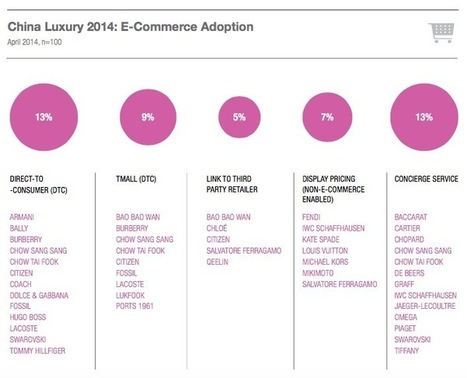
The e-commerce giant has struggled to attract international brands to Tmall – its previous foray into selling high-end products – due to the abundance of gray market and potentially counterfeit goods. Only 9% of the 100 brands featured in L2’s Digital IQ Index®: China Luxury had brand shops on Tmall. One of them was Burberry, which last year became the first foreign luxury brand to establish an official Tmall store. Few brands followed Burberry’s move, even with the added incentive of having control of their brand image on Tmall. After Burberry launched its shop, close to 6,000 lower-priced gray-market items were removed from the platform.
|
|
Scooped by
DD
July 10, 2015 4:35 AM
|
Chinese e-commerce titan Alibaba is trying to beef up sales ofluxury products, with an announcement that it will invest in luxury flash sale website Mei.com. The company said on Wednesday that it will invest an undisclosed amount in Mei.com, which peddles items like discounted Armani clothes, Tiffany jewelry and Shiseido cosmetics for a limited time to Asian consumers.
Alibaba will form a specialized service team to help Mei.com grow its user base and logistical services. The company is also seeking to complement its luxury product offerings on Tmall by cooperating with Mei.com, which works with more than 2,400 brands worldwide and counts brands such as Armani, Zegna, Michael Kors and Guerlain as partners.
|
|
Scooped by
DD
July 3, 2015 11:18 AM
|
Right now, the brands that are truly connecting with Chinese consumers are those that understand how their brand can fit into people's daily lives and schedules. It means giving customers the tools to communicate what they want, buy it anytime, obtain it without going too far out of their way, and share good experiences with their peer group — all while gaining face and looking and feeling like a smart consumer. For any truly savvy brand, this should be a global policy, not just a strategy for China.
Chinese consumers have already leapfrogged everything from voicemail to email, turning instead to WeChat to get both in a more efficient way. So, it's only natural that many are leapfrogging the traditional pathways for learning about brands and collections.
|
|
Scooped by
DD
June 29, 2015 11:13 AM
|
Accelerated by two key factors–an early leap to mobile and Chinese President Xi Jinping’s protracted anti-corruption crackdown–many Chinese consumers already expect brands to be both automated and humanized, responsive to their demands and efficient enough to get products to them quickly, discreetly, and cost-effectively.
Right now, the brands that are truly connecting with Chinese consumers are those that understand how their brand can fit into people’s daily lives and schedules. But what does this mean? It means giving customers the tools to communicate what they want, buy it anytime, obtain it without going too far out of their way, and share good experiences to their peer group–all while gaining face and looking and feeling like a smart consumer. For any truly savvy brand, this should be a global policy, not just a strategy for China.
|
|
Scooped by
DD
June 29, 2015 8:00 AM
|
For brands working to connect with Chinese tourists in the midst of their vacations, mobile internet is the way to go. According to a new report by Ctrip, travelers’ internet “addiction” goes beyond their intense preliminary research—it remains strong while they’re on the road.
The report notes that Chinese travelers are determined to access mobile internet even when traveling to countries with limited public WiFi. This is common knowledge for many airports, shopping malls, and boutiques worldwide, a growing number of which are providing free WiFi to push offers and promotions to Chinese visitors. (Whose first move when entering a store is often to check for WiFi. Because what is the point of overseas travel if you can’t brag about it on WeChat?)
|
|
Scooped by
DD
June 19, 2015 9:39 AM
|
When it comes to beauty sales in China, brands’ digital marketing and commerce strategies are becoming just as important as their brick-and-mortar sales—but few have a solid grasp on how to best reach their Chinese customers online.
According to digital marketing research firm L2’s recently released “2015 Digital IQ Index” for personal care in China, which ranks brands’ China digital prowess, only four brands can be described as “genius” for their digital strategies. Meanwhile, the majority of companies are “average,” “challenged,” or “feeble.”
|
|
Scooped by
DD
June 12, 2015 4:19 AM
|
L2 released this week the Digital IQ Index®: Personal Care: China, which emphasizes the importance of a strong mobile strategy in the region. Mobile’s share of e-commerce is expected to grow exponentially in the next few years. Close to half of online personal care purchases are expected to occur on a mobile phone this year, up from a third in 2014. By 2016, mobile spending is expected to surpass desktop.
QR codes – which never took off in the U.S. or Western Europe – are an important component of a mobile strategy in china. Of the 71 brands in the study present on Tmall, 68% enable QR codes for shopping the brand store online. Mobile-only discounting is another strategy to nudge consumers to complete the transactions on the spot, one that 48% of brands in the study have employed.
|
|
|
Scooped by
DD
September 3, 2015 9:30 AM
|
China’s vast online gray market, which has in recent years been powered by young shoppers purchasing in-demand items overseas and re-selling them to buyers within mainland China, has long been a headache for the world’s largest luxury and premium consumer brands. According to a report by Bain & Co., Chinese consumers made an estimated 70 percent of luxury purchases in 2014 either online (via third-party or daigou agents) or on trips abroad.
Meanwhile, the daigou market continues to grow despite efforts to crack down. Over the course of the last year, a handful of major players—among them Burberry and L’Occitane—launched official stores on Alibaba’s Tmall platform, after assurances that this move would see Alibaba rid the platform of gray market resellers. However, there are few signs that China’s vast daigou market, and its legions of consumers—who may live in far-flung rural or smaller urban areas that will probably never get a true luxury boutique—is fading.
|
|
Scooped by
DD
August 20, 2015 5:41 AM
|
Web culture is everything that we love at Labbrand: it’s chaotic, reactive and constitutes one giant laboratory for cultural innovation. It is a window into what’s going on in China that every brand should pay attention to. That’s why we bring you the keys to deciphering Chinese web culture with the “China Web Culture Digest”.
In this issue, we are bringing you some of the hottest online jargons in 2015.
|
|
Scooped by
DD
August 3, 2015 5:14 AM
|
As China remains the fastest-growing e-commerce market in the world, social media and mobile shopping are crucial shopping channels that will only get stronger with the next generation.
According to a recent survey by real estate consultancy CBRE, 45 percent of Chinese respondents said they buy online at least once a week, with those in third- and fourth-tier cities particularly prone to use online retail due to fewer brick-and-mortar options.
|
|
Scooped by
DD
August 6, 2015 11:37 AM
|
While many luxury brands across the world have embraced e-commerce wholeheartedly, some historic labels like Chanel and Hermès are holding out on selling their goods online for fear of cheapening their image. This may be a useful strategy for Europe and North America, but according to a new report by Exane BNP Paribas, high-end brands that aren’t online in China are losing out.
The results of the firm’s survey of over 5,000 Chinese luxury consumers find that “ostrich” brands—or those that are sticking their proverbial head in the sand when it comes to embracing the digital luxury market—need to “wake up” to the reality of the way Chinese luxury consumers shop.
|
|
Scooped by
DD
July 30, 2015 10:59 AM
|
Recognized as one of the top apps in the 2015 “Best of Mobile Insight Report” by digital intelligence firm L2, Tory Burch’s Tory Daily app is one of the best examples of how commerce-driving content can be global. The app has been downloaded 700,000+ times to date and is a daily destination for the majority of visitors to the Tory Daily blog. A third of traffic to the site comes from outside of the United States, with sizable groups of engaged users in China, Hong Kong, Brazil, Mexico, Canada, South Korea, Australia, Saudi Arabia, and Japan.
At the heart of Tory Daily’s success is a commitment to storytelling. Rather than simply promoting Tory Burch items, the blog has become a destination for curated lifestyle content with book reviews, artist interviews, lifestyle tips from the founder, and playlists. Further proof of the blog’s journalistic bent: Creative Director Honor Brodie, who oversees the blog, is a former Vanity Fairand InStyle journalist.
|
|
Scooped by
DD
July 15, 2015 8:49 AM
|
As Alibaba’s efforts to bring foreign luxury brands onto its Tmall platform have met with slow success, the e-commerce giant is planning to leverage a new $100 million investment in flash sales site Mei.com to introduce more premium labels to the site.
The “strategic investment” that was announced this week appears to include an understanding that Mei.com sales will be featured on Tmall. According to Alibaba CEO Daniel Zhang, the company hopes “that Mei.com will exert its advantages to create synergy with Tmall.com in providing more premium luxury goods to consumers.” Meanwhile, Mei.com founder Thibault Villet stated that “together with Tmall.com, we will bring premium and trusted genuine brands to consumers. In the future, we see a significant opportunity to provide enhanced shopping experiences for Chinese customers in search of affordable fashion and luxury products.”
|
|
Scooped by
DD
July 3, 2015 11:09 AM
|
Email rates are stagnant in China due to issues with email service providers, firewalls, and security. Part of implementing a global strategy is recognizing the best way to reach users in each country. In China, all signs point to WeChat, the highest source of internet traffic in the country with over half a billion active users, according to Tencent’s March 2015 report. WeChat’s foundation as a one-to-one mobile messaging platform makes it the ideal platform for marketers to replace email in China.
WeChat has a deep understanding of (mainly Chinese) consumer behaviors with a robust innovation cycle, continuing to impress users every time it launches new relevant features, such as WeChat payment (with Chinese New Year Red Envelopes), Shake to add friends, WeChat Moments, and more. With these popular functionalities and its consistent commitment to improve user experience, it is not surprising to see that WeChat has evolved to be the leading mobile platform in China–integrating social, commerce, service, and communication.
|
|
Scooped by
DD
July 8, 2015 9:51 AM
|
In just five years, the share of beauty and personal care products sold online in China has increasednearly sixfold. Today, 15 percent of the industry’s sales are now generated online—three times the penetration observed in other major markets. Online competence is no longer a differentiator for brands operating in the market, but table stakes.
Mobile, however, is the real competition arena for personal care brands. Close to half of online personal care purchases are expected to occur on a mobile phone this year, up from a third in 2014. And by 2016, mobile spending in China is expected to surpass desktop.
|
|
Scooped by
DD
July 1, 2015 5:48 AM
|
The European luxury industry has a China paradox.
“We Chinese demand discounts. We love discounts,” said Sir David Tang, at the 2015 Financial Times Business of Luxury Summit in Monaco on June 9. The Hong Kong entrepreneur, restaurateur, raconteur, and founder of fashion label Shanghai Tang said, “Loyalty equals a discount for Chinese shoppers. Give them a discount and they will feel special. They will be loyal.”
And herein lies the paradox. Nothing matters more to European luxury than protecting a brand’s heritage. The word “discount” makes a luxury CEO go weak at the knees. Equally, there’s nothing the Chinese consumer values more than a handbag bearing three little words: “Made in France”—and a price tag that assures them they’re buying the best on the planet.
|
|
Scooped by
DD
June 29, 2015 8:04 AM
|
In 2015, China mobile social networking users will reach 335.9 million with an increase of 20.7%, estimated by eMarketer. Besides, the number will continue grow and by 2019, users will exceed 480.4 million, representing 34.8% of total population.
|
|
Scooped by
DD
June 26, 2015 8:46 AM
|
As China’s online shoppers gain easier access to goods shipped from abroad, e-commerce giant Alibaba is working to stay ahead of the curve with the introduction of new international shopping option on its B2C platform Tmall.
|
|
Scooped by
DD
June 17, 2015 4:11 AM
|
For Personal Care brands in China, online competence is no longer a differentiator but table stakes, as noted in L2’s new Digital IQ Index® for Personal Care brands in China. In five years, the share of Beauty & Personal Care products sold online in China has increased nearly six-fold, and 15% of the industry’s sales are now generated online. This is three times the penetration observed in other major markets.
|