Your new post is loading...

|
Scooped by
DD
November 12, 2015 9:12 AM
|
A host of retailers are working with Dealmoon.com to get in on the largest Chinese shopping day of the year.
Although lesser-known in the United States than Black Friday and Cyber Monday, Singles’ Day’s $9 billion revenue last year made it the largest shopping day of the year for the second time in a row. Getting in on the “celebration” will give the retailers clear spikes in sales for the day and could help position them better to global markets.
|
|
Scooped by
DD
November 6, 2015 4:30 AM
|
11 November – next Wednesday – will be Singles’ Day in China. Originally a date popular amongst young people in mainland China celebrating being single (an anti-Valentine’s day, if you will), Single’s Day has more recently become Chinese e-commerce giant Alibaba’s world-famous annual online shopping frenzy. Last year, Alibaba pulled in a record-breaking US$9.3 billion from the 24-hour shopping spree.
The day’s excitement has now extended beyond Alibaba’s own shopping platforms Taobao and Tmall and permeated virtually every major e-commerce platform in mainland China. It’s a blockbuster opportunity for brands and retailers both domestic and foreign. Let’s take a look at how brands can take advantage of Single’s Day. Brands should note the following.
|
|
Scooped by
DD
November 6, 2015 4:21 AM
|
Macy’s first entry in the to the Chinese market – a Tmall store – went live this week. In a short Q&A, L2’s Head of APAC Danielle Bailey discusses Macy’s expansion plans and probability of success.
|
|
Scooped by
DD
November 3, 2015 5:44 AM
|
At Café Ruhe in Beijing’s swish Shuangjing district, a small placard is glued to the table in front of each seat. “Order So Easy,” it says.
Next to the text is printed a black and white code. Barely bigger than a postage stamp, it’s a portal to a new world flourishing in China, where a wave of innovation has created new ways of doing business on phones that has eclipsed Western rivals. In the process, it has turned on its head much of what has long been thought about China. In this space, no longer are Chinese entrepreneurs copying others. Now, others are copying China, as the country seeks to build Internet commerce into a new platform for growth in a slowing economy.
|
|
Scooped by
DD
October 27, 2015 6:07 AM
|
A diner eats with a group of friends and splits the check by sending a QR code out to his party — each of whom can automatically pay their portion of the bill with the tap of their phones. That same diner can use that very same app to buy movie tickets after dinner — and then hail a cab home at the end of the night. That’s not all, either. The same single app lets him create a pair of custom Nikes, send an order to the nearest Starbucks, browse Burberry’s latest runway collection, count the number of steps he takes each day, plan a family vacation, upload and share photos with friends, order delivery, host a conference call and keep up with the news.
While such an app sounds implausibly futuristic, for WeChat’s 600 million monthly users, the seamless experience is a daily fact of life. WeChat, founded by Tencent in 2011, has built an infrastructure for mobile commerce within the walls of a singular app, simultaneously catering to the mobile-first consumers of China and solidifying its leadership in the same market, one that far outpaces the U.S.
|
|
Scooped by
DD
October 26, 2015 9:40 AM
|
Tencent Holdings Ltd. will charge the users of its popular messaging mobile application a fee for spending and money transfers totaling more than 20,000 yuan per month, an employee of the Internet giant says, but smaller amounts friends send to each other as gifts will still remain free.
Users of the app known as Weixin and WeChat will be charged 0.1 percent for spending and transfers over 20,000 yuan per month, the source said. He said on October 21 the company made the change on October 17.
|
|
Scooped by
DD
October 14, 2015 4:30 AM
|
A previous L2 Daily posts discusses how WeChat has yet to prove that it has scalable reach. But L2 research on spending suggests Beauty and Personal care conglomerates are looking at this platform as the next “must-win” for brands. Beauty brands have especially invested in sophisticated WeChat accounts: Fifty-three percent of the 100 Beauty brands tracked by L2 have invested in WeChat Commerce and 60% have integrated loyalty programs with the app. Procter & Gamble, L’Oréal, Shiseido and others are actively posting on WeChat, with Estée Lauder Companies and L’Oréal in the lead for engagement.
|
|
Scooped by
DD
October 9, 2015 9:43 AM
|
Founded just over four years ago, WeChat is winning the game of numbers in China. Its monthly active users have surpassed Sina Weibo by a multiple of three (600 vs. 211). However, in terms of a platform where brands can engage users, Sina Weibo is still winning, and by far. The average Sina Weibo post from a personal care brand reaches 212x the number of users than a post on WeChat, and the average Beauty brand post on Sina Weibo has 52x the reach of a WeChat Post from a Beauty brand.
|
|
Scooped by
DD
September 29, 2015 4:25 AM
|
Despite the hype about influencer marketing, not all social media stars with a large following are created equal. Different mini-celebrities give different boosts to brands, based on their following, how often they are willing to name-drop a brand, and timing. L2 analyzes the impact of Weibo influencers Gogoboi and Shu Pei Qin on Tommy Hilfiger and Louis Vuitton.
Instead of spending time on YouTube, Facebook, and Twitter, Chinese consumers share and follow content on microblogging sites (BBS), Weibo and increasingly WeChat. In May, Tommy Hilfiger enlisted model/influencer Qin, which led to spike in absolute engagement for the brand.
|
|
Scooped by
DD
September 18, 2015 9:21 AM
|
As fake high-end alcohol remains a rampant problem in China, Rémy Martin is the latest of several high-end alcoholic beverage companies using high-tech solutions to fight counterfeits. As Chinese consumers shell out money for brand-name alcohol, many are duped by counterfeiters using fake labeling or even refilled bottles. Online Chinese retailers such as Alibaba have been facing pressure from consumers and the government over the massive amount of fake items in the underground daigou market, which is worth billions.
In order to combat this problem, Cognac-seller Rémy Martin collaborated with Selinko, an anti-counterfeiting service, to produce a smart bottle, which works in conjunction with mobile phones. Available in China this fall, the bottle uses near field communication (NFC) tags to verify the bottle’s authenticity and whether or not it’s been opened via a mobile app.
|
|
Scooped by
DD
September 14, 2015 3:37 AM
|
While Alibaba’s anticipated flood of international luxury fashion brands flocking to Tmall has been more of a trickle in recent years, the Chinese e-commerce behemoth and its competitor JD.com may make more headway in getting high-end brands on their platforms in another way—through international department stores and duty-free giants.
This week, JD.com announced that it’s teaming up with major South Korean retailer Lotte, which will sell fashion and beauty products on the JD Worldwide platform through the site’s “Korean Mall.” The announcement comes not long after Alibaba revealed earlier this month that it will be teaming up with South Korean duty-free retailer Shilla as well as Thailand’s King Power duty-free shops to allow users to reserve goods online before they travel so they can quickly pick them up in-store when abroad.
|
|
Scooped by
DD
September 8, 2015 6:54 AM
|
E-Commerce in China is developing rapidly among which cross-border E-Commerce is booming at an amazing speed. "One Belt one Road" Cross Border E-Commerce Cooperation is one of the main topic that was debated today in the World Business Leaders Rountable in Xiamen (China). I participated as guest speaker on behalf of COACH with the topic : Role of E-Commerce in Luxury Retail Development Strategy in Greater China. I think it was important to present a Brand perspective around all other B
|
|
Scooped by
DD
September 3, 2015 9:47 AM
|
British luxury leather brand Mulberry is looking to woo Chinese shoppers—and lovers—today in its mobile-led marketing campaign for Qixi Festival, or Chinese Valentine’s Day. Called “Mulberry Love Letters,” the O2O campaign allows Chinese people based all over the world to send heartfelt messages over WeChat that, with the help of digital marketing firm Hot Pot Digital, Mulberry transforms into a custom image for the recipient.
To then bring people into their stores, Mulberry has promised a selected number of recipients a chance to take their digital love letter into one of the participating shops in Shanghai, Beijing, London, Paris, New York, and Toronto to receive a handcrafted leather bracelet that can be personalized.
|
|
|
Scooped by
DD
November 9, 2015 12:03 PM
|
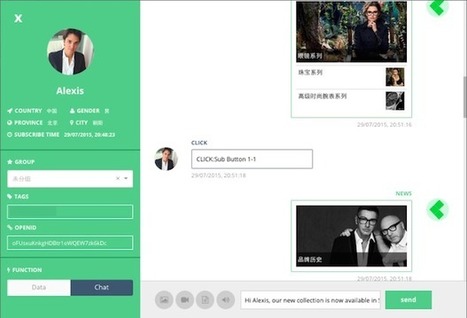
CRM and social media have been, for a while, antagonist topics for marketers and digital specialists. Traditionally, the value of a customer is defined by financial segmentation. You purchase X USD/RMB worth of items a year, you are a VIP customer. You don’t, you are a regular customer. This mantra more or less worked for decades, until the digital and mobile revolution illustrated by WeChat in China (or Kakao, Line, and WhatsApp elsewhere) changed the game and the way consumers interact with one another. Closed messaging-app platforms have surpassed public social media platforms (Weibo, Renren, Facebook, Twitter), forcing companies to adapt themselves to a new ecosystem.
|
|
Scooped by
DD
November 6, 2015 4:27 AM
|
Singles Day is a consumer holiday in China and the world's biggest online shopping day of the year. Last year, Chinese consumers spent almost £6bn online through Alibaba stores alone in just 24 hours. Singles Day takes place every year on November 11.
Known in China as "bare sticks holiday", because of how it looks numerically, Singles Day began as an anti-Valentine's Day in the 1990s when students started celebrating their singledom. In 2009, Alibaba – the Chinese online shopping platform that is now one of the world's biggest retailers – spotted a commercial opportunity in this celebration of singlehood. It was also a chance to boost sales in the lull between China’s Golden Week national holiday in October and the Christmas season.
|
|
Scooped by
DD
November 3, 2015 9:42 AM
|
China’s e-commerce retail sales are expected to increase by 42.1% to US$672.01 billion, accounting for over 40% of the global e-commerce retail sales in 2015 estimated by eMarketer. The e-commerce market in 2018 is expected to reach US$1.57 trillion according to eMarketer. China has become the world’s largest e-commerce market.
With the development of mobile networks, mobile commerce market is booming in China. Although smartphone market in China is saturating, the smartphone penetration is expected to reach 38.6% this year.
|
|
Scooped by
DD
October 29, 2015 9:32 AM
|
This week Facebook launched Message Requests, a replacement for the Other Inbox that lets users contact strangers using only their names. Like other recent updates such as a dedicated shopping feed, the feature testifies to Facebook’s ambition to replace traditional means of communication and commerce: who needs to search for a phone number when you can just type a person’s name?
However, while Facebook continues to roll out groundbreaking features, its messaging service has yet to rival the power of WeChat. The Chinese platform has created a vast ecosystem for everything from messaging to online shopping, taking advantage of the country’s thriving mobile commerce market. With 600 million users, it’s swiftly gaining on Facebook Messenger.
|
|
Scooped by
DD
October 26, 2015 10:39 AM
|
There are different ways to look at branding and it is certain that I have a very different one.
It is fascinating to imagine the journey of a brand that starts with an idea from an entrepreneur. Personality, interests, and environments bring to life ideas, leading to a project and the first version of a brand, followed by ongoing cycles of brand innovations. Brands tend to be perceived as intangible, but the whole process of branding is definitely chemical, physical, and biological: even the slightest brand association is supported in our brain by dozens of neuronal links and is constantly shaped and reshaped by our experiences!
|
|
Scooped by
DD
October 15, 2015 5:34 AM
|
Alibaba Group Holding Ltd. will open offices in three European countries and expand further in the U.S. as it seeks to revive growth and reassure jittery investors. China’s biggest e-commerce operator will enter France, Italy and Germany within the next few months, President Michael Evans said at Alibaba’s headquarters in Hangzhou Tuesday.
With a slowing domestic economy, Alibaba is stepping up its global ambitions to turn around investor sentiment battered by a $117 billion slide in market value since November. With less than a month until Singles’ Day, the busiest shopping promotion on the Chinese calendar, the company is looking to lure global merchants to sell to the country’s rising middle class.
|
|
Scooped by
DD
October 12, 2015 4:05 AM
|
While many historic global luxury brands remain hesitant to embrace e-commerce as they strive to maintain their traditional heritage, Chinese luxury consumers show no such reluctance as they increasingly head online for their high-end shopping fix.
According to KPMG’s annual “China’s Connected Consumers” report released this week, Chinese luxury shoppers are showing rapidly growing demand for purchasing online. According to a survey of more than 10,000 online Chinese luxury shoppers, the average respondent’s spending went up 28 percent from last year for an average of 2,300 RMB (US$362) per transaction. In addition, they’re showing a willingness of between 75 and 95 percent to shop for most categories online with massively increased confidence in spending. Consumers said they would feel comfortable spending a maximum of 4,200 RMB online this year, a 121 percent jump from last year’s 1,900 RMB.
|
|
Scooped by
DD
September 29, 2015 4:49 AM
|
Swiss watchmaker Tag Heuer is giving Chinese consumers the opportunity to buy its timepieces directly online with the opening of its first ecommerce flagship.
Created as part of an exclusive agreement with JD.com, the leading direct sales site in China, the brand now has a branded boutique within the multi-brand marketplace, which will sell items designed specifically with Chinese clientele in mind. Chinese consumers often feel more comfortable shopping for luxury goods through a platform they are familiar with, which may help Tag Heuer convince them to buy online.
|
|
Scooped by
DD
September 24, 2015 6:11 AM
|
While most European luxury brands are wary of agreeing to sell their goods on mass-market Chinese e-commerce platforms, Milan Fashion Week’s organizer is embracing e-tail giant JD.com with a high-profile new partnership.
The Camera Nazionale della Moda Italiana chose the day before Milan Fashion Week’s start to announce its new deal with the Chinese e-commerce company, which will feature the launch of an “Italian Fashion Mall” on JD.com this Sunday. Called “Fashion Shiner,” the partnership also includes the Milan-based fashion school Europe Design Centre and will promote both Italian fashion and design products.
|
|
Scooped by
DD
September 16, 2015 12:21 PM
|
While it may be a no-brainer for retailers around the world that accepting UnionPay cards can enhance the Chinese customer experience, it pays to be up-to-date on the next frontier of Chinese payment methods.
Last week, Japanese department store Daimaru Matsuzakaya announced that, starting September 30, Chinese travelers will be able to pay for items with a quick mobile phone scan through WeChat payment. The adoption of the new Chinese payment method comes after the store saw its sales volume more than quadruple from March to August as a result of Japan’s massive Chinese tourist influx.
|
|
Scooped by
DD
September 14, 2015 3:32 AM
|
As Apple continues on its quest to up the fashion quotient of its Apple Watch, the brand’s newly announced partnership with luxury brand Hermès could give the wearable gadget what it needs to take off Apple’s most important market for the future—China.
This week, Apple unveiled that its new Apple Watch collection will feature bands crafted by Hermès in a move that marks the first instance the electronics brand has ever collaborated with a luxury label. The watch will be available starting October 5 at both Apple stores and Hermès boutiques across the world, including in China. The partnership was described as “a great marketing coup” by Luca Solca, the head of luxury goods at Exane BNP Paribas, who wrote in an investor note that the new watch “attracts consumer interest, and provides a ‘cool’ spin on what was so far a ‘geek’ product.”
|
|
Scooped by
DD
September 3, 2015 9:25 AM
|
As a powerhouse of the global digital economy, China is an opportunity that United States companies cannot ignore. Consumers there have embraced online retail, creating a market worth $450 billion, and they are now jumping into the sharing economy, too. Even so, the digital revolution is only just beginning, with a middle class that is set to swell to 650 million by 2020.
Innovative peer-to-peer platforms such as Uber, Airbnb and Coursera, and pure-play ecommerce retailers including Gilt Groupe, Net-a-Porter, Revolve Clothing and Shopbop are already making great strides in China. But many other U.S. companies are struggling.
|