Your new post is loading...

|
Scooped by
DD
April 18, 2016 6:03 AM
|
Luxury brands including Fendi, Dior, and Marc Jacobs may not have official shops on Tmall, but China’s fashionistas can now easily find them on the platform’s newly launched “Luxury Channel” created in partnership with flash sales site Mei.com.
Yesterday, the two companies held a star-studded, high-tech runway extravaganza in Shanghai to promote the new channel. Celebrities on hand for the festivities included reality star and socialite Olivia Palermo and singer Li Yuchun (Chris Lee), and the event was live-streamed on Tmall and Youku. Users watching online had the opportunity to purchase any of the 42 looks from the new platform in real time. Selected from 80 designers featured on Mei.com, the looks included brands such as Karl Lagerfeld and Moschino, with one styled by Olivia Palermo featuring pieces by Saint Laurent and Chloe. In order to capture viewers’ attention, the show also hosted a singing performance by pop star Tia Ray, while actor Yilun Sheng walked the runway in one of the outfits.
|
|
Scooped by
DD
April 14, 2016 4:43 AM
|
Thanks to China’s e-commerce boom, the country’s package-delivery business has been growing at 30 percent a year. On the most recent Single’s Day—an online buying fest that takes place every November 11—consumers ordered 680 million packages, across all Chinese websites, that needed delivery.
That’s good news with a nagging downside: growth is eroding margins for many e-commerce players as they struggle with the basics of moving so many goods. Alibaba, for example, has slated $16 billion for future logistics investments, both to increase its market reach and to improve the reliability and speed of delivery. (Alibaba owns T-mall, which sold $150 million in merchandise in just over a minute during Singles Day 2015 and ended it with more than $13 billion in total sales.)
|
|
Scooped by
DD
April 13, 2016 4:13 AM
|
The Mall of Emirates in Dubai, United Arab Emirates is making shopping easier for Chinese consumers visiting the destination with the launch of a visitors’ application.
Mall of Emirates’ mobile app was designed with Chinese consumers in mind and offers a simple, easy-to-navigate guide to Dubai’s “shopping resort.” With a roster of more than 630 international brands operating stores within the Mall of Emirates, an app will help Chinese tourists make the most out of their experience and ensure decent foot traffic to leading labels within the mall.
|
|
Scooped by
DD
April 11, 2016 5:14 AM
|
China‘s track record for economic growth has been impressive in the last several decades, with China accounting for up to one-third of global growth in recent years.
However, China is slowly transitioning from a manufacturing-reliant economy to one focused more on services, with the service sector accounting for 46 percent of GDP in recent years, doubling its size over the last two decades.
|
|
Scooped by
DD
April 1, 2016 5:08 AM
|
To celebrate the launch of a new flash sales luxury channel partnership, Mei.com and Alibaba Group hosted an interactive fashion show in Shanghai on Wednesday night.
The red carpet featured celebrities from abroad, including Olivia Palermo, who styled one of the runway looks, as well as Chinese singers Chris Lee and Tia Ray — with the latter performing a few numbers during the show. Several hundred VIP clients and customers of Mei.com and Alibaba’s TMall, along with China’s fashion media, attended the event, held at the former site of Shanghai’s 2010 World Expo. The show featured looks from Mei.com styled to represent the fashion ethos of the world’s four major style capitals — London, Paris, New York and Milan.
|
|
Scooped by
DD
March 22, 2016 4:38 AM
|
Despite concerns about economic growth, the country’s consumers keep spending. Yet our latest survey reveals changes in what they’re buying and how they’re buying it.
Cooling economic growth, a depreciating currency, and a gyrating stock market are making political and business leaders concerned that China’s economic dream may be ending. Yet Chinese consumers remain upbeat. In fact, consumer confidence has been surprisingly resilient over the past few years as salaries have continued to rise and unemployment has stayed low.
|
|
Scooped by
DD
March 7, 2016 10:34 AM
|
While fake luxury goods have been causing a headache for brands across the world for decades, they’ve been especially problematic in China, where both cheap knockoffs and high-quality imposter items are easily available. This problem certainly hasn’t gotten any better as the country’s e-commerce market has taken off, bringing not only growth opportunities for legitimate brands, but also a wider available of counterfeit items than ever.
Jing Daily’s new report released this week, “China’s Online Gray Market and Counterfeits,” looks at the main causes and effects of the rampant proliferation of counterfeit luxury goods online in China based on experts’ analysis. In addition, it provides advice for brands on the best ways to respond to China’s massive online counterfeit boom. Below are a few things brands can do to hit back at online counterfeiters:
|
|
Scooped by
DD
February 24, 2016 4:20 AM
|
The Chinese New Year frenzy may have died down, but some luxury brands haven’t missed a beat when it comes to marketing in the weeks following the holiday. Lunar New Year ended with Valentine’s Day, a holiday that, while not as widely celebrated in China as Singles’ Day or Chinese Valentine’s Day, is one lucrative enough that brands like Tiffany & Co. embrace it. Since January, the jewelry company has been gathering opinions from Chinese followers on its WeChat account about the meaning of love as part of its international Valentine’s Day campaign that interprets the phrase made famous by that 1960’s comic strip, “Love Is…”
|
|
Scooped by
DD
February 22, 2016 4:37 AM
|
With an optimistic plan to take on entrenched Chinese mobile payment rivals, Apple Pay made its move into mainland China on Thursday this week in hopes of making the country its biggest market.
While some experts doubt the prospects of Apple’s high-tech payment system to compete with local giants including Alipay and WeChat, luxury retail is taking notice of the method. On the date of Apple Pay’s launch, Lane Crawford announced that all of its mainland China locations will offer Apple Pay, making it one of the first retail locations in the country to offer the service. “Offering Apple Pay as a payment option to our customers is another important step towards an even stronger connected commerce strategy, constantly evolving and leveraging on the digital and mobile world which is vitally important in Asia,” said Lane Crawford President Andrew Keith in a press release.
|
|
Scooped by
DD
February 16, 2016 5:48 AM
|
Coinciding with Lunar New Year, U.S. fashion label Michael Kors is launching its first campaign on popular Chinese social photography application “in.”
On the app, the brand has created a series of stickers depicting a cartoon monkey on a world tour as well as popular handbag styles, which “in” users can add to their photos before sharing with family and friends. According to Michael Kors, this is the first time a luxury fashion brand has partnered with “in,” giving the label visibility on a widely used platform during the important shopping holiday.
|
|
Scooped by
DD
February 10, 2016 4:52 AM
|
Kate Spade is bringing Chinese shoppers onto cobblestone lanes with its stylish models—virtually, that is, with the help of its Spring Festival WeChat campaign. The brand has stepped up the usual text and pictures micro-blog experience by taking a high-tech route that shows off its monkey-themed accessories when users shake their smartphones.
The Chinese-language app’s home screen features nine tiles, three of which are spades, symbols of the brand, and six of which feature select items from Kate Spade’s Chinese New Year collection. These include a cute, cowhide crossbody monkey bag, along with red handbags and a red lace dress. Clicking on a tile that features an accessory opens up a new screen that shows a model on an urban street corner (seemingly not in China) wearing the accessory.
|
|
Scooped by
DD
February 1, 2016 4:35 AM
|
Line, the Asian messaging app company known for its cute animated stickers, is developing a digital butler service as it bids to boost its revenue with standalone apps and services.
A source inside Line, who declined to reveal their identity because they are not authorized to talk to press, told TechCrunch that the digital butler will launch in Thailand in February, after which the initiative may expand to other countries if it shows promise. Line, which is based in Japan but owned by Korea’s Naver group, has placed priority on monetizing its userbase —currently 215 million monthly active users — and expanding its presence in ‘winnable’ parts of Asia, over making gains in Europe and the U.S. as it had done before.
|
|
Scooped by
DD
February 1, 2016 3:32 AM
|
Uber is hoping to squeeze more money from users in China after it announced a tie-in with Alibaba’s Alipay that will enable Uber China customers to pay their fare using the payments service when they are overseas.
Alipay and Uber China first partnered to cover domestic rides in 2014, but now the duo are tapping into the huge market for Chinese tourism and business travel. Initially the partnership goes live in Hong Kong, Macau, and Taiwan — three hotspots for travel during the upcoming Chinese New Year — but Uber China said the agreement “will be extended to more regions around the world during the year”.
|
|
|
Scooped by
DD
April 18, 2016 4:18 AM
|
With the most Internet users of any country, China is the world’s largest and fastest-growing e-commerce market. Capitalizing on opportunities, however, is becoming harder for consumer-facing companies as e-commerce penetration rates plateau in high-tier cities and as digital attackers, especially in the online-to-offline space, cut into incumbents’ margins.
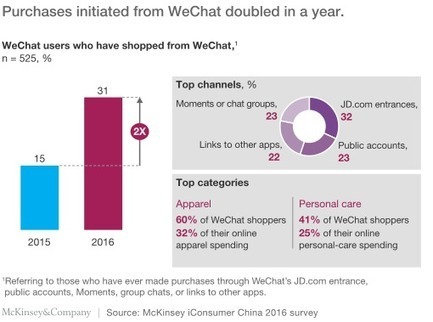
According to McKinsey’s latest survey of China’s Internet users, promising sources of e-commerce growth are emerging. The research points to areas with major growth potential: the uptake of online shopping among consumers in low-tier cities, e-commerce penetration beyond first-mover product categories such as apparel, purchases initiated from social media platforms, and the use of cross-border shopping to supplement domestic channels.
|
|
Scooped by
DD
April 14, 2016 3:59 AM
|
Alibaba Group Holding Ltd. will be the first Internet retailer to become a member of the largest nonprofit global organisation that fights counterfeit products and piracy, part of the Chinese company’s effort to shed its image as a haven for cheap brand knockoffs.
The company has joined the International AntiCounterfeiting Coalition, which unveiled a new type of membership for “intermediaries” such as online marketplaces where counterfeits — everything from headphones to designer purses and sports memorabilia — can flourish. Alibaba reaches more than 400 million online shoppers in China, mostly through its Tmall and Taobao sites.
|
|
Scooped by
DD
April 11, 2016 5:31 AM
|
Living in a world of only Chinese apps—no Google, Facebook, Twitter!—made me appreciate how remarkable the country's Internet actually is.
|
|
Scooped by
DD
April 5, 2016 2:14 PM
|
China wants its shoppers to buy luxury goods at home, not abroad.
China is raising fees on packages ordered from abroad and cracking down on smugglers who carry in suitcases full of luxury goods, in a concerted effort to encourage shopping at home and squeeze a grey market that shoppers use to avoid tax.
|
|
Scooped by
DD
March 22, 2016 4:50 AM
|
China's consumers are ignoring the bears. Consultancy McKinsey & Co. is tipping that China's shoppers will increase their spending by 10 percent per year through the end of the decade as incomes rise. Some 55 percent of consumers expect a significant wage increase over the next five years.
It's not just staple goods that will be filling the shopping trolleys. Consumers are spending more on luxury items like spa visits, travel and entertainment. The shift is just another sign of China's economy changing away from one that is fueled by heavy industry and exports and towards one where consumers and services drive growth.
|
|
Scooped by
DD
March 16, 2016 5:20 AM
|
Over the past few years, China's outbound tourism industry has been booming and continues to grow at an impressive rate. Just last year alone saw up to 109 million outbound Chinese travellers and this is predicted to reach over 230 million by 2020. Chinese today increasingly do their luxury purchasing abroad.
On top of this, the general attitude and habits of Chinese consumers have also evidently changed with most people being mobile driven in China. Up to 98% of all consumers in China own a smartphone (exceeding 1.3 billion users), and 90% of Chinese luxury consumers use WeChat. Their dependence and reliance of their mobile phones also far surpass people from other countries.
|
|
Scooped by
DD
February 29, 2016 3:48 AM
|
As incomes have risen in China, its consumers have stepped up their purchases of imported goods. But now, impatient for the latest products and better prices, they can buy directly from foreign retailers and suppliers at the click of a mouse or the swipe of a screen. Cross-border consumer e-commerce amounted to an estimated 259 billion renminbi ($40 billion) in 2015, more than 6 percent of China’s total consumer e-commerce, and it’s growing at upward of 50 percent annually. The country’s major e-commerce site, Alibaba’s Tmall, has moved into the market with a cross-border site (Tmall Global), as have smaller consumer rivals and start-ups, while US e-commerce leader Amazon is increasingly active in China.
|
|
Scooped by
DD
February 23, 2016 5:06 AM
|
When Chinese e-commerce giant JD.com held its recent New York Fashion Week runway show on February 17, a group of up-and-coming designers from China had a big opportunity to showcase their collections on the international stage. But the event was also aimed at catching the attention of U.S. brands, which JD.com hopes to sign to its site as it markets itself up as a global shopping platform for consumers in China.
Chinese labels chosen for the show included Alicia Lee, Gioia Pan, Ruiping Guo, Chi Zhang, and Cahill+ (by international soccer star Tim Cahill, who currently plays for the Shanghai Shenhua soccer team). One key aim of the presentation was “bring the unique creations of leading up-and-coming designers in China’s fashion scene to the global stage,” says Lijun Xin, President of JD.com’s Apparel and Home Furnishing Business Unit. “Doing so helps raise awareness and strengthens China’s growing fashion savvy.”
|
|
Scooped by
DD
February 19, 2016 9:04 AM
|
Apple Inc. on Thursday launched its smartphone-based payment system in China where the electronic payments market is already dominated by an arm of e-commerce giant Alibaba.
Apple said "Apple Pay" could be used by 19 banks, "numerous merchants" and app developers. Apple's electronic payment system started in the United States in October 2014 and has since spread to Britain, Canada and Australia.
|
|
Scooped by
DD
February 15, 2016 4:44 AM
|
After making its runway debut at Milan Fashion Week last year, China’s largest direct sales online retailer JD.com is continuing its high-fashion push with an upcoming New York Fashion Week show that highlights emerging Chinese designers.
Taking place on February 17, the event will feature the collections of five designers chosen in collaboration with the Milan-based Europe Design Center. In addition to mainland Chinese designers Alicia Lee, Ruiping Guo, and Chi Zhang, the show will feature the looks of Taiwanese label Gioia Pan and the sporty designs of soccer star Tim Cahill, who plays on the Shanghai Shenhua in the Chinese Super League and the Australian national football team.
|
|
Scooped by
DD
February 2, 2016 4:01 AM
|
Magic Leap, the much-hyped augmented reality company that’s raised over $500 million, doesn’t have a consumer product yet, but that isn’t stopping the company from focusing on the potential of the Chinese entertainment market. And raising more money, too.
The Florida-based company is adding Alibaba founder and executive president Jack Ma to its board of directors as part of an upcoming Series C funding round that values it at $5 billion, a source close to Magic Leap told TechCrunch. ..
|
|
Scooped by
DD
February 1, 2016 3:42 AM
|
Chinese online retailer JD.com, looking for ways to reach consumers in the country’s vast rural interior, is testing drone deliveries to the remote countryside.
The Beijing-based company said Thursday it has started an experiment with bright red drones emblazoned with its logo to carry small packages to far-flung areas that are difficult to reach with regular truck routes.
|