Your new post is loading...
Twenty-five years ago, the term “literacy” was synonymous with the printed word. Today, that definition has evolved and being literate necessitates more than simply interacting with text. We must be digitally literate, too. Teachers have an even harder task; we must cultivate this ability to adapt t
Via Ana Cristina Pratas

|
Rescooped by
Jess Chalmers
from The Mixing Panel
September 2, 2015 1:14 AM
|
whereas cMOOC communities persist and do meaningful things in the world, in general xMOOC communities are less robust. They don't persist. They connect students as students, but not as colleagues.
Via catspyjamasnz
|
|
Rescooped by
Jess Chalmers
from Digital Delights
August 31, 2015 5:20 PM
|
Colleges and universities must address several critical issues in the years ahead in order to prepare for the next seismic change: the unbundling of higher education.
Via Ana Cristina Pratas
|
|
Rescooped by
Jess Chalmers
from Infotention
August 31, 2015 5:18 PM
|
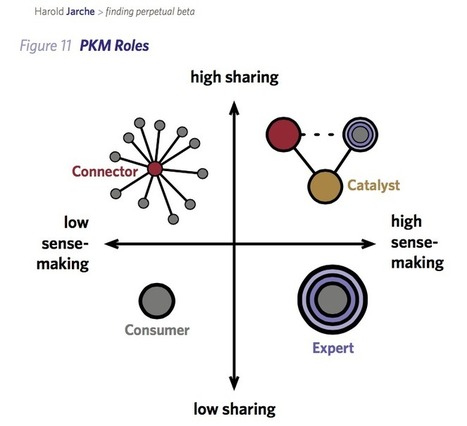
How do you make sense of all the data, information, and knowledge that passes by you each day? How do you connect with other professionals?
The discipline of PKM helps to develop four core work skills, identified by the Institute for the Future: sense-making; social intelligence; new media literacy; and cognitive load management.
Via Howard Rheingold
|
|
Rescooped by
Jess Chalmers
from Educational Technology News
August 30, 2015 7:08 AM
|
We’re going to take a look at how Blooms taxonomy can be 'flipped', so that learners are actively involved in knowledge construction from the outset.
Via EDTECH@UTRGV
|
|
Rescooped by
Jess Chalmers
from Keep learning
August 30, 2015 7:07 AM
|
In recent years, the market for e-learning services and platforms is growing rapidly in the corporate environment. E-learning is being utilized for training within the corporate structure in various ways, including employee training, organization on-boarding, process trainings, soft skills trainings and so on. According to a popular research, the global e-learning market is growing at the rate of 15.06 percent, making it one of the fastest growing industries in the world. Driving this growth is the massive popularity of handheld devices, such as mobiles and tablets, which is heralding the era of mobile learning.
Via Edumorfosis, Giselle Pempedjian
|
|
Rescooped by
Jess Chalmers
from Leadership
August 22, 2015 8:35 PM
|
Insights, tips and best practices for executive business leaders and managers
Via Anne Leong
Microsoft PowerPoint is the most flexible tool to create professional-grade infographics. The software is already installed on your computer and it's easy to use. You don't have to be a design pro to create good-looking and meaningful infographics. You can pick individual elements or icons to create entirely new graphics. Microsoft PowerPoint lets you export your infographics to many different file formats, which allows you to share it on all of the popular social media platforms.
Via Ana Cristina Pratas
LinkedIn can make or break your chances of getting an interview — you probably already know this. But just like with your resume, what you leave off your profile is just as important as what you keep on it. When it comes to the latter, we've given you plenty of tips regarding what should be there — from brilliant summaries to killer headlines that attract recruiters. But today we're talking about the former — all the items you need to leave off. Or, in most cases, remove before you make one more more hiring manager cringe and X out. I know, that sounds bleak. However, there is a silver lining, and it's that removing these items won't take you more than five minutes.
Via The Learning Factor
|
|
Scooped by
Jess Chalmers
July 28, 2015 6:47 PM
|
Stephen's Web, the home page of Stephen Downes, with news and information on e-learning, new media, instructional technology, educational design, and related subjects
|
|
Scooped by
Jess Chalmers
July 28, 2015 5:00 AM
|
It is a painful fact that employees quickly forget most of what they learn in training. The forgetting
curve
quickly erodes the benefit of the instruction—that is, unless you know the secret of the “booster”!
Here is a
simple way, proven through research, to improve memory and behavior change following instruction.
|
|
Scooped by
Jess Chalmers
July 21, 2015 11:38 PM
|
As an instructional designer, it is critical that you know the difference between crammed learning and spaced learning, so you can design eLearning courses that stick.
|
|
|
Rescooped by
Jess Chalmers
from Teaching Empathy
September 2, 2015 4:58 AM
|
How do we identify, scaffold, and credential skills in an ever-changing digital environment? In this keynote, Doug Belshaw will discuss work he began at Mozill…
Via catspyjamasnz
|
|
Rescooped by
Jess Chalmers
from E-Learning-Inclusivo (Mashup)
August 31, 2015 5:17 PM
|
Stanford University used MOOCs as an opportunity to create a supportive environment for faculty to explore, create, and express themselves in new ways through open and digital education. Following its early support for MOOCs, Stanford built "soft infrastructure" to incubate good ideas and allow courses to evolve over time.
Via Ana Cristina Pratas, juandoming
|
|
Rescooped by
Jess Chalmers
from Educational Technology News
August 30, 2015 7:07 AM
|
"Professors, administrators, and ed-tech vendors don’t always speak the same language when it comes to talking about experimental approaches to teaching and research. Terms like “flipped classroom” and “digital humanities” get thrown around a lot these days, but different people often mean different things by them. And some people still don’t know what they mean, despite their buzzword status."
Via EDTECH@UTRGV
Sometimes, being asked the right question at the right moment is a powerful motivator. Case in point: My dad said to me at college graduation, "We know what you can do. But who are you going to be?" At the time, I wanted a job and hadn’t yet realized how connected employment is with happiness and life’s purpose. I was a bit too hungover to come up with a good answer in the moment. However, the question stuck with me, and it resurfaces when I'm off-track.
Via The Learning Factor
|
|
Rescooped by
Jess Chalmers
from Digital Delights
August 22, 2015 8:05 PM
|
This presentation uses the same slides as the presentation delivered in Banff in April, and the text of which may be found here. The context is updated a bit b…
Via Ana Cristina Pratas
|
|
Rescooped by
Jess Chalmers
from E-Learning-Inclusivo (Mashup)
August 12, 2015 7:57 PM
|
One of the most distinguishing skills of a company executive and leader is managing uncertainty, ambiguity and therefore complexity. Managing complexity is not just a fashionable topic but a key organisational plus that needs to be mastered by any top manager. To understand why this is the case those concerned first need to be aware of the sources of complexity within a firm.
Via juandoming
You probably don't need research to tell you that people are feeling more and more overwhelmed and overscheduled, but if anecdotal evidence isn't enough to make this clear, studies do exist. Americans tell pollsters they struggle to find work-life balance and generally feel like they spend their days on a slightly too fast treadmill scurrying to catch up.
But no worries--this problem has an obvious solution, right? All we need is better time management--get more done, choose and batch tasks more wisely, keep tabs on our to-do list more carefully, etc.
That seems reasonable but it's totally wrong, according to a fascinating article by business psychologist Tony Crabbe that appeared on Quartz recently. The in-depth piece looks at the history of the relationship between work and time (hint: we weren't always so clock obsessed) and goes on to argue that, as we've misdiagnosed what ails us, the prescribed treatment--time management--is actually making our problems worse.
"Time management, we believe, is the solution to our busyness: if we could organize our time better, we'd be less overwhelmed, happier, and more effective. We are completely wrong on all three counts, and it's damaging our lives and our careers," Crabbe writes.
Via The Learning Factor
|
|
Scooped by
Jess Chalmers
July 28, 2015 5:00 AM
|
In this second article in the Performance Support series, the authors ask, “Isn’t it our core mission to develop learning solutions that ensure people can perform effectively when they are called upon to act?” The authors begin to explore what it means to broaden the scope of our work to include the Five Moments of Learning Need.
|
|
Scooped by
Jess Chalmers
July 22, 2015 6:52 PM
|
The secret of coaxing great employee performance is just one sentence long.
|
|
Scooped by
Jess Chalmers
July 21, 2015 11:43 PM
|
Coaching isn’t just something that specialized professionals do. In fact, some of the most powerful coaching experiences are informal exchanges in the hallways, cafeterias, offices and other workspaces in the…
|