The modern learning ecosystem framework is a method for meeting workplace learning and performance needs. Here’s how it works and why you should use it.

 Your new post is loading...
 Scoop.it! The modern learning ecosystem framework is a method for meeting workplace learning and performance needs. Here’s how it works and why you should use it. 
No comment yet.
Sign up to comment
Scoop.it!
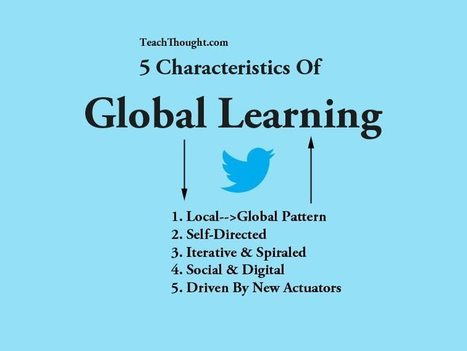
This post clarifies 5 important characteristics of global learning, including the use of digital educational technology. Via EDTECH@UTRGV
Scoop.it!

Learn professional communication tips to get you hired, promoted, funded! Join Silicon Valley communication gurus Marc and Blythe Musteric as they share communication tips from their 20,000+ hours of coaching clients in Silicon Valley. From interpersonal communication to presentations and public speaking to grammar, effective communication can be challenging. Via Nik Peachey

Nik Peachey's curator insight,
September 28, 2017 3:58 AM
Really useful listening materials for business English.
Scoop.it!
Stream 594: Find Your Happy Place at Work by HBR IdeaCast from desktop or your mobile device
Scoop.it!

A few weeks ago I was asked to speak to a group of school leaders. From the outset I was concerned that the brief from the client meant that I’d be doing a lot of talking. I flagged this with… Via Ana Cristina Pratas
Scoop.it!

We may live in a digital world, but soft skills like communication, problem solving, collaboration, and empathy are becoming more valued than technology, says Paul Roehrig, chief strategy officer for Cognizant Digital Business, a business and technology service provider.
“People skills are more and more important in an era where we have powerful and pervasive technology,” he says. “It sounds counterintuitive, but to beat the bot, you need to be more human.”
When evaluating their hiring plans for 2017, 62% of employers rate soft skills as very important, according to CareerBuilder. But a recent survey by the Wall Street Journal found that 89% of executives are having a difficult time finding people with these qualities. Via The Learning Factor

The Learning Factor's curator insight,
September 12, 2017 6:37 PM
“To beat the bot, you need to be more human.”
Scoop.it!

From
hbr

Many of the most successful people had to fight tooth and nail for opportunities to learn new skills and advance up the corporate ladder. That’s often because what they wanted to learn and achieve wasn’t in sync with what their bosses wanted for them. You’re not a data scientist. You’re not cut out for engineering. Sales isn’t what you do. Lines like this are still used all too frequently when employees tell their managers that they want to move in a new direction.
But this is only half the story. Managers are under tremendous pressure to generate results. You have annual quotas, quarterly goals, and increasing competition. Who has time to let employees go learn skills that may not be relevant for years, or may not serve your unit at all?
I hear these challenges all the time as I work with managers at all levels, particularly in large corporations. I’ve also faced them myself with the companies I founded and scaled. It’s a tough balancing act. But I’ve learned key lessons to help managers turn lofty goals — such as making learning and development a central pillar of the workday — into real actions that mitigate damage to, and even help strengthen, the bottom line. Here’s how. Via The Learning Factor
The Learning Factor's curator insight,
August 1, 2017 6:31 PM
It’s good for them, the team, and the company. 
Jerry Busone's curator insight,
August 4, 2017 8:00 AM
I come across this all the time...leaders hold back a person from a 3.5 day learning program because their team is off to a slow start when doing the opposite would help change the results .. I ask .How will your unit’s monthly, quarterly goals change as a result? Also todays associate if they are not allowed to stretch their wings and learn they leave..or do nor perform at their best.
Scoop.it!

I recently realized I have not blogged nearly enough about the importance of networking and building your own professional learning network. While I note the importance of my own PLN … Via Ana Cristina Pratas
Scoop.it!

Teacher professional learning is of increasing interest as one way to support the increasingly complex skills students need to learn in preparation for further education and work in the 21st century. Sophisticated forms of teaching are needed to develop student competencies such as deep mastery of challenging content, critical thinking, complex problem-solving,
effective communication and collaboration, and self-direction. In turn, effective professional development (PD) is needed to help teachers learn and refine the pedagogies required to teach these skills. However, research has shown that many PD initiatives appear ineffective in supporting changes in teacher practices and student learning. Accordingly, we set out to discover the features of effective PD.
This paper reviews 35 methodologically rigorous studies that have demonstrated a positive link between teacher professional development, teaching practices, and student outcomes. We identify the features of these approaches and offer rich descriptions of these models to inform those seeking to understand the nature of the initiatives.
Learn more / En savoir plus / Mehr erfahren:
https://gustmees.wordpress.com/?s=coaching
https://gustmees.wordpress.com/?s=professional+development
Via Gust MEES, Rosemary Tyrrell, Ed.D., juandoming

Gust MEES's curator insight,
June 7, 2017 2:22 PM
Teacher professional learning is of increasing interest as one way to support the increasingly complex skills students need to learn in preparation for further education and work in the 21st century. Sophisticated forms of teaching are needed to develop student competencies such as deep mastery of challenging content, critical thinking, complex problem-solving,
effective communication and collaboration, and self-direction. In turn, effective professional development (PD) is needed to help teachers learn and refine the pedagogies required to teach these skills. However, research has shown that many PD initiatives appear ineffective in supporting changes in teacher practices and student learning. Accordingly, we set out to discover the features of effective PD.
This paper reviews 35 methodologically rigorous studies that have demonstrated a positive link between teacher professional development, teaching practices, and student outcomes. We identify the features of these approaches and offer rich descriptions of these models to inform those seeking to understand the nature of the initiatives.
Learn more / En savoir plus / Mehr erfahren:
https://gustmees.wordpress.com/?s=coaching
https://gustmees.wordpress.com/?s=professional+development

Rosemary Tyrrell, Ed.D.'s curator insight,
June 8, 2017 10:59 AM
A must-read for anyone interested in faculty professional development
Scoop.it!

Encouraging lifelong learning in our children requires patience, diligence, and faith in what they can become. And pathways like these help too. Via juandoming

Trisha Ahrent Beamish's curator insight,
August 6, 2017 6:51 PM
Growth mindset is an area that I am exploring more for my students. I believe that when students see themselves as learners they can be risk takers who are up for any challenge. I chose this graphic to shoe the difference between growth and fixed mindsets. 
Khumalo's comment,
September 13, 2020 9:43 AM
I think this graphic should be a constant reminder to learners, so to encourage and help them to be better human beings.
|
Scoop.it!

Your brain is a comparison engine. In every new situation, it automatically rifles through your memory of every other situation you’ve encountered in the past. It swiftly finds one or a few that are similar to the current scenario, then uses that information to figure out what to do next. Most of the time, you do this without you ever realizing it.
Sometimes this cognitive reflex works to your advantage, and sometimes it doesn’t. But since it’s always happening anyway, you might as well make it work for you more often than against you–at least as best you can. Here’s how. Via The Learning Factor
The Learning Factor's curator insight,
October 15, 2017 6:36 PM
Social comparisons sometimes make us feel better and sometimes don’t. Here’s how to use that tendency to actually get better. 
CCM Consultancy's curator insight,
October 16, 2017 1:48 AM
When you compare yourself to someone better than you on a dimension, that’s called an “upward social comparison”; when you compare yourself to someone you consider worse off on a given dimension, it’s “a downward social comparison.” So while these comparisons can be useful (in both directions) for figuring out where you stand, they can make you miserable, too. If you’re always making upward social comparisons and find yourself lacking something, you may start feeling bad about how you measure up.
Scoop.it!

In this post I share an activity I undertook to seek feedback from friends and family on areas I could improve.
Scoop.it!

Ana Cristina Pratas's curator insight,
October 5, 2017 6:02 AM
"The development of communities of inquiry, highly engaged in the cocreation, discovery and development of knowledge, capabilities and skills, is enabled by learning management systems, collaborative platforms and social-constructivist teaching activities (Garrison, Anderson & Archer, 2000, 2001a, 2001b; Garrison & Anderson, 2003). This paper explores the current state of communities of inquiry (COI) in teaching and learning in the digital age, including the technology to support learner presence (Shea & Bidjerano, 2010) and personal learning environments. It also argues for the communities of inquiry model to evolve into a learning model, that recognizes the importance of motivation, self-efficacy and personal skills in effective communities of inquiry.
The paper addresses five key questions examined through the lens of the Community of Inquiry Model:
• What skills and abilities need to be developed for teachers and learners to fully leverage the power of communities of inquiry? What are the prerequisites for effective learning?
• What are we learning from the growth of peer-to-peer learning and peer assessment which supports the power of communities of inquiry?
• What can emerging technology approaches to adaptive learning and adaptive assessment bring to the practice of communities of inquiry?
• What are the known best practices and emergent next practices for communities of inquiry?
• What are examples of communities of inquiry in action from a variety of settings around the world?"
Scoop.it!

Nearly every job seeker has made the same, tragic resume-writing mistake at least once. Many people are still making this mistake right now. Are you one of them?
Scoop.it!

Jay Cross, the author of the 2007 seminal book, Informal Learning, Rediscovering the Natural Pathways that Inspire Innovation and Performance, recently wrote a blog post in which he explained that… Via juandoming
Scoop.it!

"New Center For Public Education research declares a "one-size-fits-all" approach to professional development dead, with a steady procession of new standards and curriculum demanding an ongoing approach, eSchool News reports." Via EDTECH@UTRGV
Scoop.it!

1. Learn something new, even if it's stressful: Mastering a new skill means more stress now but more happiness later.
If you are willing to push through a bit of added stress in the short term, you can experience huge gains in happiness for the long term.
So learn a new skill. Though you'll take on a bit more stress, research shows you'll be happier on an hourly, daily, and long-term basis.
The gains from this investment in time and energy were documented in a 2009 study published in the Journal of Happiness Studies. Participants who spent time on activities that increased their competency, met their need for autonomy, or helped them connect with others reported decreased happiness in the moment yet increased happiness on an hourly and daily basis.
The key, according to the study, is to choose the right new skill to master, challenge to undertake, or opportunity to get out of your comfort zone. The greatest increases in happiness come from learning a skill you choose, rather than one you think you should or feel forced to learn. Via The Learning Factor

Marcia Buxton's curator insight,
September 15, 2017 6:26 AM
Something to consider for the wellbeing of our teams.

Lucero D's curator insight,
September 15, 2017 8:42 AM
When we were first married my husband and I played a game for married couples with some long married friends. One of the questions was, "How would you describe yourself in one word?", and your spouse had to choose the one to match yours in order to get a point in the game. I don't remember all the choices, but rose and book were the two that stood out to me. I recall hoping that my would know that I would instinctively choose book. Not because I love to read or that I think I'm smarter than everyone else BUT because I LOVE to learn new things. Thankfully, he didn't choose rose and we kicked the other couples butts!!! I enjoy attempting to master new skills like making kombucha, learning to ferment vegetables, making bread, baking something new, learning about how to keep chickens, gardening difficult to grow flowers or vegetables, figuring out how to fix my bike by myself. . . You see, I'm not afraid to get myself dirty. What my husband finds frustrating about these things is that though the habits become part of my regular routine I don't develop them to the point of perfection so I can make a business of it. There is a very good reason for this. I want to continue learning skills which will benefit my family and bring me joy and have the freedom to practice them without the stress of it becoming a burden. At one time I wanted to have my own business. Then I saw the reality of things. . . My husband has a cabinet shop. Really that is a misnomer - he has a manufacturing facility. He USED to be a cabinet maker. He USED to enjoy making things out of wood and took pride is the work of his hands. Now he is slave to his business. His entire life is his business - keeping customers happy and people employed so the business can continue to grow. He has employees who make boxes for his clients. His hands rarely ever touch the materials with which he once so loved working. What was once his creative outlet is now his living nightmare, his taskmaster, and the focus of all his attention. He has a wife who loves him and two beautiful, sweet, smart little girls who are growing so fast and he has little time to spend with them. They'll be grown and gone before he knows it and he'll have missed it all. Time will go by and I'll become more and more the stranger who is married to a house that he happens to sleep in.
Scoop.it!

David Wiley and George Siemens are offering a new 6 week MOOC – Introduction to Open Education – on EdX at the beginning of October. There is already a Twitter hashtag - #openedMOOC - and you can enrol on the EdX website where you can also find the course syllabus: Week 1: Why Open Matters… Via Ana Cristina Pratas
Scoop.it!

This is the first in a three-part series on implementing microlearning in the workplace to drive business results. Via Carlos Fosca, juandoming
Scoop.it!
Advances in educational technology are altering delivery methods of course materials as well as student interactions with the content and their instructors. Adaptive technology platforms and advancements in online learning tools are disrupting traditional learning models, some faculty perceive the changes as a paradigm shift that diminishes their role in designing the learning experience. These tools are freeing up faculty to undertake deeper roles as mentors, guiding students through active learning exercises instead of dispensing information in lecture formats. Join us to hear from two presenters who are addressing the evolving roles of faculty and collaborate on devising strategies with your colleagues. Via Edumorfosis, juandoming
Scoop.it!
100 ways to energise groups: Games to use in workshops, meetings and the community Via Ana Cristina Pratas
Scoop.it!

The neuroscience of how the brain learns and what influences the most successful brain acquisition and application of learning should be included in all teacher education programs. Via John Evans

MFaculty's curator insight,
June 9, 2017 10:00 AM
This is incredibly relevant for today's educators across levels and disciplines.
|