Buzz e-sante
248.4K views | +46 today
Buzz e-sante
Le média du digital santé
Curated by Rémy TESTON
Your new post is loading...
Rescooped by Rémy TESTON from Social Media and Healthcare
June 4, 2014 3:53 PM
Scoop.it!

The growing influence of social media in healthcare

The growing influence of social media in healthcare | Buzz e-sante | Scoop.it

Social media has established itself as a powerful channel for voices in the NHS, whether it is to create professional networks, raise safety concerns or seek support in self-management of conditions. Participation is no longer optional, writes Claire Read

A recent episode of the BBC documentary series Business Boomers focused on the amazing growth of Amazon, tracking its development from garage-based small business to multinational giant.

It was filled with an array of interesting tidbits but arguably the most memorable was a clip from a 1994 episode ofTomorrow’s World.

In it, the earnest presenter - surrounded by a collection of very bulky and very beige computers - explained how “something called the internet” was set to revolutionise the availability of information.

It was a stark reminder of just how far digital communication has come in a short time; a reminder that is particularly important within healthcare.

Foreword to the HSJ and Nursing Times Social Media Pioneers supplementSocial Pioneers interactive graphicThe mobile friendly list of our Social Media PioneersNow you’ve signed up, the real work beginsDean Royles: The path to picking our Social Media PioneersDownload a free PDF of the supplementHealth chiefs flock to Twitter to talk to staff and the public

A digital age

Those the NHS is recruiting today - the leaders of tomorrow - will never have known a world without the internet.

Paediatric and young adult patients will fall into the same category. And soon enough we will have a generation not only of “digital natives” but of social media natives.

‘Online networks seem likely to offer solutions to many of the current communication challenges the health service is facing’

It all means healthcare practitioners and organisations are likely to have no choice but to engage with social media. It is where their patients and colleagues will expect to have conversations, and so not to be there would simply not be sustainable.

The growing influence of social media in healthcare is associated with the sustainability of the NHS in a much broader sense, however.

Online networks seem likely to offer solutions to many of the current communication challenges the health service is facing, and provide an extremely positive reason for the growing influence of social media in healthcare.


Take sharing concerns. In the aftermath of the Francis report, much attention has been focused on ensuring staff can speak out without fear and safe in the knowledge that their worries will be suitably investigated.

Twitter provides a simple way to encourage this sort of open environment: a nurse tweeting his or her chief executive a concern seems far more transparent than other potential methods. It is no coincidence that Twitter has provided a natural home for the Nursing Times Speaking Out Safely campaign.

Online connections

There is also frequent talk of the importance of the NHS sharing knowledge and innovation more effectively. Here too social media networks are making a tremendous difference, allowing healthcare professionals to build connections both inside and outside their own organisations.

WeNurses is a tremendous example of this, bringing together nurses from across the world in Twitter conversations. Knowledge and views are being shared, and in some instances huge and valuable professional networks being built.

Let us not fall into the trap of thinking it is only healthcare professionals who are serving to increase the influence of social media in the NHS, however.

‘Patients have been the trailblazers, making electronic connections with fellow sufferers of a condition and coming together to raise concerns about standards of treatments’

In many ways, it is patients who have been the trailblazers (as our list of Social Media Pioneersdemonstrates). They began by making electronic connections with fellow sufferers of a condition, and continued by coming together to raise concerns about the standards of treatments at particular institutions.

Surely the next step will be for those working within the health service to fully employ social media to converse with service users?

This again will address many of the communication challenges currently being placed in front of health service managers: the question of how to build openness and a genuine dialogue with patients that is based on listening.

Twenty years ago, the internet was the new development. Few could now imagine our lives without it. It seems likely that, in 20 years time, we will be saying the same thing about social media. It has already influenced the health service - but it is only just getting started


Via Plus91
Paul Deemer's curator insight, June 6, 2014 4:41 AM

The social media movement continues to gather pace in the NHS 

Rescooped by Rémy TESTON from Social Media and Healthcare
June 4, 2014 2:43 AM
Scoop.it!

Social media taking hold in healthcare

Social media taking hold in healthcare | Buzz e-sante | Scoop.it

There's a widespread irony surrounding the phenomenon known as "social media."

It's hard to imagine someone who doesn't know, in general terms, what it is, but it's safe to say that many, perhaps most, people still don't know all that social media consists of, or how best to use it for their business.

Perhaps nowhere is this more true than in the healthcare sector. Blogs abound, movers and shakers chat on Twitter, and providers are increasingly opening lines of communication with their patients via Facebook or their own, dedicatedpatient portals.

And yet most observers would agree that healthcare still has a ways to go before it can be considered social media-savvy.

As Christina Thielst, a social media consultant and the editor of a new HIMSS book, Applying Social Media Technologies in Healthcare Environments, recently described it, healthcare administrators have known about social media for quite some time.  The problem, she said, is that in the early days they learned about it primarily through general media reports, and many of those focused on events such as security breaches or other inadvertent releases of personal health information. Consequently, they got scared off.  

The good news, however, is that things are turning around.

"There's certainly been a lot of progress," she said, "but more needs to be done if healthcare stakeholders are going to truly leverage social media tools." 

In her view, there are three main reasons for the growth in social media in healthcare.  First, older people, who are the largest and most regular group of users of healthcare systems, are getting used to social media tools. They learned to use them as a way to keep up with family, and now they're connecting with their friends.

"Society, in general, has recognized that social media is more than just a young person's toy," Thielst said.

Next, hospital administrators have realized that there are marketing advantages to social media, as marketing through newspapers has gotten significantly more expensive at the same time as audiences have shrunk.

Finally, the media stories, once predominantly negative, are finally getting better.  Moreover, groups like the American College of Healthcare Executives and HIMSS are working hard to instruct healthcare executives both in the value of social media and how best to use it.

Those educational goals lie at the root of the new HIMSS book. A compilation of numerous perspectives, the book includes chapters written by a range of healthcare stakeholders, including caregivers, administrators, marketers, patients, lawyers, clinicians and healthcare information specialists.

One of the contributors, who writes from the patient perspective, is Clarissa Schilstra.  Now a student at Duke University, Schilstra spent many of her childhood and teen years battling two bouts leukemia, and according to her "the experience would have been completely different" had she and her family not been able to use social media tools. 

One key tool, she said, was the care page her parents were able to set up and use to keep friends and family apprised of their daughter's progress.

Now a pre-med student, Schilstra uses her own web site (www.teen-cancer.com) to provide accounts of her experience and resources for other teens who may be struggling with similar conditions.

Another chapter in the book looks at social media in healthcare from the other end of the patient-provider relationship. Written by Craig Kartchner, senior director of marketing for Intermountain Healthcare, the chapter recounts a number of social media programs the Utah-based provider has launched in recent years.

As Intermountain sees it, Kartchner said, "the more meaningful, actionable information members of our community have, the better equipped they are to make intelligent decisions about their care. Social media are effective for getting this kind of information to patients and interacting with them on a personal level – in fact, social media were made for exactly that."

Among the social media uses Kartchner described were "a blog network rich with content," the use of Facebook and YouTube channels to answer questions from the public, and "regular live chats with experts from throughout our organization."

According to Christina Thielst, some of the other case studies in the book include a discussion of clinics in Oregon and northern California that are combining social platforms with new Patient Centered Medical Homes to facilitate access to care for patients in hard-to-reach places, and a program launched by Boston-based Partners Healthcare that has used Facebook to facilitate care for teenage patients.

Thielst pointed out that it's important for healthcare stakeholders to distinguish between social media brands and the underlying technology. Twitter, for example, is a micro-blog, while Facebook is a social network.

The distinction is important, she said, because while the brands may come and go, the underlying technology is here to stay and can be used in a number of different ways.

"The key," she said, "is for healthcare organizations to figure out the right tool for the right purpose for the right audience."

Topics: Social media, Patient portals, Healthcare Information and Management Systems Society (HIMSS), Intermountain Healthcare, Partners HealthCare
Via Plus91

No comment yet.
Scooped by Rémy TESTON
June 4, 2014 2:21 AM
Scoop.it!

Les hébergeurs de données de santé publient un livre blanc avec six recommandations

Premier site français d’information en continu sur les technologies de l’information et de la communication (TIC, NTIC) dans la santé - TIC santé
No comment yet.
Scooped by Rémy TESTON
June 3, 2014 2:55 AM
Scoop.it!

June : bijou connecté pour mesurer l'exposition au soleil

June : bijou connecté pour mesurer l'exposition au soleil | Buzz e-sante | Scoop.it
La start-up Française Netatmo lance un nouvel objet connecté pour mesurer l'exposition au soleil : June. Découverte. Le marché des bracelets connectés est en pleine expansion avec de nouveaux acteu...
No comment yet.
Scooped by Rémy TESTON
June 2, 2014 2:12 PM
Scoop.it!

16 juin 2014 : Colloque ayant pour thème " Ouverture et Sécurité des données du domaine santé-social". Inscriptions. | csfrs

16 juin 2014 : Colloque ayant pour thème " Ouverture et Sécurité des données du domaine santé-social". Inscriptions. | csfrs | Buzz e-sante | Scoop.it

#Le CSFRS a pour objet le soutien, la coordination et l’animation des efforts développés en matière de recherche et de formation stratégiques dans les domaines de la sécurité et de la défense de façon à permettre l’élaboration et l’actualisation d’instruments de référence de niveau international.

No comment yet.
Scooped by Rémy TESTON
June 2, 2014 10:51 AM
Scoop.it!

Semaine de prévention du diabète du 2 au 8 juin 2014

Semaine de prévention du diabète du 2 au 8 juin 2014 | Buzz e-sante | Scoop.it
La Semaine de Prévention du diabète se déroule du 2 au 8 juin 2014. Organisé par la Fédération Française des Diabétiques, cet événement vise à informer et sensibiliser le public sur le diabète. Une campagne « terrain » va être menée par les 104 associations locales et régionales de l'AFD.
No comment yet.
Scooped by Rémy TESTON
June 1, 2014 6:56 AM
Scoop.it!

SAMI : la grande offensive de Samsung dans la santé

SAMI : la grande offensive de Samsung dans la santé | Buzz e-sante | Scoop.it
Les géants du web semblent de plus en plus attirés par le domaine de la santé. Dernier exemple en date lors de la conférence de presse de Samsung à San Francisco faite mercredi. Le constructeur sud-coréen y a présenté un nouveau bracelet baptisé Simband. Encore à l'état de prototype, ce nouveau device doit permettre de mesurer une batterie de données comme la température, le taux de globules rouges, la concentration en oxygène ou encore la distance parcourue. Le dispositif ne devrait pas être commercialisé tel quel mais servira de base au développement de nouveaux appareils de wearable computing. Les données médicales issues de ces devices devraient être stockées sur SAMI (Samsung Architecture Multimodal Interactions), une nouvelle plateforme de big data qui constitue le noyau dur de cet écosystème.
No comment yet.
Scooped by Rémy TESTON
June 1, 2014 3:16 AM
Scoop.it!

Cédric Hutchings (Withings): «Demain, avoir un tableau de bord de sa santé sera une évidence»

Cédric Hutchings (Withings): «Demain, avoir un tableau de bord de sa santé sera une évidence» | Buzz e-sante | Scoop.it
INTERVIEW - Le cofondateur de la société spécialisée dans les objets connectés dédiés au bien être et à la santé est persuadé que ces nouveaux outils vont bouleverser la relation patient-médecin…
No comment yet.
Scooped by Rémy TESTON
June 1, 2014 3:14 AM
Scoop.it!

Now You Can See Which Diseases Are Trending At The Doctor's Office

Now You Can See Which Diseases Are Trending At The Doctor's Office | Buzz e-sante | Scoop.it
An electronic health record company is offering up a fascinating new way to see what's making people sick, how they're getting treated, and what...
No comment yet.
Rescooped by Rémy TESTON from eHealth in Switzerland
May 31, 2014 2:36 PM
Scoop.it!

Tendances futures dans la santé

Les tendances futures au niveau technologique et numérique qui influenceront le domaine de la santé dans les années à venir.

Via ICT_Sierre
No comment yet.
Scooped by Rémy TESTON
May 31, 2014 2:29 PM
Scoop.it!

Voici pourquoi vous devez faire davantage confiance à un docteur qu'à Wikipédia

Voici pourquoi vous devez faire davantage confiance à un docteur qu'à Wikipédia | Buzz e-sante | Scoop.it
SANTÉ - Il ne faut jamais croire tout ce que vous lisez sur Internet, surtout en matière de santé. Pour cause, selon une étude publiée dans le Journal de l'association américaine d'ostéopathie, les pages Wikipédia de plusieurs grandes maladies contiendraient en moyenne neuf erreurs sur dix.
No comment yet.
Scooped by Rémy TESTON
May 31, 2014 2:18 PM
Scoop.it!

Infographie : comment se soigner en ligne ?

Infographie : comment se soigner en ligne ? | Buzz e-sante | Scoop.it
Face à la multiplication des canaux digitaux et des outils en ligne, la société 121doc publie une infographie sur les différents moyens présents sur la toile pour aider au mieux le patient. Découve...
No comment yet.
Scooped by Rémy TESTON
May 31, 2014 2:16 PM
Scoop.it!

Les réseaux sociaux et le monde hospitalier : un savant dosage à trouver.

Les réseaux sociaux et le monde hospitalier : un savant dosage à trouver. | Buzz e-sante | Scoop.it
L’utilisation des réseaux sociaux par les établissements de santé et les professionnels de santé a fait l’objet de mises en garde et de rédaction de guides de bonnes pratiques sur le sujet. On peut...
No comment yet.
Scooped by Rémy TESTON
June 4, 2014 3:00 AM
Scoop.it!

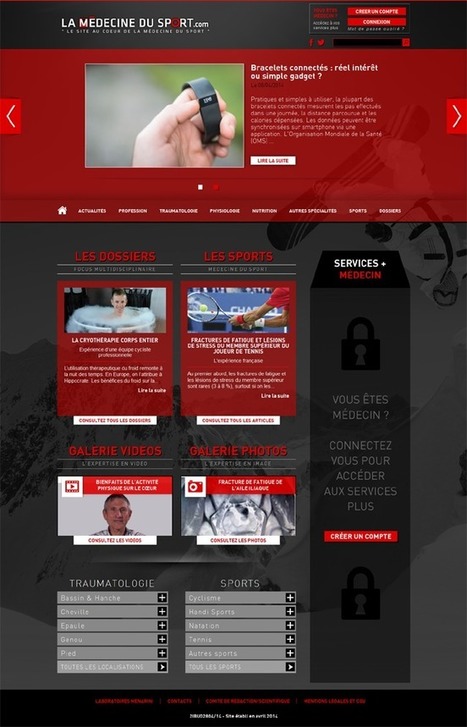
Menarini lance un site web dédié à la médecine du sport

Menarini lance un site web dédié à la médecine du sport | Buzz e-sante | Scoop.it
Le laboratoire Menarini lance un nouveau site web dédié à la médecine du sport pour le grand public et les professionnels de santé : lamedecinedusport.com. Présentation. Pour apporter au grand publ...
fabrice gaullier's curator insight, June 4, 2014 6:14 AM

du vrai contenu ...

Rescooped by Rémy TESTON from Health, Digital Health, mHealth, Digital Pharma, hcsm latest trends and news (in English)
June 4, 2014 2:42 AM
Scoop.it!

Artificial Intelligence Is Now Telling Doctors How to Treat You | Business | WIRED

Artificial Intelligence Is Now Telling Doctors How to Treat You | Business | WIRED | Buzz e-sante | Scoop.it
Artificial intelligence is still in the very early stages of development–in so many ways, it can’t match our own intelligence–and computers certainly can’t replace doctors at the bedside. But today’s machines are capable of crunching vast amounts of data and identifying patterns that humans can’t.

Via Celine Sportisse
No comment yet.
Rescooped by Rémy TESTON from Social Media and Healthcare
June 3, 2014 6:00 AM
Scoop.it!

Medical Students Need Training on Social Media Privacy

Medical Students Need Training on Social Media Privacy | Buzz e-sante | Scoop.it

The social media savvy of many incoming medical students may be leading to unintended medical privacy and confidentiality breaches, according to Pennsylvania State College of Medicine researchers. And medical schools may need to offer more guidance in potential pitfalls.


“We assessed how medical students engage with social media platforms like Facebook and found that they have a pretty sophisticated understanding of its risks and benefits,” said Daniel R. George, Ph.D, M.Sc. .


He and Dr. Michael J. Green, professor of humanities, conducted two studies that report findings from a survey of 2,109 medical students nationwide.


In the first study, researchers asked students how they and their peers would and should respond to eight hypothetical scenarios involving Facebook. The scenarios focused on ethical issues including privacy, the patient-doctor relationship, and relationships with peers.


In one scenario, a student revealed on Facebook that she was caring for a local weatherman. The majority of students, 55 percent, said they should address a peer who violates patient privacy on Facebook. Almost half of the students also indicated that this is what they would actually do.


However, 31 percent thought their peers would not do anything to address the situation.


Another hypothetical scenario involved a patient asking a student for medical advice over Facebook. Most students, 61 percent, said that they should explain to the patient that this form of communication is not acceptable. However, 30 percent believed their peers would send a short message with the advice asked.

The researchers reported their findings in AJOB Empirical Bioethics.

Overall, the students seemed to be mindful of the potential dangers of social media use and had a good understanding of how it could be used or misused in a professional context.


However, when faced with an ethical dilemma, there was a disconnect between what the students said they would do versus what they thought they should do. Though 39 percent of students said that they should tell a hypothetical peer to remove drunken pictures and foul language from Facebook, 41 percent said they would actually do nothing.


Most felt their peers would probably do nothing as well.

Some students promoted strategies for integrating Facebook into future practice, such as sending appointment reminders and relaying public health information to their patient base.

In the words of one student, “If I had a professional Facebook account, (patients) could stay updated on things like schedule changes, get (appointment) reminders, join fundraisers … or stay up to date on public health type information.”


“I think some patients would see it as above and beyond if a doctor messaged them to see how they were doing,” wrote another. “In this day and age I think a lot of patients might actually appreciate that kind of personal contact from their doctor.”


“Students seem to understand the risks of using social media like Facebook, but there is clearly a need for medical schools to help students take the proper course of action,” said George.

In the second study, published in BMJ Postgraduate Medical Journal, the researchers examined what students believe about the ways residency programs use Facebook in their admission processes.


Researchers presented students with a hypothetical situation in which a residency admissions committee finds inappropriate pictures on an applicant’s Facebook page. The pictures showed the applicant drinking beer and wearing a provocative Halloween costume. Researchers asked students how the admissions committee should respond.


More than 60 percent of students believed that the inappropriate pictures alone should not result in rejection from the residency program, but that the pictures should be considered along with other factors.


About one-third of the students thought the pictures should have no influence on the application process whatsoever. Less than three percent indicated that the pictures should be grounds for rejection.


However, previous research has found that more than half of the residency programs in the country would reject applicants based on unprofessional Facebook content, such as the inappropriate pictures in the scenario.


“Although most students feel that social media profiles shouldn’t affect admission, the reality is that many admissions committees are screening them,” said George.


“This is another example of how medical schools have an obligation to help educate students to minimize risk.”


Via Plus91
No comment yet.
Scooped by Rémy TESTON
June 2, 2014 3:18 PM
Scoop.it!

Withings équipe le premier contrat d’assurance santé en France avec des objets connectés

Withings équipe le premier contrat d’assurance santé en France avec des objets connectés | Buzz e-sante | Scoop.it
Pour la première fois en France, un assureur, Axa Santé, lance une offre d’assurance complémentaire santé individuelle incluant un objet connecté :...
Louis Joseph's comment June 3, 2014 4:00 AM
Ce système est anti mutualise, il va réévaluer les risques et par conséquent augmenter vos tarifs santé la plupart du temps, voire ne plus vous couvrir dans certains cas
Scooped by Rémy TESTON
June 2, 2014 12:43 PM
Scoop.it!

Ça y est, AXA conditionne un avantage santé à un objet connecté

Ça y est, AXA conditionne un avantage santé à un objet connecté | Buzz e-sante | Scoop.it
Aurez-vous encore votre liberté lorsqu'il faudra choisir entre payer cher sa mutuelle santé, ou accepter de voir son comportement scruté par des machines au service de
No comment yet.
Scooped by Rémy TESTON
June 2, 2014 3:56 AM
Scoop.it!

Le meilleur du digital santé - Mai 2014

Le meilleur du digital santé - Mai 2014 | Buzz e-sante | Scoop.it
Découvrez les dernières nouveautés du digital santé francophone au cours du mois de mai 2014. Nouveaux sites, blogs, contenus et campagnes web Infographie : les Français assument leur vieillissemen...
No comment yet.
Scooped by Rémy TESTON
June 1, 2014 3:44 AM
Scoop.it!

L'iWatch d'Apple pourrait protéger votre peau du soleil

L'iWatch d'Apple pourrait protéger votre peau du soleil | Buzz e-sante | Scoop.it
Elle n'est pas encore sortie, mais les rumeurs sur la montre intelligente d'Apple n'arrêtent pas de fleurir sur le Web.
No comment yet.
Rescooped by Rémy TESTON from Objets connectés & automesure | Wearables, capteurs & quantified self — Pharmageek
June 1, 2014 3:15 AM
Scoop.it!

La CNIL planche sur les capteurs connectés au corps humain

La CNIL planche sur les capteurs connectés au corps humain | Buzz e-sante | Scoop.it
Les objets mesurant pouls, poids, tension et autres paramètres de santé soulèvent d'importantes questions éthiques, estime la CNIL.

Via Lionel Reichardt / le Pharmageek
No comment yet.
Rescooped by Rémy TESTON from Objets connectés - Internet des objets - Mobilité
May 31, 2014 2:37 PM
Scoop.it!

Plusieurs modèles d'iWatch rondes en production dès le mois de juillet

Plusieurs modèles d'iWatch rondes en production dès le mois de juillet | Buzz e-sante | Scoop.it
Rondes, minces, belles et allant de l’entrée de gamme jusqu’au haut de gamme, les iWatch d’Apple commencent à se révéler peu à peu.

Via Jean-Pierre Blanger
No comment yet.
Scooped by Rémy TESTON
May 31, 2014 2:30 PM
Scoop.it!

Samsung dévoile une plateforme dédiée à la santé - Internet - Notre Temps

Le fabricant sud-coréen de produits électroniques Samsung a dévoilé mercredi une nouvelle plateforme numérique dédiée à la santé, qui utilise des capteurs pour surveiller ...
No comment yet.
Scooped by Rémy TESTON
May 31, 2014 2:27 PM
Scoop.it!

E-SANTÉ : POUR QUELQUES (GROSSES) POIGNÉES DE DONNÉES...

E-SANTÉ  : POUR QUELQUES (GROSSES) POIGNÉES DE DONNÉES... | Buzz e-sante | Scoop.it
J’étais hier à la CNIL…pour une conférence intitulée « Quantified self, m-santé : le corps est il un nouvel objet connecté ? ». Voici un lien vers le résumé sur storify et vers le très intéressant ...
No comment yet.
Scooped by Rémy TESTON
May 31, 2014 2:17 PM
Scoop.it!

HubSanté Diabète : plateforme de suivi pour diabétique

HubSanté Diabète : plateforme de suivi pour diabétique | Buzz e-sante | Scoop.it
Une nouvelle plateforme pour accompagner les diabétique a vu le jour : HubSanté Diabète. Découverte. Un patient passe en moyenne 3 heures par an en consultation. Dans le cas d’une personne atteinte...
No comment yet.