


Buzz e-sante
248.4K views |
+46 today
 Your new post is loading...
 Scoop.it! 
Part of Philips Hospital to Home’s suite of telehealth programs, eCareCoordinator and eCareCompanion, received USDA’s 510(k) clearance, are focused on patient care within the home and the first clinical applications to be available through the cloud-based digital health platform.
The application gives clinicians real-time access to both objective health data – like vital signs, blood pressure and weight — as well as subjective responses collected via health questionnaires and other communication with the care team about the patient’s status.

Scoop.it!

Ce n'est pas nouveau, Google s'attaque de plus en plus à votre santé. Pour cela, les fondateurs de l'entreprise, Larry Page et Sergueï Brin,...
Scoop.it!

La loi Léonetti sur la fin de vie prévoit la possibilité pour chacun d'entre nous de laisser des directives anticipées, c'est-à-dire d'indiquer notre volonté face à l'acharnement thérapeutique. Peu de personnes le font, d'où l'idée de deux Varois qui ont créé un site internet pour offrir ce service.
Scoop.it!
Lionel Reichardt, PHARMAGEEK - La santé mobile, enfin une révolution ! Via Lionel Reichardt / le Pharmageek
Scoop.it!

We are learning a great deal about how to empower patients to self-manage their health, and what to do with all of this patient-generated data. Via JP DOUMENG

Keith McGuinness's curator insight,
October 1, 2014 7:43 PM
One reason to be cautious is a problem of semantics. There are too many words that seem suddenly to mean different things to different people. ‘Engagement’ is one of them. Jargon proliferates rapidly at the beginning of something. As the stewards of connected health or mHealth, or whatever more useful term emerges, we must be cautious about jargon. I believe the perfectly good word ‘engagement’ is becoming jargon. Too many are using this word as if it were a bona fide health metric. I too have been at this for more than 20 years, but from the developer side. Developers love engagement. They compete for advertising dollars based on engagement. Engagement can mean, ‘whatever gets a consumer to return to my app.’ Stickiness is neutral. Consider this. A consumer (aka a patient) is offered a choice between two apps. Both apps promise to help with behavioral issues that affect hypertension. Both apps are equally engaging. But only one of them is effective to reduce hypertension. The consumer does not know which one. Under such conditions the choice, based on engagement alone, is a 50-50 proposition. Half of the patients, drawn in by ‘engagement’ will choose a behavioral placebo. As for CarePass, it is/was a platform offered by Aetna, a health plan. If you are a health plan that wants to enthrall app developers, provide a platform that reimburses for the apps that join it, that would be enthralling. To be fair to Aetna, if you are an app developer that wants to enthrall a health plan, measure outcomes continuously, that would likewise be enthralling, and reimbursable. Outcomes first, then engagement.
Scoop.it!

Le champ d’action de l’intelligence artificielle ne cesse de s’étendre, et devrait bientôt frapper les smartphones. L’Operating System sera en mesure de simuler des cellules neuronales, et le device pourra reconnaitre des objets et des visages.
Scoop.it!

Doctors are turning to clinical calculators that crunch big data to help patients make informed medical decisions. Via Giovanna Marsico

Denise Silber's curator insight,
September 26, 2014 3:09 AM
Thanks to @giomarsi for pointing this out.
Scoop.it!

iHealth was the first company to sell a medical device through Apple, so it's only natural it's also the first to fully integrate its products with Apple's HealthKit. That means all the data iHealth's connected monitors and trackers collect not only gets sent straight to the app, it's also automagically logged in your electronic health record. Via Alex Butler

Olivia Klenda's curator insight,
September 30, 2014 6:50 PM
The new HealthKit is a great way to keep track of your personal health records, exercise, and eating habits.
Scoop.it!

Orange Healthcare, entité dédiée à la stratégie santé du groupe Orange, concentre son expertise autour de trois domaines d’intervention : les services pour les professionnels de santé, les services de télésanté et les services de prévention. Orange Healthcare est un partenaire technologique privilégié du secteur de la santé, il contribue à moderniser les infrastructures de santé mais également les systèmes de soins dans leur ensemble, en équippant les établissements de santé en solutions de communication au niveau national et international. Hébergement et sécurisation des données informatisées des patients, meilleure gestion des matériels médicaux, amélioration de l’accueil des patients, perfectionnement du parcours patient et équipement multimédia, télésuivi des maladies chroniques, services de maintien à domicile, accompagnement de la perte d'autonomie, services de télémédecine sont autant de réponses qu’Orange Healthcare se propose d’apporter au monde médical à travers ses offres.
Scoop.it!
Interview réalisée à l'occasion de la conférence Santé Connectée, le 18 septembre 2014 aux Salons de la Maison des Arts et Métiers. Via e-Santé Bretagne
Scoop.it!
Objets connectés, "wearables", capteurs, m-health, big data, Google glass, réalité augmentée, gamification, simulation virtuelle, imprimante 3D ..., l'essor fu… Via Jerome Leleu
|
Scoop.it!

Réseaux, forums, blogs : de plus en plus de communautés de patients sont présentent sur le Web. Ces données constituent un nouveau domaine de recherche. Via Renaloo
Scoop.it!

Patient engagement is an essential part of health care. This is especially true of eye care, because early symptoms of many ocular diseases are often detected only by the patient. The growing use of social media platforms such as Facebook, Twitter, and Tumblr has made it easier for doctors to interact with their patients, facilitating prevention and early diagnosis. Some doctors have built thriving online communities around their clinics and services. Here are four ways you can use social media outlets to increase your patient engagement: Write a blog or an email newsletter to keep patients informed about common eye problems. Knowledge and information are the progenitors of prevention and early diagnosis. Patients who are better informed about how the eye functions and how common problems develop will be more likely to recognize symptoms and discuss them with their eye doctor. This enables ophthalmologists to treat problems early in order to prevent further damage to the patient’s eye, making clear vision a possibility for many more years. Utilize blogging and microblogging sites like Tumblr and Twitter to keep patients informed about common eye problems and advances in ocular technology. Most important, stay relevant. For example, during summer you could write about the effects of UV rays on the eyes and why sunglasses are important to eye health. July is eye injury prevention month, so throughout the month you could include content related to that topic. Inform patients about current deals and offers via Facebook, Twitter, and e-mail. Many people access their social media accounts via apps on their cell phones. Because cell phone apps often alert users to messages, tweets, and tags, these are often the most direct means of contacting patients. Use your e-newsletter and social media outlets to inform patients about any deals and services you are offering. You can use text alerts to remind patients about upcoming appointments. Use Twitter Cards and QR codes to drive social media traffic to your website. Consisting of up to four pictures and 140 characters, Twitter Cards are great tools for directing traffic from Twitter to your website or blog, where people can receive more information about the services and specialists available at your practice. Twitter Cards can also be used to advertise deals, services, or new technology you might be offering. They are great tools for providing small, digestible amounts of information while enabling users to investigate further. Similar to Twitter Cards are QR codes, such as those frequently seen on print advertising; these are excellent tools for driving traffic from one medium to another. Cell phones apps scan printed QR codes and then direct users to a specific site, such as a website, or a Twitter or Facebook feed. Only so much information can be conveyed on a small, printed advertisement, which is why QR codes are so useful. QR codes bridge print and electronic media by instantaneously giving people access to further information about your practice. Use analytics programs to optimize your influence on social media. Free analytics programs, such as those offered by Twitter, provide detailed information about the influence and effectiveness of users’ Tweets and Twitter cards. Tumblr also provides users with analytics about their posts and followers, although to a less-detailed extent. In many ways, social media can function as free advertising. Analytics programs allow you to capitalize on this by increasing awareness about your practice and the services offered. Manage your online reputation with Google+ and other patient review services. Word-of-mouth marketing is an incredible tool for expanding your customer base. Review sites are the modern means for people to share their thoughts and experiences. Health-specific websites such as Vitals, ZocDoc, and Healthgrades enable patients to search for local specialists and review their experience with specific doctors. Many people check review sites such as these before making an appointment, so it is important to have as many good reviews as possible. Read these reviews and heed customers’ feedback in order to continue to improve your practice and, in turn, your ratings. Google Places combines all your reviews into one easily accessible place, so check these sites frequently. Social media is a powerful tool for reaching out to people. It is easier now than it has ever been to gather and share information. Although this is often applied to our personal lives, health care professionals can use social media’s networking capabilities to increase their patient engagement and online reputation, increasing awareness, prevention, and early diagnosis.
Via Plus91
Scoop.it!

En suisse, une application médicale pour Google Glass vient d'être développée pour la médecine d'urgence.
Scoop.it!

Le think tank Renaissance Numérique a publié il y a quelques jours un livre blanc "D’un système de santé curatif à un modèle préventif grâce aux outils numérique". Synthèse en infographie. Source :...
Scoop.it!

Saviez-vous que l’Internet des Objets est considéré comme la troisième évolution de l’Internet, baptisé WEB 3.0 ? Comme Internet a révolutionné la communication, l’Internet des objets pourrait révolutionner notre manière de vivre notre santé. Via Marie Françoise de Roulhac
Scoop.it!

La start-up nommée Bionym vient de boucler un tour de table s’élevant à 14 millions de dollars. Son idée ? Utiliser le rythme cardiaque comme outils d’authentification pour les tâches de tous les jours.
Scoop.it!
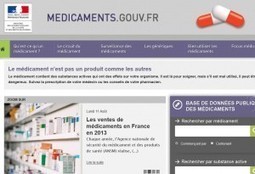
Le 1er octobre 2013, Marisol Touraine lançait www.medicaments.gouv.fr, la première base de données publique et gratuite de référence sur les médicaments, comprenant plus de 12 000 spécialités pharmaceutiques et adossée à un site web d’informations pédagogiques. Au cours des douze derniers mois, plus de 7 millions de pages de la base ont été consultées, par près de 900 000 internautes.
Scoop.it!

Notwithstanding HealthKit’s aborted launch due to a software bug, digital health companies have jumped at the opportunity to integrate their products with Apple AAPL +2.94%’s HealthKit, a hub of personal health data that consumers can display in Apple’s new Health app in iOS 8. Many are betting that the tech giant has the clout and reach to make Health an indispensable tool for patients looking to engage with their doctors outside the clinic. “It’s going to be the biggest health release ever,” says Daniel Kivatinos, a founder of electronic health record provider drchrono. It might take some time for doctors still struggling with electronic health records to widely accept the deluge of data HealthKit brings, but many companies don’t want to be caught flat-footed. Soon after Apple announced HealthKit in June, HealthLoop went to work to integrate its software. The start-up allows doctors to check in with their patients between visits, especially post surgery, to follow their progress. Patients who underwent joint replacement, for example, can now opt to share with their doctors who prescribe HealthLoop, the number of steps they took or their temperature from trackers and blue-tooth enabled devices uploaded through HealthKit. A lack of activity or a spike in fever, can prompt a clinician to intervene. “HealthLoop is able to wrap these streams of biometric data with clinical context,” says Jordan Shlain, founder of HealthLoop and a practicing internist. The application of biometric data in a defined clinical context, such as hypertension or diabetes, is critical in determining the success of monitoring devices with health care providers, as well as patients who are motivated to engage because of illness. “If data comes in and is not actionable, no one is going to bother,” says Michael Blum, a cardiologist at the University of California, San Francisco, and director of its Center for Digital Health Innovation, which validates tracking devices in a clinical setting. iHealth Labs, a subsidiary of Chinese medical equipment company Andon Health, which Apple chose as a partner to pilot HealthKit, sells FDA-approved wireless blood pressure and glucose monitors, among other tracking tools. Data from blood pressure cuffs are uploaded onto mobile devices, such as the iPhone and iPad, and are currently used in clinical studies at UCSF, and the VA Medical Center in San Francisco. iHealth’s chief marketing officer Jim Taschetta says Apple introduced the company to electronic health records vendors Epic Systems and UK-based EMIS Group, as well as Stanford University, and Duke Medicine. To test HealthKit, Duke incorporated readings from iHealth blood pressure monitors into its Epic patient portal. Epic has integrated its MyChart with HealthKit, but it is up to its customers to decide whether they want to enable sharing. Taschetta is encouraged to see a handful of health care leaders adopt HealthKit. “The odds are in our favor to see widespread adoption,” he says. Other companies tying into HealthKit include electronic health record providers Cerner CERN +0.57%, drchrono, and athenahealth .
Scoop.it!

Je pensais pouvoir faire le malin avec ce titre mais il s’avère qu’il existe déjà quelques milliers d’occurrences sur google qui traitent (malheureusement) de ce sujet. Même si « octobre rose » aurait de quoi donner des idées à certaines maisons d’édition, le sujet qui se cache derrière est bien plus grave qu’il n’y parait. Evelyn H …
Scoop.it!
Scoop.it!

Pharma Companies Should Have Public Social Media Disclosure Policies, Survey Results Show http://t.co/5p25GDl5sK #AdPromoFDLI Via Olivier Delannoy
Scoop.it!

Une nouvelle application mobile proposant un service sur mesure auprès de son pharmacien a vu le jour : Pharmao. Découverte. Pharmao se présente comme une application mobile permettant de bénéfici...
|






