Your new post is loading...
THIS week, BRICS TV was launched in Sandton amid much fanfare and excitement. The event was made up of an intimate crowd of individuals from the BRICS nations. And the crowd’s modest size was misleading – it belied the very significance of the entrance into the global mainstream media of a true multinational broadcaster that will certainly impact the flow and form of geopolitical news. In fact, as the ANC’s bigwig Nomvula Mokonyane later said: “BRICS TV will add momentum to a (rapidly) changing world order based on equality, mutual benefit, and reciprocal growth (among BRICS nations).” BRICS TV is a multi-genre television channel now found on StarSat, channel 509. It has been described as “a versatile broadcasting platform catering to a wide range of viewers’ interests and preferences”. The launch was done through logistical collaboration with the National Radio and Television Administration of China. Ayanda Hollow, the president of the television station described in full as “BRICS Africa Channel”, addressed the launch gathering and had the following to say about the new venture: “BRICS Africa Channel intentions are clear: to cascade the resolutions and benefits of the BRICS summits to our audiences, to narrate compelling stories that impact the lives of citizens from the BRICS-Plus nations and to the world.” He continued: “As we see it, as we question it, as we develop culturally together, we will take responsibility for our BRICS TV.” The advent of BRICS TV also brings with it ample opportunities for industry stakeholders – from journalists to producers, scriptwriters, documentary producers, and even filmmakers – the channel is on the lookout for compelling content. Hollow said: “I want to share a fantastic opportunity available to all African television producers and storytellers: Our partnership with China’s TV Theatre and New Vision and New Image, allows you to co-produce with China and the BRICS nations. We must create our future, create jobs for the creative industries, and champion BRICS narratives of development, shaping the world we want for a better Africa and multipolar world order.” As part of an aggressive content development Hollow, who is also the outgoing communications director at the Government Communication and Information Services (GCIS), elaborated as follows: “We plan to commission work in Sepedi, Zulu, and Kiswahili to be dubbed into Mandarin, ensuring all BRICS nations enjoy our African-originated stories. We will deepen our people’s understanding of each other and celebrate our inheritance in cultural and historical moments, activating the stories of women’s liberation movements that are well exhibited at Freedom Park Wall of Names (in Pretoria).” BRICS TV is headed by Nyana Molete (editor-in-chief), formerly national television editor with the SABC. Also on board is Nothando Maseko (managing editor). She is also the former executive producer of the SABC’s Morning Live show and head of news. Peter Ndoro, also formerly with the SABC, is a lead news anchor at BRICS TV. There can be no doubt, therefore, the channel is led by seasoned, highly professional media practitioners who will bring in major editorial experience, collectively. Also speaking at the BRICS TV launch, the ANC’s first deputy secretary-general Nomvula Mokonyane, who is also the party’s head of its sub-committee on international relations, touched on the impact of globalisation. “The world is changing at a faster pace than before. To adapt, we need to build a new paradigm of a shared value system,” she said, before adding: “In this instance, television plays an important role as a conveyor belt in the value chain, each sharing and benefiting from culture as change instrument.” She acknowledged that BRICS exists within the framework of “a global environment with increased connectedness and interdependence of world cultures and economies”. The ANC heavyweight said: “China and South Africa are thousands of miles apart, yet we remain connected through an interwoven value system appreciative of our different cultures, each enhanced towards a common agenda of development that will contribute towards the advancement of a new global order.” Mokonyane further said: “Globalisation has its own challenges, so are BRICS, multilateralism, intra-trade and intra-party, and party-to-party relations. As the world gravitates towards a new order, enemies of global change would – as an act of resistance and failure to adapt to a geo-economic shift and a shift in power relations – often define these developments as a new form of colonialism. She quoted Chinese President Xi Jinping’s recent words: “Countries need to keep an open mind in appreciating the perceptions of values by different civilizations, and refrain from imposing their own values or models on others and from stoking ideological confrontation.” Now, it is my considered view that the entrance of BRICS TV into the global arena must be welcomed by all. First and foremost, consumers of news deserve a plurality of voices, just as is desirable in democracies across the world. The British Broadcasting Corporation (BBC) does a heck of a good job advancing – without fail – the geopolitical agenda of the UK regardless of which party is in office. In all corners of the globe, the BBC either has offices or stringers feeding their London HQ with news packages aligned to the national interest and foreign policy objectives of Great Britain. In fact, in the US the ABC (American Broadcasting Corporation) does an excellent domestic job of projecting a purely pro-American standpoint. It is aided by an avalanche of other news networks, notably CNN, which excels in pushing the US foreign policy objectives in virtually every country on Earth. As they say, until the hunted tell their story, the tales of hunting will always be told from the perspective of the lions (hunters). Thus the emergence of BRICS TV is revolutionary in its own way. It basically brings together the national interest of all the five members of BRICS (Brazil, Russia, India, China, and South Africa). As Hollow noted, the intentions are clear: “To cascade the resolutions and benefits of the BRICS summits to our audiences”. The BRICS bloc is a hugely important organisation in global affairs. It serves as an antithesis to the powerful Western-oriented organisations such as the G7, or the EU. It stands to reason, therefore, that its critics would want to see BRICS fail. So far, BRICS has continued to thrive. In fact, there are more than two dozen applications for BRICS membership from countries in the global south that include Saudi Arabia, Iran, Venezuela, Egypt, Kenya, Argentina, and Indonesia, among others. The pending BRICS heads of state summit scheduled to take place here in South Africa from August 22-24 is a case in point. A confirmed total of 40 foreign heads of state are expected to attend the summit. The growing stature of BRICS in geopolitics, and the bloc’s open campaign for a multipolar world as opposed to the Western-led unipolar world, poses a major headache to the US-led Western hegemony in international affairs. The determination of public discourse and the opinions of Afrocentric scholars and decision-makers will find an enthusiastic home on BRICS TV. So, too, will be the standpoint of the global south in geopolitics, and the timeous communication of pro-BRICS messages. Without the ownership of the means of communication platforms, it is practically difficult and impossible at times to share one’s views. BRICS TV will therefore pose a major challenge to the one-sided Western-led news reporting that way too often peddles the national agenda of their governments and report adversely about BRICS-Plus countries. Hence, in my view, the expected major turnout of the heads of state confirmed to attend the summit. It is it my sincerest hope that the Western nations in the EU and Nato will not ban BRICS TV for its clear stance in support of the agenda of the BRICS bloc. I raise this concern following the sudden banning of RT (Russia Today) by the powerful European authorities, removing a popular television channel that many news consumers tuned in to hear the “other side of the story”. The plurality of voices and the proliferation of news networks and airwaves are fundamentally beneficial to global citizens. No authority, no matter how powerful, should get away with apportioning to itself the power to decide what the citizens of the world should be told, or not. That’s not democracy in any form or shape. It smacks of dictatorship, in spite of attempts to mask it as “protection from propaganda”. BRICS TV will hopefully become a long-desired game changer in a unipolar media world order.
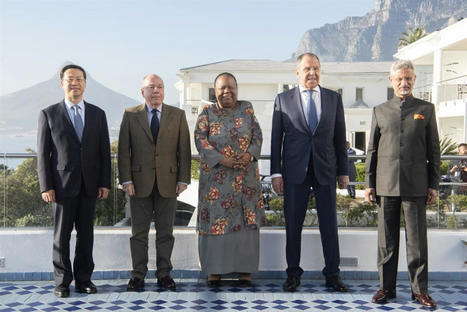
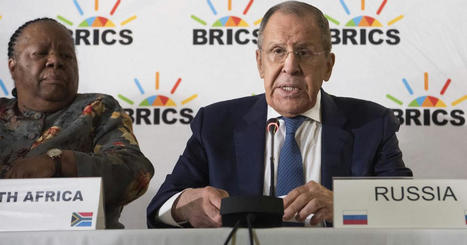
Ma ZHaoxu, deputy Minister of Foreign Affairs of China, Mauro Viera, Minister of Foreign Affairs of Brazil, Naledi Pandor, South African Minister of International Relations and Cooperation, Sergei Lavrov, Minister of Foreign Affairs of Russia, and Subrahmanyam Jaishanker, Minister of Foreign Affairs of India, at the BRICS Foreign Ministers Meeting in Cape Town.
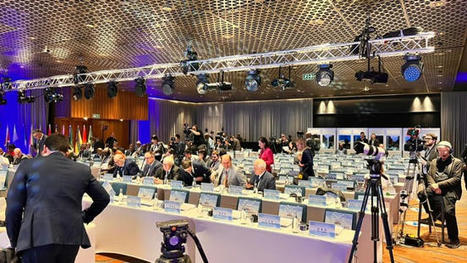
Attendees at the 6th BRICS Media Forum held in Johannesburg on Saturday. Picture: Supplied AFRICA, a continent of rich cultural diversity and immense potential, stands at the threshold of a new era. South African chairperson of the BRICS Media Forum, Dr Iqbal Survé, said the collaboration with Africa was not just a strategic move but a commitment to leveraging our collective strength to uplift the voices of an entire continent. Survé was addressing the BRICS Media Forum 2023 on Saturday where he said this collaboration was a testament to the belief in a global media landscape that would reflect diversity, inclusivity, and shared aspirations. The BRICS alliance – Brazil, Russia, India, China, and South Africa – represents nearly half of the world’s population and a significant portion of the global economy. Survé said: “Africa’s journey toward sustainable development and prosperity aligns seamlessly with the goals of the BRICS Media Forum. By lending our collective voice to the African narrative, we can highlight the successes, challenges, and aspirations of the continent. Our stories can inspire international cooperation, attract investment, and ultimately contribute to Africa's growth trajectory. “In this journey, let us remember that our collaboration with Africa is not just a one-way street. Africa’s vibrant cultures, stories, and perspectives enrich our global dialogue. By embracing this diversity, we promote cross-cultural understanding and amplify the voices of those who deserve to be heard. Together, we can counter the homogenization of news and create a media ecosystem that resonates with all corners of the world.” The forum, whose theme is “BRICS and Africa: Strengthening Media Dialogue for a Shared & Unbiased Future”, will be discussing several themes to create a way forward for BRICS media as a cooperative, and serve as a road map for global media. The key themes are Championing Justice: Media’s Role in Shaping a New World Order; Strengthening Exchanges: Media’s Recipe in Invigorating Africa’s Growth; and Fostering Innovation: Media’s Duty in Driving Green Development. Survé said: “As we move forward, let us stay united in our commitment to uphold the true essence of BRICS and work collaboratively towards a future of shared growth and understanding. Furthermore, by championing a free press and independent media, we pay homage to the struggles of our past while contributing to a more just and informed global landscape. “Let us embody the role of truth-bearers, defenders of justice, and architects of a new world order founded on principles of cooperation and advancement. As we deliberate, let us hold fast to the wisdom of Nelson Mandela: ‘A critical, independent, and investigative press is the lifeblood of any democracy.’” He said the influence of the BRICS alliance, representing half the world’s population, must champion press freedom. “We stand in solidarity with fellow African nations, advocating for press freedom – a cornerstone of democracy. “In Africa, false information obstructs progress, deters investments, and erodes trust. Misleading narratives deepen divisions, eroding social cohesion and fostering mistrust among communities. Polarisation disrupts rational dialogue, stifles collaboration, and gives rise to extremism. This problem extends beyond borders, causing international tensions and conflicts. “To address this, media literacy education is vital. Especially as the dissemination of news on social media does not uphold to traditional standards. Equipping individuals with critical thinking skills helps combat fake news. International collaboration is key to identifying and countering disinformation sources. Cross-border fact-checking mechanisms deter the spread of falsehoods,” Survé said. He said South Africa’s journey as part of the BRICS alliance held great significance in shaping a better world. By addressing anti-BRICS sentiment through transparency, education, engagement, cultural diplomacy, and emphasising contributions, the country would strengthen its foundation for progress. “Together, we have the power to dispel misconceptions and build a narrative that resonates globally.”
Chairperson of Sekunjalo Group Dr Iqbal Survé has called for BRICS countries to support independent journalism in the face of fake news and disinformation and media attacks against independent media voices. He was speaking during the 6th BRICS Media Forum held at Houghton Hotel on Saturday. Picture: Itumeleng English / African News Agency (ANA) Good Morning Mininster Fu Hua Minister Hu Hepping Mr. Dimitri Gornostaev Mr. Srinivasan Ramani Mr. Jose Juan Sanchez Minister Mutsvangwa Good Morning Ladies and Gentlemen and Colleagues from the Media. As the South African Chairman of the BRICS Media Forum, I am truly honoured to stand before you today. This forum unites us not just as representatives of media organisations, but as champions of a shared purpose that will shape a new and just world order. The inception of the BRICS Media Forum stands as a testament to the idea that when we join forces, we amplify our impact. We recognized the potential to transcend borders, cultures, and languages – to foster understanding and facilitate dialogue among our nations. It is more than a gathering of media houses; it is a symbol of our collective strength, shared values, and shared aspirations. Our mission goes beyond storytelling; it's about truth, fostering understanding, and driving positive change. In a world facing complex challenges, unity is our path to finding solutions. Our collaboration provides the platform to explore, discuss, and share these solutions, facilitating dialogue, and bridging the gaps that sometimes divide us. Our unity underscores our belief in shared values and stories, forging a stronger, more informed world. Let's reignite trust in journalism, serving as beacons of integrity. By sharing resources, insights, and innovative practices, we can reshape the media landscape and inspire the next generation of storytellers. NEW WORLD ORDER Today, we convene at the BRICS Media Forum to discuss vital topics that extend beyond our newsrooms. As media houses, our role carries great responsibility, as we shape narratives that can influence the new world order. The new world order isn't just about geopolitics; it encompasses ideas, values, and aspirations guiding humanity. In this evolving era, where media's role transcends borders, our forum becomes crucial in shaping this narrative. BRICS nations collectively represent a significant part of the world's population and economy. Our diverse cultures and viewpoints enrich global conversations. With this diversity, we advocate for an inclusive, cooperative, and just new world order. By harnessing our strengths in the BRICS Media Forum, we contribute to a world of cooperation and shared progress, striving to overcome conflicts. So, how can we leverage our platform to shape this new world order? Sharing best practices, such as fact-checking methods and ethical reporting guidelines, can help counter disinformation. Developing media literacy programs can educate citizens across BRICS nations about credible sources, understanding bias, and critically evaluating information. Prioritising objective reporting, focusing on facts and multiple perspectives, builds trust among media and audiences, reducing the likelihood of sensationalism or misinformation. Our digital presence must be harnessed strategically. Social media and digital platforms transcend borders, making them powerful tools to engage with a global audience. By effectively utilising these platforms, we can ensure that our message of cooperation, mutual respect, and justice reaches every corner of the world. Emphasise collaborating on digital marketing strategies that underpin the digital media realm in order to optimise our impact. We should amplify the voices of the marginalised and under-represented. Our forum can shed light on the challenges faced by developing nations, giving them a platform to express their perspectives and aspirations. By highlighting the stories of those who are often overlooked, we contribute to a world order that values every voice. To achieve a world order where diplomacy and communication are prioritised over confrontation, we must bridge gaps and foster dialogue. This can be achieved through exchanges and workshops that allow journalists to learn about each other's cultures, histories, and challenges. This reduces stereotypes and enhances empathy, leading to more accurate and sensitive reporting. We must stand against narratives of division and promote narratives of unity. Yet, even as we endeavour to contribute to the new world order, we are confronted with the challenge of anti-BRICS sentiment that undermines our collective progress. ANTI-BRICS SENTIMENT In recent times, we find ourselves in the midst of an unprecedented wave of information warfare that seeks to exploit our unity and erode our collaborative efforts. Misinformation and misconceptions breed scepticism and hinder our efforts to secure financial aid and support. Media houses stand as the front-line defence against misinformation. Just as soldiers are entrusted with the protection of a nation, media practitioners bear the responsibility of safeguarding accurate information. Amidst waves of sensationalism and false narratives, our commitment to truth and ethical journalism serves as a shield against the erosion of reliable information. Just as a skilled general strategises to counter threats, we must actively exchange best practices in countering disinformation. By developing robust media literacy programs, we empower our societies to discern fact from fiction. We address the challenge of anti-BRICS sentiment, aiming to counter discord and foster collective progress. Truth is our strongest weapon against it. To dispel negativity and foster a more informed perspective, we must disseminate accurate information, showcase the benefits of our collaboration, and engage in open dialogues. Media can provide responsible journalism, while education campaigns and analysis inform audiences about BRICS benefits. The BRICS constitution expanded to address broader global challenges, and we must prioritise social cohesion through transparency, education, engagement, and cultural diplomacy. Together, we can counter anti-BRICS sentiment, stand united for truth, education, engagement, and highlight the alliance's relevance and positive impacts. In our pursuit of truth, we must also champion the cause of a free press and independent media. In South Africa, the birth of independent media bore witness to a nation's struggle for freedom. It is a testament to our commitment to counter oppressive forces, to seek accountability, and to uphold the voices of the marginalised. The mission of independent media resonates with our quest for justice and equality. In our country’s darkest times, the media became the beacon of hope, revealing the atrocities of apartheid and mobilising global support for our struggle. It was through the power of information that the world became aware, united in solidarity, and eventually contributed to our triumph over oppression. This narrative reminds us of the potency of media to effect change, to challenge the status quo, and to inspire progress. AFRICA CONTEXT However, the fight for a free press extends beyond our borders. The influence of BRICS alliance, representing half the world's population, must champion press freedom. We stand in solidarity with fellow African nations, advocating for press freedom – a cornerstone of democracy. In Africa, false information obstructs progress, deters investments, and erodes trust. Misleading narratives deepen divisions, eroding social cohesion and fostering mistrust among communities. Polarization disrupts rational dialogue, stifles collaboration, and gives rise to extremism. This problem extends beyond borders, causing international tensions and conflicts. To address this, media literacy education is vital. Especially as the dissemination of news on social media does not uphold to traditional standards. Equipping individuals with critical thinking skills helps combat fake news. International collaboration is key to identifying and countering disinformation sources. Cross-border fact-checking mechanisms deter the spread of falsehoods. COLLAB WITH AFRICA Africa, a continent of rich cultural diversity and immense potential, stands at the threshold of a new era. Our collaboration with Africa is not just a strategic move; it is a commitment to leveraging our collective strength to uplift the voices of an entire continent. This collaboration is a testament to our belief in a global media landscape that reflects diversity, inclusivity, and shared aspirations. Africa's journey toward sustainable development and prosperity aligns seamlessly with the goals of the BRICS Media Forum. By lending our collective voice to the African narrative, we can highlight the successes, challenges, and aspirations of the continent. Our stories can inspire international cooperation, attract investment, and ultimately contribute to Africa's growth trajectory. In this journey, let us remember that our collaboration with Africa is not just a one-way street. Africa's vibrant cultures, stories, and perspectives enrich our global dialogue. By embracing this diversity, we promote cross-cultural understanding and amplify the voices of those who deserve to be heard. Together, we can counter the homogenisation of news and create a media ecosystem that resonates with all corners of the world. CONCLUSION In conclusion, our journey as part of the BRICS alliance holds great significance in shaping a better world. By addressing anti-BRICS sentiment through transparency, education, engagement, cultural diplomacy, and emphasizing our contributions, we strengthen our foundation for progress. Together, we have the power to dispel misconceptions and build a narrative that resonates globally. As we move forward, let us stay united in our commitment to uphold the true essence of BRICS and work collaboratively towards a future of shared growth and understanding. Furthermore, by championing a free press and independent media, we pay homage to the struggles of our past while contributing to a more just and informed global landscape. Let us embody the role of truth-bearers, defenders of justice, and architects of a new world order founded on principles of cooperation and advancement. As we deliberate, let us hold fast to the wisdom of Nelson Mandela: "A critical, independent, and investigative press is the lifeblood of any democracy."
Trade imbalances must be rectified, says SA chapter of Brics Business Council. As the country prepares to host the 15th Brics (Brazil, Russia, India, China and South Africa) summit, in Sandton next week, South Africa could be poised to reap the benefits of better access to foreign markets, free trade agreements and better loan terms from Brics financial institutions… developments which could help jumpstart our economy and create jobs. But trade imbalances, especially with China, are a worry. Busi Mabuza, chair of the SA chapter of the Brics Business Council, says the summit and the business-related events around it are an opportunity for the council to promote its proposal that SA’s partners…
BRICS Media Forum. 19 August 2023. The BRICS Media Forum at Houghton Hotel as one of the breakaway build-up sessions ahead of the main summit next week. Picture: Timothy Bernard/ African News Agency (ANA) Johannesburg – More than 200 local and international delegates gathered at the 6th BRICS Media Forum, which got under way at the Houghton Hotel, Johannesburg, on Saturday. Among those who are in attendance are the chairman of the Sekunjalo Group, Dr Iqbal Survé; Minister Fu Hua; executive deputy head of China’s central committee, Hu Heping; and other delegates. ANC leader Dakota Legoete delivered messages of solidarity with media freedom and the war against fake news and disinformation. The director of CHN Energy, Wang Min, said BRICS countries must work hard to ensure energy security. “We should work together as members of the BRICS countries to address climate change in light of a changing global world. “China is striving to achieve carbon neutrality through efficient energy. Each BRICS country has enough talent and skills to realise clean energy. We should strengthen our collaboration among ourselves. “Media, in this regard, is an important force for empowerment and, with support, energy co-operation between BRICS countries," Wang Min said. Legoete said the BRICS Media Forum has become an important component of the BRICS agenda. He said the weaponisation of the media by Western powers and those who seek to dominate the continent of Africa and attack the BRICS agenda should not be allowed to have their way any more. “We must applaud how this forum and platform has grown into a platform that promotes mutual trust and plays a pivotal role on the global stage,” he said. South Africa - Johannesburg - BRICS Media Forum. 19 August 2023. The BRICS Media Forum at Houghton Hotel as one of the breakaway build-up sessions ahead of the main summit next week. Picture: Timothy Bernard/ African News Agency (ANA) “We witness every day the weaponisation of the media. We now see how one country uses bullying tactics to attack states and institutions it doesn’t like. Engagements in the next few days will hopefully result in finding solutions for BRICS countries. “In a changing and complex world, the media becomes a resource for modernisation, strengthening national sovereignty, and promoting our unique history and sustainable development for the future of humankind. “This platform can be an impetus to optimise food security, advance science in medicine, and other aspects of life, and help us become custodians for the future of humankind,” Legoete said. Chairman of the Sekunjalo Group and Independent Media, Dr Survé, said the BRICS Media Forum, which was established in 2015, has become a big part of the BRICS countries in light of challenging media sentiment against the BRICS countries. 3-Click Trading: Act on Quick Signals!avatrade.com Gauteng Surgeon: Easy Method Relieves Tinnitus (Ear Ringing) - Stop Doing Thishealthtrend.live Get ready for load-shedding with reliable home backup power solutions.EcoFlow Official Ramaphosa's plot to kill the ANC continues. Sisulu is a case in point to erase the history of the ANC “The BRICS Media Forum is special because, as the world changes, we need to collaborate more. It was Mandela who championed the media and freedom of the media and other freedoms in all aspects of life,” he said. Dr Survé said South Africa, as a rainbow nation, encourages unity in the country, which is why collective effort is needed to find solutions and shared values in all aspects of life. He said the freedom of the media was an important part of ensuring that each and every view finds its voice in the face of attacks against differing voices, such as Independent Media, which has been attacked for its alternative and pro-BRICS stance. “In a world facing complex challenges, unity is our only hope for finding solutions. It can’t be unity in theory, but in practice. “We need to transform forums such as these. We need to take many steps forward. Our collaboration allows us to bridge the gaps that divide us. We need to reignite trust in journalism and share resources so we can reshape the media landscape.” He said this anti-BRICS sentiment comes at a time when more than 40 countries had applied to become part of BRICS. “Never before has the world faced so many crises. We need to leverage our platforms to bring about a new world order. Anti-BRICS sentiments seek to exploit our unity. “In South Africa, it is only our organisation that represents the viewpoint of the BRICS. Other news media are hostile to BRICS. We have been targeted by those who seek to entrench and promote misinformation. We have to unite against those who are waging a warfare against BRICS countries,” he said.
Dr Iqbal Survé is the co-chair of the BRICS Media Forum and former chair of the BRICS Business Council. The BRICS alliance - Brazil, Russia, India, China, and South Africa - represents nearly half of the world’s population and a significant portion of the global economy. As such, the influence these nations wield in shaping media narratives is immense. The forum, whose theme is: “BRICS and Africa: Strengthening Media Dialogue for a Shared & Unbiased Future,” therefore, presents an opportune moment for BRICS nations to showcase their commitment to media ethics, truthfulness, and inclusivity in a world where fake news and fast news is encroaching on reality. Three key topics will be discussed, to create a way forward for BRICS media as a co-operative, and serve as a road map for global media. These are: Championing Justice: Media’s Role in Shaping a New World Order; Strengthening Exchanges: Media’s Recipe in Invigorating Africa’s Growth, and Fostering Innovation: Media’s Duty in Driving Green Development. Underpinning the forum should be a most crucial aspect, the reaffirmation of press freedom. In many countries around the world, media freedom has faced challenges, ranging from censorship to direct government control and even manipulation, for example, by the financial sector whose hidden hand in global politics is becoming more apparent. The recent chilling example of the UK’s Brexit campaigner, Nigel Farage, who had his bank accounts closed because the bank took a personal view on Farage’s politics, is a case in point. Closer to home, the World Bank has put the squeeze on Uganda’s anti-LGBTQ laws, whilst South Africa’s big banks have all but strangled the Sekunjalo Group of companies on the pretext of a risk to the banks’ reputation –what crimes have been committed by any of these companies, executives or even shareholders, remains a mystery. Worryingly, one of the companies affected by the potential bank account closures is South Africa’s largest print publishing group – Independent Media. Cutting off the voice for huge swathes of the South African people is tantamount to once again silencing the majority. This is also a lesson for BRICS, as steps need to be implemented to prevent anti-BRICS sentiment, of which there is much from the Western conservative axis, from possibly leading to bank account closures and throttling of vital financial resources, for example, to force compliance of those media who have a different opinion, or who service a different sector of society. By openly acknowledging the importance of independent journalism, the BRICS bloc can signal a collective commitment to safeguarding the free press. For Africa and the BRICS region to really grow though, the issue of disinformation and fake news also needs to be tackled. BRICS nations could, for example, establish a joint task force to combat the spread of misinformation, sharing best practices and technological solutions to ensure accurate and verified information reaches the public. In doing so, they can reinforce their position as responsible partners in the global media landscape. Another critical aspect is media diversity and inclusivity. The BRICS alliance represents diverse cultures, languages, and perspectives. Encouraging media outlets to embrace and celebrate this diversity can enrich the global conversation, promote cross-cultural understanding, and counter the homogenisation of news. By facilitating exchanges among journalists from different backgrounds, the foundation can be laid for a more inclusive media ecosystem, and one that promotes justice for all to shape the new world order that needs to be. The advent of digital media has redefined the way information is disseminated and consumed. BRICS nations should focus on media innovation and technological cooperation. By sharing ideas and resources, they can collectively harness the potential of digital platforms to reach broader audiences, especially in remote or under-served regions. Moreover, the BRICS Media Forum can act as a launchpad for discussing pressing global issues that demand international attention. Climate change, poverty, and sustainable development are just a few of the challenges that transcend national boundaries. By dedicating special coverage and resources to these topics, BRICS media outlets can leverage their combined influence to raise awareness and encourage collective action. Lastly, while co-operation and constructive dialogue are essential, the forum should also embrace healthy competition among BRICS media outlets. Encouraging rigorous investigative journalism and substantive reporting will raise the bar for media standards globally, ultimately benefiting the public by providing them with accurate, insightful, and comprehensive news coverage. The upcoming BRICS Media Forum in South Africa is a pivotal moment to emphasise press freedom, combat misinformation, promote media diversity, foster technological cooperation, and address global challenges. In so doing, BRICS countries can collectively shape the future of global journalism.
As South Africa hosts the Brics summit, experts highlight the necessity of solid domestic policies for the country's economy, Trade agreements within the Brics bloc are going to be beneficial for the South African economy but South Africa must get its domestic policies in order, an expert says. Daniel Silke, a political economy analyst, said the Brazil, Russia, India, China and South Africa bloc itself was not necessarily going to bring substantive benefits to South Africa. But in the long run, the association would make a difference for country like SA. Brics is scheduled to hold its 15th summit in Johannesburg from Tuesday to Thursday, chaired by President Cyril Ramaphosa. United Nations secretary-general Antonio Guterres and the five presidents…
he Brics Media Forum at the Houghton Hotel in Johannesburg was one of the breakaway build-up sessions ahead of the main summit next week. Picture: Timothy Bernard/ African News Agency (ANA) Johannesburg - Calls for the BRICS to expand beyond the five current countries who formed the economic bloc continue to grow as geopolitics shift. Chinese President Xi Jinping has been praised as a visionary leader who has ensured that the Chinese economy and the people of China enjoy the benefits of living in a functional socialist republic that prioritises the interests of his people. Various scholars spoke on the recent reports inspired by Xi's economic framework which indicates that China has become one of the fastest-growing economies of the world. Co-director of the Confucius Institute and Centre for Africa China Studies at Unisa, David Monyae, who was one of the scholars who spoke on Xi’s economic thought, called for a new world order where Africa is not seen as the poverty-stricken part of the world but as an equal and progressive part of the world where issues of security and justice are prioritised. Monyae was speaking during the latter part of the 6th BRICS Media Forum held at Houghton Hotel on Saturday. He said the formation of BRICS had been a great step towards a new world order that takes issues of security and other pillars of development seriously. Monyae called for the expansion of BRICS, which has seen more countries of the world applying to be part of it ahead of the BRICS Summit this coming week. "BRICS should be the Herod of international justice and forums such as the United Nations. I would be remiss if I don't touch on the importance of BRICS to Africa. Africa is the future of the world. Bismark once said, ‘He who rules Africa will rule the world’. However, I believe he who collaborates with Africa will secure their future. It is befitting that an African country hosted BRICS and we turn the plight of this continent," he said. “Security and other pillars are crucial. We need to be mindful of that. We have seen the lack of security has ignited instability and war... It will do us good to realise that we cannot continue to be seen as the home of poverty. Some of the core issues are felt across Latin America and Asia and BRICS can't be an elite group but has to expand to ensure it carries the aspirations of the poor of the world.” Andre Thomashausen, professor of international law at Unisa, said the communist party of China and Xi’s thought emphasises the enjoyment of human rights collectively rather than individually. "At the core of his thoughts is collective and equal rights to be free from hunger and disease. These values are defined by the government of China ensuring democracy freedom justice and rule of law. In such a framework, law officials are bound by the laws and officials are charged for transgression of laws. "However, in South Africa, every aspect of the country is in a state of disrepair including rail and the roads. More than 20 million South Africans are jobless. The mismatch of labour has been unprecedented in South Africa. In China, the system is designed to improve the lives if its people under the equal sovereignty of state. “The duty if all states is the enhancement of human dignity and human rights. These cannot be served by economies that place the interest of private wealth over that of the citizens. Africa has a misalignment of development needs and is forced to spend the bulk of its economy servicing debt, but Xi's framework is positioned to ensure the development of the future of the people of China," Thomashausen said. The Star
Minister says these are mere western representations of our nations aimed at reproducing old pattens of domination Keynote address by Dr Nkosazana Dlamini Zuma, MP, Minister in the Presidency for Women, Youth and Persons with Disabilities, BRICS Youth Summit, Durban, South Africa, 18 July 2023 18 July 2023 Thank you, Programme Director, Mr Waseem Carrim, NYDA CEO, Acting Premier of the KwaZulu Natal Province, Ms Nomagugu Simelane, Colleagues from South Africa’s National Executive present, NYDA Executive Chairperson, Ms Asanda Luwaca and the NYDA Board, Ambassador Anil Suklal, the BRICS Sherpa, Representatives from all BRICS Member States, Members of the Diplomatic Corps, All distinguished guests I would like to welcome you to the Southern tip of Africa and the Eastern Seaboard of our beautiful nation, the Republic of South Africa. I am honoured to join you in this important BRICS YOUTH SUMMIT. I wish to extend a very warm South African welcome to all of our guests from BRICS nations and beyond. This summit provides us with an all important platform to exchange insights, share experiences, and consolidate our positioning in the lead-up to the forthcoming meeting of BRICS Ministers responsible for Youth Affairs and the upcoming BRICS Summit. We hold this meeting in accordance with South Africa’s BRICS Chairship theme: “BRICS and African: Partnership for Mutually Accelerated Growth, Sustainable Development, and Multilateralism.” Mandela Day: This summit starts on a very significant day, not just for South Africa, but all global citizens who celebrate and honor the life and legacy of our struggle stalwart and father of our democratic nation, uTata Nelson Mandela. We are also meeting a month and 2 days after from South Africa’s Youth Day, June 16. Celebrating the 1996 Youth Day in Polokwane, President Mandela had this to say about the significance of the role that young people have played in shaping the trajectory of this nation: “We owe it to the youth who perished in struggle on June 16 and in the many years that followed, to ensure that we achieve what we have set for ourselves: to build a better life for all South Africans. On that fateful day 20 years ago, you jolted the nation from its slumber, and rejected the slave education that the apartheid regime had implemented, with the hope of making Blacks accept their slavery. You changed the course of history, and accelerated the downfall of the apartheid system”. I wish to repeat here today that every single one of you in this summit is sitting on the verge of a geopolitical revolution that is BRICS, and all of you are once again in the process of jolting the global community from its slumber. What we make of BRICS and what becomes of this alliance has the potential to change the course of history and accelerate the downfall of an unjust imperialist world order. BRICS is a breakaway from the past. Your Summit, Our Expectations: I hold each one of you in very high regard, and you have serious expectations on what could potentially come out of this crucial summit: Firstly, in an increasingly polarised global environment, I expect your summit to be anti-imperialist. It is in the DNA of every single BRICS nation, historically and today, to be anti-imperialist at every turn. I expect you to pay particular attention to skills, knowledge and cultural exchanges amongst BRICS youth in order to deepen and future proof this alliance. Urgent attention needs to be directed to joint skills development initiatives, with a particular focus on STEM. In the advent of the internet and digital transformation, skills and cultural exchange programmes are easier and cheaper. I expect to see your plans to learn each other’s languages as a fundamental tool of further integration and deepening of ties within BRICS. I expect your summit to drive an in-depth and substantive understanding of your economic strengths as BRICS. of the BRICS nations has a competitive advantage. In Russia, you have a very strong energy and defence industry. In India you have an incredible ICT sector. In Brazil, you a very strong Agricultural sector. China remains an unmatched manufacturing and infrastructural hub. South Africa’s strength has a strong Mining and Tourism sector. Your summit should be able to connect entrepreneurs from Brasilia with those in Mumbai, those in Beijing with those in Johannesburg and Moscow. Beyond your commitment to BRICS, practical steps oh how you move forward with this is what we need. All BRICS nations are blessed when it comes to oceans economy. From the South China Sea to the Indian Ocean and beyond, I expect your summit to reflect on the opportunities this presents for the future economic, energy, transformation and food security. When skilled across the oceans value chain, BRICS Youth should be in a position to future proof our geo-strategic interests, now and in future. With regard to agriculture, I expect your summit to reflect on how, amongst ourselves, we should be able to produce what we consume and consume what we produce. Your Immediate Responsibilities as BRICS Youth: In order for BRICS to reach its full potential and achieve its revolutionary purpose, we need to locate it within its proper context. Consequently, I wish to take the time I have with you to outline what I believe are the most urgent responsibilities of youth within the BRICS alliance: First, as BRICS Youth Leaders, you have the responsibility to gain a firm grip and understand the history of BRICS nations themselves. Closely study the history of India and China, understand the journey traveled by Brazil and the Russian Federation, and locate South Africa among these nations before the formation of BRICS. As BRICS Youth Leaders, you have the responsibility to be historical enough to separate facts about BRICS from the dominant Eurocentric narratives of the world. These narratives are mere western representations of our nations aimed at reproducing old pattens of domination and control of the world at all cost. You need invest in an accurate version of your past in order to take the wheel and steer this BRICS train of freedom and multipolarity towards its logical and intended destination. History is indeed a clock that we all must internalise to tell the geopolitical time of the day. The history of BRICS nations represents a compass for us to find ourselves on the map of human geography. Our past tells us where we are and who we are. But most importantly, our past tells us where we still must go and what we still must be. Who are your traditional allies? What brought us together? What is it about this alliance that unsettles dominant global forces? You have to be able to respond cogently in no uncertain terms. The history of BRICS is fundamentally a history of resistance against colonial conquest and imperial abuse. From Beijing to Delhi, from Brasilia to Saint Petersburg, a culture of resistance and the quest for self-determination is what brings us together. BRICS is not an accidental alliance. The Pioneering Civilizations of BRICS Nations As we host representatives of young people from Brazil, Russia, India, China and South Africa, bear in mind the enormous responsibility for our collective search for an alternative, equitable, and more humane society. The world finds itself at a crossroads, and as the Global South and BRICS nations in particular, we are on the verge of an unprecedented geopolitical revolution. A revolution whose impact, if seized and conducted responsibly, will reverberate through generations and for centuries to come. Beyond the role of defining this revolution, oppressed people of the world are looking at us for alternative directions toward a more humane and collectively prosperous global community. Importantly, you are standing on the shoulders of thousands of years of Pioneering Civilisations among individual BRICS Nations. For example, the Chinese civilisation which is older than 5 000 years and has traversed a journey that presents ample lessons for the Global South. Over the past century, the Communist Party of China (CPC) has led China’s rise from the depths of colonial invasion to the 2nd largest economy in the world. In an era of widespread social and economic insecurity and widening disparities between and within nations, China has been exemplary in nurturing a system of meritocratic governance across its political stratum, the success of which can be seen in the country’s record levels of industrialisation, job creation, peaceful co-existence and the lifting millions of people out of poverty. As a result, China has achieved and exceeded the poverty reduction targets set out by the United Nations Agenda 2030, a decade ahead of time. Remarkably, China has recorded this achievement while adhering to a national poverty benchmark that is higher than that applied by the World Bank. In his latest book titled “Has China Won?” Singaporean Scholar Dr Kishore Mahbubani notes that “under the leadership of the Communist Party of China, the bottom 50% of China’s population have had their best thirty years in 3 000 years”. Similarly, the Indian Civilisation , which also spans thousands of years, and the country’s rise and development from the ashes of colonialism should be looked at closely. Three decades ago, few imagined that India would rule the IT industry, and that of the top ten IT companies in the world, nearly half would be of Indian origin. Fewer of us imagined that Indian companies would be providing jobs globally, including in the west. The history, investment, and decisive leadership that went into making India a tech giant today is worth an in-depth analysis. Brazil has a rich history pre-dating it’s occupation by the Europeans. Some of the earliest human remains that were found in the area of Pedro Leopoldo provide evidence of human habitation going back at least 11,000 years. The sophisticated pottery and evidence of mound building found by archeologists on the island provided the first evidence that a complex well-populated society with sophisticated settlements had existed on these islands. Brazil has come a long way to overcome its colonial past to occupy its space in the galaxy of nations. Over the last 70 years in particular, the country’s economy has developed to become one of the top 10 largest economies in the world as one of the world giants of mining and beneficiation of mining resources through strategic industrialization, agriculture, and manufacturing, and a rapidly growing service sector. Brazil is the world’s primary source of coffee, oranges, and cassava (manioc) and a major producer of sugar, soy, and beef. We also have much to learn from the rich history of Russian civilization which dates back more than a millennium. It was the largest and leading republic of the Soviet Union. Despite its current challenges, Russia is one of the world’s most industrialized countries in various sectors like machine-building, they manufacture steam boilers and turbines, electric generators, grain combines, automobiles, and electric locomotives. Russia is able to meet its demand for shipbuilding, electric-power-generating and transmitting equipment, consumer durables, machine tools, instruments, and automation components. Russia’s factories also produce armaments, including tanks, jet fighters, and rockets, which creates employment for its citizens. Here in South Africa and most parts of the continent, we have to also reflect and share experiences on and learn from the history of wars of resistance that far predate the struggle against apartheid capitalism. As the continent, we are on a journey towards developing the continent to its full potential through the implementation of Agenda 2063, the Africa we want. The purpose of the history of BRICS civilisations is to prepare you into responsible and effective handlers of power. Our present day reality point to the fact that past injustices, even when they appear to be distant in time , will continue to endure in people’s lives in both material and affective ways unless, and until, they are consciously and carefully addressed. In other words, it is only when you are armed with an undiluted sense of the history of the journey traveled by BRICS nations that you will be able to cease the current moment and repair past injustices. Mariam Makeba was more forthright about this point when she said: “The conqueror writes history, they came, they conquered and they write. You don't expect the people who came to invade us to tell the truth about us. They will always write negative things about us. And they have to do that because they have to justify their invasion in all the countries.” Secondly, as BRICS youth leaders, you have the responsibility to rally all of the Global South and all of Africa behind the win-win and mutually reinforcing vision of BRICS. The year 2023 marks three and a half decades (34 years) since the fall of the Berlin wall, and what many mistakenly thought was the end of the Cold War, we now know it was not. This was a conflict from which the Hegemonic West emerged with the strength to impose developmental models that, in the main, succeeded in reproducing fundamental disparities between and within nations. In all of this, the Global South and Africa, in particular, have been at the receiving end. This year also marks the 60th anniversary of the Organization of African Unity (OAU), an important reminder of what this continent has endured and continues to endure. The era of BRICS should thus be seen as a necessary continuation of this fight to write our own developmental script and the fight to determine our destiny without any form of neocolonial supervision. The dominant Bretton Woods system and its subsequent neoliberal order have been based on rules that were not only imposed on us but have also been strictly applied only to the extent that they benefit Western corporations regardless of the immediate and/or future detriment of developing countries. Moreover, the West’s expressed belief in the developmental models they imposed on us has been a case of do, as I say and not as I do. Each of the Bretton Woods Institutions (WTO,WB,IMF) has served the enduring and hegemonic principles of unipolarity, principally in pursuit of Western dominance and control of wealth-producing resources from the developing world. In their design, the development policies that have subsequently been imposed on the developing world have mostly resembled what Ha-Joon Chang called Predatory Samaritans’ “baited hook” that is, a carefully constructed debt trap that co-opts our developmental aspirations and, under the cloak of inclusion, and exploit our individual and collective repayment struggles The evidence is clear, we have had centuries of a raw and mostly inhumane deal, a deal that BRICS should bring to an abrupt end. As people who will inherit BRICS nations, I wish to stress that multipolarity is not an option, it is a break with an unjust past and a precondition for us to live as sovereign people. Thirdly, consistent with our theme, you have the responsibility to make the concept of BRICS relatable to people from all walks of life, particularly those who remain at the margins of society. The BRICS concept must not be an elite one. Is there a relationship between BRICS and the price of bread in the streets of Soweto? You must be able to explain and give meaning to multipolarity and multilateralism, beyond common jargon. In this way, you will be able to demonstrate, in simple terms, the potential socioeconomic and cultural benefits of this alliance to every man and woman in the streets. BRICS is as good as people who believe in it; beyond that, it is a concept. BRICS and its Multipolar outlook is fundamentally about repairing an unjust past and preparing for a future of collective well-being and prosperity among equals. Multipolarity is a departure from the dominant reality of a unipolar world order, in which there is only one dominant power. In a multipolar world, power is dispersed, and no one country has the ability to dictate the international agenda. The rationale behind multipolarity is that it promotes stability and reduces the likelihood of conflicts. When there is no single dominant power, each great power must negotiate and cooperate with others to achieve its national interests. The presence of multiple centers of power also means that no single power has the ability to impose its will on others, which can help prevent conflicts and promote peaceful resolution of disputes. In a unipolar world, marked by the supremacy of a singular superpower, we are having to resist a tendency to reduce the developing world into satellite states of the superpower. We are resisting the rise of hegemonic tendencies, whereby the dominant nations draw on their colonial legacies to impose their values, political systems and economic policies on the Global South , thereby undermining our sovereignty, and often using their hard power to crush resistance. Through multipolar approaches to international relations , we are able to reassert the checks and balances in global governance, against unilateral impunity. The fourth point I wish to make is that, for us, as South Africa, our passion for BRICS must run alongside our drive for the integration of both Africa and Africans, those at home, and in the diaspora. Through African integration, we should seek to take back the slavery, colonialism, and neo-colonialism that took away from us: an African frame of mind. The mere point of unity among Africans places us in the arena of world power and great potential for the future we want. It is from this arena of world power, in an evolving and increasingly contested geopolitical reality, that African self-determination and self-reliance can be attained without sacrificing our way of life. Our forefathers knew then what we must know now that only those who unite and command the wealth-producing resources of the land can be considered truly sovereign. It is therefore not surprising that African integration was a central theme of the conference that founded the OAU. Addressing the sitting that founded the Organisation of African Unity (OAU) on the 25th May 1963, President Kwame Nkrumah made a statement that should be repeated this afternoon: “Africa must unite or perish …The struggle against colonialism does not end with the attainment of national independence … We are fast learning that political independence is not enough to rid us of the consequences of colonial rule. Without necessarily sacrificing our sovereignties, we can forge a political union based on defence, foreign affairs and diplomacy and a common citizenship, a monetary zone and a central bank. We must unite in order to achieve full liberation. The Fifth reminder I wish to leave you with is that master’s tools will never dismantle the master’s house. As BRICS Youth Leaders, you are responsible for writing a new developmental script. Which script must include a blueprint for integration and interconnection of people and systems across the BRICS nations and its partners Integration should mean integrated Finance, ICT for communication, trading, and accessibility of public health services by bridging the distance between national systems. Our integrated ICT strategies should connect our youth digitally, enable cultural exchanges and leverage the power and ability of the creative industry to generate millions of jobs across BRICS. You also have the intellectual responsibility to break society from their seemingly acceptance of rentier capitalism as an accepted orthodoxy. BRICS Youth leaders should lead the charge against this and other forms of exploitation where we literally have to pay to survive - you need to imagine a society where everyone has basic socio-economic security. The Sixth point I wish to stress is that you have the responsibility to end the manufacturing of consent through media monopolies currently engaged in mainstream misinformation and disinformation campaigns. I expect you to take this matter very seriously. Ongoing misinformation about and against BRICS itself should motivate you all to imagine new and alternative media platforms and narratives that do not reduce us into subjects or even objects. We need alternative forms of conscious journalism out of this summit. Finally, I expect your summit to reimagine an Alternative Banking and Financing Architecture for the global south. Productive societies require productive sectors of the economy, industrialised around manufactured finished goods and away from the shipping of raw materials. We currently have a structural problem of a banking industry that is not only greatly concentrated and monopolised, but also in many ways does not serve our interests. Those who prefer us shipping raw materials will not fund our manufacturing plants, they will not fund a rail system that connects the content for the movement of people, goods and services. We need an alternative public banking and finance system beyond the dominant one, and we need it urgently. The New Development Bank is thus a step in the right direction but we need to domesticate alternative banking as a matter of urgency. For example, in South Africa we are forced to kneel before 5 banks. This represents some of the most concentrated banking systems in the world. The greater concentration of banking to the big 5 has clearly undermined accountability, hindered development, stifled competition and passed on the cost burden to citizens. Without control over finance and banking, only those projects that converge with the interest of private interests will be funded while the interests of the communities we serve take a backseat. An alternative world based on principles of social solidarity and multipolarity is within our reach, the dominant order has reached its sell by date, let's change gears and ensure a decisive break with our untenable past. I thank you. Issued by Department of Women, Youth and Persons with Disabilities, 18 July 2023
EThekwini mayor Mxolisi Kaunda, Deputy Minister of Trade, Industry and Competition, Nomalungelo Gina, and director at Cosmic Energy Africa Derek Naidoo during the KZN Brics Trade and Investment Seminar that took place in Durban at Elangeni hotel. l Thuli Dlamini Durban — KwaZulu-Natal will take full advantage of business opportunities that will come with the BRICS Summit which begins next week. This was revealed by Thabane Zulu, the CEO of the Richards Bay Industrial Development Zone (RBIDZ), who delivered a welcoming message on behalf of the Economic Development, Tourism and Environmental Affairs MEC, Siboniso Duma. Zulu was speaking at the BRICS KZN Trade and Investment Seminar held at Southern Sun Elangeni and Maharani Hotel in Durban, on Thursday. Zulu welcomed delegates from Saudi Arabia, Egypt, Qatar and other countries who also attended the event. It was also attended by Trade, Industry and Competition Deputy Minister Nomalungelo Gina. Zulu told the delegates that the provincial government was determined to take advantage of opportunities offered by being part of BRICS. “I wish to remind the people of this country and the world that KZN hosted the BRICS Summit in 2013 and BRICS Business Council from July 22 to 23, 2018.” He said the MEC had stated that through the province’s entities Trade Investment KwaZulu-Natal, Dube Trade Port and Richards Bay Industrial Development Zone, a programme had been developed that will ensure “we present to the potential investors key areas that should be considered for investment”. “We strongly believe that KZN cannot prosper in isolation. We wish to state unequivocally that our long-term success lies in the integration of our economy with economies of the countries in the BRICS bloc,” said Zulu. He said the provincial government had arranged for companies operating in the province and emerging entrepreneurs to be part of the seminar to establish links with their foreign counterparts. Delegates at BRICS Trade and Investment seminar that took place yesterday in Durban. l SUPPLIED The second leg of the seminar will be held at Richards Bay on Friday. Zulu said that the visit to the Richards Bay Industrial Development Zone, which will take place on Friday, must be viewed within the context of the provincial government’s commitment to direct potential investors to all corners of the province, including rural and township areas. He said the MEC had also reflected on the township economy. “As the province, we are interested to host our very own township economy in BRICS dialogue in the future in partnership with the Township Economic Commission of South Africa and the Department of International Relations and Co-operation BRICS Directorate.” He said, in this regard, the MEC believed that countries in the BRICS Bloc must collaborate to develop the townships and rural areas. “He (Duma) has echoed the words of the Minister in the Presidency for Planning, Monitoring and Evaluation, Maropene Ramokgopa, who pointed out recently that BRICS member countries have the capacity to leverage the combined resources, experiences and expertise to support each other in nurturing vibrant township economies.” Zulu urged delegates to come back to the province next month since it would be tourism month. He said that they would have the opportunity to visit game parks and World Heritage Sites.
The fact that South Africa is willing to support Russia in its war against Ukraine (or at least support Russia more than it supports Ukraine), says something about its rulers’ human rights orientation, which might be closer to the governmental children of Mao and Stalin than those of Mandela and Sisulu. One problem with the upcoming BRICS Summit was immediately apparent the moment that Iqbal Survé promoted “responsible journalism in South Africa” in the name of the related BRICS Media Forum. Survé, the co-chair of the forum and former chair of the SA BRICS Business Council, called for “steps” to be “implemented to prevent anti-BRICS sentiment, of which there is much from the Western conservative axis, from possibly leading to bank account closures and throttling of vital financial resources, for example, to force compliance of those media who have a different opinion, or who service a different sector of society”. He went on to recommend that, “By openly acknowledging the importance of independent journalism, the BRICS bloc can signal a collective commitment to safeguarding the free press. “For Africa and the BRICS region to really grow though,” Survé wrote, “the issue of disinformation and fake news also needs to be tackled. BRICS nations could, for example, establish a joint task force to combat the spread of misinformation, sharing best practices and technological solutions to ensure accurate and verified information reaches the public. In doing so, they can reinforce their position as responsible partners in the global media landscape.” It is not hard to see where this is coming from. Survé has failed to throttle criticism of his dodgy dealings and the transformation of the Independent Media group from watchdog to lapdog and personal praise poodle. He appears ignorant of the incontestable fact that Russia and China are not home to free and critical media and are unlikely allies in the fight against fake news. Presumably, he has no beef with their state censorship which protects the nomenclature against the vagaries of criticism and “deals with” journalists by making them literally go away. Still, the lack of a sense of irony is not the only problem with BRICS. Iqbal Survé during Day 1 of the 10th BRICS Summit at the Sandton Convention Centre on 25 July 2018 in Sandton, South Africa. (Photo: Gallo Images / Wessel Oosthuizen) The term ‘Global South’ The first and most fundamental of these is conceptual. The BRICS nations are purported to represent “Global South” aspirations. But as Stewart Patrick and Alexandra Huggins point out in a recent Carnegie paper, the term is misleading and unhelpful for a number of reasons, though this has not stopped some notables from employing it. “Many countries of the Global South face huge debts, increasing poverty and hunger, and the growing impacts of the climate crisis,” observed the UN Secretary-General António Guterres last November. World Bank President Ajay Banga has also used the term, as has US President Joe Biden and some of his officials, including the national security adviser and the secretary of commerce. So too have leaders of the Global South spoken in this way about themselves. Coined originally by Carl Oglesby, a US writer and activist, in 1969, the term is becoming increasingly popular among academics in search of a jargon rail. But that is no recommendation of its accuracy or usefulness. Usage has unsurprisingly increased, given the revived bipolarity between the West and China/Russia, especially in the light of the latter’s invasion of Ukraine, and growing economic problems in the developing world in the wake of growth slowdowns, debt mismanagement and the coronavirus pandemic. But, note Stewart and Huggins, the term lends itself to generalisations and commits similar mistakes to the ones that blighted development in the past. For one, it supposedly represents what was once termed the “Third World”, today a pejorative label, which includes no fewer than 134 countries. Given the differences between large states and small, littoral and landlocked, oil-rich and poor, service economies and industrial powerhouses with large and small populations, including two-thirds of the Earth’s people, it risks “conceptual incoherence”, coming up with premises and policies so general they are not useful, and reinforcing “inaccurate and outdated dichotomies and stereotypes”. Indeed, many of its members have enjoyed impressive growth because of — and not despite — the global economy that other members rail against. It also lumps together diverse political regimes, including model democracies (Costa Rica, for example) and totalitarian regimes (take your pick). Respect for human rights? But perhaps this suits some, and points to the second failure of the BRICS concept. How valuable is this body when its members apparently don’t share core values, not least of human rights and the maintenance of global order? The fact that South Africa is willing to support Russia in its war against Ukraine (or at least support Russia more than it supports Ukraine), says something about its rulers’ human rights orientation, which might be closer to the governmental children of Mao and Stalin than those of Mandela and Sisulu. Third, if BRICS actually wants to change the basis of the world’s power structures, what might its actionable recommendation be for restructuring the United Nations? At its core, for all of the grandstanding on this issue, the problem with this objective, tired old pinata that it has become, is that the current members don’t want to be diluted and the aspirants can’t agree among themselves who should become new permanent members. Global South alphabet soup While we are regularly informed that all manner of countries want to join BRICS, it is not alone in the alphabet soup of new international bodies representing bits of the Global South. These include the CIVETS (Colombia, Indonesia, Vietnam, Egypt, Turkey and South Africa), the MINT economies (Mexico, Indonesia, Nigeria and Turkey) and the EAGLEs (Emerging And Growth-Leading Economies — Brazil, China, Egypt, India, Indonesia, South Korea, Mexico, Russia, Taiwan and Turkey), IBSA (India, Brazil and South Africa), the 23-member Iora (Indian Ocean Rim Association, formerly the Indian Ocean Rim Association for Regional Cooperation), as well as VISTA, MIST/ MIKT/TIMS, Next 11, and many others, not least the Southern African Development Community (SADC), the Common Market for Eastern and Southern Africa (Comesa) and most importantly, the African Continental Free Trade Area (AfCFTA). What is BRICS’s comparative advantage given the diversity of its membership and their size and orientation, save what they are against (the West)? Finally, related to the above, South Africa has made a choice to put its limited resources — financial and human — behind BRICS. Is this sensible, given that it should be investing as much as it can to access the richer markets of the world? At last glance, the share of developed economies (members of the Organisation for Economic Development and Cooperation, for instance) amounted to 63% of the global economy, three-quarters of world trade, 95% of official development assistance, and just 18% of the world’s population. Thus, investing a big chunk of time, money and energy in BRICS is akin to withdrawing the last bits of your taxpayers’ savings, going out for a fab meal for two and betting the remainder on red.
Data show that Russia is an insignificant trade partner of South Africa. In terms of economic partnerships, it is a clapped-out Lada vehicle, a lemon with not much juice to be squeezed from it. As the BRICS 22-24 August summit looms in Johannesburg -- in the shadow of Pretoria's difficult diplomatic dance over Moscow -- it is important to note just how unimportant Russia is to South Africa's economy. South Africa exports mostly citrus to Russia, giving it a shot of vitamin C. Russia exports mostly fertiliser to South Africa -- and briquettes for our braais. As a percentage of South Africa's trading relationship with other BRICS members, trade with Russia barely registers. At a BRICS Business Breakfast last month, some useful data underscored the point that Russia is basically a brick compared with the Great Wall of Chinese trade flows to South Africa. "SA's trade with Russia is relatively low, representing only 1.7% of the country's total trade (exports + imports) with the BRIC economies in 2022," the presentation said. "Relatively low" is an understatement. The other BRICS members -- China, Brazil and India -- account for 98.3% of South Africa's trade within the grouping. China has the tiger's share at 67.6%. Whatever was loaded on the Lady R Russian cargo ship might have made a material difference to South Africa's 2022 trade data with Russia, even if it was only lemons and...
|
The BRICS countries will meet over a three-day summit in Johannesburg this week. This is what you need to know. The BRICS countries, an acronym of the five members Brazil, Russia, India, China and South Africa, meet for three days for a summit in Johannesburg starting Tuesday. Representing 23% of the world's gross domestic product (GDP) and 42% of the world's population, they are seeking to dull Western economic domination in global affairs. Here are some facts and figures about the BRICS A new world order? A group of emerging economies, it was formally launched in 2009 and it meets yearly at a summit hosted in rotation by one of the member countries. The meetings aim to assert their position particularly in relation to the United States and the European Union. It promotes the recognition of a multipolar global order with economic and political balance, with the aim of breaking away from organisations formed in the post-World War II era, such as the World Bank and the International Monetary Fund (IMF). Aspirants The bloc whose economic growth is mainly driven by China and India, is now open to expansion. Twenty three candidates have applied to join the BRICS, and an almost similar number have expressed an interest - among them Argentina, Ethiopia, Iran and Saudi Arabia. One of the attractions of the group is the New Development Bank, created in 2015 with the aim of offering an alternative to the World Bank and the IMF. The Shanghai-headquartered bank has since invested $30 billion in infrastructure development projects in member states and other developing economies. READ | BRICS bank raises R1.5 billion in first South Africa bond auction The Putin dilemma Preparations for the summit saw diplomatic tensions rise on the global stage after host President Cyril Ramaphosa invited Russia's President Vladimir Putin who is the target of an International Criminal Court (ICC) arrest warrant over the war in Ukraine. Following months of speculation, Pretoria finally said Putin will attend the summit via video link. South Africa, whose ruling ANC party forged relations with Moscow during the Cold War, when the Soviet Union backed its fight against apartheid, has refused to condemn Russia's invasion of Ukraine. Down with the dollar The five countries account for 18 percent of international trade, the majority of which is transacted in dollars. Critical of the greenback's predominance in world trade, one of their goals is to free themselves from the dollar. The bloc supports the increased use of members' national currencies for trade and the introduction of a common payment system in the long term. Brazil and China earlier this year signed a bilateral agreement to settle their trade in their local currencies.
Corne Mulder says it is a well-known fact that Russia wants to expand its influence to the Middle East via BRICS Dividing line between BRICS and the West increasingly poses a risk to South Africa Iran's possible joining of the BRICS group and growing demands from Russia for active support from BRICS countries against the West are creating a crisis for South Africa. Iran formally requested to become part of the BRICS group, which currently consists of China, Russia, India, South Africa and Brazil. It is a well-known fact that Russia wants to expand its influence to the Middle East via BRICS. According to media reports, President Vladimir Putin of Russia reportedly asked the leaders of BRICS countries during last week's BRICS summit to cooperate with Russia in the face of the West's sanctions against it. It will compel South Africa, which has up to now maintained an attitude of neutrality and dialogue towards the conflict in Ukraine, to support active steps against attempts to persuade Russia through sanctions to reconsider its aggression towards Ukraine. This, in conjunction with allowing a country like Iran to join BRICS, will increase America and the West’s scepticism towards the BRICS partners. In the process, South Africa's trade relations with America and the West could suffer severe damage. South Africa finds itself in an increasingly uncomfortable position, particularly due to its economic dependence on America with which it has the beneficial AGOA trade agreement that allows certain African countries to export goods to America duty free or at a much lower tariff. It would come as no surprise if America were to reconsider including South Africa in its AGOA agreement in the near future. Thus far, South Africa's silence was seen as just that. However, participating in actions against the West, with new allies like Iran, could drastically change the situation.
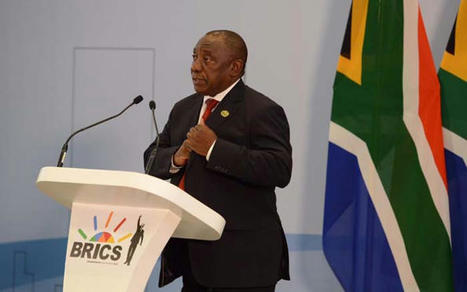
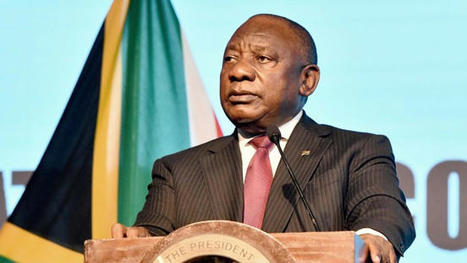
Ramaphosa said there has been a tectonic shift in the geopolitical landscape of the world recently, with the era of one power having dominance over many parts of the world over. President Cyril Ramaphosa delivering the closing address at the BRICS Summit in Sandton, Johannesburg. JOHANNESBURG - President Cyril Ramaphosa believes the growth of Brazil, Russia, India, China and South Africa (BRICS) organisation shows that the world has entered a "multipolar" era. Ramaphosa spoke on the sidelines of the African National Congress’s national working committee (NWC) meeting at the Turffontein Racecourse in Johannesburg on Saturday. The President said he is looking forward to hosting the world’s leaders for the BRICS summit at Sandton Convention Centre this coming week. ALSO READ: - Motorists warned about Sandton and Midrand road closures ahead of BRICS summit
- SA confident of hosting safe and secure BRICS summit Ramaphosa said there has been a tectonic shift in the geopolitical landscape of the world recently. He said the era of one power having dominance over many parts of the world is over. Ramaphosa said Brics summit presents an opportunity for world leaders to address many issues, including the case of unilateral sanctions. "Because we now have a new world order and the BRICS Summit is going to be discussing all that, and the important thing is that South Africa, small as we are, is right at the epicentre of these types of discussions, testifying to the role that we play. We're not arrogant about it, humble but we're recognised for the key role that we play," the President said. Ramaphosa is expected to address the nation on Sunday regarding Brics and other foreign policy issues relating to South Africa.
RT told Brics media summit that Western media's depiction of the rest of the world must change. Russia Today (RT) addressed the Brics media forum in Johannesburg. Photo: iStock Against a background of decades marked by the American and British media as the arbiters of what is important and relevant for the world, Russia Today (RT) has called for a media landscape in the new world order, which it says “has to be truly multipolar”. Addressing the two-day Brics media forum in Johannesburg, RT first deputy editor-in-chief for news, Elizaveta Brodskaya, said the international news market was monopolised by the US and the UK, with CNN and BBC being the dominant players. ‘Africa defined according to Western media’ She said in 2003, CNN and BBC painted “the picture they (Western countries) wanted about the Iraq invasion”. “Colin Powell was sitting in the UN Security Council, waiving a vile of fake evidence supposed to prove non-existent possession of weapons of mass destruction by Saddam Hussein – lying, but there being nobody to call him a liar,” said Brodskaya. Reflecting on the new world order championed by Brics, Brodskaya said some sections of the international community – “even those not from the West”, had “a particular image of the world, in part created by the Western media”. READ MORE WATCH: Putin’s grain threat ALSO READ: South Africa and Russia, the ‘strange bedfellows’ Said Brodskaya: “Let us take Africa, where there are two topics that dominate the coverage on the continent by the mainstream media, like CNN and BBC. “It is either a piece on something horrible – war, hunger, disease and corruption – or a package on African fauna. “These range from lions and Kalashnikovs – defining Africa according to Western media – something until very recently, a narrative parroted by the rest of the world. ‘Countries set own agenda’ RT believes that the local population of each country should set the agenda of what is covered, Brodskaya said. “Our local correspondents tell us what is important to them, not the other way around.” Brodskaya said the “monopoly on narrative” took place on a global scale. “It is a simple and straightforward formula – something becomes an important cultural issue in the United States, and then very quickly this issue is extrapolated around the world. “Take the topic of transgender rights. Ten years ago, this was not an issue of conversation. Now we have local media around the world writing stories and filming movies on the topic. “From Nigeria to India, everyone must be concerned about whether the government should or should not provide its citizens with the right to change their gender. “I am not saying that this is not a real issue – what I am saying is that this issue had been artificially inserted into media coverage around the world,” maintained the RT editor. ALSO READ: Brics bloc benefits: South Africa must ‘get house in order’ first ‘Independent platforms’ On what it would take to have “a truly independent media in the new world order”, she said: “We need a platform independent of foreign government control. “We have made some progress on this in Russia, with China and India having their own platforms. This process is just starting on a global level and we have a long way to go.” On the dawn of the multipolar world, she said: “The Western media dominance is not only a question of what topics to cover – but an idea that the values that western liberalism propagates being made relevant and beneficial for a global society. “Anything that does not fit this moral code, is considered at best ignorant – at worst barbaric. “As I look around in this room, I see people from around the world. “Your personal experience, education and values, are often based on the knowledge and wisdom formed by centuries of cultural development. “It is absurd that anyone from the Western media would feel comfortable to judge your countries’ morality as if they are talking to a baby.” The Brics media forum – expected to adopt key resolutions on Sunday – serves as a platform to highlight new developments within Brics countries (fastest-growing emerging markets of Brazil, Russia, India, China and South Africa).
Professor Anil Sooklal, ambassador-at-large for Asia and BRICS and South Africa’s Sherpa, speaking at a BRICS event. File Picture: Timothy Bernard African News Agency (ANA) Durban - The BRICS bloc was never created as a bloc against any other entity and is not in competition with any other existing forum, Professor Anil Sooklal, ambassador-at-large for Asia and BRICS and South Africa’s Sherpa, said on Monday. The BRICS countries, Brazil, Russia, India, China and hosts South Africa, will gather at the Sandton Convention Centre in Gauteng next week for the 15th summit. President Cyril Ramaphosa has also extended invitations to heads of state of more than 50 other countries. Sooklal said a narrative was put in the public domain that BRICS was anti-West and the coalition was created against the G7, but this was not an accurate description of why the bloc was created. He said BRICS came together to look at how the countries could work collectively in terms of the shared values they have in terms of reshaping the current global architecture, taking the interests of the Global South and projecting them as part of creating a more inclusive, representative and fair multi-polar world. “BRICS is far more visible on the global stage including the issue of Russia and South Africa hosting the summit and the ICC arrest warrant that has brought undue attention to the challenges it posed for the host country. “We have dealt with that in a manner that all of our BRICS partners, including Russia, are quite satisfied. “President Ramaphosa has done a good job, through a consultative process, with all BRICS partners to find a solution that does not detract from the summit,” Sooklal told Bloomberg Television. He said the factor that has brought focus on BRICS is its possible expansion. “The large number of countries, major emerging market developing countries that have collectively approached BRICS to become full members.” Sooklal said partners from the Global North fully understand that South Africa has very strong relations with them, and “we respect those relations and we continue to grow it and so too do we have relations with BRICS, other countries in the Global South and on the African continent”. “This is the diversity of South Africa’s interaction with the global community. We don’t play one country against another or one region against another.”
The susy Brics programme will include boosting trade and investment of member nations. Flags of the Brics countries. Picture: iStock Various parties and stakeholders are gearing up for the Brazil, Russia, India, China and South Africa (Brics) summit where topics like the expansion of the forum and cooperation will top the agenda. The summit will run from next Tuesday to Thursday in Johannesburg and is planned to boost trade and investments among Brics members but more importantly, to strengthen the economic standing of the global south. More countries from Africa, the Middle East, Asia and the Americas – including several oil-exporting nations have applied for Brics membership. The summit will take place against earlier rumours that India might attend virtually and that New Delhi was opposed to the expansion of Brics, something that has since been refuted by International Relations and Cooperation Minister Naledi Pandor. The meeting will be preceded by a full programme of events this week including a welcome reception tomorrow afternoon and the opening ceremony on Saturday morning. READ MORE WATCH: Putin’s grain threat This will be followed by media panel discussions on Sunday to address various topics regarding the media. READ: Brics in Soweto: township economy dialogue launched In the run-up to the main events, various private and public stakeholders will discuss the formation of the (private-sector) Brics Health and Pharmaceutical Forum in Pretoria today. The forum’s objectives include establishing a Brics Clinical Research and Development Innovation Centre to advance clinical research. The forum seminar recently discussed malaria, non-communicable diseases, mental health and closer institutional cooperation in the health regulatory environment. The forum findings include that the Brics nations could invest in healthcare infrastructure development in Africa, including the building and development of hospitals, clinics, medical equipment and research facilities. These would be presented to ministers, ambassadors and other officials during a gala dinner. Tomorrow, the Brics Business Council together with the Gauteng Growth and Development Agency and the Organisation for Global Africa Cooperation will hold the Africa caucus comprising senior representatives of large companies from Africa. From 2pm, an hour-long discussion involving business representatives such as chairpersons and CEOs of large firms will be held on the sidelines of the Brics Business Forum. The forum will discuss how to share South Africa’s strategy and plans to develop and strengthen business ties between Africa and Brics countries. South Africa has proposed to promote trade and investment between the rest of African business communities and the Brics nations. The participants will explore initiatives to promote the participation of the African private sector in the activities of the Brics council and to facilitate and strengthen Africa’s trade and investment partnerships with Brics nations and its business communities. They will also identify opportunities and challenges for the implementation of the African Continental Free Trade Area.
Minister Ramokgopa delivered the keynote address at the inaugural Township Economy in Brics dialogue. Business owners and various stakeholders gathered at Vilakazi Street in Soweto on Tuesday for the official launch of the Township Economy in Brics dialogue. A collaborative effort between Dirco Brics Directorate and the Township Economic Commission of South Africa (TECSA), the initiative is geared towards inclusion of township economies on the Brics agenda. During her keynote address at the launch, Minister in the Presidency for Planning, Monitoring and Evaluation, Maropane Ramokgopa said the township economy has become a focal point for local economic development which fosters entrepreneurship and community empowerment. “Townships have become engines of economic vitality, contributing significantly to GDP and fostering job creation,” she added. ALSO READ: SA to host 13th Brics national security advisers’ meeting READ MORE WATCH: Putin’s grain threat Multi-pronged approach Ramokgopa said a multi-pronged approach is required to ensure sustained growth of the township economy – prioritising education and skills development, public-private partnerships and legislative efforts to accelerate township economies. “Government policies should be tailored to encourage investment, while private sector entities can offer mentorship, funding and marketing access,” said Ramokgopa. The minister also said eliminating red tapes to create a business-enabling environment would yield business growth in townships. ALSO READ: How the EFF plans to get Brics countries to boycott summit ‘Townships must benefit from Brics’ Ramokgopa said the relationship between Brics and member states extends beyond governments. “Townships within Brics nations must also benefit from opportunities of this association,” said Ramokgopa. “Brics member countries have the capacity to leverage the combined resources, experiences, and expertise to support each other in nurturing vibrant township economies,” she added. Ramokgopa further said exchanging best practices and sharing insights on how to nurture and sustain township economies between members would go a long way. “By doing so, [we] can collectively uplift the millions of individuals who call townships home,” she added. ‘Step in the right direction’ Independent Economist Prof. Bonke Dumisa said the Township Economy dialogue is a “step in the right direction”, but said he was not sure of the initiative’s prospective success. Dumisa said most township businesses are currently operated by foreign nationals, and hoped the dialogue would help enable South Africans to “reclaim” ownership of the township economy. “Let’s try and get the [township economy] back in the hands of South Africans,” he told The Citizen. Dumisa said however, South Africans with township businesses must be prepared to put in the work, and not chase instant gratification or overnight success. Cautioning small business owners against entitlement, Dumisa said entrepreneurs must take responsibility for their own businesses. “Do it on [your] own before expecting support from entities,” he concluded. ALSO READ: Govt has no plans ‘yet’ to move Brics summit to another country – Ntshavheni Quick facts about SA’s informal sector: - Contributes at least 6% to GDP (Stats SA, 2021)
- Makes up R184bn of the total R716 FMCG market – 26% (Trade Intelligence, 2022)
- Accounts for one-third of local jobs (Stats SA,2021)
- 70% of SA households buy from informal traders (Trade Intelligence, 2022).
- 107 000 people joined sector in the first quarter of 2023 (Stats SA, 2023).
Proposed forum Ramakgopa proposed the establishment of a ‘Township Economic Development Forum,’ within the BRICS framework – said the platform would be a repository for best practices, fostering cross-learning and cooperation among Brics member countries. ALSO READ: Brics summit to be held in Joburg, with Putin’s shadow looming large “By creating mechanisms to facilitate investments in township projects, this can accelerate the pace of development and upliftment,” she explained. Taking townships to Brics Ramakgopa said townships are the economic gateway for millions of people. “The township economy in SA is not just as story of adversity, but a tale of resilience, resourcefulness and renewal,” said Ramokgopa. “We must be deliberate about taking Brics to townships and our townships to Brics,” she concluded.
OHANNESBURG - Leaders of the BRICS emerging economies, which account for about a quarter of the world's wealth, meet in Johannesburg this week looking to widen the bloc's influence and push for a shift in global geopolitics. South Africa's Cyril Ramaphosa is expected to host China's President Xi Jinping, India's Prime Minister Narendra Modi and Brazil's President Luiz Inacio Lula da Silva for the annual three-day summit starting on Tuesday. Russian President Vladimir Putin also will join remotely. Putin decided against attending in person as he is the target of an International Criminal Court arrest warrant that South Africa is in theory bound to enforce if he sets foot in the country. Russian Foreign Minister Sergey Lavrov will travel to Johannesburg instead Representing billions of people across three continents, with economies undergoing varying levels of growth, the BRICS share one thing in common -- disdain for a world order they see as serving the interests of rich Western powers "The traditional global governing system has become dysfunctional, deficient and missing in action," Chen Xiaodong, the Chinese ambassador to Pretoria said at a briefing on Friday, adding the BRICS are "increasingly becoming a staunch force in defending international justice There is growing interest in the bloc -- at least 40 countries have expressed interest in joining, and 23 of those have formally submitted applications to become BRICS members. - 'Polarised world' - Anil Sooklal, South Africa's ambassador-at-large for Asia and the BRICS, told AFP on Friday that one of the reasons countries are lining up to join is "the very polarised world we live in, that has been further polarised by the Russia-Ukraine crisis, and where countries are being forced to take sides". "Countries in the South don't want to be told who to support, how to behave and how to conduct their sovereign affairs. They are strong enough now to assert their respective positions," added Sooklal. The BRICS have raised hope for countries looking to restructure the global "architecture", he said. "The major markets are now in the Global South... but we are still on the margins in terms of global decision-making." Lebogang Legodi, international politics lecturer at the University of Limpopo, agrees that many states keen on joining the group "are seeing BRICS as an alternative to the current hegemony" in world affairs. Around 50 other leaders will attend a "friends of BRICS" programme during the summit, which will be held at a convention centre in the heart of Johannesburg's Sandton, historically referred to as the richest square-mile on the continent. This year's gathering is themed "BRICS and Africa: Partnership for mutually accelerated growth, sustainable development and inclusive multilateralism". It comes at "a critical inflection point," said Steven Gruzd of the Africa-Russia Africa project at the South African Institute of International Affairs. "The current multilateral system is under strain," he said. A decision on expanding the BRICS membership is expected at the end of the summit, according to Sooklal. An upbeat Ramaphosa told a meeting of the ruling ANC party in Johannesburg on Saturday that "we are going to have a fantastic BRICS summit". He said the presence of so many heads of state "goes to show the influence and the impact that South Africa" has in the world. But experts closely watching the BRICS aren't very optimistic about the meeting's outcomes. "I don't think this summit will yield those dramatic results because the power is still with Western countries. China is rising, but is not the dominant power yet," said SAIIA's Gruzd. Formally launched in 2009, the BRICS now account for 23 percent of global GDP and 42 percent of the world's population. The combined bloc represents more than 16 percent of the world's trade. - by Susan Njanji And Claire Doyen
President Cyril Ramaphosa explains why BRICS and SA's foreign policy is vital to the nation’s progress President Cyril Ramaphosa said South Africa’s Foreign Policy was important to the country’s growth and hosting the 15th BRICS Summit would increase collaboration and investment opportunities for the country. Image: GCIS President Cyril Ramaphosa has stressed the importance of playing good hosts to the mass influx of visitors over the next week or so as a number of political and business delegates arrive in the country to attend the 15th BRICS (Brazil, Russia, India, China and South Africa) summit which will be held in Johannesburg. In a nationally televised address to the nation, Ramaphosa reminded South Africans that the foreign relations the country sought would increase collaboration, secure greater trade opportunities and increased investment, and would result in working closely with partners across the globe to entrench peace and democracy. “Through stronger relations with other countries, manifested through investment and trade relations, we can grow our economy, create more opportunities for new businesses and create jobs,” he said. South Africa’s foreign policy aimed to promote the country’s national interest based on the protection and promotion of our national sovereignty and constitutional order. It is also aimed at improving the well-being, safety and prosperity of its citizens, and the achievement of a better Africa and world. “The key pillars of our foreign policy include the promotion of human rights, peace and stability and the strengthening of trade and investment ties with other countries,” he said. Ramaphosa said that South Africa’s foreign policy stance it had taken since the advent of democracy had positioned South Africa as a reliable and influential partner on the continent and in the world. This, he said, had enabled the country to have friendly and valuable relations with countries around the world at political, diplomatic, trade, investment, sporting, social and many other levels. It was these principles that guided South Africa’s participation in BRICS, he said. Together, the members of BRICS make up a quarter of the global economy, they account for a fifth of global trade and are home to more than 40% of the world’s population. He said BRICS as a formation played an important role in the world due to its economic power, market potential, political influence and development cooperation. “Yet the value of BRICS extends beyond its sheer size. “BRICS countries can collectively shape global dynamics, and acting together, have the potential to drive significant changes in the world economy and international relations. “Together, the BRICS members have used their collective voice to call for a world that is more equitable, balanced and governed by an inclusive system of global governance,” he said. Ramaphosa said that being a BRICS member had created positive opportunities for South Africa and had further enabled the country to have a strategic relationship with China. Based on this strategic relationship between South Africa and the People’s Republic of China, the two heads of state would sign several agreements during President Xi Jinping’s State visit on Tuesday in Pretoria. “We have steadily strengthened trade and investment ties with other BRICS countries alongside collaboration in areas like development, skills, technology, security and innovation,” he said. South Africa has benefited from the New Development Bank, which was established by the BRICS countries in 2015. South Africa country has been funded by the bank in several infrastructure projects to the value of R100 billion in sectors such as roads, water and energy. “South Africa has always championed the interests of Africa within BRICS. To further advance the African development agenda, more than 30 Heads of State and Government from across Africa will be attending the summit. “We want to build a partnership between BRICS and Africa so that our continent can unlock opportunities for increased trade, investment and infrastructure development,” he said. BRICS call for finance to strengthen infrastructure 5 days ago Ramaphosa added that there were great opportunities for other BRICS countries to participate in the African Continental Free Trade Area by locating production and services in various countries on the African continent, including South Africa’s own, by partnering with local companies and entrepreneurs. The 15th BRICS Summit, taking place this week in Sandton, is expected to discuss a number of issues including the important issue of the possible expansion of the membership of BRICS.
Maximum resources mobilised for Brics event in Johannesburg, says NaTJOINTS Leaders of the Brics member states (from left) Narendra Modi, Xi Jinping, Cyril Ramaphosa, Luiz Inacio Lula da Silva and Vladimir Putin. Photo: Suppiled The country’s law enforcement agencies are beefing up security around the Brics Summit venue in Johannesburg. This is ahead of the high-profile gathering set to kick off on Tuesday next week. The summit, which will be attended by leaders of the Brics countries bloc comprising Brazil, Russia, India, China and South Africa, will take place at the Sandton Convention Center until Thursday. According to the National Joint Operational and Intelligence Structure (NaTJOINTS) — which include the police, South African National Defence Force (SANDF) and the State Security Agency (SSA) — security around the summit venue will be tight. We have mobilised maximum resources from all government departments involved in the planning of this particular event. “Together with the various law enforcement agencies, including the Ekurhuleni Metro Police Department (EMPD) and Johannesburg Metro Police Department (JMPD), we are executing and implementing the security plan accordingly, which will include more boots on the ground,” NATJOINTS said in a statement on Thursday. Community catches alleged hitman after councillor survives hit Heads of state who will be part of the summit include SA’s President Cyril Ramaphosa, Brazil’s President Lula da Silva, China’s President Xi Jinping and India’s Prime Minister Narendra Modi. Russian President Vladimir Putin will participate in the summit virtually as the International Criminal Court (ICC) has issued a warrant of arrest against him. The United Nations’ secretary-general, Antonio Guterres, has been invited to the summit. Measures to ensure that the delegates are safe are currently being implemented. ALSO READ | Minister Dlamini-Zuma calls for youth to counter anti-Brics narrative “NaTJOINTS is ready to ensure that as government prepares to welcome heads of state, ministers and leaders from various countries from across the world, this happens in a safe and secure environment with minimal to no incidents of instability and criminality,” the body said. Formed in 2010, Brics’ objective is to forge close ties among member countries. While the five member countries make up 23% of the global economy, the bulk of their respective trade is not between the Brics members. So, among other things, the summit will seek ways to increase trade between the members.
Two of the Brics countries — China and Russia — are currently embroiled in a dispute with the West over issues such as Russia’s invasion of Ukraine and China’s attempts to take over Taiwan. The current tensions between the West and the two countries have created perceptions that Brics is an anti-West bloc. However, South Africa’s International Relations and Co-operation minister Naledi Pandor denied that the Brics bloc viewed the West as an enemy. “I don’t think we see Brics as being pro-Russia or anti-West. I think that would be extremely wrong,” Pandor told a media briefing on South Africa’s preparedness for the summit. “As I have said many times before, South Africa’s trading partners in the West are very, very important to South Africa’s economic progress. So, I don’t think we would join or be part of any organisation that is anti this and pro that. We have a set of principles and values that I have articulated, which join us together, and we pursue those. “None of them are intended to make enemies of anyone. We believe in a world that collaborates and works together to the greater good.” While Brics comprises the five countries, Ramaphosa has invited 67 other leaders to be part of next week’s summit. The theme of the summits is, “Brics and Africa: Partnership for Mutually Accelerated Growth, Sustainable Development and Inclusive Multilateralism.”
SA is against domination by superpowers, strives for global peace and cooperation through Brics, says Ramaphosa. President Cyril Ramaphosa and other Brics countries heads of states. Photo: Gallo Images President Cyril Ramaphosa has reiterated South Africa’s “non-aligned” policy, saying that participants in the upcoming Brics summit are all seeking a change for fair global systems. Ramaphosa on Sunday night addressed the nation on the country’s foreign policy and the crucial upcoming Brics summit to be held in Johannesburg next week. Brics is made up of Brazil, Russia, India, China and South Africa. ALSO READ: Brics bloc benefits: South Africa must ‘get house in order’ first Changing world rules The summit, billed to be the most significant in Brics’ history, will have a bearing on South Africa’s relationships with other countries and its position globally. READ MORE Sassa grant: How much, when and where to collect in September “Our world has become increasingly complex and fractured as it is increasingly polarised into competing camps. “Multilateralism is being replaced by the actions of different power blocs, all of which we trade with, invest with, and whose technology we use,” he said. In order to work from an equal and fair footing, Ramaphosa added, government continues to advocate for open and rules-based global governance, trade and financial system. “It must be a system that does not depend on the exercise of power or unilateralism, but by the advancement of the interests of the people of the world. “It is in this rules base system that we seek to advance African prosperity and industrialisation. “We seek to change the rules to be fairer but ultimately, we want to promote an open system of economic and political relations.” ‘No to domination’ Ramaphosa referred to the Cold War years when the world was split between the Soviet Union and the West. He said it was during this era that many African countries were undermined because of their stance and alignment with the world’s superpowers. This has forced South Africa to seek cooperation with other countries than being dominated by others, said the President. “While some of our detractors prefer overt support for their political and ideological choices, we will not be drawn into a contest between global powers. “Instead, our country strives to work with all countries for global peace and development. “It is for this reason that South Africa is a member of the Non-Aligned Movement, a forum of 120 countries that are not formally aligned with or against any major power bloc.” ‘Supporting the oppressed’ Additionally, said Ramaphosa, non-alignment does not mean that mean neutrality on matters of principle and national interest. “Our non-aligned position exists alongside our active support for the struggles of the oppressed and marginalised in different parts of the world. “We have always believed that the freedom we won – and the international solidarity from which we benefited – imposes a duty on us to support the struggles of those who continue to experience colonialism and racial oppression. “That is why we will continue to support the struggles of the people of Palestine and Western Sahara.” ALSO READ: Brics: Spotlight on the role of media He further announced that South Africa will hold the European Union-South Africa summit later this year to promote investment and trade. The Brics summit has attracted more than 40 countries who are seeking to join the bloc. This has heightened debate on a Brics Plus that would incorporate more countries. They include Saudi Arabia, Argentina, the United Arab Emirates, Egypt and the Democratic Republic of Congo (DRC). More than 30 heads of African states and the United Nations Secretary-general António Guterres will attend the summit. Russia’s delegates will be led by Foreign Minister Sergey Lavrov after President Vladimir Putin’s decision not to attend in lieu of the ICC arrest warrant hanging over his head.
Decision taken in June by Brics leaders that Russia’s president Vladimir Putin would stay away Expand Naledi Pandor, South African minister of international relations and co-operation, and Sergei Lavrov, Russian foreign affairs minister, during a press conference at a Brics foreign ministers meeting on June 1st, 2023, in Cape Town, South Africa. Photograph: Rodger Bosch/AFP Although economic development is the central theme of a Brics summit South Africa is hosting this week, expanding the group of five nations to increase its influence over world affairs is also high on the bloc’s agenda. South Africa’s leader Cyril Ramaphosa will host Chinese president Xi Jinping, Brazil’s Luiz Inácio Lula da Silva and Indian prime minister Narendra Modi at the three-day Johannesburg event, which opens on Tuesday. It is the 15th summit of the group now comprising Brazil, Russia, India, China and South Africa. Russia’s Vladimir Putin will attend the conference virtually, though it is the first to be held in-person since 2019, as he faces an International Criminal Court (ICC) arrest warrant for alleged war crimes in Ukraine. Were Putin to travel local authorities would be obliged to arrest him as South Africa is a member of The Hague-based International Criminal Court. Consequently a decision was taken in June by the Brics leaders that Russia’s president would stay away.
|