Your new post is loading...

|
Rescooped by
Gilbert C FAURE
from Immunology and Biotherapies
January 30, 2020 1:15 PM
|
Point of view of an Immunologist/curator in 2020 Après Bobcatsss 2020, ECIL 2021, ICDF 2022, HESIVAXs with the motto UTA "Understand to Act" Notre proposition « Désinformation Vaccinale: Curation, Observatoire, Littératies » a été retenue pour le séminaire annuel de l’Académie des Controverses et de la Communication Sensible, intitulé « La désinformation : nouvelles formes, nouveaux défis », qui s'est tenu à Paris le mardi 26 novembre 2024. Voir ci-après posts du 27 novembre, avec lien vers la présentation sur Slideshare. Présentation le 20 mars 2025 à InfoxsurSeine deux jours pour décrypter la désinformation et échanger autour des solutions.
Quels outils concrets face aux manipulations de l’information et à l’essor de l’IA générative ? Avez vous acheté le numéro Juillet/septembre 2025 de la RECHERCHE sur LE FAUX? des sujets à approfondir - Vaccins et argent Making money with vaccines, against vaccines le sujet le plus chaud, de 3,36 euros par mois à 300 millions de dollars? - Publications vraies et fausses particulièrement difficile - Obligations, exemptions, incitations, peut-être plus simple?
|
|
Scooped by
Gilbert C FAURE
Today, 4:16 AM
|
Mandatory reading!
“A narrative has taken hold that science and the humanities are at odds. In universities around the world, investment in cutting-edge technologies often comes at the expense of retrenchment in philosophy, history, literature and the arts. Contraction of the humanities is presented as an unavoidable cost of modernization. But that ‘zero sum’ logic is flawed. As science and technology race ahead, the world needs humanities research to understand the reasons and implications.”
|
|
Scooped by
Gilbert C FAURE
Today, 2:38 AM
|
The fear of aging is driving a wave of biohacking businesses promising to help restore youth and fight disease. Four Corners investigates the race to reverse the aging process.
|
|
Scooped by
Gilbert C FAURE
Today, 2:37 AM
|
One would think that everything he learned about pseudoscience, he learned from Coast to Coast AM.
#ChemTrails #DARPA #JunkScience #ConspiracyTheory
https://lnkd.in/eXMRHfZt
|
|
Scooped by
Gilbert C FAURE
Today, 2:35 AM
|
Dans bien des cas, les #étudiants commencent à consommer l'information immédiatement. Ce n'est que plus tard, voire pas du tout, qu'ils se demandent si elle est fiable. Ce système fonctionnait relativement bien dans un monde où la plupart des #informations provenaient d'éditeurs, de journaux, de chaînes de télévision et de sources reconnues. Elle est beaucoup moins efficace à l'ère des médias synthétiques, des contenus générés par l'#IA, des recommandations algorithmiques et de la #désinformation virale. Aujourd'hui, les étudiants ont besoin d'une nouvelle #habitude : À vérifier avant #consommation.
Extrait 💬 : "Si la dernière décennie nous a appris à questionner l'information, la prochaine décennie pourrait nous obliger à la vérifier avant de la consommer. Cela ne signifie pas pour autant aborder chaque contenu avec cynisme. Cela signifie aborder l'information avec #curiosité."
Source : Cathy Collins, Ed.D.
|
|
Scooped by
Gilbert C FAURE
Today, 2:33 AM
|
Video...
Science vs. Misinformation: How to Spot Fake News (Demystifying Medicine McMaster):
https://lnkd.in/dTHZVyBt
Glimpse: In an internet world full with dramatic headlines and social media rumors, this video offers essential techniques for spotting false information and fake news. Dr. Alexander Hall, a specialist in science communication, describes how false information propagates, how to identify dubious sources, and how cognitive biases affect how people understand information. The video provides helpful advice on fact-checking, identifying warning signs, and using critical thinking when analyzing internet content. The film, which was produced by McMaster University students in association with the Demystifying Medicine Program, focuses on providing viewers with science-based skills to navigate the current information landscape and prevent being duped by deceptive or incorrect claims.
|
|
Scooped by
Gilbert C FAURE
Today, 2:29 AM
|
Let me ask a few questions.
If vaccines truly caused autism, how would pediatricians have missed it?
I've given thousands upon thousands of vaccines over nearly 30 years. I follow children from birth through adolescence. I'm asked about autism almost every single day. If there were an obvious pattern, don't you think I'd have noticed it?
Now let me ask something else.
Why are pediatricians the ones having this fight?
Why aren't the vaccine manufacturers leading the conversation?
Why isn't the government explaining why it recommends vaccines?
Why aren't school systems, which benefit from healthier children and fewer missed school days, speaking up?
Why aren't health insurers, who save money when diseases are prevented, making the case?
Instead, it falls on the pediatrician sitting in an exam room with one worried family at a time.
The irony is that we're probably the group with the least incentive to do it.
We don't manufacture the vaccines.
We don't set vaccine policy.
We don't run the school systems.
We're simply the people who care for children every day and answer the same difficult questions over and over again.
So maybe ask yourself this:
Why are the people with the least to gain the ones carrying almost the entire burden of defending childhood vaccination? | 17 comments on LinkedIn
|
|
Scooped by
Gilbert C FAURE
Today, 2:19 AM
|
In this age of crisis, technology is pulling us apart. At its best, journalism can bring us together again, writes Guardian editor-in-chief Katharine Viner
|
|
Scooped by
Gilbert C FAURE
July 18, 7:53 AM
|
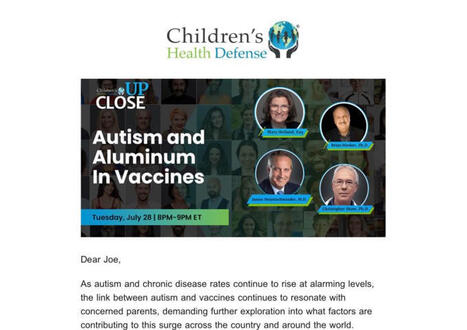
The literature is so clear that anyone pushing this causality link between aluminium in vaccines and autism should viewed as fools. And yes, Children's Health Defense remains one of such fools. What baffles us all is that anyone with a MD degree would be involved in anything and any lies on such presented by Children's Health Defense. As for Hooker and Shaw, the lack of credibility makes their presence in such event totally understandable… But all of this does change the reality: the science and data on such is clear. There is no link, no causality implication between aluminium in vaccines and autism.
|
|
Scooped by
Gilbert C FAURE
July 18, 7:46 AM
|
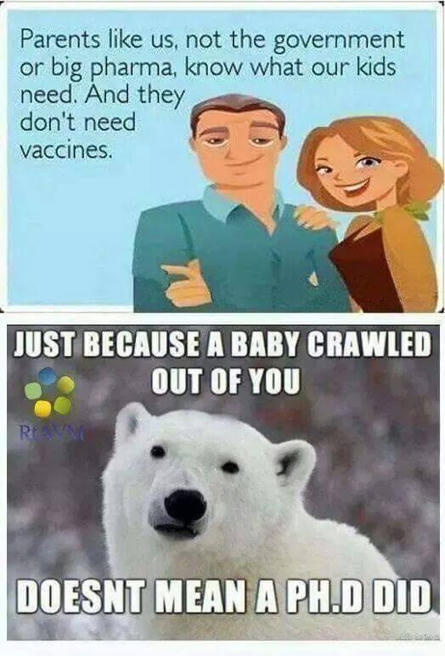
The anti-vaccine movement is full of all sorts of inaccurate claims, bizarre views, and distorted facts. This dissociation with reality often causes anti-vax arguments to conflict with one another. Therefore, in this post I am going to describe 10 anti-vax arguments or claims which are either hypocritical or conflict with other anti-vax claims (i.e., they…
|
|
Scooped by
Gilbert C FAURE
July 18, 7:44 AM
|
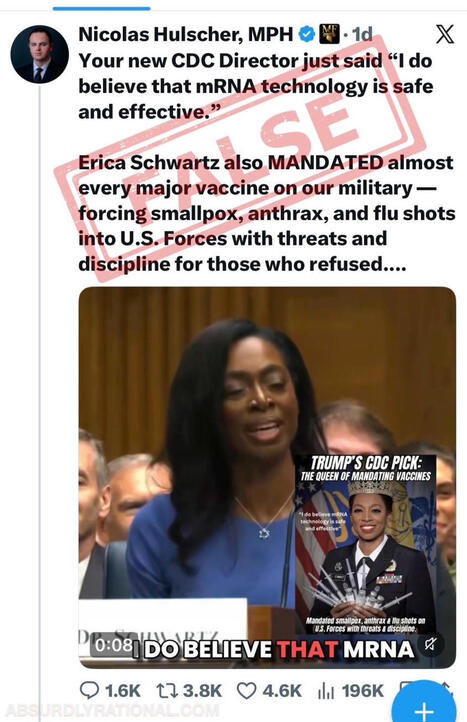
Nicolas Hulscher is absurdly easy to fact check -because he so rarely includes any facts in his posts. It’s like counting jelly beans in an empty jar.
1. Schwartz did not uniquely mandate any of these vaccines. Immunization mandates have existed since the revolutionary war.
2. Smallpox and anthrax vaccines are NOT broadly mandated across the military. They are reserved for special units at risk of exposure to biological agents of war.
3. Whether you miss a flu shot or a curfew -failure to comply with a lawful order in the military has always been met with swift discipline.
4. She is not “your new CDC director.” The senate hasn’t even voted yet.
Complaining about vaccines in the military right after an influenza death proximal to Pete Hegseth’s mandate pause -is a really bad look.
Honestly, the scientific integrity of Schwartz‘s answers were disappointing at her hearing. Read Jeremy Faust’s excellent take on this.
She made a big effort to appease the cheesy-potatoes of the AV movement -and STILL wasn’t able to curry their favor.
What have we learned from Nicolas?
Partial irrationality is insufficient to sway the irrational… which is why no one should ever try in matters of medicine. The halfway point between fact and fiction -is fiction.
Links in comments. | 17 comments on LinkedIn
|
|
Scooped by
Gilbert C FAURE
July 18, 7:29 AM
|
One of the first things I learned in medical writing was this:
The same information can be written in completely different ways depending on who will read it.
A doctor, patient, researcher, and regulator may all need the same information.
But they do not need it communicated in the same way.
That is why one of the first questions medical writers ask is:
"Who am I writing for?"
Did you get the answer right before Slide 4?
#MedicalWriting
#MedicalCommunication
#PatientEducation
#HealthcareCommunication
#HealthLiteracy
#MedicalWriter
|
|
Scooped by
Gilbert C FAURE
July 18, 4:44 AM
|
Another week, another paper in Nature Health from the MAI Futures and Health teams.
The team are doing pathbreaking analysis on real world use of AI. Reviewing 1.7m conversations across 109 countries, it's crystal clear that Copilot is an invaluable health resource. But that's particularly true for people with low confidence in their health systems.
People sometimes think that AI is a technology for elites, opening up a new divide. This research contradicts that narrative. Instead it was you would expect from the rapid democratization of expertise - something there for people around the world when they need it most and have no where else to turn.
Props to Beatriz Costa Gomes, Philipp Schoenegger and the rest of the team for the great work. Lots more to come from us on understanding how AI is and will change healthcare.
https://lnkd.in/eR6xZn8V
|
|
|
Scooped by
Gilbert C FAURE
Today, 5:08 AM
|
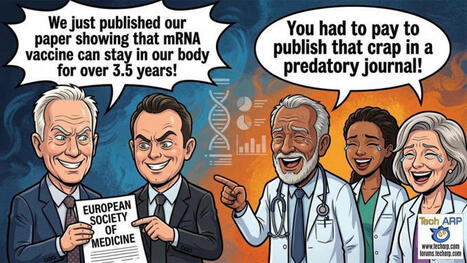
Did a new study prove that Pfizer’s mRNA vaccine persists in the body for 3.5 years and alters human DNA? 🧬
Following a wave of viral claims, the authors of a controversial single-patient case report have paid to publish their work in the Medical Research Archives (European Society of Medicine).
In my newly updated investigation at Tech ARP, I break down why publishing in a known predatory journal does not validate broken science.
Why the scientific consensus remains unchanged:
1. A Predatory Pay-to-Play System: The European Society of Medicine (ESMED) is widely recognised as a predatory publisher. It bypasses rigorous peer-review and charges up to $3,999 to publish papers that legitimate, indexed databases like MEDLINE and PubMed Central refuse to carry.
2. The Power of One ($N=1$): A single, highly subjective case report of one individual provides zero statistical power and cannot establish causation for billions of vaccinated people.
3. The Missing Baseline: The authors failed to sequence the patient's DNA before vaccination in 2021. The mutations they observed are simply natural background genomic noise accumulated with age.
4. Basic Biology: Vaccine mRNA degrades rapidly in the cytoplasm and is physically locked out of the cell nucleus, making genomic alteration impossible.
Peer-reviewed credentials should not be bought. Learn how to spot predatory science in our complete medical analysis.
👇 Read the full fact-check and see the data breakdown in the first comment below.
#PublicHealth #FactCheck #mRNA #MedicalScience #TechARP #MedEd | 34 comments on LinkedIn
|
|
Scooped by
Gilbert C FAURE
Today, 4:15 AM
|
In this TED talk, anthropologist and VCP founder and director Heidi J. Larson explains how vaccine confidence depends on the
entire trust chain: from science labs to clinics to governments.
Break one link, and confidence weakens.
#VaccineConfidence #PublicHealth #TrustInScience #GlobalHealth #ScienceCommunication
https://lnkd.in/dBA5vRiT
|
|
Scooped by
Gilbert C FAURE
Today, 2:37 AM
|
True fact. Disinformation is a rising tide that threatens to swamp critical thinking and evidence based information, but finding a solution is a vastly complex and is going to take an awful lot of stakeholders. The points made here are excellent, but I am afraid it's a much broader scope as far as solutions.
https://lnkd.in/ePsEceqE
|
|
Scooped by
Gilbert C FAURE
Today, 2:36 AM
|
When headlines turn hostile, truth becomes the first casualty. A calm look at how media attacks shape trust, reputation, and the way we react online.
|
|
Scooped by
Gilbert C FAURE
Today, 2:35 AM
|
📖Classroom Reflection: 5 Key Points About Misinformation
Today our group discussed the topic of misinformation and disinformation. Here are the five key points we identified:
1. Speed gives error messages an advantage
Social media spreads false content much faster than traditional media. With just a single click, unverified claims can reach millions before fact-checkers even see them.
2. Intentions do not erase impact
Misinformation and the sharing of errors can be as harmful as false information and malicious sharing. The damage caused by such misinformation whether to reputation, politics, or society is serious, regardless of intent.
3. Personal responsibility is important
Before clicking "Share," we all need to first verify whether the information is true. Checking reliable sources is a small step, but it can greatly reduce the spread of misinformation.
4. Media literacy is no longer optional.
In a digital world saturated with artificial intelligence-generated content, people must develop skills to distinguish credible information from unreliable sources.
5. The platform must be strengthened
Social media companies should invest more in fact-checking and algorithm adjustments to reduce the visibility of questionable content. This is not just a user issue, but a structural one.
Final thoughts:
These five points remind us that addressing misinformation is a shared responsibility among individuals, educators, and platforms. The next time you see a shocking headline, pause and ask: has this been verified? Because in the battle for truth, every conscious click matters.
#Misinformation #Disinformation #MediaLiteracy #ClassReflection #CommunicationStudies
|
|
Scooped by
Gilbert C FAURE
Today, 2:32 AM
|
Science depends on trust. Every published paper becomes part of a collective body of knowledge that researchers, regulators, healthcare professionals, policymakers, and the public rely upon. The assumption is that published findings have been generated through rigorous experimentation, careful analysis, and independent peer review. But what happens when that assumption is no longer safe? https://lnkd.in/eM-NMkUj
|
|
Scooped by
Gilbert C FAURE
Today, 2:26 AM
|
Pour le virologue belge Bernard Rentier, il est urgent d'investir dans une pédagogie explicite de l’incertitude scientifique au lieu de faire la chasse aux "fausses informations".
|
|
Scooped by
Gilbert C FAURE
July 18, 11:04 AM
|
Another case of lack of critical analysis of a paper, one of ignorance, of not reading a paper properly or completely, or one of bias and lies ? But let’s look at the limitations of the refered study only to see how irrelevant this finding is. « There were several limitations of this study. First, this was a retrospective study from a single hospital; thus, our findings
may lack generalizability. Second, we did not prepare participants to obviate myocardial glucose uptake, and we excluded participants who had fasted for less than 12 hours. This potentially led to physiologic uptake and affected the result, although it was statistically significant under the same preparation conditions. Third, myocardial 18F-FDG uptake in scans
that are not specifically performed to assess cardiac inflammation and that are influenced by many factors (age, sex, insulin resistance, diet, etc) are subject to inaccuracies. »
One can’t believe that a pseudo doctor had no knowledge of these limitations making this clinically irrelevant. As well, the authors did not assess COVID infections status as COVID itself as an infection could induce the same issues. OUF
|
|
Scooped by
Gilbert C FAURE
July 18, 7:50 AM
|
One of the biggest vaccine myths in history may have started with a tragedy—and an answer that medicine simply didn’t have yet.
In the 1970s and 1980s, some infants developed devastatin
|
|
Scooped by
Gilbert C FAURE
July 18, 7:44 AM
|
Did you know that the hepatitis B vaccine was first licensed in the United States in 1981 for use in high-risk populations?
It wasn't until 1991 that universal infant hepatitis B vaccination was recommended.
Understanding the history of hepatitis B vaccination recommendations can provide important context when evaluating current public health policies and disease prevention strategies.
We've included a resource in the first comment for those who would like to learn more about hepatitis B and the hepatitis B vaccine.
#vaccines
|
|
Scooped by
Gilbert C FAURE
July 18, 7:43 AM
|
Chers parents ne baissons pas la garde , la lutte contre les maladies infantiles continue.
Respectons toujours le calendrier vaccinal de nos enfants.
#VACROUTINE237
#PEVCAMEROUN
|
|
Scooped by
Gilbert C FAURE
July 18, 4:50 AM
|
ℹ️ 🎓 Les fausses informations et les croyances infondées en santé constituent aujourd'hui un champ de recherche en plein essor en psychologie sociale, à l'intersection de nombreuses questions : confiance envers les institutions, adhésion aux recommandations de santé, décisions de soins, vaccination, pratiques de soins non conventionnelles, ou encore diffusion des connaissances scientifiques.
J'ai eu le plaisir de coordonner un symposium consacré à cette thématique lors du 16ᵉ Congrès International de Psychologie Sociale, sous le soleil d'Aix-en-Provence ☀️🪻 .
L'un des objectifs était de faire dialoguer deux équipes de recherche développant des travaux complémentaires sur ces questions :
📖💉 Les présentations de Virginie Bagneux et Laurie Levard ont apporté un éclairage sur les croyances infondées en santé, leurs déterminants et les enjeux liés à la vaccination.
🎗️🏥 Celles de Sylvain Delouvée et Léo Toussard ont exploré ces problématiques dans le champ de l'oncologie, en articulant approches théoriques et recherches empiriques.
Les présentations ont mis en évidence plusieurs points de convergence, tant sur les déterminants psychosociaux étudiés que sur les enjeux méthodologiques et les implications pour la recherche et l'application. Les échanges avec le public et qui s'en sont suivis ont permis de prolonger ces réflexions et pourront fait émerger plusieurs autres pistes de recherche, d'application et potentielles collaborations.
Un grand merci aux 4 intervenants pour la qualité de leurs présentations et des échanges, à l'ensemble des participants ainsi qu'aux organisateurs du congrès, l'Association pour la Diffusion de la Recherche Internationale en Psychologie Sociale (ADRIPS) et le Laboratoire de Psychologie Sociale (LPS) d'Aix-Marseille Université. Merci également pour le soutien du Cancéropôle Nord-Ouest et l'Anthropo-Lab ~ Laboratoire d'anthropologie expérimentale.
|
|
Scooped by
Gilbert C FAURE
July 18, 4:43 AM
|
📊 WHO has published an updated AMR Fact Sheet, a useful resource for anyone working in health, research, policy, or innovation.
Here are a few facts I have selected:
🔹 Antibiotic use and misuse: the misuse and overuse of antibiotics remain major drivers of AMR. In 2022, first-choice ("Access") antibiotics accounted for only 53% of global human antibiotic consumption, highlighting the continued reliance on broader-spectrum agents.
🔹 Antibiotic resistance is increasing. In 2023, 1 in 6 bacterial infections was resistant to antibiotic treatment. Between 2018 and 2023, resistance increased in more than 40% of monitored bacteria–antibiotic combinations, with average annual increases ranging from 5–15%. WHO estimates that resistance is highest in the South-East Asia and Eastern Mediterranean Regions, where 1 in 3 infections are resistant. For gonorrhoea, ciprofloxacin resistance has reached 75%.
🔹 Fungal AMR is an emerging global concern as drug-resistant fungal infections are becoming increasingly difficult to treat. Of particular concern is the spread of multidrug-resistant Candidozyma auris (formerly Candida auris). Resistance is also growing in Aspergillus species, with many strains no longer responding to azole antifungals widely used in both medicine and agriculture.
🔹 AMR goes beyond bacteria. The emergence of drug-resistant parasites continues to threaten progress in malaria control and elimination efforts.
🔹 WHO leads include efforts to prevent and control AMR through the Global Action Plan on Antimicrobial Resistance (GAP-AMR) 2026–2036, working closely with FAO, #WOAH and UNEP-WCMC under a #OneHealth approach. The GAP-AMR is implemented through NAPs and supported by WHO's Strategic and Operational Priorities 2025–2035, including efforts to advance the development of new therapies, vaccines and diagnostics.
📖 Read the updated fact sheet: https://lnkd.in/dvQBRtHQ
💡 AMR is not only about preserving existing medicines. It is also about accelerating innovation, strengthening health systems, improving access, and ensuring that effective treatments remain available for future generations.
#AMR #AntimicrobialResistance #OneHealth #GlobalHealth #Innovation #Diagnostics #Antibiotics #FungalInfections #Malaria #PublicHealth #WHO
Read here the fact-sheet: https://lnkd.in/dvQBRtHQ
Philip Mathew World Health Organization Kim Chriscaden
|