Your new post is loading...

|
Rescooped by
Gilbert C FAURE
from Immunology and Biotherapies
January 30, 2020 1:15 PM
|
Point of view of an Immunologist/curator in 2020 Après Bobcatsss 2020, ECIL 2021, ICDF 2022, HESIVAXs with the motto UTA "Understand to Act" Notre proposition « Désinformation Vaccinale: Curation, Observatoire, Littératies » a été retenue pour le séminaire annuel de l’Académie des Controverses et de la Communication Sensible, intitulé « La désinformation : nouvelles formes, nouveaux défis », qui s'est tenu à Paris le mardi 26 novembre 2024. Voir ci-après posts du 27 novembre, avec lien vers la présentation sur Slideshare. Présentation le 20 mars 2025 à InfoxsurSeine deux jours pour décrypter la désinformation et échanger autour des solutions.
Quels outils concrets face aux manipulations de l’information et à l’essor de l’IA générative ? Avez vous acheté le numéro Juillet/septembre 2025 de la RECHERCHE sur LE FAUX? des sujets à approfondir - Vaccins et argent Making money with vaccines, against vaccines le sujet le plus chaud, de 3,36 euros par mois à 300 millions de dollars? - Publications vraies et fausses particulièrement difficile - Obligations, exemptions, incitations, peut-être plus simple?
|
|
Scooped by
Gilbert C FAURE
Today, 4:44 AM
|
Another week, another paper in Nature Health from the MAI Futures and Health teams.
The team are doing pathbreaking analysis on real world use of AI. Reviewing 1.7m conversations across 109 countries, it's crystal clear that Copilot is an invaluable health resource. But that's particularly true for people with low confidence in their health systems.
People sometimes think that AI is a technology for elites, opening up a new divide. This research contradicts that narrative. Instead it was you would expect from the rapid democratization of expertise - something there for people around the world when they need it most and have no where else to turn.
Props to Beatriz Costa Gomes, Philipp Schoenegger and the rest of the team for the great work. Lots more to come from us on understanding how AI is and will change healthcare.
https://lnkd.in/eR6xZn8V
|
|
Scooped by
Gilbert C FAURE
Today, 4:43 AM
|
Antimicrobial Resistance: A Silent Global Health Crisis
Most people think antibiotics will always work when they are sick, but this is becoming less true every year. Antimicrobial resistance (AMR) occurs when bacteria, viruses, fungi, and parasites evolve and no longer respond to medicines that once treated them effectively. This makes common infections harder to treat, increases healthcare costs, and puts millions of lives at risk.
According to the World Health Organization (WHO), antimicrobial resistance is one of the top 10 global public health threats. Research published in The Lancet estimated that 1.27 million deaths were directly caused by antimicrobial resistance in 2019, while AMR contributed to nearly 5 million deaths worldwide. Without stronger action, experts warn that resistant infections could become even more common in the coming decades.
One major cause of AMR is the misuse and overuse of antibiotics. Taking antibiotics without a prescription, not completing prescribed treatment, and using antibiotics for viral infections such as the common cold all contribute to this growing problem. Antibiotic use in livestock and agriculture also plays a role by encouraging resistant bacteria to develop and spread through the food chain and the environment.
We all have a role to play in slowing antimicrobial resistance. Simple actions such as using antibiotics only when prescribed by qualified healthcare professionals, completing the full course of treatment, practicing good hand hygiene, receiving recommended vaccinations, and supporting infection prevention efforts can help protect these life-saving medicines for future generations.
Antimicrobial resistance is a reminder that protecting public health requires responsible choices from individuals, healthcare providers, governments, and communities. Together, we can help preserve the effectiveness of antibiotics and safeguard global health.
GlobalHealth CommunicationCenter
UNICEF
UNICEF USA
World Health Organization
BYU Public Health Department
Author: Godfrey Chinedu Anusiem
Public Health Advocate | Applied Health Professional
|
|
Scooped by
Gilbert C FAURE
Today, 2:31 AM
|
Judy Gold also breaks down Larry David's drag moment.
|
|
Scooped by
Gilbert C FAURE
Today, 2:30 AM
|
Emotional responses and engagement with misinformation in adolescents (Frontiers in Psychology):
https://lnkd.in/dR87Z4n3
Glimpse: According to the study, teenagers are able to discern between true and fake war-related headlines, but their interaction with misleading material is motivated more by feelings than by assessments of reliability. High-arousal negative emotions, particularly fear and wrath, significantly boosted intents to share and comment in a simulated social media feed experiment with Romanian high school students, whereas neutral emotional reactions resulted in little involvement. Accuracy evaluations are important, but emotional arousal is the main driver of interaction, according to mixed-effects models. The study shows that adolescents' online behavior is influenced by quick, emotion-driven mechanisms rather than only evaluative reasoning by combining cognitive and affective processes. In order to assist adolescents control affect-driven involvement in high-intensity digital contexts, media literacy programs must address emotional triggers in addition to accuracy checks through techniques like lateral reading and rhetorical cue detection.
---
Free articles and analyses on soft counter-extremism, against online hate, and on the theory of mis-/disinformation (usually third-party content).
The most recent LinkedIn posts on the above subjects, with glimpses, can be accessed via:
• https://lnkd.in/eBarZAew
Two-week reviews available via the following three Policyinstitute.net websites:
• counter-terrorism.org
• preventhate.org
• strategism.org
The views expressed in this post is that of the author(s) of the source content and do not necessarily represent those of Policyinstitute.net and its staff. While we carefully produce the glimpses to the articles, documents, or recordings that we hyperlink, we are not responsible for textual changes nor for imponderable parts of the original items.
#policyinstitutenet #preventradicalization #preventextremism #counterextremism #preventhate #disinformation #misinformation
|
|
Scooped by
Gilbert C FAURE
July 17, 11:02 AM
|
Trust isn't something you build. It's a reading on a dial, produced by six drivers that have nothing to do with the word "trust" itself: competence, benevolence, integrity, predictability, transparency, and reciprocal vulnerability.
None of them can be targeted directly. All of them can be built as procedures long before the emergency starts.
|
|
Scooped by
Gilbert C FAURE
July 17, 9:30 AM
|
Each year, the World Health Organization and UNICEF release the clearest picture we have of how many people are reached with vaccines.
This year, the data shows that child immunization coverage inched forward in 2025 compared to 2024, with 85% of children worldwide receiving their basic childhood immunizations. Fifty years ago, that figure was just 5%.
HPV vaccine access also continues to improve, with 33% of girls receiving the vaccine last year, up from 31% in 2024, driven by 15 new country introductions.
That progress reflects decades of commitment: countries strengthening their health systems, partners sustaining investment in programs like Gavi, the Vaccine Alliance, and health workers reaching children and their families.
But the data also shows where gaps remain. 13.5 million children have still not received a single vaccine. In 2025, 57 countries reported large or disruptive measles outbreaks. This means it’s more important than ever to ensure every child can access lifesaving vaccines.
We've come a long way, but the job isn't finished. Vaccines work, and our task now is to maintain that momentum so every child, no matter where they live, has the opportunity to grow up healthy and reach their full potential.
|
|
Scooped by
Gilbert C FAURE
July 17, 9:27 AM
|
Je suis scientifique et ce que je vais dire ne va pas plaire à tout le monde : pour lutter contre la désinformation, nous n'avons pas besoin de plus de faits scientifiques.
Quand une fake news se propage, je vois toujours les mêmes réflexes :
- publier une étude,
- montrer un graphique,
- ajouter des chiffres,
- puis d'autres chiffres,
- puis encore d'autres chiffres…
Comme si le problème était un manque de données.
Entre Google, ChatGPT, les émissions santé à la TV, les réseaux sociaux et tonton Gérard, il y a toujours quelqu’un pour répondre à nos questions en citant “une étude”.
Le problème n'est pas (toujours) l'absence de faits, le problème est que les faits voyagent mal.
Une étude scientifique est rarement conçue pour captiver l'attention du grand public.
Une histoire, si. Or, les désinformateurs sont très bons pour raconter des histoires.
Face à ça, nous n’avons pas seulement besoin de produire davantage de connaissances.
Nous devons aussi créer davantage de ponts entre ces connaissances et le grand public.
Parce qu'aujourd'hui, la bataille ne se joue pas uniquement sur les données trouvées.
Elle se joue aussi sur notre capacité à les rendre accessibles.
Et sur ce terrain-là, nous avons besoin de plus de vulgarisateurs, d’experts qui viennent expliquer, simplement, sans jargon (mais rigoureusement !) ce qu’il se passe, ce qu’on sait et ce qu’on ne sait pas encore au grand public.
C’est un vrai enjeu de santé publique, qui doit être considéré par les scientifiques comme par les politiques 🙏
♻️ Repartagez ce message si vous êtes d’accord
💬 Donnez vos idées en commentaires pour mieux faire circuler les données, on a besoin de tout le monde !
| 19 comments on LinkedIn
|
|
Scooped by
Gilbert C FAURE
July 17, 9:25 AM
|
Media literacy is now just as important as learning to read and write, lawmaker says (EUPerspectives):
https://lnkd.in/dpRuxfMt
Glimpse: As important as learning to read and write, media literacy is today regarded as a fundamental democratic ability. The article makes the case that societies must treat media literacy as a fundamental skill rather than an optional add-on due to the rapid changes in the information ecosystem, including AI-generated content, algorithmic amplification, dwindling trust in institutions, and increasingly hazy boundaries between journalism, opinion, and manipulation. Three priorities are highlighted by educators and politicians throughout Europe: enhancing critical thinking abilities, educating individuals to identify false information and synthetic media, and including media literacy courses at all educational levels. The article emphasizes that media literacy allows people to actively and intelligently participate in democratic life in addition to safeguarding them against damage. Societies run the risk of increasing polarization, becoming more susceptible to manipulation, and losing public trust if media literacy is not widely practiced.
|
|
Scooped by
Gilbert C FAURE
July 17, 9:19 AM
|
"Rumours are part of society. The issue is, how do we, from a public health perspective, deal with it?"
This quote from Dr Tina D Purnat's talk at the 14th IFPH at the University of Manchester took me right back to why we started our project last year.
As a researcher in a referral oncology hospital, I kept encountering rumours among cancer patients about their medications and when I traced where many of these originated, I found they were spreading through the online patient groups they'd formed with each other.
But instead of treating this as simply a "misinformation problem" to correct, my team and I decided to use it as an opportunity: to actually study the nature of these groups and the real needs driving them. Things like:
⭕ Concerns patients have about their treatment
⭕ Confusion when choosing between different treatment options
⭕ Lack of information on how to manage medication side effects
And countless other questions that, once understood, can help us improve the quality of care we offer cancer patients in Iran.
The novelty of our work doesn't stop there; we're also using LLMs, combined with clinician input and patient validation, to help make sense of this at scale.
Grateful to my team at the Clinical Research Development Center of Amir Oncology Hospital for this work, especially to Dr Elahe Meftah.
🎉 I'm honoured to have had the chance to present a small part of this project as a poster at this festival this week. The abstract is now available in the European Journal of Public Health:
https://lnkd.in/eU8VEaXU
#IFPH2026 #HealthMisinformation #OncologyResearch #CancerCare #PatientExperience #DigitalHealth #PublicHealth #LLM #PublicHealthFestival #ManchesterUniversity #PublicHealthResearch
|
|
Scooped by
Gilbert C FAURE
July 17, 9:12 AM
|
A year ago today, a study out of Denmark was published that the media hailed as conclusively proving that aluminum-containing vaccines are not associated with chronic childhood illnesses including allergies, autoimmune diseases, and neurodevelopmental disorders.
But the study was systematically biased in favor of the null hypothesis, as illuminated by its own key data IMPLAUSIBLY showing a protective effect of aluminum on childhood development:
https://lnkd.in/eQZgUWnu
|
|
Scooped by
Gilbert C FAURE
July 17, 9:09 AM
|
🔎📰 Misinformation on vaccines (aka NON-SPECIFIC VACCINE EFFECTS (NSE) this time on the diphteria-tetanus-pertussis vaccine) playing out - again!
It’s a disgrace - to be witnessing this in 2026😳
#NSEvaccNeverReplicated
|
|
Scooped by
Gilbert C FAURE
July 17, 8:51 AM
|
"Although I discuss clinical research in the form of case-control, cohort, and randomized controlled studies, I have always preferred data from meta-analyses and systematic reviews since they provide the most robust clinical evidence.
But the most important point to make is that placebo controlled randomized clinical trials are not the only way to determine safety and effectiveness of vaccines. There are larger, statistically powerful methods that can tell us how any drug, including vaccines, are working.
Anti-vaccine activists love to cherry-pick research that seems to support (but rarely does) their desire to say “ah-ha” about vaccines. Unfortunately for them, research is complicated and there are lots of different types of studies that indicate vaccines are very safe and very effective."
|
|
|
Scooped by
Gilbert C FAURE
Today, 4:50 AM
|
ℹ️ 🎓 Les fausses informations et les croyances infondées en santé constituent aujourd'hui un champ de recherche en plein essor en psychologie sociale, à l'intersection de nombreuses questions : confiance envers les institutions, adhésion aux recommandations de santé, décisions de soins, vaccination, pratiques de soins non conventionnelles, ou encore diffusion des connaissances scientifiques.
J'ai eu le plaisir de coordonner un symposium consacré à cette thématique lors du 16ᵉ Congrès International de Psychologie Sociale, sous le soleil d'Aix-en-Provence ☀️🪻 .
L'un des objectifs était de faire dialoguer deux équipes de recherche développant des travaux complémentaires sur ces questions :
📖💉 Les présentations de Virginie Bagneux et Laurie Levard ont apporté un éclairage sur les croyances infondées en santé, leurs déterminants et les enjeux liés à la vaccination.
🎗️🏥 Celles de Sylvain Delouvée et Léo Toussard ont exploré ces problématiques dans le champ de l'oncologie, en articulant approches théoriques et recherches empiriques.
Les présentations ont mis en évidence plusieurs points de convergence, tant sur les déterminants psychosociaux étudiés que sur les enjeux méthodologiques et les implications pour la recherche et l'application. Les échanges avec le public et qui s'en sont suivis ont permis de prolonger ces réflexions et pourront fait émerger plusieurs autres pistes de recherche, d'application et potentielles collaborations.
Un grand merci aux 4 intervenants pour la qualité de leurs présentations et des échanges, à l'ensemble des participants ainsi qu'aux organisateurs du congrès, l'Association pour la Diffusion de la Recherche Internationale en Psychologie Sociale (ADRIPS) et le Laboratoire de Psychologie Sociale (LPS) d'Aix-Marseille Université. Merci également pour le soutien du Cancéropôle Nord-Ouest et l'Anthropo-Lab ~ Laboratoire d'anthropologie expérimentale.
|
|
Scooped by
Gilbert C FAURE
Today, 4:43 AM
|
📊 WHO has published an updated AMR Fact Sheet, a useful resource for anyone working in health, research, policy, or innovation.
Here are a few facts I have selected:
🔹 Antibiotic use and misuse: the misuse and overuse of antibiotics remain major drivers of AMR. In 2022, first-choice ("Access") antibiotics accounted for only 53% of global human antibiotic consumption, highlighting the continued reliance on broader-spectrum agents.
🔹 Antibiotic resistance is increasing. In 2023, 1 in 6 bacterial infections was resistant to antibiotic treatment. Between 2018 and 2023, resistance increased in more than 40% of monitored bacteria–antibiotic combinations, with average annual increases ranging from 5–15%. WHO estimates that resistance is highest in the South-East Asia and Eastern Mediterranean Regions, where 1 in 3 infections are resistant. For gonorrhoea, ciprofloxacin resistance has reached 75%.
🔹 Fungal AMR is an emerging global concern as drug-resistant fungal infections are becoming increasingly difficult to treat. Of particular concern is the spread of multidrug-resistant Candidozyma auris (formerly Candida auris). Resistance is also growing in Aspergillus species, with many strains no longer responding to azole antifungals widely used in both medicine and agriculture.
🔹 AMR goes beyond bacteria. The emergence of drug-resistant parasites continues to threaten progress in malaria control and elimination efforts.
🔹 WHO leads include efforts to prevent and control AMR through the Global Action Plan on Antimicrobial Resistance (GAP-AMR) 2026–2036, working closely with FAO, #WOAH and UNEP-WCMC under a #OneHealth approach. The GAP-AMR is implemented through NAPs and supported by WHO's Strategic and Operational Priorities 2025–2035, including efforts to advance the development of new therapies, vaccines and diagnostics.
📖 Read the updated fact sheet: https://lnkd.in/dvQBRtHQ
💡 AMR is not only about preserving existing medicines. It is also about accelerating innovation, strengthening health systems, improving access, and ensuring that effective treatments remain available for future generations.
#AMR #AntimicrobialResistance #OneHealth #GlobalHealth #Innovation #Diagnostics #Antibiotics #FungalInfections #Malaria #PublicHealth #WHO
Read here the fact-sheet: https://lnkd.in/dvQBRtHQ
Philip Mathew World Health Organization Kim Chriscaden
|
|
Scooped by
Gilbert C FAURE
Today, 4:38 AM
|
New publication in PLOS Digital Health!
This paper mapped and evaluated existing digital, health, and civic literacy platforms, assessing how well they support digital citizenship for health among young people.
Read here: https://lnkd.in/dJhpMYy4
I worked on this during my research fellowship at Digital Transformations for Health Lab, and I’m forever thankful for the opportunity to carry out this work and grow as a researcher. DC4H was a new area for me, and I’m grateful to Whitney Gray, Louise Holly, and Tomiwa Akinsanya for their support and guidance throughout the fellowship and beyond. It has been an amazing journey doing the work and also a long review process, but I'm glad to finally see it published as a journal article.
#DigitalLiteracy #HealthLiteracy #CivicLiteracy #DigitalCitizenshipForHealth | 12 comments on LinkedIn
|
|
Scooped by
Gilbert C FAURE
Today, 2:30 AM
|
The One Nation senator made the previously unreported remarks during a live stream discussion with three prominent Australian anti-vaccine mandate activists.
|
|
Scooped by
Gilbert C FAURE
July 17, 11:03 AM
|
We believe people don’t remember statistics. They remember stories. They don’t act because information exists—they act because information connects. Our role is to transform evidence into clarity, clarity into confidence, and confidence into meaningful conversations that improve health.
|
|
Scooped by
Gilbert C FAURE
July 17, 10:48 AM
|
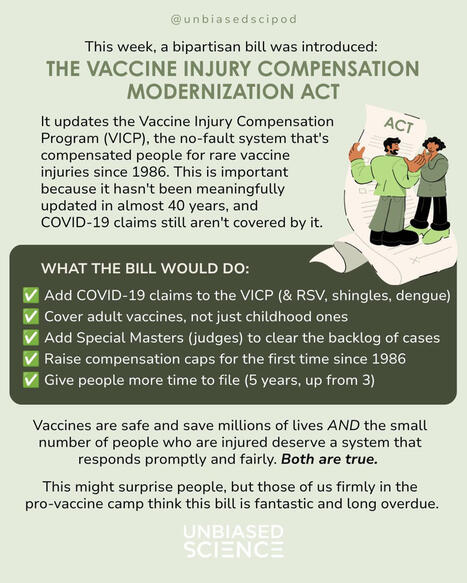
A bill with bipartisan support was just introduced, and we are very happy about it. It would modernize the program that compensates people in the rare cases when a vaccine causes a serious injury, and it would finally bring COVID-19 vaccine claims into that system.
A bit about how this works. The Vaccine Injury Compensation Program (VICP) has been around since 1986. It's a no-fault system, which means people don't have to sue a manufacturer or prove negligence to be compensated. It runs on a small excise tax on vaccines rather than taxpayer dollars, and it uses an "injury table" that lists injuries known to be associated with certain vaccines. If someone experiences one of those recognized injuries in the expected timeframe, it's presumed connected, and they don't have to prove causation from scratch. Other claims can still be considered, they just require more evidence.
If you're wondering why COVID-19 wasn't already included, it comes down to timing. When the vaccines first rolled out under emergency use authorization, injury claims were routed into a separate, more limited program called the Countermeasures Injury Compensation Program (CICP), which was built for public health emergencies. That program doesn't allow you to appeal a decision, doesn't cover pain and suffering, and has a large backlog of claims that have been sitting without a decision for years. Even after the COVID-19 vaccines received full FDA approval and were added to the immunization schedule, those claims were never moved into the stronger, fairer VICP that covers other routine vaccines. This bill fixes that.
Our support for vaccines has always been about public health, not pharma companies. Vaccines save millions of lives. In the rare instances where someone is injured, we feel strongly that they deserve a fair, timely, and compassionate path to compensation. Standing up for those people and standing up for vaccines are the same thing, and it's encouraging to see both parties recognize that.
We will share updates as we have them.
https://lnkd.in/dDqpA4y5
|
|
Scooped by
Gilbert C FAURE
July 17, 9:29 AM
|
People believing this misinformation should be referred for psychiatric evaluation. Such is a lie… And McCullough Foundation posts such shows how desperate they are for views for nothing…
|
|
Scooped by
Gilbert C FAURE
July 17, 9:26 AM
|
New South Wales health authorities have hailed a vaccination program that has nearly halved hospitalisations for a potentially deadly respiratory virus among newborn babies a "fantastic" success, as the winter illness peak fast approaches.
|
|
Scooped by
Gilbert C FAURE
July 17, 9:22 AM
|
How long does misinformation from McCullough Foundation stay on LinkedIn ? Too long. Now regarding the spike protein staying in one’s blood ? Well, not controlling for COVID infections and long COVID shows how terrible these claims are…
|
|
Scooped by
Gilbert C FAURE
July 17, 9:13 AM
|
"Every time I share information about the MMR vaccine, the same question comes back: Why do you care so much about a disease with a case-fatality rate of one or two in a thousand?
My answer comes in two parts.
The first is simple. Even one preventable death is one too many, especially when the thing standing between a person and that death carries an exceedingly small risk of its own. We're weighing a vanishingly rare serious vaccine reaction against a disease that can kill, and that can do serious, lasting harm along the way.
The second part is the one that the "case-fatality rate" question doesn't account for. It treats measles as a coin flip. Heads you live, tails you die, as if there weren't an entire world of possibilities in between. There is, and that in-between is where measles does some of its most underappreciated damage.
Start with immune amnesia. When I talk to my immunology buddies about this, their eyes get wide. Measles doesn't just make you miserable for a week or two. It infects immune cells, including the long-lived memory cells your body uses to recognize infections it has already beaten, and it wipes out part of that hard-won memory.
A 2019 study in Science found measles erased anywhere from 11% to 73% of children's existing antibody repertoire, and even kids with mild cases lost about 20% on average. Your body can be left having to relearn defenses against infections it had already beaten, and it can take two to three years to rebuild what measles took. A statistical analysis of childhood mortality data suggests that, before the vaccine, this immune amnesia may account for as much as half of all childhood deaths from infectious disease,...
Measles does obvious harm in the moment, too. About one in five unvaccinated people who catch measles in the United States end up hospitalized, often with pneumonia or dehydration. Utah's ongoing outbreak has hospitalized 8% of its cases so far. In South Carolina, one hospital system that treated the outbreak there saw 16% of its confirmed patients admitted, two with encephalitis, or brain swelling.
In young children, measles can also cause swelling of the upper airway to the point of obstruction. Conducted during a 2025 outbreak, a Pediatrics study found this kind of stridor in about one in eight children with measles. Nearly 90% were hospitalized, and some needed intensive care. Not one of them died. Roughly one in 1,000 develops acute encephalitis, which can leave children deaf or with permanent intellectual disability even if they pull through.
SSPE, subacute sclerosing panencephalitis, is rare. But it's a nightmare. Years after what looked like a full recovery, the measles virus can reactivate in the brain and begin a slow, relentless demolition: cognitive decline, seizures, loss of motor control, then death. There's no cure, and it is almost always fatal. "
|
|
Scooped by
Gilbert C FAURE
July 17, 9:11 AM
|
New today at American Journal of Public Health from Timothy Callaghan, PhD and I:
We document a sharp increase in anti-vaccine bills (including efforts to weaken or repeal vaccine mandates) introduced in state legislatures across the US in the post-COVID era. We also show that this increase is primarily due to the actions of Republican lawmakers across the states (and holds when controlling for broader state-level political dynamics).
To be clear: most anti-vaccine bills will never become law. But, some do. And that could have negative public health implications for all of us.
Data for this study come from the State Vaccine Policy Project (SVPP) that Tim Callaghan and I co-run at BUSPH. All processed and content coded data used in this study are publicly available (see the OSF access link in the piece). We're looking forward to continuing to collect, code, and process vaccine legislative data up through the present day.
But... this is (really) hard work to do! We are immensely grateful to pilot funding from Boston University School of Public Health to conduct this research. We also could not do this work without SVPP coders past and present, including: Juhi Shahani, Emma Mears, MPH, Alejandra R., Rachel Ma, & Grace Connors, MPH (and from Tess Mathes, MS, MPH, Nithya Malisetti, Ava Ordog, & Shosi Hansen, MPH who are helping us continue this work).
Thanks all for making this work possible!
https://lnkd.in/gSCPHf7a
|
|
Scooped by
Gilbert C FAURE
July 17, 8:56 AM
|
My latest Center for Infectious Disease Research and Policy (CIDRAP) op-ed is up, and it's about something that really grinds my gears... the idea that death is the only bad thing that can happen if you get measles.
We hear this all the time: "....but the case fatality rate is only one or two in a thousand," as if measles is a coin flip, heads you live, tails you die, nothing in between.
The in-between does a lot of damage. For one, immune amnesia that wipes out part of your immune memory and takes years to rebuild. There's also hospitalizations, airway swelling that lands little kids in the ICU, encephalitis, and SSPE, which can surface years after recovery and is almost always fatal. None of those things show up in a case fatality rate.
The MMR shot protects against all of it, not just the worst case. Read more in the full op-ed over at CIDRAP: https://lnkd.in/ed3YgeBQ
|
|
Scooped by
Gilbert C FAURE
July 17, 8:50 AM
|
|