À l’occasion de la semaine de la vaccination – du 27 avril au 3 mai 2026 –, et à l’initiative de l’Institut Pasteur, des personnalités issues de la recherche scientifique, de la médecine, de la culture, des médias et de la politique – dont de nombreux anciens ministres de la Santé – ont appelé à un « sursaut collectif face à la désinformation et aux attaques contre la science et la rationalité ».
Les idéologies “antivax” et les remous géopolitiques creusent les inégalités vaccinales à l’échelle mondiale et hypothèquent l’avenir de la recherche. Au centre des inquiétudes, les États-Unis. Superpuissance financière, politique et scientifique, le pays est devenu le maillon faible de la vaccination.
« L’arrivée au ministère de la Santé de Robert Kennedy Jr, un “antivax” qui accuse la vaccination de tous les maux, provoque une baisse de la couverture vaccinale dans le pays. Et cela fait extrêmement peur », estime le Dr Robert SEBBAG, médecin attaché dans le service des maladies infectieuses de l’hôpital Pitié-Salpêtrière, à Paris, et président de l’ONG ACTION CONTRE LA FAIM.
Depuis l’installation à la Maison Blanche de la nouvelle administration Trump, les fausses informations relatives à la vaccination passent désormais par les canaux officiels. En novembre 2025, la principale agence sanitaire des États-Unis, les CDC (Centres de prévention et de lutte contre les maladies) relayaient une indéboulonnable fausse théorie sur les liens supposés entre les vaccins et l’autisme.
Notre proposition « Désinformation Vaccinale: Curation, Observatoire, Littératies » a été retenue pour le séminaire annuel de l’Académie des Controverses et de la Communication Sensible, intitulé « La désinformation : nouvelles formes, nouveaux défis », qui s'est tenu à Paris le mardi 26 novembre 2024.
Voir ci-après posts du 27 novembre, avec lien vers la présentation sur Slideshare.
Présentation le 20 mars 2025 à InfoxsurSeine deux jours pour décrypter la désinformation et échanger autour des solutions. Quels outils concrets face aux manipulations de l’information et à l’essor de l’IA générative ?
Avez vous acheté le numéro Juillet/septembre 2025 de la RECHERCHE sur LE FAUX?
des sujets à approfondir
- Vaccins et argent Making money with vaccines, against vaccines
le sujet le plus chaud, de 3,36 euros par mois à 300 millions de dollars?
- Publications vraies et fausses particulièrement difficile
- Obligations, exemptions, incitations, peut-être plus simple?
The topic addresses Fake news as a global problem, extracting material focusing on vaccinations, vaccination hesitancy and anti-vax attitudes. The subject is evolving constantly with health consequences all over the world.
This topic became a research action project at CREM (Centre de Recherche sur les médiations)
Ir covers not only Fake News still thriving on the internet,
but also efforts of many (supranational bodies, scientific societies, researchers...) to improve health literacies of laypeople, and medical students on this sensitive topic...
Fake News related to Covid and Vaccinations slightly decreased compared to other topics such as ukrainian war, gaza war, and politics in USA even sports related informations... but the involvement of politicians in the topic very much increased !
Unfortunately, as Jonathan Swift so eloquently said: Reasoning will never make a man correct an ill opinion, which by reasoning he never acquired.
“The greatest enemy of knowledge is not ignorance; it is the illusion of knowledge.” — Daniel J. Boorstin
🛠️ Tool of the Week: Practical Resources for Immunization Economics
How do you make sense of a growing body of economic evaluations —often with different methods, assumptions, and results? 📊💉
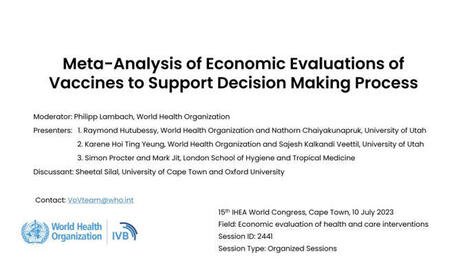
This week, we’re highlighting “Meta-Analysis of Economic Evaluations of Vaccines to Support Decision Making Process”, an Immunization Economics IHEA Pre-Congress presentation that brings together and builds on established approaches for synthesizing economic evidence.
Developed by experts from World Health Organization, the London School of Hygiene and Tropical Medicine, U. of London, and the University of Utah, this presentation shows how meta-analysis goes beyond traditional literature reviews to translate complex evidence into clear policy insights.
The presentation covers: 📚 What meta-analysis of economic evaluations is and how it works in practice 🧪 A case study on influenza vaccination to show how pooled evidence can inform decisions ⚠️ Key challenges to keep in mind when applying these methods in policy and practice
Decision-makers are often faced with too much evidence and not enough clarity. This approach helps bring that evidence together into actionable insights.
We talk a lot about social media, AI, and information. Much less we understand how they actually work. Here is a compact map of the key concepts.
Complex system A network of interacting elements — people, content, technologies, institutions. System-level behavior emerges from local interactions and cannot be reduced to individual parts.
Stochastic process A process governed by both rules and randomness. Same starting point, different possible outcomes. What we describe are probabilities, not certainties.
Algorithm A computational function mapping inputs to outputs. Often adaptive: it learns from data and optimizes objectives such as ranking, recommendation, and classification.
Platform A socio-technical system combining infrastructure, algorithms, and users. It shapes visibility and diffusion through data collection and ranking mechanisms.
Attention A limited cognitive resource. Among many stimuli, only a few are processed. What captures attention spreads.
Attention economy A system where attention is scarce and optimized. Content is designed to maximize engagement, regardless of informational quality.
Bias Systematic deviations in judgment. Cognitive shortcuts that reduce effort but introduce predictable errors.
Confirmation bias The tendency to favor information that aligns with prior beliefs. It affects what we select, interpret, and remember.
Personalization The adaptation of information environments based on behavioral data. Different users see different versions of the same world.
Infodemic An overproduction of information exceeding our ability to verify and process it. High-quality and low-quality content compete in the same space.
Echo chamber A network where similar nodes mostly connect to each other. Reinforcement dominates, exposure to disagreement declines.
Polarization Opinions shift toward more extreme positions. Middle ground shrinks, distance between groups increases.
Echo platform Segregation at the system level. Different platforms host systematically different audiences and content distributions.
LLMs Statistical language models that learn probability distributions over text. They generate coherent outputs without direct access to verified representations of reality.
Epistemia An information regime where plausibility replaces verification. Coherence and linguistic form become the dominant criteria for truth.
Understanding these mechanisms is not about being right. It is about understanding why those who sound convincing often seem to be.
A boy has a sudden seizure and is rushed to hospital, diagnosed with highly contagious measles and meningitis. His mother refuses all vaccinations for her kids, believing online myths linking vaccines to autism and weak immunity.
One concept worth understanding in evidence-based work is the Woozle Effect.
It occurs when a claim gains the appearance of strong evidential support through repetition and citation, even though the original research did not clearly establish it.
- A preliminary or limited finding is published. - Later summaries describe it with slightly more certainty. - Secondary sources cite those summaries rather than the primary paper. - Caveats, exclusions and uncertainty gradually disappear. - Repetition creates familiarity. - Familiarity is mistaken for reliability. - The proposition becomes treated as established knowledge.
Eventually, the claim can feel settled simply because it has circulated widely enough.
The Woozle Effect is usually driven less by dishonesty than by repetition, assumption and uncritical citation. It often reflects ordinary human tendencies: confirmation bias, inherited beliefs, deference to consensus and failure to revisit primary sources.
The result is that non-facts can become common sense. In any field that relies on research, policy or expert opinion, that carries obvious risk.
The Woozle Effect is not merely about misinformation. It is about how intelligent people, acting in good faith, inherit certainty they did not build.
That is why disciplined analysis often begins with a deceptively simple question:
What did the original evidence actually show?
Repetition can amplify a claim but it cannot validate one.| 23 commentaires sur LinkedIn
À l’occasion de la semaine de la vaccination – du 27 avril au 3 mai 2026 –, et à l’initiative de l’Institut Pasteur, des personnalités issues de la recherche scientifique, de la médecine, de la culture, des médias et de la politique – dont de nombreux anciens ministres de la Santé – ont appelé à un « sursaut collectif face à la désinformation et aux attaques contre la science et la rationalité ».
Les idéologies “antivax” et les remous géopolitiques creusent les inégalités vaccinales à l’échelle mondiale et hypothèquent l’avenir de la recherche. Au centre des inquiétudes, les États-Unis. Superpuissance financière, politique et scientifique, le pays est devenu le maillon faible de la vaccination.
« L’arrivée au ministère de la Santé de Robert Kennedy Jr, un “antivax” qui accuse la vaccination de tous les maux, provoque une baisse de la couverture vaccinale dans le pays. Et cela fait extrêmement peur », estime le Dr Robert SEBBAG, médecin attaché dans le service des maladies infectieuses de l’hôpital Pitié-Salpêtrière, à Paris, et président de l’ONG ACTION CONTRE LA FAIM.
Depuis l’installation à la Maison Blanche de la nouvelle administration Trump, les fausses informations relatives à la vaccination passent désormais par les canaux officiels. En novembre 2025, la principale agence sanitaire des États-Unis, les CDC (Centres de prévention et de lutte contre les maladies) relayaient une indéboulonnable fausse théorie sur les liens supposés entre les vaccins et l’autisme.
"Let me start with a confession. I used to be the parent who gripped my child’s hand too tightly at the clinic and felt my stomach drop. This was not because of the needle but because of the stories. The whispers and warnings, the doubts about something unnatural entering a healthy body through a vaccine, unsettled me far more than the procedure itself.
I have learned that fear has a geography. In Nigeria, it is vast and varied. It exists in Makoko’s alleys, where a mother cannot miss a day of fish trading for the clinic. It lives in dusty Borno, where a young father’s trust in government is broken after seeing more violence than medicine. It is even found in air-conditioned Lagos living rooms, where educated couples debate the ethics of the HPV vaccine over snacks and drinks.
This is the landscape of World Immunisation Week, which is observed this year from April 24 to April 30. The global theme is “For every generation, vaccines work”. That phrase is not a slogan you paste on a banner and forget. It is a quiet declaration that the same needle that protected your grandfather from smallpox protects your newborn from rotavirus. It serves as a reminder that immunity does not go out of style or retire. It passes from arm to arm, from decade to decade, like a torch that must never drop.
Now, let me give you a figure that should unsettle you. The World Health Organisation estimates that one in five Nigerian children still misses out on routine immunisation. That is not a statistic. That is a child in Kaduna who will never see his fifth birthday because of measles. That is a baby girl in Ebonyi who contracts polio just as the country celebrates being polio‑free."
Right wing influencers aligned with MAHA, like Jeffrey Tucker at the Brownstone Institute, are calling for the elimination of the FDA. It’s all recycled “health freedom” revisionist history and ahistorical nonsense long peddled by libertarians like Zach Weissmueller, Nick Gillespie, and Ronald Bailey at Reason. The real goal is to eliminate the FDA, thereby giving quacks their long-desired freedom from pesky laws and regulation protecting the public. https://lnkd.in/euQ_U3NM
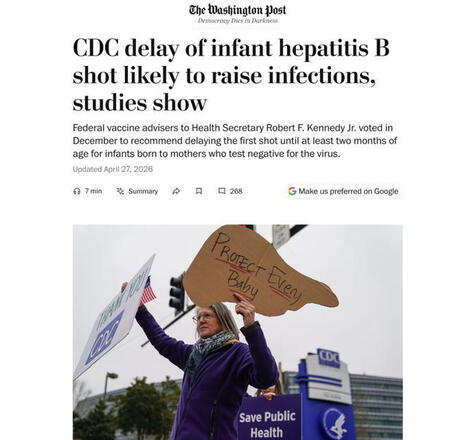
Two rigorous new studies reach the same conclusion: delaying the hepatitis B birth dose means hundreds more infant infections, more liver cancer, more deaths, and millions of dollars in added costs. The evidence for the birth dose has always been strong. These studies make it even stronger. https://lnkd.in/gp4EszHb
More than 30 million doses. Over 1 million zero-dose children reached. In collaboration with the International Rescue Committee and with funding from Gavi, partners are helping deliver routine and catch-up vaccination in some of the world’s most fragile and conflict-affected settings. This milestone shows what’s possible when immunisation delivery models are designed for crisis contexts. Read more: https://bit.ly/4cJrMwx #WorldImmunizationWeek
Vaccines have long been considered by experts to be among the most studied medical interventions, and on the whole, Americans are still broadly supportive of them.
But during President Donald Trump’s second term, the agency that makes recommendations about vaccines—the U.S. Centers for Disease Control and Prevention (CDC)—has, without new scientific evidence, cast fresh doubt on their safety and resurfaced the disproven link between vaccines and autism.
"Misinformation from top health officials in the Trump administration has created a “crisis of public trust” – and Congress should conduct oversight hearings and possibly impeach officials such as Robert F Kennedy Jr, the secretary of the US Department of Health and Human Services (HHS), according to a recently released report.
Experts say that officials in the past year have focused intently on both vaccines and autism, including efforts to connect autism to the use of acetaminophen (frequently sold as Tylenol) during pregnancy, despite growing evidence of no link, and replacing all members of the federal autism committee with advisers who have anti-vaccine and pseudoscientific histories.
The first meeting of the Interagency Autism Coordinating Committee (IACC) was abruptly postponed in March and rescheduled for Tuesday, the same day the report was published by the Autistic Self Advocacy Network (ASAN) and the American Association of People with Disabilities (AAPD).
We detected Aids through a federal early warning system. Trump has decimated it Read more The report includes a timeline of all HHS actions taken in the first year of the second Trump administration. Such changes have been “harmful to its mission” and “detrimental to the autistic community”, such as widespread layoffs, reductions in force and terminations, cutting autism research by about $31m, and removing warnings about dangerous and unproven autism treatments from the website of the US Food and Drug Administration (FDA), said Zoe Gross, director of advocacy at ASAN.
“When you look at it, one thing after another, you can really realize how overwhelming it has been for those of us who are in the autism trenches trying to combat this misinformation and stigmatizing language and these bad decisions, as well as how dedicated this government is to spreading misinformation and to pursuing policies that damage public health,” Gross said." https://lnkd.in/giunuBw6
We all know Secretary Kennedy changed the language about vaccines and autism to cause uncertainty, fear and doubt about vaccines, violating his promise to Senator Cassidy and trick parents into not protecting their children from disease.
Here is a study showing that his effort to mislead parents may be effective. "...key results:
* Respondents who read the current uncertainty-based statement about autism said they were more uncertain that vaccines are safe and were less inclined to get recommended vaccines compared with people reading the previous statement on autism. * Those who read the current uncertainty-based statement were also less likely to trust that the CDC was handling critical situations well and correctly. The respondents were more likely to support science-denial strategies such as impossible evidentiary standards and cherry-picking scientific findings. * The study also employed a control group that read neither of the CDC statements. In this group, survey responses generally fell between those of the uncertainty-based and the consensus-based groups. " https://lnkd.in/gWJH-UMn
Also: Skeptical Raptor is asking for your help and support to keep going - his blog is self-funded, and costs him. Here is how you can help: https://lnkd.in/gJv88E65
Dans une tribune publiée dans Les Echos, Laura Chaubard (École Polytechnique), Edouard Kaminski (Université Paris Cité) et Luis Vassy (Sciences Po) rappellent un point essentiel : face à l’explosion de la désinformation et aux bouleversements liés à l’IA, la question n’est pas seulement technologique, elle est démocratique.
Leur message est clair : • Sans réalité vérifiable partagée, il n’y a pas de débat public solide. • La méthode scientifique, fondée sur la preuve, le doute et la réfutation, est un bien commun. • Les universités forment les nouvelles générations à cette exigence intellectuelle. • Les libertés académiques doivent être garanties pour que ce travail puisse se poursuivre.
Congratulations Ceinwen Jones, AALIA (CP) and the SCIS Data team for another fantastic issue of SCIS Connections! It is a privilege to have contributed my article, How to build a collection for purpose, with purpose. Read this, and the other terrific articles online at https://lnkd.in/g8NbxjBe .
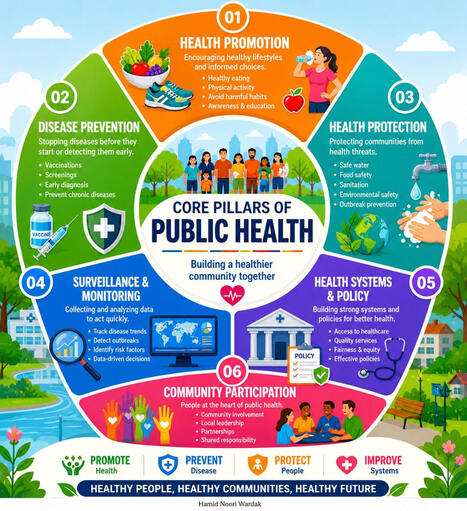
#The_Core_Pillars_of_Public_Health : are the main areas that guide how we protect and improve people’s health at the community level.
Health promotion is about helping people live healthier lives. This includes encouraging good habits like healthy eating, physical activity, and avoiding harmful behaviors such as smoking. It focuses on awareness and behavior change before disease even starts.
Disease prevention works to stop illnesses before they occur or catch them early. This includes vaccinations, screenings, and early diagnosis. It is strongly linked with preventing conditions like Diabetes or Cardiovascular Disease.
Health protection involves protecting communities from health threats. This includes safe water, food safety, sanitation, and controlling environmental risks. For example, preventing outbreaks of diseases like Cholera through clean water systems.
Surveillance and monitoring means constantly collecting and analyzing health data. This helps identify disease trends, outbreaks, and risk factors so action can be taken quickly.
Health systems and policy focus on organizing healthcare services and creating policies that ensure access, quality, and fairness. It ensures that hospitals, clinics, and programs work effectively for everyone.
Community participation is essential—public health is not only about experts, but also about people. Communities must be involved in decision-making and health programs for real impact.
The hantavirus conspiracy theories are coming! Peter McCullough is already pushing the use of Ivermectin for Hantavirus infections. https://lnkd.in/gyhfHcYQ
"In February 2025, Robert F Kennedy Jr began his tenure as secretary of the Department of Health and Human Services (HHS) with an unusual message for the federal department responsible for protecting public health.
America’s greatest challenge, he said, was not just chronic disease but a “spiritual malaise”, a kind of soul-sickness derived from America’s moral decline.
“Spiritual and physical maladies thrive on one another,” Kennedy told HHS employees in his first address. The solution, he said, “must begin with a spiritual question”, of personal responsibility and inward vigilance against the dark forces that would keep Americans “sedated” and “compliant”.
Weeks later, the White House moved to cut 20,500 jobs across the very agency tasked with protecting public health.
This March, as the US faced its worst measles resurgence in 34 years – one he has largely ignored – Kennedy again warned the nation of the same nebulous threat.
This time, he took a more militant tone. “Malevolent forces”, he told an audience of doctors-in-training, must be met with “spiritual warfare”, waged through the “sacred ritual” of eating dinner together as a family.
Now over a year into his tenure, Kennedy champions personal discipline while casting institutional science as a dark force in a cosmic struggle against the light. He has promoted pseudoscientific or unproven remedies, including vitamin A for measles, peptides for longevity and the nutritional benefits of raw milk, while sowing doubt about the safety and efficacy of vaccines.
Because of his granola aura as a former environmental advocate, Kennedy’s invocation of the “spiritual” can initially sound benign – more hippy than doctrinaire.
Yet his repeated references to spiritual forces are more than run-of-the-mill wellness vernacular. They are a signal that the Christian nationalist movement that helped propel Trump into office is now reshaping the public health agency from the inside.
The effect is corrosive, eroding the nation’s shared epistemological reality – like a worm working its way through brain tissue." https://lnkd.in/dGzK6pq8
Recent research highlights the potential of "freedom framing" in public health messaging to address vaccine hesitancy. Survey data indicate that individuals with higher vaccine concerns are more receptive to messages emphasizing personal autonomy, compared to mandates or appeals to social responsibility. This approach resulted in a six percentage point increase in willingness among hesitant respondents. These findings suggest that tailoring communication strategies to align with individual values may be more effective than universal messaging. Further behavioral studies are planned to assess the impact of this framing on actual vaccination rates in real-world settings.
Pregnant women’s mental imagery, what they see when thinking about vaccines, can meaningfully shape their decisions.
Our latest research shows positive imagery predicts earlier vaccination, while negative imagery aligns with hesitancy. A reminder that vaccine communication isn’t just about facts; it’s also about emotions and imagination.
I had my Digital Health class do informal content analyses of the top 10 most viewed TikTok videos on a health topic of their choice. Students (N=100 undergrads) are mostly allied health science majors---our future healthcare professionals! I wanted them to understand what type of health content the algorithm rewards and the importance of science communication. What they found was fascinating and occasionally horrifying. ⬇️ ⬇️
Obesity – the top videos were of two types: healthcare professionals debunking misinformation (yay!) and fat phobic influencers (UGH!). It was a shame to see the algo promoting such mixed messages.
Diabetes – top videos were dominated by healthcare professionals and influencers and contained mixed messages about diet and causes of diabetes. Diabetes content had more misinformation than other topics.
Breast cancer – the misinformation on this subject was bad. One top video was of a patient with breast cancer discouraging people from traditional therapies (e.g., chemo, radiation) and another was of an influencer promoting breast cream that "prevents" cancer. Thankfully, half of the top videos were by healthcare professionals providing evidence-based education about prevention and treatment.
Skin cancer – this was the topic in which the experts were leading the narrative. Nearly all top videos were docs showing folks what different types of skin cancer look like and how to prevent and treat them. Gross pics get views! Go derms! 💚
Depression and ADHD: patients dominated the top videos. Mental health professionals rarely appeared. Patients did a great job of debunking myths and destigmatizing these conditions. Go patients! ❤️
Key issues:
❓ Creator confusion: Students sometimes confused who the creator was because the person in the video was not always the person who posted it. Influencers often used expert and patient voices to elevate and legitimize their content.
💲 HCPs were the most likely to be selling stuff: Promotional content was almost always by healthcare professionals and they were typically peddling supplements and peptides. Students who noticed the creator was selling something downgraded their credibility, but many students did not notice that the creator was selling something.
❌ Evidence for claims was rare: Healthcare providers almost never provided evidence or links to evidence for their health claims. This made it difficult for students to assess the credibility of claims made.
🤡 Who dis? Some top videos were from accounts with cryptic bios and cartoon profile pics that made it impossible to know the identity of the creator.
🏥 Where’s public health? Of many hundreds of top videos, only ONE was from a public health org (WHO). 😮 | 22 comments on LinkedIn
This study provides the first cost-effectiveness analysis of chikungunya vaccines in an endemic middle-income setting. Both the live-attenuated and recombinant vaccines were cost-effective compared with no vaccination, with the live-attenuated vaccine yielding greater NMB under base-case assumptions. However, given ongoing postmarketing safety evaluations of the live-attenuated product, policy decisions should weigh comparative effectiveness alongside emerging safety data and population-specific risk profiles. Overall, our findings indicate that chikungunya vaccination represents a potentially scalable cost-effective strategy to reduce the long-term health and economic burden of disease in endemic settings. https://lnkd.in/dcZtd7xg
Nous espérons que vous avez passé un agréable weekend du 1er mai ! Avec les congés et ponts, notre agenda est un peu moins chargé (on vous laisse souffler !) mais nos membres pourront profiter de ces activités :
- 22 mai : Formation sur les bases immunologiques avec le Professeur Jean Daniel Lelièvre (Vaccine Research Institute)
- 26 mai : Apéro débat sur le thème de "Décliner ses sujets" (plus d'informations prochainement !)
- 26 mai : Visite à Paris à l'Institut de Myologie
Joyeux mois de mai à toutes & tous et au plaisir de vous croiser lors de ces événements !
To get content containing either thought or leadership enter:
To get content containing both thought and leadership enter:
To get content containing the expression thought leadership enter:
You can enter several keywords and you can refine them whenever you want. Our suggestion engine uses more signals but entering a few keywords here will rapidly give you great content to curate.


 Your new post is loading...