Your new post is loading...

|
Rescooped by
Gilbert C FAURE
from Immunology and Biotherapies
January 30, 2020 1:15 PM
|
Point of view of an Immunologist/curator in 2020 Après Bobcatsss 2020, ECIL 2021, ICDF 2022, HESIVAXs with the motto UTA "Understand to Act" Notre proposition « Désinformation Vaccinale: Curation, Observatoire, Littératies » a été retenue pour le séminaire annuel de l’Académie des Controverses et de la Communication Sensible, intitulé « La désinformation : nouvelles formes, nouveaux défis », qui s'est tenu à Paris le mardi 26 novembre 2024. Voir ci-après posts du 27 novembre, avec lien vers la présentation sur Slideshare. Présentation le 20 mars 2025 à InfoxsurSeine deux jours pour décrypter la désinformation et échanger autour des solutions.
Quels outils concrets face aux manipulations de l’information et à l’essor de l’IA générative ? Avez vous acheté le numéro Juillet/septembre 2025 de la RECHERCHE sur LE FAUX? des sujets à approfondir - Vaccins et argent Making money with vaccines, against vaccines le sujet le plus chaud, de 3,36 euros par mois à 300 millions de dollars? - Publications vraies et fausses particulièrement difficile - Obligations, exemptions, incitations, peut-être plus simple?
|
|
Scooped by
Gilbert C FAURE
Today, 4:42 AM
|
Dans cet épisode du Conseil Scientifique Indépendant, Louis Fouché reçoit Annette Lexa, toxicologue experte judiciaire, inscrite sur la liste Eurotox et auprès du tribunal judiciaire de Metz, avec plus de 40 ans d’expérience en toxicologie réglementaire.Annette Lexa explique la différence fondamentale entre science académique et science réglementaire, et décortique avec précision les documents réglementaires européens (Risk Management Plans, guidelines OMS, AMM conditionnelle) qui ont encadré le développement des vaccins à ARN messager en 2020-2021.Elle révèle :L’absence totale de lignes directrices adaptées aux vaccins ARN au moment de leur mise sur le marché
Les manquements graves en phase préclinique (pharmacocinétique, toxicité, qualité, stabilité)
Les seuils d’acceptabilité d’impuretés et de risques très différents entre médicaments et substances chimiques
Le choix contestable du principe actif (ARN seul vs nanolipides + ARN)
La précipitation, l’impréparation et les pressions qui ont conduit à une autorisation conditionnelle malgré des données incomplètes
Un exposé technique mais clair sur la science réglementaire, souvent ignorée, qui montre que toutes les alertes étaient déjà dans les documents officiels dès 2020-2021.Avec la participation d’Eric Ménard.Liens utiles :
→ Fil X (Twitter) d’Annette Lexa : recherche « Annette Lexa »
→ Conseil Scientifique IndépendantSi vous voulez comprendre comment la réglementation a été contournée et pourquoi tant de questions posées dès le début se sont révélées justifiées, cet entretien est essentiel.
Partagez, likez et commentez !
#ScienceRéglementaire #VaccinsARN #AnnetteLexa #LouisFouché #Toxicologie #AMMConditionnelle #ConseilScientifiqueIndépendant
|
|
Scooped by
Gilbert C FAURE
Today, 4:38 AM
|
I’ve spent some time collecting examples and notes to discuss with young people how our health decisions and discussions are often more about making sense of health information than simply evaluating facts.
Our health decisions are rarely just about the data; they are deeply personal and subjective. We often make choices based on how information feels and who is sharing it, rather than just the medical facts. Because our life circumstances and the digital environments we inhabit are always shifting, we might look at the same health choice differently today than we did a year ago. To navigate this, we need to understand how our digital relationships and the emotional "vibe" of our online spaces quietly shape how we make sense of our well-being.
For example, a person might ignore a formal medical article about stress but then decide to try a specific supplement after hearing a cousin describe their own relief in a private WhatsApp voice note. The clinical facts about the supplement didn't change, but the feeling of trust and the intimacy of that digital connection is what actually moved the needle on their decision.
I have organized these cases into five thematic "digital ecologies" to help navigate these complex environments and I link to these in a separate article.
To deepen these discussions, I suggest practicing five critical inquiry skills for critical health literacy in digital contexts:
1/ contrast commercial vs. caring by looking for revenue models behind health advice
2/ use the empathy filter to understand why information feels right, rather than just what is wrong
3/ apply the relatability test to see how platform "vibes" and aesthetics affect our skepticism
4/ identify the incentive trap to see if an algorithm is rewarding accuracy or just shocking content
5/ recognize the authority shift and why "real people" on screens often feel more trustworthy than institutional experts
On a related note, there is currently a call for papers out in Health Promotion International (HPI) for anyone working on critical health literacy. You can find the details here: https://lnkd.in/egcz-2fA
These are just notes, not a formal toolkit, although they could certainly be turned into something more useful for an educator.
Samantha Thomas Orkan Okan Angela Leung Becky White, PhD Catherine BERTRAND-FERRANDIS Elisabeth Wilhelm
|
|
Scooped by
Gilbert C FAURE
Today, 4:37 AM
|
■QUELQUES RÉFLEXIONS■(13)
☆☆☆
▪︎Je viens de lire sur Internet que le vaccin à ARNm est un bon vaccin, permettant de sauver beaucoup de vies humaines pendant la pandémie covidique, et que les effets secondaires sont rares et bénins, rarement délétères.
Quel mensonge éhonté !
Je résume ici ce que représente le vaccin à ARNm dont j'ai fait état dans mes nombreuses Publications sur LinkedIn :
- Être vacciné avec le vaccin à ARNm n'empêche pas de CONTRACTER le virus et de le TRANSMETTRE à d'autres personnes.
- Vacciner en pleine épidémie ne sert à rien car il faut savoir qu'un vaccin est un TRAITEMENT PRÉVENTIF non curatif.
- Le vaccin à ARNm provoque des EFFETS SECONDAIRES DÉLÉTÈRES, parfois mortels.
- Ces effets secondaires sont psychosomatiques, c'est à dire provoquent des problèmes PSYCHIQUES ( troubles du comportement...) et SOMATIQUES ( myocardites...).
- Le vaccin à ARNm est responsable à ce jour d'environ VINGT MILLIONS DE MORTS dans le monde, et ce n'est pas fini.
- Le vaccin à ARNm n'a aucune TOLÉRANCE et aucune EFFICACITÉ.
- Il a été commercialisé et utilisé avant même que les ESSAIS CLINIQUES soient terminés, à cause de l'"urgence absolue" à vacciner, selon les déclarations des "autorités sanitaires" assassines et cupides.
- Katherin Jansen, qui est une ancienne responsable du secteur Recherche et Développement ( R&D) du laboratoire Pfizer, a comparé ce vaccin à un avion qu'on a fait voler alors qu'il n'a pas encore fini d'être construit ( "we flew the aéroplane while we were still building it").
|
|
Scooped by
Gilbert C FAURE
April 3, 12:33 PM
|
Many thanks President Julius Maada Bio for highlighting how the #GaviLeap reform will accelerate Sierra Leone’s goals to further boost immunisation coverage, protect children against deadly diseases and strengthen health systems. Gavi, the Vaccine Alliance looks forward to supporting your journey to self reliance.
|
|
Scooped by
Gilbert C FAURE
April 3, 12:26 PM
|
Can Everything that Counts be Counted?
We've gotten very good at counting things in global health. Doses delivered. People reached. Percentage coverage. These numbers matter — but they're not the same as understanding.
Most M&E frameworks I encounter are fundamentally counting frameworks. They tell us whether something happened. Rarely do they tell us why.
This matters more than we tend to acknowledge. When a vaccination campaign succeeds, we celebrate the coverage numbers. But without understanding the mechanism — what shifted in people's motivation, their confidence, their sense that vaccination was easy and socially approved — we can't reliably replicate that success. We got lucky, or we got good, and we can't tell the difference.
The Fogg Behavior Model offers one useful lens here: behavior happens when motivation, ability, and a prompt align. If your M&E isn't measuring those intermediate steps, you're testing whether a key opened a lock — without learning anything about how the key works.
In my own work evaluating HPV vaccination campaigns in Nigeria and Bangladesh, the most important finding wasn't the vaccination rate. It was why the rate changed — through shifts in caregiver motivation and perceived ability, not through increases in factual knowledge. That distinction has direct implications for how you design the next campaign.
Global health has a replication problem. Part of the reason is that we invest in doing, and in counting what we've done — but not in understanding. Until we treat behavioral mechanisms as core M&E outputs, not optional research add-ons, we'll keep rebuilding the wheel.
What counts isn't always what can be counted. And what can be counted isn't always what counts.
#GlobalHealth #BehavioralScience #MandE #VaccineUptake #HPV #BehavioralInsights #PublicHealth #EvidenceBasedPolicy #ImplementationScience #HealthCommunication
|
|
Scooped by
Gilbert C FAURE
April 3, 12:01 PM
|
The World Economic Forum and the United Nations both ranked false and misleading information as top-tier global risks. The combination of rapid dissemination of poor quality information through social and digital media, amplified by the power of generative AI and the erosion of trust in public health agencies are reshaping the global health landscape.
In a new opinion piece, Scott C. Ratzan MD, Carolina Batista MD and Lawrence Gostin, chairs of the Nature Medicine Commission on Quality of Health Information for All, argue that quality health information is a fundamental determinant of health.
They define quality health information as “scientifically sound, accessible, clear, understandable and essential for appropriate decision-making that improves health.”
Quality health information shapes health and well-being in profound ways: in clinical settings, health behaviors, scientific innovation and broader socio-economic, commercial and political contexts. It is vital to understand the power of information and the urgency of developing effective tools to improve the health information environment.
Read now in Nature Medicine (link 👇)
#healthliteracy #globalhealth #qualityofinformation #misinformation #genAI
|
|
Scooped by
Gilbert C FAURE
April 3, 11:41 AM
|
A story told with Adobe Spark
|
|
Scooped by
Gilbert C FAURE
April 3, 11:38 AM
|
Merci à La Revue Parlementaire de nous avoir ouvert ses pages.
La 𝗱𝗲́𝘀𝗶𝗻𝗳𝗼𝗿𝗺𝗮𝘁𝗶𝗼𝗻 𝗲𝗻 𝘀𝗰𝗶𝗲𝗻𝗰𝗲 𝗲𝘁 𝗲𝗻 𝘀𝗮𝗻𝘁𝗲́ constitue un 𝗿𝗶𝘀𝗾𝘂𝗲 𝘀𝘆𝘀𝘁𝗲́𝗺𝗶𝗾𝘂𝗲 𝗺𝗮𝗷𝗲𝘂𝗿 𝗽𝗼𝘂𝗿 𝗻𝗼𝘁𝗿𝗲 𝗱𝗲́𝗺𝗼𝗰𝗿𝗮𝘁𝗶𝗲. Il est temps que les parlementaires prennent pleinement conscience du danger et s'emparent du sujet.
Pour les 156 entretiens de notre rapport fait avec Herve Maisonneuve Dominique Costagliola,
✅ seuls 4 𝗽𝗮𝗿𝘁𝗶𝘀 𝗽𝗼𝗹𝗶𝘁𝗶𝗾𝘂𝗲𝘀 sur 8 ont répondu
❌ les autres sont restés silencieux malgré nos relances répétées
Au mieux : 𝗺𝗮𝗻𝗾𝘂𝗲 𝗱𝗲 𝗰𝗼𝗻𝘀𝗰𝗶𝗲𝗻𝗰𝗲 du problème
Au pire : la désinformation en santé utilisée comme outil politique pour capter des voix de manière irresponsable.
Car derrière la désinformation en santé, il y a 𝗱𝗲𝘀 𝗿𝗲𝘁𝗮𝗿𝗱𝘀 𝗱𝗲 𝘀𝗼𝗶𝗻𝘀 et 𝗱𝗲𝘀 𝘃𝗶𝗲𝘀 𝗲𝗻 𝗷𝗲𝘂
Il est temps de 𝗽𝗿𝗲𝗻𝗱𝗿𝗲 𝗰𝗲 𝗽𝗿𝗼𝗯𝗹𝗲̀𝗺𝗲 𝗮̀ 𝗯𝗿𝗮𝘀-𝗹𝗲-𝗰𝗼𝗿𝗽𝘀 et de 𝗽𝗿𝗼𝘁𝗲́𝗴𝗲𝗿 la science, la santé et notre démocratie.
Yannick NEUDER, Stephanie RIST, Edouard Philippe, Thomas Mesnier, Arnaud Robinet, Gabriel Attal, Frédéric Valletoux, Marine Tondelier, JOMIER BERNARD, Manuel Bompard, Hadrien Clouet, Jordan Bardella, Marine Le Pen, anne-sophie de surgy, Antoine PELISSOLO, Fabien Roussel, Raphaël Glucksmann, Geneviève Darrieussecq, philippe berta, Bruno Retailleau, Sébastien Lecornu, Emmanuel Macron, Pierre Ouzoulias, Stéphane Piednoir, Pierre Henriet, Gérard Larcher, ACADEMIE NATIONALE DE MEDECINE DE FRANCE, Académie des sciences, Académie nationale de Pharmacie, ACADEMIE VETERINAIRE DE FRANCE, Conseil économique social et environnemental, Assemblée nationale, Sénat
|
|
Scooped by
Gilbert C FAURE
April 3, 11:35 AM
|
Go beyond basic vaccinology and learn how vaccines are evaluated in the real world. Join LSHTM’s Epidemiological Evaluation of Vaccines short course to explore methods for assessing vaccine efficacy, safety and policy across global settings.
|
|
Scooped by
Gilbert C FAURE
April 3, 11:32 AM
|
A study finds that vaccine-hesitant older adults are more willing to accept hypothetical COVID shots when they are described as preserving their freedom and autonomy rather than as complying with government recommendations.
https://lnkd.in/e6ta7DiF
With Parthasarathy Krishnamurthy and Ye Hu of University of Houston, Jess Steier of Unbiased Science, Elisabeth Marnik of the Evidence Collective, David Higgins, MD, MPH of University of Colorado Anschutz.
|
|
Scooped by
Gilbert C FAURE
April 3, 11:30 AM
|
Before vaccines, death and disability stalked children.
Then shots turned once-common infections into something doctors only read about in textbooks.
But when immunization rates drop, plagues from the past can come roaring back, as measles has in American communities where parents decided not to vaccinate their children.
Imagine what would happen if even the people who wanted shots couldn’t get them.
Stanford epidemiologists Mathew Kiang and Nathan Lo modeled that scenario. We used their findings to illustrate what a future without vaccines could look like.
Read the full story: https://propub.li/41EbQVD
(Illustrations by Daniel Zender for ProPublica)
|
|
Scooped by
Gilbert C FAURE
April 3, 8:29 AM
|
13 % de mortalité en moins.
Et si ce n’était que le début ?
On parle souvent du vaccin antipaludique comme d’une innovation.
Mais une innovation ne vaut que par son impact.
Quatre ans après son introduction dans les pays pilotes (Ghana, Kenya, Malawi), les données montrent :
✔️ 13 % de réduction de la mortalité
✔️ 22 % de réduction des hospitalisations pour paludisme grave
(Source : évaluation phase pilote du vaccin antipaludique)
🔆 13 %.
Ce chiffre peut sembler modeste.
Mais en santé publique, 13 % signifie :
– des milliers d’enfants qui rentrent à la maison
– des hospitalisations évitées
– des systèmes de santé moins saturés
Comme on le dit souvent :
“Une petite brèche peut sauver un village entier.”
La vraie question n’est pas :
Le vaccin fonctionne-t-il ?
Les données répondent déjà.
La vraie question est :
Sommes-nous capables d’atteindre une couverture suffisante pour amplifier cet impact ?
Parce qu’un vaccin introduit ne sauve pas des vies.
Un vaccin complété, oui.
Et c’est là que commence le vrai défi.
#VaccinAntiPaludique
#MortalitéInfantileRéduite
|
|
|
Scooped by
Gilbert C FAURE
Today, 8:16 AM
|
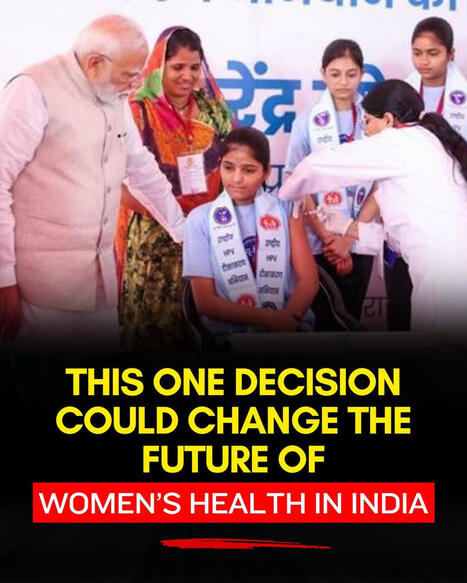
The Indian healthcare system rolling out free HPV vaccination for adolescent girls is a big step in the right direction.
As a gynecologist, this is something we’ve been hoping to see at scale for years.
Cervical cancer is one of the few cancers we can actually prevent and yet, so many women in India still get diagnosed late, often when options are limited. That’s the real problem this initiative is trying to solve.
The HPV vaccine, like Gardasil, works best when given early, before exposure to the virus. Which is why targeting adolescent girls through government programs makes so much sense. It shifts the focus from reaction to prevention.
For new mothers, this is especially important. A lot of parents today are far more aware and proactive about their child’s health. But when it comes to HPV, there’s still hesitation, mostly because it hasn’t been part of routine conversations for long.
This initiative changes that. It normalises prevention at the right age, through the right channels and the impact can be massive.
Fewer cases of cervical cancer.
Fewer late diagnoses.
Fewer families going through something that is largely preventable.
This is what strong public health looks like, not just treating disease, but reducing the chances of it happening in the first place.
If you’re a parent, this is worth understanding and discussing with your doctor. Because sometimes, the most powerful healthcare decisions are the ones taken early. | 21 comments on LinkedIn
|
|
Scooped by
Gilbert C FAURE
Today, 4:41 AM
|
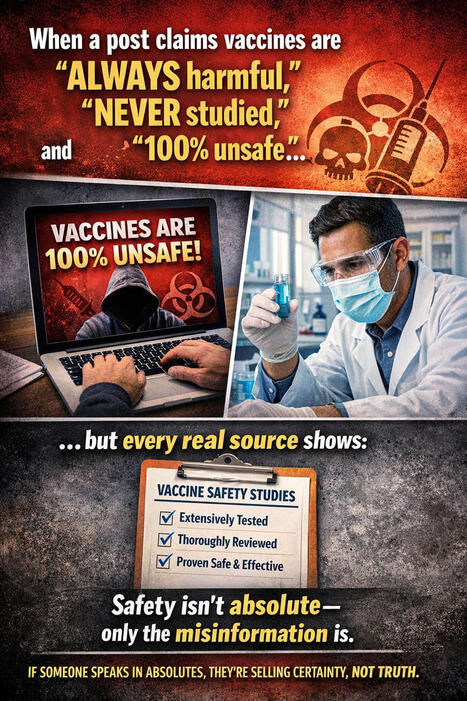
How do you detect disinformation? — absolute words distort reality — can undermine democratic processes, public health, and trust in institutions -💉🌀 Vaccine Disinformation (Absolute‑Words)
“When a post says vaccines are ‘ALWAYS dangerous’ and ‘NEVER tested’…”
“…but every actual study says the opposite.”
If someone speaks in absolutes, the truth is usually missing. For example use of the words "all" , "always," "never," "everyone," or "undeniably"—can increase the perceived credibility and urgency of a message, even when the underlying information is false.
|
|
Scooped by
Gilbert C FAURE
Today, 4:37 AM
|
Les rapports se succèdent et confirment qu’un 𝗽𝗿𝗼𝗯𝗹𝗲̀𝗺𝗲 𝗺𝗮𝗷𝗲𝘂𝗿 existe : 𝟰𝟬 % des contenus de 𝗱𝗲́𝘀𝗶𝗻𝗳𝗼𝗿𝗺𝗮𝘁𝗶𝗼𝗻 sur les plateformes concernent la 𝘀𝗮𝗻𝘁𝗲́, loin devant la guerre en Ukraine (𝟮𝟬 %) et la politique nationale (𝟭𝟬 %).
https://lnkd.in/e6XmYNjm
Dominique Costagliola, Herve Maisonneuve, Ministère de la Santé, Arcom
|
|
Scooped by
Gilbert C FAURE
Today, 4:29 AM
|
"Demetre Daskalakis joined the Centers for Disease Control and Prevention in 2020. Along the way, he helped lead a response to the mpox outbreak and, more recently, ran an agency division focused on containing infectious diseases like influenza and COVID-19.
From that vantage point, Daskalakis saw, firsthand, an unsettling shift in the way the CDC operated once Robert F. Kennedy Jr. took control of the Department of Health and Human Services and the web of agencies under its purview. Daskalakis says he had an open mind when Kennedy, a known vaccine skeptic, came aboard. He was prepared to aid Kennedy’s desire to better public health and show him the ins and outs of the CDC. But what he saw instead was a raft of policies he believes prioritize ideology over established science. "
https://lnkd.in/g_mPMetT
|
|
Scooped by
Gilbert C FAURE
April 3, 12:26 PM
|
𝐖𝐡𝐚𝐭 𝐝𝐨𝐞𝐬 𝐢𝐭 𝐭𝐚𝐤𝐞 𝐭𝐨 𝐯𝐚𝐜𝐜𝐢𝐧𝐚𝐭𝐞 𝐭𝐡𝐞 𝐰𝐨𝐫𝐥𝐝'𝐬 𝐡𝐚𝐫𝐝𝐞𝐬𝐭-𝐭𝐨-𝐫𝐞𝐚𝐜𝐡 𝐜𝐡𝐢𝐥𝐝𝐫𝐞𝐧?
𝐅𝐢𝐫𝐬𝐭, 𝐲𝐨𝐮 𝐡𝐚𝐯𝐞 𝐭𝐨 𝐟𝐢𝐧𝐝 𝐭𝐡𝐞𝐦. 𝐓𝐡𝐚𝐭 𝐬𝐨𝐮𝐧𝐝𝐬 𝐬𝐢𝐦𝐩𝐥𝐞. 𝐈𝐭 𝐢𝐬𝐧'𝐭.
Zero-dose children, those who have never received a single routine vaccine, are disproportionately found in the places our data systems struggle most: remote communities, conflict zones, urban slums, and nomadic populations.
We spent months reviewing how #geospatial tools are being used to map these children. We looked at 102 studies, 68 countries, and a rapidly growing field of #spatial science applied to immunisation, led by Ann Njogu.
👉The science is advancing fast: 70% of studies published in just the last four years
👉 Sophisticated methods exist to generate high-resolution estimates of vaccine coverage
But:
►Evidence is concentrated in a handful of countries, esp. Nigeria, Ethiopia and India
► The most marginalised populations are consistently left out of models
► We're still not speaking the same language; ZD definitions vary widely across studies
►Over-reliance on household surveys (DHS)
► Routine data (DHIS2) that could power real-time monitoring sits largely untapped
► Advanced geospatial modelling is dominated by a handful of well-resourced academic groups
The result? The countries that need geospatial evidence the most are the least equipped to produce or act on it.
✮ Reaching ZD children requires not just better tools but also investment in local capacity, open and reproducible methods, and stronger partnerships between academic groups and national programmes.
Because you can't reach children you can't find
Preprint: https://lnkd.in/efGsmjCM
This work is part of the REACH-OUT Project with contributions from many colleagues: Moses Musau, Swati Srivastava, Emma Clarke-Deelder, PhD, Caroline Mudereri, Felix Rubuga, Yvonne Opanga, GASHAIJA Absolomon, Hassan Sibomana, Jeanine Condo, Frank Badu Osei (PhD), Lenka Beňová, Justine Blanford, Aleksandra Torbica, Alessia Melegaro, Carlo Federici and others.
#ZeroDoseChildren #GlobalHealth #Immunization #Geospatial #PublicHealth #Vaccines
|
|
Scooped by
Gilbert C FAURE
April 3, 12:03 PM
|
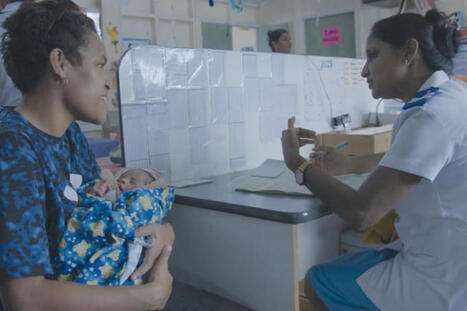
🌏 Big news from the Pacific — and a reminder of why investing in digital foundations matters.
Fiji just launched its first-ever nationwide digital immunization record system — replacing paper-based records that were routinely lost, duplicated, or inaccessible when families moved between islands.
The system covers 220 immunization sites and supports approximately 500 healthcare workers, ensuring every child has a secure vaccination record accessible from anywhere in the country - including in areas with limited connectivity. No small feat in a maritime archipelago.
But this is not just a digital upgrade. It's digital infrastructure.
By replacing paper with a secure nationwide digital system, Fiji is building a more resilient and efficient healthcare system - one that can withstand disease outbreaks and climate-related emergencies alike.
This investment is being built as underlying Digital Public Infrastructure (DPI) for Health. When you build foundational systems that are interoperable, scalable, and country-owned, the returns compound. The same infrastructure powering immunization records today can anchor a multi-country telehealth programme across the Pacific tomorrow — connecting patients in remote atolls to clinical expertise and cutting costs across the system.
This is what UNICEF's advocates for globally: stop funding isolated pilots. Invest in systems that make every intervention stronger, cheaper, and more resilient.
Read more at https://lnkd.in/dcPEttGF
Congratulations to Fiji's Ministry of Health, #UNICEF Pacific, and the Government of Japan. 🇫🇯
#DigitalHealth #DigitalPublicInfrastructure #DPI #HealthSystems #SanteSuite #Gavi #WorldBank #Pacific #Immunization #DigitalTransformation #HealthForAll
|
|
Scooped by
Gilbert C FAURE
April 3, 12:00 PM
|
As vaccine-preventable diseases continue to rise in the United States, we are presented with an opportunity to increase transparency and build trust among those who are hesitant to get vaccinated. Research has shown that when presented with credible information and visible evidence, confidence in vaccines grows.
This is why strong systems and trusted partnerships are so important. The Partnership for International Vaccine Initiatives (PIVI), a program of The Task Force for Global Health, Inc., works alongside health leaders around the world to strengthen vaccination programs and ensure that life-saving innovations reach people safely and efficiently.
When we lead with evidence and come together, we create a healthier world for all. Read more of what PIVI's Dr. Joe Bresee has to say in this recently published op-ed: https://bit.ly/4sGx4hH
|
|
Scooped by
Gilbert C FAURE
April 3, 11:39 AM
|
𝗪𝗵𝘆 𝗖𝗵𝗼𝗼𝘀𝗶𝗻𝗴 𝗕𝗲𝘁𝘄𝗲𝗲𝗻 𝗔𝗰𝘁𝗶𝗼𝗻 𝗥𝗲𝘀𝗲𝗮𝗿𝗰𝗵 𝗮𝗻𝗱 𝗖𝗮𝘀𝗲 𝗦𝘁𝘂𝗱𝘆 𝗖𝗮𝗻 𝗠𝗮𝗸𝗲 𝗼𝗿 𝗕𝗿𝗲𝗮𝗸 𝗬𝗼𝘂𝗿 𝗧𝗵𝗲𝘀𝗶𝘀.
Many graduate students weaken their thesis by confusing 𝗮𝗰𝘁𝗶𝗼𝗻 𝗿𝗲𝘀𝗲𝗮𝗿𝗰𝗵 with 𝗰𝗮𝘀𝗲 𝘀𝘁𝘂𝗱𝘆—yet the two serve fundamentally different academic purposes.
𝗔𝗰𝘁𝗶𝗼𝗻 𝗿𝗲𝘀𝗲𝗮𝗿𝗰𝗵 is initiated to solve an 𝗶𝗺𝗺𝗲𝗱𝗶𝗮𝘁𝗲 𝗽𝗿𝗼𝗯𝗹𝗲𝗺 It focuses on 𝗶𝗺𝗽𝗹𝗲𝗺𝗲𝗻𝘁𝗶𝗻𝗴 𝘀𝗼𝗹𝘂𝘁𝗶𝗼𝗻𝘀, often within the 𝗳𝗶𝗲𝗹𝗱 𝗼𝗳 𝗲𝗱𝘂𝗰𝗮𝘁𝗶𝗼𝗻, where researchers may also 𝗮𝗰𝘁 𝗮𝘀 𝗽𝗮𝗿𝘁𝗶𝗰𝗶𝗽𝗮𝗻𝘁𝘀 in the research process. This approach is practical, intervention-based, and solution-oriented.
𝗖𝗮𝘀𝗲 𝘀𝘁𝘂𝗱𝘆, by contrast, involves 𝗶𝗻-𝗱𝗲𝗽𝘁𝗵 𝗮𝗻𝗮𝗹𝘆𝘀𝗶𝘀 of a 𝗽𝗮𝗿𝘁𝗶𝗰𝘂𝗹𝗮𝗿 𝗲𝘃𝗲𝗻𝘁 𝗼𝗿 𝗰𝗮𝘀𝗲 𝗼𝘃𝗲𝗿 𝗮 𝗹𝗼𝗻𝗴 𝗽𝗲𝗿𝗶𝗼𝗱 𝗼𝗳 𝘁𝗶𝗺𝗲. It emphasizes 𝗼𝗯𝘀𝗲𝗿𝘃𝗶𝗻𝗴 𝗮𝗻𝗱 𝗮𝗻𝗮𝗹𝘆𝘀𝗶𝗻𝗴 𝗮 𝘀𝗶𝘁𝘂𝗮𝘁𝗶𝗼𝗻, is 𝘂𝘀𝗲𝗱 𝗶𝗻 𝗺𝗮𝗻𝘆 𝗳𝗶𝗲𝗹𝗱𝘀, and 𝗱𝗼𝗲𝘀 𝗻𝗼𝘁 𝗽𝗿𝗼𝘃𝗶𝗱𝗲 𝗮 𝘀𝗼𝗹𝘂𝘁𝗶𝗼𝗻 𝘁𝗼 𝗮 𝗽𝗿𝗼𝗯𝗹𝗲𝗺. Researchers typically 𝗱𝗼 𝗻𝗼𝘁 𝘁𝗮𝗸𝗲 𝗽𝗮𝗿𝘁 in the research setting.
Misunderstanding this distinction leads to flawed methodology, weak research design, and inconsistent findings—common issues in rejected proposals.
📲 If you need thesis help, WhatsApp DocAdeson on: +14243487554
♻️ find this useful? follow + like + repost + comment.
#DrAdeson
#AcademicResearch
#ResearchMatters
#ResearchCommunity
#AcademicWriting
#PhDLife
#PostdocLife
#GradSchool
|
|
Scooped by
Gilbert C FAURE
April 3, 11:36 AM
|
|
|
Scooped by
Gilbert C FAURE
April 3, 11:35 AM
|
I recently participated in the "Sustaining the Gains in Childhood Vaccination" meeting with state and local immunization managers hosted by the International Vaccine Access Center at Johns Hopkins BSPH.
There, we discussed the many challenges local immunization managers are currently facing and proposed practical, actionable solutions.
While at the meeting, I also had the opportunity to highlight the work of Center for Infectious Disease Research and Policy (CIDRAP)'s Vaccine Integrity Project, whose staff are conducting independent evidence reviews of several key vaccines.
Thank you to the staff at IVAC for hosting this important discussion and giving me the opportunity to showcase the Project's work.
More information about the Project can be found here: https://lnkd.in/eGmYwQVq
|
|
Scooped by
Gilbert C FAURE
April 3, 11:31 AM
|
Another from #philipmcmillan that LinkedIn should have removed.
|
|
Scooped by
Gilbert C FAURE
April 3, 11:29 AM
|
Kenya is projected to save about Ksh4 billion (USD 30milliom) in healthcare costs through continued rotavirus vaccination, according to findings reported by the Kenya Medical Research Institute (KEMRI) and the One Health Trust.
The analysis shows that the rotavirus vaccine is not only protecting children from severe diarrhoeal disease but also significantly reducing hospital admissions and the overall financial burden on the health system.
Experts explain that by preventing thousands of cases that would otherwise require treatment, the country is easing pressure on hospitals while freeing up resources for other critical health needs.
The findings also suggest that sustained immunisation efforts could continue to deliver long-term economic and public health benefits, especially for young children who are most vulnerable to rotavirus infections.
|
|
Scooped by
Gilbert C FAURE
April 3, 7:10 AM
|
Journée internationale du fact-checking : face aux infox, les faits comptent.
ℹ️ Les manipulations de l’information se diffusent aujourd’hui à grande vitesse. Elles fragilisent les sociétés, alimentent les tensions et s’inscrivent dans une véritable guerre informationnelle, où la bataille se joue aussi dans le champ des perceptions.
Face à cette réalité, la France agit.
À travers son opérateur CFI, agence française de développement médias par exemple, le ministère de l’Europe et des Affaires étrangères soutient celles et ceux qui, partout dans le monde, vérifient les faits et déconstruisent les infox.
🌐 En 2025, l’accompagnement de 25 000 personnes dans le cadre de projets de CFI a permis de soutenir des réseaux de vérification qui rassemblent aujourd’hui plus de 300 fact-checkers dans 14 pays.
Cette action s’inscrit dans la durée : former, relier, structurer des écosystèmes capables de faire face aux manipulations de l’information.
💡 Elle s’appuie aussi sur le développement d’outils innovants.
🔎 Parmi eux, askVera, une solution française gratuite d’intelligence artificielle, permet de vérifier plus facilement la fiabilité d’une information. Déployée notamment en Afrique francophone, elle est déjà utilisée pour répondre aux enjeux de vérification au quotidien.
Soutenir le fact-checking, c’est renforcer la capacité de chacun à s’informer librement et de manière éclairée.
|