Your new post is loading...

|
Rescooped by
Gilbert C FAURE
from Immunology and Biotherapies
January 30, 2020 1:15 PM
|
Point of view of an Immunologist/curator in 2020 Après Bobcatsss 2020, ECIL 2021, ICDF 2022, HESIVAXs with the motto UTA "Understand to Act" Notre proposition « Désinformation Vaccinale: Curation, Observatoire, Littératies » a été retenue pour le séminaire annuel de l’Académie des Controverses et de la Communication Sensible, intitulé « La désinformation : nouvelles formes, nouveaux défis », qui s'est tenu à Paris le mardi 26 novembre 2024. Voir ci-après posts du 27 novembre, avec lien vers la présentation sur Slideshare. Présentation le 20 mars 2025 à InfoxsurSeine deux jours pour décrypter la désinformation et échanger autour des solutions.
Quels outils concrets face aux manipulations de l’information et à l’essor de l’IA générative ? Avez vous acheté le numéro Juillet/septembre 2025 de la RECHERCHE sur LE FAUX? des sujets à approfondir - Vaccins et argent Making money with vaccines, against vaccines le sujet le plus chaud, de 3,36 euros par mois à 300 millions de dollars? - Publications vraies et fausses particulièrement difficile - Obligations, exemptions, incitations, peut-être plus simple?
|
|
Scooped by
Gilbert C FAURE
Today, 9:23 AM
|
Who’s shaping the health information patients find on social media?
Many people are encountering health information from a wide range of sources — including people without formal credentials.
Our analysis of 6,800+ health and wellness influencer accounts found that 41% identify as health care professionals, while 16% share no credentials at all.
|
|
Scooped by
Gilbert C FAURE
Today, 9:17 AM
|
There are a lot of questions around #hantavirus, and once again we’re seeing a spike in misinformation and harmful narratives. Being on a healthy information diet is vital to your health.
A few things to keep in mind:
- Don't blindly share messages without pausing.
- Check your sources - is it from a credible source, a public health and science body, from your health care provider?
- Beware of videos floating around, especially those that look overly polished and synthetic. If you see a video clipped from WHO on another channel, always corroborate it with the source - for example: visit our website, or our corporate social media channels and look for that exact information. Context and the full picture matter. We are again seeing short clips taken out of our public statements/videos and distorted to promote misleading narratives.
We are working round the clock to bring you accurate, timely updates.
Here’s what you can expect from us:
1) Disease outbreak news out now, this gets updated regularly: https://bit.ly/49AGmUM
2) Short lives on our channels every day around 16:00 CEST, tune into WHO on LinkedIn, X, Facebook and YouTube
3) Explainer videos from experts.
4) Graphics/tiles that inform you what you need to know about hantavirus.
5) DG-led press briefings on WHO corporate channels, with clips from the press conference highlighting key messages and takeaways.
Kudos to my team working alongside technical experts, at the WHO, to keep you informed, and up-to-date on our channels.
Give World Health Organization a follow.
And also follow our chief, Dr Tedros Adhanom Ghebreyesus.
|
|
Scooped by
Gilbert C FAURE
Today, 9:10 AM
|
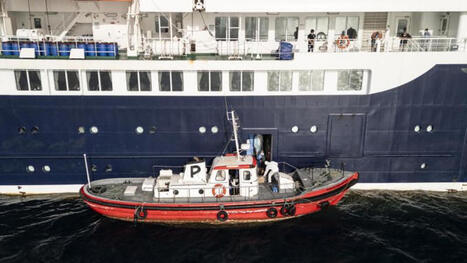
En mai 2026, l'éclosion de hantavirus à bord du navire MV Hondius a jeté une lumière crue sur un système de financement vaccinal paradoxal : celui-ci ne se déverrouille vraiment qu'une fois l'épidémie "réalisée". Cette chronique explore un dilemme rarement formulé explicitement dans le débat public, mais qui structure silencieusement nos choix collectifs en matière de santé mondiale.
#hantavirus
|
|
Scooped by
Gilbert C FAURE
Today, 8:57 AM
|
This week, five taxpayer-funded vaccine studies came back with the same conclusion -- vaccines are safe. The Trump regime tried to bury them, because releasing proof that vaccines work would infuriate their base.
Scientists reviewed 7.5 million Medicare records and found only about one in a million experienced severe allergic reactions. A peer-reviewed journal had already agreed to publish one paper before Trump's FDA yanked it back.
Harvard professor Aaron Kesselheim called it censorship: “At any other time in history, this would be a major scandal that would lead to congressional hearings and resignations of leadership.”
The Bottom Line: The vaccines are safe -- and the regime just got caught trying to bury the proof.
Read more here:
https://lnkd.in/e-xNfajR
| 62 comments on LinkedIn
|
|
Scooped by
Gilbert C FAURE
Today, 8:56 AM
|
Interesting article but I have two main issues with it, that I've been having with journalism more broadly:
1) The author tries to analyse our current situation of information crisis, but ionly references two other authors and not ONE academic! This is an ongoing issue in journalism that ignores academics who have been working on these issues for decades (I invite her to come to the Association of Internet Researchers conference who has been running for decades) and all of a sudden "discover" things or wait for tech whistleblowers to say the same things academics have been saying for decades. It's lazy journalism and helps the ongoing anti-intellectualism and image of academics of being in the 'ivory tower'.
2. The authors says "As our supporters have often told us, many of themare giving us money so that other people can read the Guardian for free". This is disingenuous because there are NO FREE articles on the Guardian as it sends cookies to people's devics which basically extract people's data to then be sold by adtech companies in real-time-bidding. I understand many online newspapers use this business model to survive but to present it as free is simply a lie and ironically this is business model is the reason for a lot of the inforation crisis the author describes! It's exactly the extraction and selling of our data that these tech billionaires make moeny from, which if she would actually talk with academic she would know.
https://lnkd.in/ejun8XZK
|
|
Scooped by
Gilbert C FAURE
Today, 5:38 AM
|
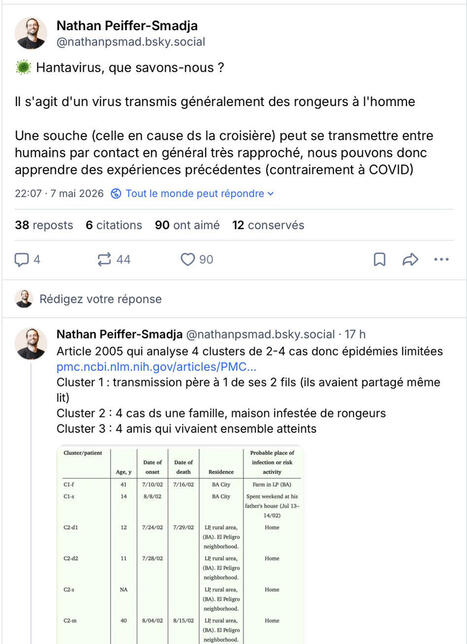
🦠 Un post d'information à propos d'Hantavirus sur Bluesky Social si cela vous intéresse, cela me permet également de faire de la pub pour ce réseau que je considère être celui de l'avenir pour la communication scientifique / médicale grand public (Twitter / X c'est fini et Linkedin c'est interpro et pas grand public à mon avis)
Très facile de le rejoindre et des discussions scientifiques intéressantes !
https://lnkd.in/eKYj5S2f
|
|
Scooped by
Gilbert C FAURE
Today, 3:51 AM
|
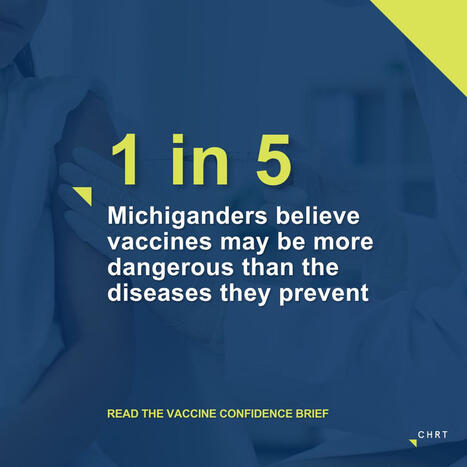
Most Michiganders trust vaccines. But hesitancy and uncertainty still remain.
Our latest Cover Michigan Survey shows:
• Most parents report their children are up to date on vaccines
• Nearly 1 in 5 believe vaccines may be more dangerous than the diseases they prevent
• Confidence varies across education, geography, and political affiliation
These gaps highlight the need for clear, evidence-based communication and stronger community outreach.
Read the full brief at the link in the comments.
|
|
Scooped by
Gilbert C FAURE
Today, 3:25 AM
|
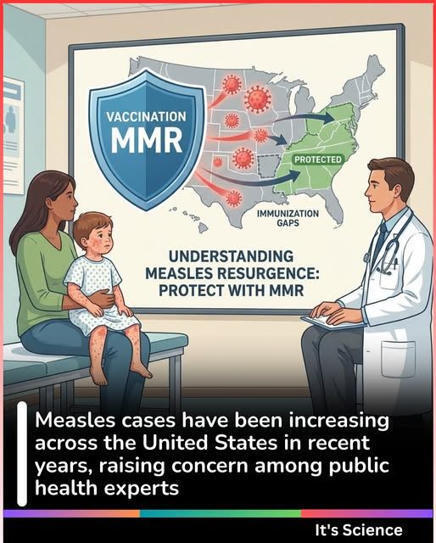
Measles cases have been increasing across the United States in recent years, raising concern among public health experts. The resurgence is being closely linked to declining vaccination rates in certain communities, where vaccine hesitancy has grown.
Health authorities report that measles, once declared eliminated in the US in 2000, has made a comeback through localized outbreaks. These outbreaks often begin when unvaccinated individuals come into contact with travelers carrying the virus from countries where measles is still widespread.
Research from the Centers for Disease Control and Prevention (CDC) shows that the measles, mumps, and rubella (MMR) vaccine remains highly effective, providing about 97 percent protection after two doses. Despite this, vaccination coverage has dropped below the critical threshold of around 95 percent in some regions, weakening herd immunity.
Studies, including CDC surveillance reports and peer-reviewed epidemiological analyses, highlight that misinformation and distrust in vaccines have played a significant role in this decline. Public health experts warn that even small reductions in vaccination rates can lead to rapid outbreaks because measles is one of the most contagious viruses known.
Medical professionals continue to emphasize that vaccination is the most effective way to prevent the spread of measles. They also stress the importance of restoring public confidence in vaccines to avoid further outbreaks and protect vulnerable populations such as infants and immunocompromised individuals.
|
|
Scooped by
Gilbert C FAURE
Today, 3:20 AM
|
Is extending HPV vaccination beyond age 14 a good investment for LMICs?
This pre-print paper models HPV catch-up vaccination strategies across 132 countries—and highlights both the potential impact and the financing trade-offs.
Key insights:
🌍 Up to 9.2 million cervical cancer cases could be prevented with catch-up to age 30
💰 Budget impact varies widely across countries and can exceed immunization budgets
💉 Vaccine procurement drives ~70% of total costs
🤝 Gavi support could reduce costs by ~70% for catch-up up to age 18
⚖️ Cost-effectiveness is maintained in most settings—but declines with older age groups
The trade-off: expanding age ranges increases health impact—but also requires greater upfront investment and careful prioritization. Countries will need to align vaccination strategies with available resources, delivery capacity, and long-term sustainability.
Read more here 👉 https://lnkd.in/e7cQc9UD
Authors: Abrham Wondimu Dagne, PhD, Damien Georges, Alina Macacu, Rachel Wittenauer, MPH, PhD, Ahmad Fuady, Andrea Gini, iacopo baussano, Irene Yi Sum Man
|
|
Scooped by
Gilbert C FAURE
Today, 3:18 AM
|
""Kennedy has now gone suddenly silent on vaccines. This should give no one solace that he is done with his attempts to undo vaccine policy to the fullest possible extent.
For years, Kennedy has been one of the most prominent figures in the anti-vaccine movement, advancing claims about vaccine safety that contradict scientific consensus. His advocacy has included promoting the debunked theory linking vaccines to autism, now a federal policy issue under his leadership; questioning the safety of pediatric vaccines; opposing all vaccine mandates, including school-entry requirements; and spreading misinformation on social media about vaccines and science. He has previously stated that “no vaccine is safe and effective” and questioned whether the Covid-19 vaccine is more harmful than the disease itself. During the Covid-19 pandemic, Kennedy was cited in a report as a misinformation superspreader, one of only 12 individuals who accounted for more than 65% of all vaccine misinformation available on social media at the time.
One of the most consequential episodes tied to Kennedy’s advocacy occurred in the South Pacific island nation of Samoa, where Kennedy visited with anti-vaccine activists amid declining vaccination rates. Months later, in 2019, a deadly measles outbreak began. Public health experts have pointed to the role of vaccine misinformation in eroding trust and contributing to low immunization coverage during that period. Ultimately 83 people, mostly young children, died of measles in Samoa. Kennedy has disputed his role in the deaths and subsequent outbreak.
So why is he suddenly so quiet? Because the administration wants to mitigate political liabilities ahead of the midterms. But he’s still dismantling behind the scenes, even if that quiet work might just look like paperwork to the casual observer.""
|
|
Scooped by
Gilbert C FAURE
May 9, 6:45 AM
|
Alberta mother, Lydia Greene, still remembers the things people would tell her about not vaccinating her children.
|
|
Scooped by
Gilbert C FAURE
May 9, 5:26 AM
|
Connaissez-vous l’astroturfing, ces stratégies de communication qui simulent ou instrumentalisent un appui citoyen afin d’influencer des décisions politiques, des représentations sociales ou des comportements de consommation ?
Dans le cadre du cycle de séminaires « Midis internationaux » d’ELICO (Université Lumière Lyon 2, Université Jean Moulin Lyon 3 , Université Claude Bernard Lyon 1, Enssib - École nationale supérieure des sciences de l'information et des bibliothèques , Sciences Po Lyon),
Nous avons le plaisir d’accueillir le 22 mai prochain de 12h à 14h, Benoit Cordelier Ithurbide, professeur titulaire au département de communication sociale et publique de l’UQAM | Université du Québec à Montréal.
A partir de cas pratiques, sa présentation, intitulée « L’Astroturfing : entre manipulation et influence », sera introduite par Julien Auboussier (maître de conférences en sciences de l’information et de la communication) et discutée par Florent Saboul (doctorant en sciences de l’information et de la communication).
Ce séminaire à l’accès libre se déroulera à la MSH Lyon St-Étienne, salle Fernand Rude, 14 avenue Berthelot, 69007 Lyon
et en visio ici : https://lnkd.in/eNu_jZfs
Numéro du webinaire : 2790 141 2154 Mot de passe du webinaire : i8PD9vn922x
Retrouvez plus d’information ici :
https://lnkd.in/ezM9Pvvi
Merci à Valentyna Dymytrova , isabelle hare et Françoise Paquienséguy
Un séminaire ouvert à faire connaître 🙂 Céline Paganelli Valérie Lépine Marcela Patrascu Sidonie Gallot Bruno Chaudet Fabien Bonnet Sarah Cordonnier GALIBERT Olivier Isabelle Prim-Allaz Maud Damperat Camille JOUSSE MARSALA Elyes Chaouch Brigitte Sebbah Vincent LIQUETE Fabienne Martin-Juchat Thomas Heller François Lambotte Valérie Carayol Francesca Musiani …
|
|
|
Scooped by
Gilbert C FAURE
Today, 9:24 AM
|
Very excited that our look at Health and Wellness Influencers is now out! https://lnkd.in/eAX2mkcU
In this report, we explore the role that these influencers play in the health environment, combining a pair of nationally representative surveys with an in-depth look at *6,828* influencers.
Some key findings:
- 40% of Americans get health and wellness information from these influencers.
- Health and Wellness influencers are more likely to be women - the exact opposite of what we found when we looked at news influencers (https://lnkd.in/gi9tbTED)
- They come from all walks of life, with 41% of these influencers pointing to a background as a health care professional
Audiences have mixed reactions:
- 65% say it helps them better understand how to be healthy
- But roughly equal shares say it makes them feel *more* or *less* worried about their own health (about a quarter each)
- And only about 10% trust all or most of the info they get from these influencers
Much much more at the link: https://lnkd.in/eAX2mkcU and you can catch me at AAPOR next Friday talking about how we did this!
|
|
Scooped by
Gilbert C FAURE
Today, 9:22 AM
|
Ce post de Catherine Riva et Serena Tinari dans Antithèse est trompeur à plusieurs titres:
▪️ Il remet en cause l'efficacité du vaccin HPV alors que des preuves solides existent sur la diminution des infections HPV et des lésions précancéreuses.
▪️ Il use de l'argument trompeur "ce ne sont que des études observationnelles", or d'une part il ne s'agit pas d'une absence de preuves. Des données massives et convergentes peuvent produire des éléments de preuves relativement robustes :
Ecosse : "Les femmes vaccinées entre 14 et 22 ans ont présenté une réduction significative de l'incidence du cancer du col par rapport aux femmes non vaccinées"
https://lnkd.in/gZ2MdYDt
https://lnkd.in/gMrnPvYp
Royaume Uni : "Le programme de vaccination contre le HPV a réussi à presque éliminer le cancer du col de l’utérus chez les femmes nées depuis le 1er septembre 1995."
https://lnkd.in/gvUtsY6r
Australie : https://lnkd.in/gNy4_eP8
D'autre part la causalité est un sujet bien plus complexe : le lien causal entre tabac et cancer n'a pas découlé d'études randomisées. Cf critères de Bradford Hill.
▪️ Il se focalise sur la baisse des cancers du col au niveau populationnel : la phrase "Son incidence s'est-elle effondrée, comme on nous l'avait prédit à l'époque? Rien n'est moins sûr" est rhétorique, car un effet sur toute la population exige des couvertures vaccinales élevées sur des décennies (évolution lente de la maladie, remplacement des cohortes non éligibles aux vaccins). Bref, parler d'un "effondrement" immédiat à l'échelle de la population est scientifiquement absurde.
Citations :
"We knew it would take time to observe that."
https://lnkd.in/gaheq2c6
"Cervical cancer rates are expected to decline only in the longer term, because it may take years or even decades to develop cancer after HPV infection "
https://lnkd.in/gfmKAuej
▪️ Il utilise les fluctuations d'incidence du cancer du col en Suède depuis 2005 pour semer le doute : rappelons que la campagne de vaccination a débuté en 2010. Cette hausse ne peut raisonnablement pas être attribuée à la campagne de vaccination.
https://lnkd.in/gUGSA7kw
▪️ Il exige une preuve irréaliste : une étude randomisée en double aveugle pour mesurer l'effet sur le cancer prendrait des décennies, et donner des placebos à des jeunes poserait des problèmes éthiques. Ce type d'étude n'existe pas, par exple, pour les vaccins contre l'encéphalite à tiques, recommandés dans de nombreux pays (dont la Suisse).
✅ Rappelons que la vaccination HPV est recommandée en Suisse par la Commission Fédérale pour les Vaccinations, qui est composée d'experts indépendants, entre 11-15 ans (rattrapage entre 15-19 ans et à titre complémentaire entre 20-26 ans).
|
|
Scooped by
Gilbert C FAURE
Today, 9:17 AM
|
If you are into science communication in any way, I would consider this a must read. I meet with a lot of people to talk about scicomm, and more often than not, the justification for being active in scicomm is to "win" the argument, or persuade others to "just see the science."
Research on the ineffectiveness of deficit-style scicomm tells us that many tensions around science are not simply about facts. They are about values, lived experience, trust, risk, and who gets to shape decisions.
This paper does a great job with its argument for shifting science communication approaches away from persuasion and toward “scientific empowerment” for all (in my spheres, we call this civic science -- the capacity for all people to shape and benefit from science). Ask: How can you create opportunities for people to meaningfully engage with science in ways that connect to their own lives and communities?
Yes, we need to communicate science more effectively. AND we need to create conditions for people to engage with science in ways that acknowledge values, tradeoffs, and agency.
Journal of Science Communication (JCOM)
https://lnkd.in/eFYs8pe3
| 17 comments on LinkedIn
|
|
Scooped by
Gilbert C FAURE
Today, 8:59 AM
|
Deepfakes are everywhere, but digital forensics investigators are fighting back.
Learn more: https://scim.ag/4tQ0udI
|
|
Scooped by
Gilbert C FAURE
Today, 8:56 AM
|
Fuzzy Regression discontinuity design on vaccins data.
The Nature journal has published a study where researchers nvestigated whether receiving the herpes zoster vaccine reduced:
shingles disease, and more importantly, dementia risk in older adults.
The researchers exploited a policy eligibility cutoff based on date of birth, and use Fuzzy RDD to approximate the randomization locally.
Some eligible people refused vaccination,
some noneligible people later obtained vaccination.Therefore the probability of treatment changed discontinuously at the cutoff rather than perfectly and justify the Fuzzy RDD.
(link in comments)
|
|
Scooped by
Gilbert C FAURE
Today, 8:55 AM
|
Do we need to address spending, 100%. But gutting our core pandemic infrastructure and destroying our ability to track, prevent and fight outbreaks is insanity! We have had 3 coronaviruses jump species since 2000 and I havent even mentioned the other outbreaks!
|
|
Scooped by
Gilbert C FAURE
Today, 4:17 AM
|
Let the lunacy begin! Oh right, it never stopped!
An outbreak of the deadly hantavirus on a Dutch-flagged cruise ship is reviving conspiracy theories about vaccines, alleged depopulation campaigns and miracle cures that flourished during the Covid pandemic.
|
|
Scooped by
Gilbert C FAURE
Today, 3:26 AM
|
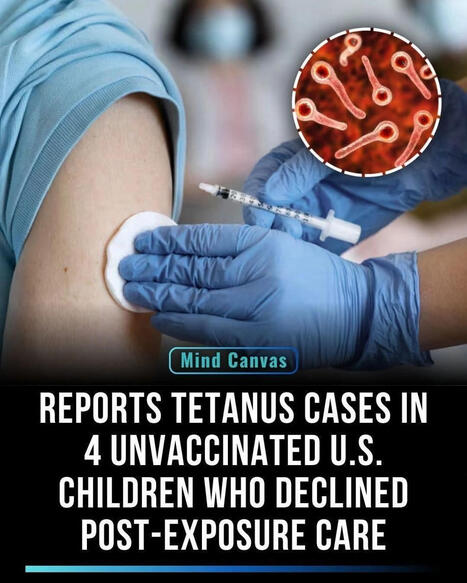
Health report refers to rare but serious infections occurring in unvaccinated individuals and the importance of timely medical treatment.
Tetanus is caused by bacteria commonly found in soil and enters the body through wounds or cuts. It can lead to severe complications if not treated promptly.
The condition is preventable through vaccination, and most cases in developed countries occur in individuals who are unvaccinated or under-vaccinated. Post-exposure medical care, including wound treatment and preventive immunization, is critical in reducing disease severity.
Centers for Disease Control and Prevention tracks cases of vaccine-preventable diseases and provides guidance on prevention, treatment, and vaccination schedules.
When individuals decline recommended post-exposure care, the risk of severe illness and complications increases significantly, making early intervention an important part of clinical management.
Sources: Centers for Disease Control and Prevention, World Health Organization, The Lancet
|
|
Scooped by
Gilbert C FAURE
Today, 3:20 AM
|
Mental images directly linked to vaccine hesitancy and uptake in pregnant women
New international research shows vivid mental images experienced by pregnant women when they think about vaccination directly influence their decision whether or not to get vaccinated.
The study is the first to investigate the prevalence of vaccination-related mental imagery during pregnancy and link it to both vaccine hesitancy and vaccination behaviour.
The findings, published in the journal Social Science & Medicine, showed mental images were common and – depending on whether the image was positive or negative, and whether it was about the impacts of diseases or the vaccine itself – could be used in some cases to predict if and when the women ultimately received the vaccine during pregnancy.
Source in comments.
|
|
Scooped by
Gilbert C FAURE
Today, 3:19 AM
|
Ethiopian Evidence Series (EES)-11
If the vaccine only waits at school, some girls never meet it!
Telake Azale,Tewodros Alemayehu and colleagues studied HPV vaccination in Ethiopia and found a major difference between girls who attend school and those who do not.
The study included more than 1100 girls, and overall vaccination coverage was 71%. However, about 85% of girls attending school were vaccinated, compared with only around 1 in 3 girls not attending school.
The study also showed that awareness campaigns through teachers, health workers, friends, and community outreach helped improve vaccine uptake.
👉In simple terms:
Many girls are protected from cervical cancer, but girls not attending school are still being missed.
👉Simple story
Two girls live in the same neighborhood. One regularly attends school and receives the HPV vaccine during a school campaign. The other is not attending school and never hears when the vaccine team arrives.
👉 Same age, same town but very different access to protection.
👉Key message
The challenge is not only having the vaccine it’s reaching every girl.
✍️ Authors: Telake Azale, Tewodros Alemayehu, Hiwot Tadesse Belay, Lisa Oot, Abebaw Gebeyehu, Zinabu Temesgen Melsebo, Tinebeb Tamir, Lidya Mulat, Melkamu Ayalew, Mengistu Bogale, Liya Wondwossen
Article link: 🔗 https://lnkd.in/d7GQbW5W
Ethiopian Evidence Series (#EES_11)
|
|
Scooped by
Gilbert C FAURE
May 9, 10:55 AM
|
World Immunization Week is also a moment of honest reflection. Outbreaks of vaccine-preventable diseases — measles, meningitis, yellow fever, whooping cough — are rising globally. Misinformation, funding shortfalls, and humanitarian crises are putting hard-won gains at risk. But here’s what I hold onto: in 2024, Gavi-supported countries immunized more than 72 million children, the highest number in a single year on record. The tools exist. The science is sound. What’s needed is will, investment, and trust. If you work in public health, healthcare, policy, or communications, your voice matters right now. Let's use it.
WHO and partners on the state of global immunization: https://buff.ly/ydiqoc9
|
|
Scooped by
Gilbert C FAURE
May 9, 5:27 AM
|
Hanta Outbreak - Extraordinary to look at the range of posts on this… made up claims from rat-infested cruise ships to this being evidence of gain of function research and a lab leak. Most of this coming from the US (or those that just cut and paste these claims (like Philip McMillan), all coming from known promulgators of misinformation - that’s how they make their living. Ironically these are the same people who have applauded the dismantling of the US outbreak control capabilities.
This must make it so much worse for those caught up in the actual outbreak. Those in quarantine, unwell, family of those deceased, and all the clinicians, public health workers and ship and port crew have enough to deal with without having to be exposed to this fallacious blame game.
The US has obligations under the International Health Regulations and despite withdrawing from WHO are cooperating in data sharing and benefiting from the global expertise that will help manage those of US nationality who have been caught up in this.
So far there is only one confirmed case in someone who was not on the shop but in close contact with someone who was whilst they were symptomatic. Three deaths among the 7 cases from the ship, two were the original couple with the earliest symptoms and it is believed unknowingly brought virus on board.
One of the other 4 cases from the boat was asymptomatic still at time of testing positive, and the other cases are reportedly on the improve. It is a long wait to be cleared for those who may have been exposed as this virus has an incubation period up to 6 to 8 weeks. The long variable incubation period also makes determining source of infection, and mode of infection, challenging. But it does help in the containment of local outbreaks giving authorities the time needed to track down contacts and to get them into care to minimize risk to them and isolated to minimize risk of further spread.
This has become global quickly as we have the unfortunate combination on cruise ships when an closure occurs of people living and mixing in close quarters who have come from all over the world. This is not the same as a pandemic. So far none of those who disembarked in late April appear to have tested positive, but critical that they are all tracked and their infection and potential infectious status be assessed given the potential that some could still be incubating the virus for some weeks. This takes effective international coordination and all the indicators to date are that this is working well.
Plenty of reliable sources are available including the WHO update posts to follow if interested. But please ignore the self serving rubbish flying around on social media and instead think about those who find themselves in the middle of the contact tracing efforts, subjects and workers, especially those who happen to then develop symptoms from an unrelated cause that would make them even more anxious.
Deakin Institute for Health Transformation
|
|
Scooped by
Gilbert C FAURE
May 9, 5:24 AM
|
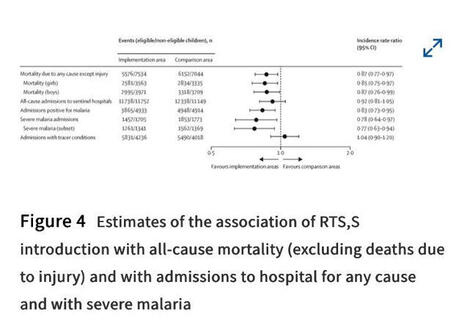
New findings: Malaria vaccine prevents child mortality
Ghana, Kenya and MalawI introduced 4 doses of RTS,S/AS01E vaccine in 2019.
>1,2 million children received dose 1.
Coverage in 2022:
Dose 1: 82·8%
Dose 3: 71·1%
Dose 4: 39·9%
An observational cluster randomised implementation study found in settings with high 3 dose coverage and low 4 dose coverage up to 46 months post implementation
⭐️ 13% reduction in mortality (mortality rate ratio was 0·87 (95% CI 0·77–0·97; p=0·016) equating to about 1 in 8 deaths in children.
⭐️ 22% reduction in severe malaria
Highlights the urgent need to implement this highly effective vaccine in affected regions
https://lnkd.in/gKKEEqyW
|


 Scoop.it!