Your new post is loading...

|
Scooped by
Gilbert C FAURE
August 6, 11:08 AM
|
HESIVAXs est un observatoire français créé en 2025 et porté par le Pr Gilbert C. Faure, consacré à l'analyse des mots, des images et des convictions liés à l'hésitation vaccinale et à la désinformation médicale. Il s'intéresse particulièrement aux stratégies de communication et aux représentations visuelles influençant la perception des vaccins. [ 1, 2, 3, 4] Objectifs et axes de l'observatoire - Analyse des discours : étude des arguments et des fausses informations circulant sur la vaccination.
- Curation visuelle : décryptage des images et des représentations graphiques mobilisées pour convaincre ou décourager.
- Recherche médicale et sociétale : ancrage dans les travaux universitaires en lien avec l'immunologie et la médiation scientifique. [1, 2]
|
|
Scooped by
Gilbert C FAURE
Today, 11:27 AM
|
It is always with very warm feelings that I get to return to the community around European Centre for Disease Prevention and Control (ECDC) and ESCAIDE.
Anders Hviid had just the best personal account and reflection of a scientist's work being caught up in the media and special interest storm.
And Steven Van Gucht gave us an absolute masterclass in science and risk communication from his experiences as Belgian federal COVID-19 spokesperson during the pandemic.
Thank you to the scientific committee of ESCAIDE, and Tyra Grove Krause and Koen Blot for leading the discussion.
We had amazing questions and participation from the audience! The recording of the session is available via web registration for the conference and I highly recommend it.
A write up of my talk to come.
|
|
Scooped by
Gilbert C FAURE
Today, 10:38 AM
|
“It’s measles mania all the time, everywhere.”
Children’s Health Defense CEO says this week’s “measles mania” in the mainstream media follows a familiar pattern.
She points to similar coverag
|
|
Scooped by
Gilbert C FAURE
Today, 10:36 AM
|
The United States has lost its measles elimination status and 10 people have died of measles this year.
Meanwhile, an anti-vaccine group led for years by Robert F Kennedy Jr has been allowed back on Facebook and Instagram, four years after Meta removed the group for repeatedly violating its misinformation policies.
The news comes after a Guardian investigation this month found health and vaccine misinformation was rampant on Facebook in a massive public group, Crunchy Moms, and that Facebook was recommending it to users despite apparent violations of its policies.
https://lnkd.in/gPX3URUH
|
|
Scooped by
Gilbert C FAURE
Today, 10:02 AM
|
|
|
Scooped by
Gilbert C FAURE
Today, 10:00 AM
|
Faire de la vaccination une priorité de notre politique de santé, c'est faire le choix de l'anticipation.
Le mercredi 25 novembre, j'aurai le plaisir d'intervenir en tant que grand témoin lors de la matinée d'échanges « Vaccination : faire le choix de l'anticipation ».
La vaccination est l'un des piliers de notre politique de prévention. Si des progrès importants ont été accomplis ces dernières années, des défis demeurent pour renforcer la confiance, améliorer la couverture vaccinale et inscrire durablement la vaccination dans les parcours de santé.
À cette occasion, je partagerai mon regard sur les évolutions de notre politique vaccinale et les enjeux à relever pour les années à venir.
Aux côtés d'experts du monde médical et associatif, dont Frédéric Le Guillou, Catherine Weil, Odile Launay, Gaetan Gavazzi et Magali LEO, nous échangerons autour de huit propositions concrètes pour faire de la vaccination une priorité d'action du prochain quinquennat.
📅 Mercredi 25 novembre 2026, de 9h à 11h (accueil dès 8h30)
📍 Morning Laffitte – 34 rue Laffitte, Paris 9e
👉 Programme et inscriptions : https://lnkd.in/edQj56py
|
|
Scooped by
Gilbert C FAURE
Today, 9:53 AM
|
|
|
Scooped by
Gilbert C FAURE
Today, 5:24 AM
|
|
|
Scooped by
Gilbert C FAURE
Today, 5:22 AM
|
|
|
Scooped by
Gilbert C FAURE
Today, 5:21 AM
|
|
|
Scooped by
Gilbert C FAURE
Today, 5:18 AM
|
|
|
Scooped by
Gilbert C FAURE
November 19, 1:10 PM
|
Pandémie de désinformation médicale: comprendre, agir et restaurer la confiance
Table ronde avec Mathieu Molimard, Mathieu Rebeaud, Alexandra Calmy et Thomas Agoritsas, animée par Isabelle Moncada.
Fausses informations, théories complotistes, défiance envers les experts… À qui faire confiance lorsqu'il s'agit de notre santé ?
De la controverse autour de l'hydroxychloroquine pendant la pandémie de COVID-19 aux fausses promesses de traitements miracles, la désinformation médicale nous concerne toutes et tous. Elle influence nos décisions, nourrit les doutes et fragilise la confiance dans la science, les professionnels de santé et les institutions.
Pourquoi les fausses informations se propagent-elles parfois plus vite que les connaissances scientifiques ? Pourquoi la parole des experts est-elle remise en question ? Comment mieux communiquer les incertitudes scientifiques et restaurer la confiance ?
Pour en débattre, quatre experts aux parcours complémentaires se réuniront autour de la journaliste Isabelle Moncada.
Comprendre, mais surtout agir !
Au-delà du constat, cette soirée explorera les moyens concrets de lutter contre la désinformation en santé. Quel rôle pour les scientifiques, les professionnels de santé, les médias et les institutions ? Comment développer l'esprit critique sans renforcer la méfiance ?
Alors que la France a récemment formulé des recommandations pour une stratégie nationale de lutte contre la désinformation en santé, où en sommes-nous en Suisse ? Et surtout, quelles actions concrètes pourrions-nous mettre en place ?
Cette soirée ambitionne de sensibiliser le grand public, mais aussi de mobiliser les professionnels de santé, les institutions, les médias et les décideurs politiques autour de cet enjeu majeur de santé publique.
Un débat ouvert à toutes et à tous, pour confronter les points de vue, explorer des solutions et poser vos questions directement aux intervenantes et intervenants !
Les intervenants
Pr Mathieu MolimardProfesseur de pharmacologie clinique – CHU de Bordeaux
Très engagé dans la lutte contre la désinformation médicale, Mathieu Molimard a récemment participé, avec Dominique Costagliola et Hervé Maisonneuve, à une mission d'expertise confiée par le gouvernement français. Leur rapport, remis en janvier 2026, propose une stratégie nationale et des mesures concrètes contre la désinformation en santé. Son expérience nourrira la réflexion sur les initiatives possibles en Suisse.
Dr Mathieu RebeaudDocteur en biochimie – EPFL
Chercheur et vulgarisateur scientifique, Mathieu Rebeaud s'est illustré pendant la pandémie par son engagement contre la désinformation sur les réseaux sociaux. Il a notamment cosigné un faux article scientifique sur l'hydroxychloroquine et les accidents de trottinette pour dénoncer les dérives des revues prédatrices, et contribué à une méta-analyse internationale sur l'hydroxychloroquine. Son parcours montre comment rigueur scientifique, humour et engagement peuvent se conjuguer pour combattre la désinformation.
Pr Alexandra CalmyProfesseure d'infectiologie – HUG et Université de Genève
Directrice du Centre de recherche clinique et ancienne membre de la Task Force scientifique suisse pendant la pandémie de COVID-19, Alexandra Calmy a été directement confrontée aux défis de la communication scientifique en période de crise. Elle partagera son expérience des relations entre science, décisions politiques et confiance du public.
Pr Thomas AgoritsasProfesseur de médecine interne – HUG et Université de Genève
Spécialiste de la médecine fondée sur les preuves (evidence-based medicine), Thomas Agoritsas travaille sur l'évaluation critique des études scientifiques et l'élaboration de recommandations médicales fiables. Il a notamment contribué au développement de MAGICapp, plateforme internationale utilisée dans le cadre de travaux de l'OMS. Il apportera son éclairage sur la construction des preuves scientifiques et l'évolution des recommandations médicales.
Animation
Isabelle MoncadaJournaliste et productrice de l'émission « 36.9° » – RTS
Spécialisée dans les questions de santé, Isabelle Moncada mettra son expérience de la vulgarisation médicale et scientifique au service de cette table ronde et des échanges avec le public.
|
|
Scooped by
Gilbert C FAURE
November 19, 4:01 AM
|
Labeled antivax and trying to claim they are not.. Children's Health Defense is beyond being antivax. They are dangerous.
The facts are straightforward and simple: vaccines saves lives.
|
|
|
Scooped by
Gilbert C FAURE
Today, 1:03 PM
|
"Vaccines are arguably one of the greatest scientific discoveries of all time. From the very first immunization for smallpox, a now-eradicated disease that killed between 300 million and 500 million people in the 20th century, to modern-day vaccines for influenza, COVID-19, measles, and much more, vaccines have saved countless lives. However, despite their success, few medical innovations have been met with more doubt and resistance. Vaccine hesitancy has been around since vaccines first existed. It has evolved over time but today remains a major barrier to advancing public health.
In this episode of Healthy Dialogue, we spoke with Paul Offit, MD, director of the Vaccine Education Center and an attending physician at the Children’s Hospital of Philadelphia, to understand the history of vaccines and vaccine hesitancy and get a sense of what might be done about it.
“Vaccines Are Largely a Victim of Their Own Success”
Early human beings had a life expectancy at birth of approximately 33 years. By 1850, that number had hardly changed.1,2 Today, life expectancy in the US is around 79 years, thanks largely to medical advancements, including vaccines.3
Deaths from many vaccine-preventable diseases dropped from hundreds or thousands per year to nearly zero. For example, in the US, pertussis killed an average of 4000 people annually from 1934 to 1943. In 2025, it killed an estimated 16 people,4 a 99.6% decrease.5
However, with success came an unexpected consequence. Once prevalent and deadly diseases are now so rare many have forgotten their impact. As Offit says, “We have the luxury of being able to question vaccines because we’re not being overwhelmed by these diseases to the degree that we were.”"
|
|
Scooped by
Gilbert C FAURE
Today, 11:25 AM
|
|
|
Scooped by
Gilbert C FAURE
Today, 10:37 AM
|
Why do some people think that a fake 96,000-patient database sabotaged hydroxychloroquine and helped get the COVID vaccine authorized? https://lnkd.in/gPjQbF3M
|
|
Scooped by
Gilbert C FAURE
Today, 10:35 AM
|
Well, another falsehood from Vejon Health Ltd .
None of such is proven post vaccination. But post infection, yes…
|
|
Scooped by
Gilbert C FAURE
Today, 10:01 AM
|
|
|
Scooped by
Gilbert C FAURE
Today, 9:56 AM
|
If you want to better understand the madness of the COVID-19 pandemic, I recommend the book "Follies and Fallacies in Medicine" (1989) by doctors Petr Skrabenk and James McCormick.
Many of the scientific fallacies the authors describe can be identified, but it was the Fallacy of Authority that reigned supreme during the period. The authors describe it as the idea that something is true because it came from an authoritative source.
“It must be true because I read it in the paper, saw it on television, the surgeon said so, the Lancet published it,” Skrabenk and McCormick write.
The fallacy is persistent in science and medicine because respect for authority underpins scientific inquiry and education. The authors explain that it’s customary for students, who memorize vast quantities of information, to fall prey to the mistaken belief that what they are reading is “truth,” particularly when the source is authoritative. Challenging the status quo becomes difficult even for bright, independent-minded thinkers.
This baked-in respect for authority helps explain why so many of the greatest scientific breakthroughs were initially met with skepticism.
Skrabenk and McCormick point out that scientists initially sneered at William Harvey when he published his work on blood circulation. Hans Krebs and Enrico Fermi both won Nobel Prizes, but their research on citric acid cycles and beta-decay was first rejected by Nature.
“There are good reasons for distrusting the opinion of authority, not only in medicine but in science proper,” Skrabenk and McCormick observed.
The authors do not advocate intellectual anarchy. But their point about questioning science and those in authority is crystal clear.
“We should be kind to all people, even those who are vested with authority,” they wrote, “but we must be ruthless in seeking and criticizing the evidence on which their beliefs are founded.”
Dr. Anthony Fauci saw things differently. When public blowback began to gain momentum in early 2021, he responded with indignance.
“Attacks on me, quite frankly, are attacks on science,” Fauci said. “All of the things I have spoken about, consistently, from the very beginning, have been fundamentally based on science.”
This statement was not true, as Fauci’s own statements later made clear. But even worse, Fauci was treating criticism of his policies as attacks on science.
In a sense, Fauci was embracing the Fallacy of Authority, and it was a strategy adopted by others.
CNN host Brian Stelter ran segments mocking people who did “their own research” ...
https://lnkd.in/gSFc7G5e
|
|
Scooped by
Gilbert C FAURE
Today, 5:25 AM
|
'There are also clear financial motivations for antiscience. For decades, the fossil-fuel industry has waged war against both climate science and scientists who threaten its bottom line. In contrast, the financial gains in disparaging vaccines have become apparent only recently. Since the start of the COVID-19 pandemic, there has been a steady drumbeat of efforts to market alternative wellness products on the Internet or through telehealth visits.'
https://lnkd.in/eQBKUZdP
|
|
Scooped by
Gilbert C FAURE
Today, 5:23 AM
|
|
|
Scooped by
Gilbert C FAURE
Today, 5:22 AM
|
|
|
Scooped by
Gilbert C FAURE
Today, 5:19 AM
|
Consentement libre pour les vaccins ?
Le Dr Fouché s'oppose à la décision étatique sur nos corps, défendant l'autonomie et le choix personnel en bioéthique. Retrouvez toutes les infos su
|
|
Scooped by
Gilbert C FAURE
Today, 5:07 AM
|
Obligation vaccinale : « Ce qu'ils font, c'est mafieux, ça s'appelle de l'extorsion »
Terroriser et confiner la population pour se présenter ensuite en libérateur : les gouvernements utilisen
|
|
Scooped by
Gilbert C FAURE
November 19, 1:09 PM
|
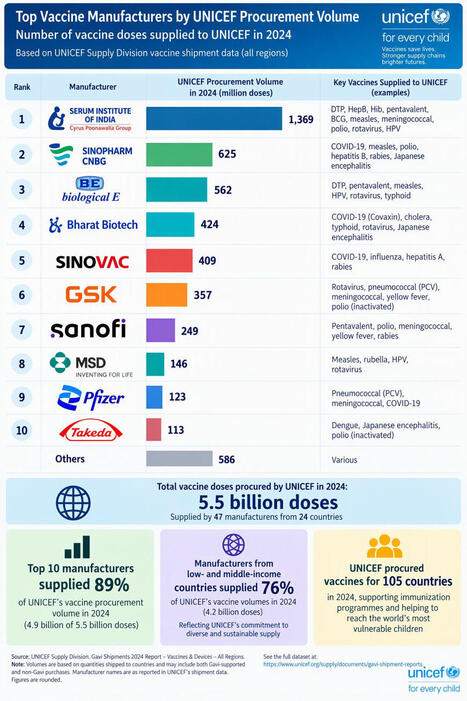
The biggest suppliers of vaccines to the global market
…are not the ones you'd expect.
Although the 10 manufacturers in the infographic below 👇 supply near 90% of UNICEF's vaccine procurement...
none of the 'big four' multinationals, GSK, Sanofi, Merck Group and Pfizer, feature in the top five.
This is because vaccine revenue and vaccine volume supply do not align.
Volumes largely reflects UNICEF vaccine supply through Gavi, the Vaccine Alliance, to global childhood national immunisation programmes (NIPs).
The top five spots are occupied by three Indian companies, Serum Institute of India Pvt. Ltd., Biological E. Limited and Bharat Biotech and two Chinese companies, Sinopharm and SINOVAC BIOTECH LTD.
These are all members of the Developing Countries Vaccine Manufacturers Network (DCVMN International), and DCVMN companies produce over 3/4 of the UNICEF vaccine supply volumes.
Their business model...
Produce vaccines:
✅ in large quantities
✅ at low profit margin
✅ for global good.
is quite different from that of the high-revenue multinationals.
So DCVMN vaccines will typically be procured by UNICEF for around $1 a dose...
a world apart from buying a vaccine at $100 a dose in the private markets of the US.
But in relation to combating global disease...
impact and global good come primarily from the DCVMN model.
Data source: UNICEF Supply Division, Gavi Shipments 2024 reports 👉 https://lnkd.in/erZZXjvZ
♻️ Repost to your networks and follow Calman MacLennan for further insights on vaccines, AMR and global health.
|
|
Scooped by
Gilbert C FAURE
November 19, 4:00 AM
|
Peter Hotez MD PhD DSc(hon) posted images on LinkedIn
|