 Your new post is loading...

|
Scooped by
Dr. Stefan Gruenwald
June 22, 2020 10:47 AM
|
The first fluorescent frog, a rare find among land animals reveals a new way to glow. Under normal light, the South American polka dot tree frog (Hypsiboas punctatus) sports a muted palette of greens, yellows and reds. But dim the lights and switch on ultraviolet illumination, and this little amphibian gives off a bright blue and green glow. The ability to absorb light at short wavelengths and re-emit it at longer wavelengths is called fluorescence, and is rare in terrestrial animals. Until now, it was unheard of in amphibians. Researchers also report that the polka dot tree frog uses fluorescent molecules totally unlike those found in other animals. The team published the find on March 13, 2020 in Proceedings of the National Academy of Sciences (PNAS). Because fluorescence requires the absorption of light, it doesn’t happen in total darkness. That makes it distinct from bioluminescence, in which organisms give off their own light generated through chemical reactions. Many ocean creatures fluoresce, including corals, fish, sharks and one species of sea turtle (the hawksbill turtle, Eretmochelys imbricata). On land, fluorescence was previously known in only parrots and some scorpions. It is unclear why animals have this ability, although explanations include communication, camouflage and mate attraction.
|
|
Scooped by
Dr. Stefan Gruenwald
June 21, 2020 2:26 PM
|
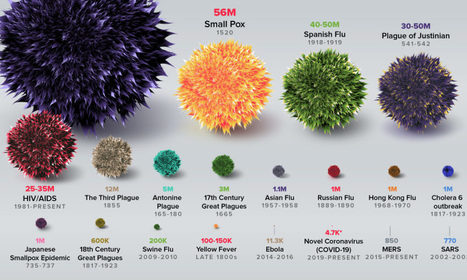
Over time, infectious diseases have been humanity's constant companion. This infographic visualizes the history of pandemics throughout times, from the Antonine Plague to COVID-19.
|
|
Scooped by
Dr. Stefan Gruenwald
June 20, 2020 4:13 PM
|
Moss balls seem to roll around glaciers in a coordinated way, and researchers can't explain why the whole group moves at about the same speed and in the same direction. PDF paper is here In 2006, while hiking around the Root Glacier in Alaska to set up scientific instruments, researcher Tim Bartholomaus encountered something unexpected. "What the heck is this?" Bartholomaus recalls thinking. He's a glaciologist at the University of Idaho. Scattered across the glacier were balls of moss. "They're not attached to anything and they're just resting there on ice," he says. "They're bright green in a world of white." Intrigued, he and two colleagues set out to study these strange moss balls. In the journal Polar Biology, they report that the balls can persist for years and move around in a coordinated, herdlike fashion that the researchers can not yet explain. "The whole colony of moss balls, this whole grouping, moves at about the same speeds and in the same directions," Bartholomaus says. "Those speeds and directions can change over the course of weeks." In the 1950s, an Icelandic researcher described them in the Journal of Glaciology, noting that "rolling stones can gather moss." He called them "jökla-mýs" or "glacier mice." This new work adds to a very small body of research on these fuzz balls, even though glaciologists have long known about them and tend to be fond of them.
|
|
Scooped by
Dr. Stefan Gruenwald
June 19, 2020 8:36 PM
|
Combining data from Chandra and other telescopes with supercomputer simulations and virtual reality, a new visualization allows users to experience 500 years of cosmic evolution around the Milky Way's supermassive black hole called Sgr A*. Each color represents different phenomena including Wolf-Rayet stars (white), their orbits (grey), and hot gas due to the supersonic wind collisions observed by Chandra (blue and cyan). There are also regions where cooler material (red and yellow) overlaps with the hot gas (purple). The visualization covers about 3 light years, or about 18 trillion miles, around Sgr A*. For more information, visit: https://chandra.si.edu/photo/2020/gcenter/
|
|
Scooped by
Dr. Stefan Gruenwald
June 17, 2020 12:29 AM
|
Findings and discussion from the Wolfram Physics Project on the structure and pathologies of spacetime, general relativity, causal structure, black-hole-like event horizons, singularities, complicated cases, dimension anomalies and space tunnels. Space emerges as the large-scale limit of our spatial hypergraph, while spacetime effectively emerges as the large-scale limit of the causal graph that represents causal relationships between updating events in the spatial hypergraph. An important result is that (subject to various assumptions) there is a continuum limit in which the emergent spacetime follows Einstein’s equations from general relativity. And given all this, it is natural to ask what happens in our models with some of the notable phenomena from general relativity, such as black holes, event horizons and spacetime singularities. Stephen Wolfram already discussed this to some extent in his technical introduction. His purpose here is to go further, both in more completely understanding the correspondence with general relativity, and in seeing what additional or different phenomena arise in our models. It should be said at the outset that even after more than 100 years the whole issue of what weird features of spacetime Einstein’s equations can imply remains a rather confusing subject, that is still very far from completely understood. But unlike with the Einstein equations, which effectively just tell one to “find a spacetime that satisfies certain constraints defined by the equations”, these new models give a direct computational way to determine the structure that is supposed to limit to spacetime. In what follows, we’ll see that our models can reproduce known implications of Einstein’s equations such as black holes, event horizons and spacetime singularities. But they also suggest the possibility of other, in some ways yet more exotic, spacetime phenomena. Some of these may in fact be things that could be found in the Einstein equations; others require descriptions of spacetime more general than the mathematical structure of general relativity can provide (notably in connection with dimension and topology change). There’s long been a view that at small enough length scales the Einstein equations will have to be supplemented by some lower-level description of spacetime, presumably connected to quantum mechanics. These models immediately provide a lower-level representation for spacetime in terms of the discrete structure of the spatial hypergraph and the causal graph—with familiar, continuum spacetime emerging as a large-scale limit, much like continuum fluid behavior emerges as a large-scale limit of molecular dynamics.
|
|
Scooped by
Dr. Stefan Gruenwald
June 16, 2020 11:59 PM
|
Are we alone? New estimations of life in the Milky Way suggest life in our neighborhood is incredibly rare. Eight. That's the minimum number of intelligent, communicating alien civilizations two astronomers at the University of Nottingham believe could exist in the Milky Way, our home galaxy. A new study, published in The Astrophysical Journal on Monday, provides an updated estimate of the likely number of alien civilizations that could exist in the Milky Way. The analysis, performed by astronomers Tom Westby and Christopher Conselice, starts with revising the Drake equation, a formula proposed by Frank Drake in 1962 to estimate how many worlds are likely to harbor intelligent life in our galaxy. The equation relies on a variety of factors, including how often sun-like stars form in the galaxy, how many stars are orbited by planets and how often life evolves and becomes intelligent enough for us to detect it. But as it is, the Drake equation is fundamentally "unsolvable" and contains a major variable we can't know until we find intelligent life: What's the average length of time alien civilizations are detectable? "The classic method for estimating the number of intelligent civilizations relies on making guesses of values relating to life," said Westby in a press release. "Our new study simplifies these assumptions using new data, giving us a solid estimate of the number of civilizations in our Galaxy." Westby and Conselice started with the Drake equation but approached the search for so-called "Communicating Extra-Terrestrial Intelligent" civilizations in a slightly different way. They built a key assumption in to their estimate: Life on another planet will arise in a similar way to how it did on Earth. In effect, this means their revised equation takes into account the idea that a planet must exist for around 5 billion years in the habitable zone around a star before it can develop intelligent life with the capability to communicate across the universe. The duo placed three different sets of limits on these "suitable planets" harboring life with weak, moderate and strong categories with different time frames for life to arise. The weakest limits allowed them to make estimates on a time frame of greater than 5 billion years, while the strongest limit only assessed worlds between 4.5 and 5.5 billion years old. When plugging the strongest limits and numbers into their complex new equation, which they dubbed the CETI Equation, the data reveals there could be a minimum of eight CETI civilizations within the Milky Way. Such an estimate is relatively close to the figure of 10 that famed astronomer Carl Sagan came up with when discussing the Drake Equation on the '80s science show Cosmos. There is a catch: Those worlds are at least 7,000 light-years away -- making it almost impossible for us to contact them. The team estimated we would need to be actively searching for signals from space for around 6,300 years before we might receive messages from another civilization. "It is clear that the lifetime of a communicating civilization is the key aspect within this problem," the authors write. On the other hand, using weaker limits, Westby and Conselice suggest there could be as many as 2,900 worlds where life has found a way that means we may be able to detect them sooner. The Fermi paradox also points to the problem of resource consumption and self destruction of a civilization. The origin of Fermi paradox dates back to a casual conversation about extraterrestrial life that Enrico Fermi had with E. Konopinski, E. Teller and H. York in 1950, during which Fermi asked the famous question: “where is everybody?”, since then become eponymous for the paradox. Starting from the closely related Drake equation22,23, used to estimate the number of extraterrestrial civilizations in the Milky Way, the debate around this topic has been particularly intense in the past (for a more comprehensive covering, see Hart24, and Freitas25). Hart’s conclusion is that there are no other advanced or ‘technological’ civilizations in our galaxy as also supported recently by26 based on a careful reexamination of Drake’s equation. In other words the terrestrial civilization should be the only one living in the Milk Way. Such conclusions are still debated, but many of Hart’s arguments are undoubtedly still valid while some of them need to be rediscussed or updated. For example, there is also the possibility that avoiding communication might actually be an ‘intelligent’ choice and a possible explanation of the paradox. On several public occasions, in fact, Professor Stephen Hawking suggested human kind should be very cautious about making contact with extraterrestrial life. More precisely when questioned about planet Gliese 832c’s potential for alien life he once said: “One day, we might receive a signal from a planet like this, but we should be wary of answering back”. Human history has in fact been punctuated by clashes between different civilizations and cultures which should serve as caveat. From the relatively soft replacement between Neanderthals and Homo Sapiens (Kolodny27) up to the violent confrontation between native Americans and Europeans, the historical examples of clashes and extinctions of cultures and civilizations have been quite numerous. Looking at human history Hawking’s suggestion appears as a wise warning and we cannot role out the possibility that extraterrestrial societies are following similar advice coming from their best minds.
|
|
Scooped by
Dr. Stefan Gruenwald
June 16, 2020 11:43 PM
|
New study suggests that plasma exchange could be the key to unlocking the body’s regenerative capacities. In 2005, University of California, Berkeley, researchers made the surprising discovery that making conjoined twins out of young and old mice — such that they share blood and organs — can rejuvenate tissues and reverse the signs of aging in the old mice. The finding sparked a flurry of research into whether a youngster’s blood might contain special proteins or molecules that could serve as a “fountain of youth” for mice and humans alike. But a new study by the same team shows that similar age-reversing effects can be achieved by simply diluting the blood plasma of old mice — no young blood needed. In the new study, the team found that replacing half of the blood plasma of old mice with a mixture of saline and albumin — where the albumin simply replaces protein that was lost when the original blood plasma was removed — has the same or stronger rejuvenation effects on the brain, liver and muscle than pairing with young mice or young blood exchange. Performing the same procedure on young mice had no detrimental effects on their health. This discovery shifts the dominant model of rejuvenation away from young blood and toward the benefits of removing age-elevated, and potentially harmful, factors in old blood. “There are two main interpretations of our original experiments: The first is that, in the mouse joining experiments, rejuvenation was due to young blood and young proteins or factors that become diminished with aging, but an equally possible alternative is that, with age, you have an elevation of certain proteins in the blood that become detrimental, and these were removed or neutralized by the young partners,” said Irina Conboy, a professor of bioengineering at UC Berkeley who is the first author of the 2005 mouse-joining paper and senior author of the new study . “As our science shows, the second interpretation turns out to be correct. Young blood or factors are not needed for the rejuvenating effect; dilution of old blood is sufficient.”
|
|
Scooped by
Dr. Stefan Gruenwald
June 15, 2020 2:59 PM
|
The head of the Russian federal space agency Roscosmos published a lengthy op-ed expressing mixed feelings about the recent SpaceX Demo-2 launch to the International Space Station (ISS). Dmitry Rogozin's op-ed, which is available on the Rocosmos website and was previously published in Forbes, points toward Russia's future plans in space as the United States moves most of its crewed opportunities back to American soil. Demo-2 is the first of what will likely be many American crewed commercial spaceflights. Flights by SpaceX's Crew Dragon capsule and, eventually, Boeing's Starliner spacecraft should largely replace the Russian Soyuz missions that NASA astronauts have relied upon since the space shuttle's retirement in 2011. In 2014, Rogozin tweeted out a memorable remark, saying that, as Russians faced U.S. sanctions related to Russian actions in Crimea, American astronauts could use a trampoline to reach space instead of the Soyuz. Shortly after Demo-2's May 30 launch, SpaceX founder and CEO Elon Musk referenced this barb, saying "The trampoline is working!" Rogozin initially said on Twitter that he loved Musk's joke and looks forward to further cooperation. But the new op-ed shows that Rogozin had more to share about the way astronauts are launched to space and the framework of international space cooperation. The Russians were asked to step in with Soyuz seats for astronauts, Rogozin said, because the space shuttle program was closed down "as the result of its immense costliness and unforgivable failure rate." Each NASA space shuttle orbiter used to carry as many as eight people at a time, although seven was a more typical crew capacity. The Russian Soyuz spacecraft has a capacity of three people. The space shuttle program flew 135 missions between 1981 and 2011. Two of those missions ended in tragedy: The shuttle Challenger exploded shortly after liftoff in January 1986, and Columbia broke apart during re-entry in February 2003. Each tragedy killed seven astronauts. The Soviet Union (a predecessor entity to Russia) lost four cosmonauts across two Soyuz mission failures in 1967 and 1971. While the Russians have had no spaceflight fatalities since then, there have been aborts.
|
|
Scooped by
Dr. Stefan Gruenwald
June 15, 2020 12:16 PM
|
Researchers at the Dutch Advanced Research Center for Nanolithography (ARCNL) and Vrije Universiteit Amsterdam (VU), developed an advanced microscope capable of super-resolution microscopy through an ultra-thin fiber. Up until now, it was generally the case that the higher the resolution of a microscope, the larger the device needed to be, making it virtually impossible to look inside the human body in real-time. Although some methods that enable researchers to look inside living animals already exist, their resolution is very limited, and it takes a long time to generate an acceptable image. With the use of smart signal processing, the researchers are able to beat the theoretical limits of resolution and speed. With this newly developed compact setup, scientists are finally able to, for example, look inside the brain in real-time and high resolution, using an ultra-thin fiber. Because the method does not require any unique fluorescent labeling, it is promising for both medical uses and characterization of 3D structures in nano-lithography!
|
|
Scooped by
Dr. Stefan Gruenwald
June 13, 2020 7:31 PM
|
The star Kepler-160 is probably orbited by a planet less than twice the size of the Earth with a star-planet distance that could permit planetary surface temperatures conducive to life. The newly discovered exoplanet, which was found by a team of scientists led by the Max Planck Institute for Solar System Research (MPS) in Göttingen is more than just another potentially habitable world. One of the key properties making it resemble the Sun-Earth system more than any other previously known world, is its Sun-like host star. Most of the Earth-like exoplanets known so far are in orbit around a faint red dwarf star emitting their energy mostly as infrared radiation rather than as visible light. The light shed on KOI-456.04 by its Sun-like host star, however, is very much like the daylight seen on our home planet. Moreover, the orbital period of KOI-456.04 around its Sun-like star is almost identical to an Earth year.
|
|
Scooped by
Dr. Stefan Gruenwald
June 11, 2020 10:53 PM
|
Researchers at Princeton University in the US have become the first to observe a robust supercurrent at the edge of a superconductor that is very different to the supercurrent in the material’s bulk. This “topological superconductivity” could come in useful for a host of new applications, they say. Topological materials are materials that have very different properties at the surface compared to those in their bulk thanks to special topologically protected “edge states”. Topological insulators – materials that act as insulators in their interior but conduct currents on their surface – have been a hot topic in condensed-matter research for several years, but their superconducting counterparts are less well-studied. To find out what happens when the interior of a topological material is not an insulator but a superconductor, Nai Phuan Ong and colleagues turned their attention to molybdenum ditelluride (MoTe2). This material is a Weyl semimetal, a recently discovered class of topological material in which electrons (which are fermions, and thus have spin-1/2) behave as if they have no mass. These oddly-behaved particles were predicted in 1929 by theoretical physicist Herman Weyl as a solution to the Dirac equation (which describes the physics of normal fermions), and they travel faster and dissipate less energy than electrons in ordinary metals or semiconductors. They also show the “chiral magnetic effect” when placed in a magnetic field, which generates a current of positive and negative Weyl particles that move parallel and antiparallel to the field. Saw-tooth pattern in critical current oscillations The researchers began by preparing slivers of crystals of MoTe2 that were between 60 to 120 nm thick. They then cooled these crystalline samples down to below 100 millikelvin – the superconducting transition temperature of MoTe2. Next, they applied a weak magnetic field to the samples while measuring the current flow through them. The Princeton team observed a quantity known as the critical current oscillating in a saw-tooth pattern as they increase the applied magnetic field. Both the height and frequency of these oscillations fit well with predictions of how these fluctuations arise from the quantum behavior of electrons confined to the edges of the material, they say. In superconducting materials, electrons overcome their mutual electrostatic repulsion to form Cooper pairs thanks to interactions between the electrons and vibrations of the material’s crystalline lattice. Once formed, these pairs behave as bosons, which have an integer spin. This means they can condense to form a “superfluid” state that behaves as a single entity, carrying electrical current through the material with no resistance at temperatures below the material’s transition temperature.
|
|
Scooped by
Dr. Stefan Gruenwald
June 11, 2020 4:11 PM
|
A new research paper co-authored by a Virginia Tech assistant professor of physics provides a new explanation for two recent strange events that occurred in Antarctica—high-energy neutrinos appearing to come up out of the Earth on their own accord and head skyward.
The anomalies occurred in 2016 and 2018 and were discovered by scientists searching for ultra-high-energy cosmic rays and neutrinos coming from space, all tracked by an array of radio antennas attached to a balloon floating roughly 23 miles above the South Pole. Neutrinos are exceedingly small particles, created in a number of ways, including exploding stars and gamma ray bursts. They are everywhere within the universe and are tiny enough to pass through just about any object, from people to lead to buildings and the Earth itself.
The events were discovered by scientists at the ANITA experiment—that's short for Antarctic Impulsive Transient Antenna, started in 2006—in the South Pole. Twice, ANITA scientists discovered radio signals mimicking highly energetic neutrinos seemingly coming upward out of the ground on their own accord. Scientists remain perplexed by the activity, with some 40 papers so far giving wildly different answers—the pulses are neutrinos that passed unencumbered through the entire core of Earth and came out of the ground; the pulses are the long sought-after "fourth" neutrino known as the sterile neutrino; the mysterious "dark matter" of space is to blame; or this is an entirely unknown frontier of particle and/or astrophysics physics begging for a Nobel.
Ian Shoemaker, an assistant professor in the Department of Physics and the Center for Neutrino Physics, both part of the Virginia Tech College of Science, has a different, simpler explanation. In a recent paper published in the journal Annals of Glaciology, Shoemaker and several colleagues posit that the anomalies are not from neutrinos, but are merely unflipped reflections of the ultra-high-energy cosmic rays that arrive from space—miss the top layer ice—then enter the ground, striking deep, compacted snow known as firn.
"We think sub-surface firn is the culprit," said Shoemaker, adding that "firn is something between snow and glacial ice. It's compacted snow that's not quite dense enough to be ice. So, you can have density inversions, with ranges where you go from high density back to low density, and those crucial sorts of interfaces where this reflection can happen and could explain these events."
|
|
Scooped by
Dr. Stefan Gruenwald
May 27, 2020 1:01 PM
|
An AI model that integrates chest CT findings with clinical symptoms could be used to rapidly diagnose COVID-19 patients. A COVID-19 diagnosis is routinely made by a positive test for the presence of SARS-CoV-2. However, the current tests are fraught with challenges. Not only are there shortages of kits, but they take time to complete and carry a possibility of false-negative results. Researchers at Mount Sinai sought an alternative method for rapid and accurate diagnosis of patients with COVID-19. They are the first in the country to use artificial intelligence (AI) combined with imaging, and clinical data to analyze patients with COVID-19. In doing this, they have developed a unique algorithm that can rapidly detect COVID-19 based on how lung disease looks in computed tomography (CT scans) of the chest, in combination with patient information including symptoms, age, bloodwork, and possible contact with someone infected with the virus. This study, titled “Artificial intelligence–enabled rapid diagnosis of patients with COVID-19,” was published recently in Nature Medicine and could help hospitals across the world quickly detect the virus, isolate patients, and prevent it from spreading during this pandemic. “AI has huge potential for analyzing large amounts of data quickly, an attribute that can have a big impact in a situation such as a pandemic. At Mount Sinai, we recognized this early and were able to mobilize the expertise of our faculty and our international collaborations to work on implementing a novel AI model using CT data from COVID-19 patients in Chinese medical centers. We were able to show that the AI model was as accurate as an experienced radiologist in diagnosing the disease, and even better in some cases where there was no clear sign of lung disease on CT,” said one of the lead authors, Zahi Fayad, PhD, director of the BioMedical Engineering and Imaging Institute (BMEII) at the Icahn School of Medicine at Mount Sinai. “We’re now working on how to use this at home and share our findings with others—this toolkit can easily be deployed worldwide to other hospitals, either online or integrated into their own systems.” This research expands on a previous Mount Sinai study that identified a characteristic pattern of disease in the lungs of COVID-19 patients and showed how it develops over the course of a week and a half. The new study involved scans of more than 900 patients that Mount Sinai received from institutional collaborators at hospitals in China. The patients were admitted to 18 medical centers in 13 Chinese provinces between January 17 and March 3, 2020. The scans included 419 confirmed COVID-19-positive cases (most either had recently traveled to Wuhan, China, where the outbreak began, or had contact with an infected COVID-19 patient) and 486 COVID-19-negative scans. Researchers also had patients’ clinical information, including blood test results showing any abnormalities in white blood cell counts or lymphocyte counts as well as their age, sex, and symptoms (fever, cough, or cough with mucus). They focused on CT scans and blood tests since doctors in China use both of these to diagnose patients with COVID-19 if they come in with fever or have been in contact with an infected patient.
|
|
|
Scooped by
Dr. Stefan Gruenwald
June 22, 2020 10:44 AM
|
The virus SARS coronavirus 2 (SARS-CoV-2) is the known cause of coronavirus disease 2019 (COVID-19). The "spike" or S protein facilitates viral entry into host cells. Now a group of researchers from Seoul National University in South Korea, University of Cambridge in UK, and Lehigh University in USA, have worked together to produce the first open-source all-atom models of a full-length S protein. The researchers say this is of particular importance because the S protein plays a central role in viral entry into cells, making it a main target for vaccine and antiviral drug development. The details can be found in a paper , "Developing a Fully-glycosylated Full-length SARS-CoV-2 Spike Protein Model in a Viral Membrane" just published online in The Journal of Physical Chemistry B. This video demo illustrates how to build this membrane system from their SARS-CoV-2 S protein models. The model-building program is open access and can be found from the home page of CHARMM-GUI by clicking on the COVID-19 Archive link , or by clicking the archive link in the header, then the COVID-19 Proteins link in the left sidebar.
|
|
Rescooped by
Dr. Stefan Gruenwald
from Soggy Science
June 20, 2020 4:21 PM
|
The second largest egg on record may belong to a sea monster known as a mosasaur that lived during the dinosaur age. A 68 million-year-old egg the size of a football — the largest soft-shelled egg on record and the second largest egg ever discovered — might belong to a mosasaur, a reptilian sea monster that lived during the age of dinosaurs in what is now Antarctica, a new study finds. If true, this would be the only mosasaur egg on record, according to the study, published online yesterday (June 17) in the journal Nature. "There's no known egg like this," study senior researcher Julia Clarke, a professor of vertebrate paleontology at the University of Texas at Austin (UT Austin), told Live Science. "This egg is exceptional in both its size and its structure." Chilean researchers found the eggs-traordinary fossil in a seasonal stream in 2011, about 660 feet (200 meters) away from the remains of 33-foot-long (10 m) Kaikaifilu hervei, a large mosasaur unearthed on Seymour Island, Antarctica, said study co-researcher David Rubilar-Rogers, a paleontologist at the National Museum of Natural History (MNHN) in Santiago, Chile. Despite the egg's proximity to the mosasaur, however, "the identity of the animal that laid the egg is unknown," the researchers wrote in the study. "Although we weren't clear on what it was, the strangeness of its shape was enough to collect it and take it to camp," Rubilar-Rogers told Live Science in an email translated from Spanish. The fossil was so bizarre, the team called it "The Thing," after the 1982 sci-fi movie based in Antarctica, which the paleontologists bravely watched when they were stuck in their tents due to bad weather, study co-researcher Rodrigo Otero, a paleontologist at the University of Chile in Santiago, told Live Science.
Via Grant W. Graves
|
|
Scooped by
Dr. Stefan Gruenwald
June 19, 2020 8:39 PM
|
Using NASA’s Chandra X-ray Observatory, astronomers have seen that the famous giant black hole in Messier 87 is propelling particles at speeds greater than 99% of the speed of light.
The Event Horizon Telescope Collaboration released the first image of a black hole with observations of the massive, dark object at the center of galaxy Messier 87, or M87, last April. This black hole has a mass of about 6.5 billion times that of the sun and is located about 55 million light years from Earth. The black hole has been called M87* by astronomers and has recently been given the Hawaiian name of “Powehi.”
For years, astronomers have observed radiation from a jet of high energy particles – powered by the black hole – blasting out of the center of M87. They have studied the jet in radio, optical, and X-ray light, including with Chandra. And now by using Chandra observations, researchers have seen that sections of the jet are moving at nearly the speed of light.
“This is the first time such extreme speeds by a black hole’s jet have been recorded using X-ray data,” said Ralph Kraft of the Center of Astrophysics | Harvard & Smithsonian (CfA) in Cambridge, Mass., who presented the study at the American Astronomical Society meeting in Honolulu, Hawaii. “We needed the sharp X-ray vision of Chandra to make these measurements.”
When matter gets close enough to a black hole, it enters into a swirling pattern called an accretion disk. Some material from the inner part of the accretion disk falls onto the black hole and some of it is redirected away from the black hole in the form of narrow beams, or jets, of material along magnetic field lines. Because this infall process is irregular, the jets are made of clumps or knots that can sometimes be identified with Chandra and other telescopes.
The researchers used Chandra observations from 2012 and 2017 to track the motion of two X-ray knots located within the jet about 900 and 2,500 light years away from the black hole. The X-ray data show motion with apparent speeds of 6.3 times the speed of light for the X-ray knot closer to the black hole and 2.4 times the speed of light for the other.
“One of the unbreakable laws of physics is that nothing can move faster than the speed of light,” said co-author Brad Snios, also of the CfA. “We haven’t broken physics, but we have found an example of an amazing phenomenon called superluminal motion.”
|
|
Scooped by
Dr. Stefan Gruenwald
June 18, 2020 11:42 PM
|
MORE INFO A cluster containing 1,500 galaxies is one thing, but much larger assemblages of galaxies also exist. The Virgo Cluster itself is a member of the so-called Virgo Supercluster, or Local Supercluster, which holds thousands of galaxies on a scale an order of magnitude larger yet. The Virgo Supercluster holds our Milky Way, the Local Group, the Virgo Cluster, and altogether some 100 galaxy groups and clusters. This amazingly large framework stretches some 110 million light-years across, and it is one of about 10 million superclusters that make up the entire cosmos. Despite the huge number of galaxies existing in the Virgo Supercluster, astronomers now know that most of the space in this volume is essentially empty, consisting of great voids. The diameters of these voids range from dozens to hundreds of millions of light-years. Filamentary chains of galaxies wind their way around the dark voids. On large scales, galaxies in clusters and superclusters are like soap bubbles, with galaxies coating the surfaces and voids lying in between. By the end of the 1980s, astronomers had identified the Great Wall, a sheet of galaxies measuring 500 million light-years across. More recently, the Sloan Digital Sky Survey uncovered the Sloan Great Wall, an assemblage of galaxies at least twice the size of the Great Wall, which covers a long dimension of some 1.4 billion light-years. NASA, ESA, and the Hubble Heritage Team (STScI/AURA) As astronomers discovered more and more distant galaxies, they found that some large mass seemed to be tugging on the local universe, pulling us in the direction of the southern constellations Triangulum Australe and Norma. Called the Great Attractor, this anomaly — some 200 million light-years away — puzzled astronomers. They eventually discovered that an even larger mass in that direction was pulling us. This mammoth structure, called the Shapley Supercluster, is 650 million light-years away and contains the greatest concentration of galaxies in our local part of the cosmos.
|
|
Scooped by
Dr. Stefan Gruenwald
June 17, 2020 12:02 AM
|
This new finding makes squid skin a potentially valuable medical product, and could reduce waste from commercial fisheries. Many types of squid have the ability to alter the color of skin cells called chromatophores, in order to blend in with their environment. This allows them to hide from predators, and is often triggered when the squid feels threatened. These same squids, including the Humboldt squid (Dosidicus gigas), are commercially fished in parts of North and South America. Now, researchers working in Spain and Mexico have identified the pigments in Humboldt squid chromatophores as ommochromes. Chemical analysis showed that the main violet-colored ommochrome is a compound called xanthommatin, which the researchers found to have strong anti-microbial properties. Their study showed that xanthommatin could inhibit the growth of several microorganisms that can cause disease in humans, including the fungus Candida albicans (which causes thrush and yeast infections) and bacteria like Salmonella enterica. Skin from the squid is often discarded as waste from fisheries, but this new research tells us that it could be used to produce valuable medical compounds. The dumping of squid skin as waste “generates pollution problems in the coasts,” says study co-author Jesús Enrique Chan in a news release, “so research like this, in which we inform about how these wastes could be used, helps to revalue them.” Humboldt squid aren’t the only squid that produces this pigment. The tiny Hawaiian bobtail squid (Euprymna scolopes) also produces the anti-microbial xanthommatin pigment, as do many other species.
|
|
Scooped by
Dr. Stefan Gruenwald
June 16, 2020 11:48 PM
|
Hummingbirds can see more colors than humans, and new research suggests the skills give them an advantage in foraging and communication. Though tiny and delicate, hummingbirds are keen at adapting to their environment — whether building a nest with a leaf as a roof or using their expert eyes to scout out their surroundings. Hummingbirds are also able to see colors that humans can't — and that gives them an edge when it comes to foraging, mating, and avoiding predators, a new study finds. Researchers report that broad-tailed hummingbirds can differentiate between colors outside of the human spectrum — when these hummingbirds look at objects like plants and bird plumage, they see colors that we do not. Colors outside of the classic rainbow may account for one-third of what hummingbirds survey. This finding was recently published in the journal Proceedings of the National Academy of Sciences (PNAS). In the eyes of animals, including humans, cells called cones and rods take in light. While rods deal with the intensity of light — making it possible to see in low light, for instance — cones help one perceive color. Humans have three types of cones, which respectively allow us to see blue, red, and green. Thanks to that ability, the full spectrum of colors that humans see include red, orange, green, blue, indigo, and violet. But we can also see combinations of colors from widely separated parts of the spectrum — like purple, which combines red and blue.vBirds, meanwhile, have four types of cones, so their color-combination possibilities are multiplied, compared to humans. In this study, researchers conducted experiments with broad-tailed hummingbirds, Selasphorus platycercus, to see whether the birds could differentiate between spectral colors and spectral colors combined with UV. The goal was to evaluate how important nonspectral colors are to these birds. The researchers used a sugar solution as a reward. For example, they tested hummingbirds to see if they could tell the difference between a green light and green light combined with UV light, based on whether they could access the reward. Humans can't see UV light, but birds can. By combining spectral light with UV, researchers proved that birds can differentiate between those colors. This means that when the birds look at objects we can see as spectral light, they are likely seeing many more colors because that fourth cone gives them the ability to see many more color combinations.
|
|
Scooped by
Dr. Stefan Gruenwald
June 16, 2020 11:37 PM
|
A team of researchers led by Arizona State University School of Earth and Space Exploration Professor Lindy Elkins-Tanton has provided the first ever direct evidence that extensive coal burning in Siberia is a cause of the Permo-Triassic Extinction, the Earth’s most severe extinction event. A team of researchers led by Arizona State University School of Earth and Space Exploration Professor Lindy Elkins-Tanton has provided the first ever direct evidence that extensive coal burning in Siberia is a cause of the Permo-Triassic Extinction, the Earth’s most severe extinction event. The results of their study have been recently published in the journal Geology. For this study, the international team led by Elkins-Tanton focused on the volcaniclastic rocks of the Siberian Traps, a region of volcanic rock in Russia. The massive eruptive event that formed the traps is one of the largest known volcanic events in the last 500 million years. The eruptions continued for roughly 2 million years and spanned the Permian-Triassic boundary. Today, the area is covered by about 3 million square miles of basaltic rock. This is ideal ground for researchers seeking an understanding of the Permo-Triassic extinction event, which affected all life on Earth approximately 252 million years ago. During this event, up to 96% of all marine species and 70% of terrestrial vertebrate species became extinct. Calculations of sea water temperature indicate that at the peak of the extinction, the Earth underwent lethally hot global warming, in which equatorial ocean temperatures exceeded 104 degrees Fahrenheit. It took millions of years for ecosystems to be re-established and for species to recover. Among the possible causes of this extinction event, and one of the most long-hypothesized, is that massive burning coal led to catastrophic global warming, which in turn was devastating to life. To search for evidence to support this hypothesis, Elkins-Tanton and her team began looking at the Siberian Traps region, where it was known that the magmas and lavas from volcanic events burned a combination of vegetation and coal. While samples of volcaniclastics in the region were initially difficult to find, the team eventually discovered a scientific paper describing outcrops near the Angara River. “We found towering river cliffs of nothing but volcaniclastics, lining the river for hundreds of miles. It was geologically astounding,” Elkins-Tanton said.
|
|
Scooped by
Dr. Stefan Gruenwald
June 15, 2020 12:17 PM
|
Quantum computing hardware continues to improve to the point where we may actually see real-world use cases in the next few years and so it’s probably no surprise that we are also seeing a steady increase in research projects that focus on how to best program these machines. One of the newest efforts in this space is Silq, a high-level programming language for quantum computers out of Switzerland’s ETH Zurich. The emphasis here is on ‘high-level programming language,’ as the researchers behind the language note that existing quantum languages for programmers still work at a very low abstraction level, which makes life for quantum programmers a lot harder than necessary. “The history of the project is that we wanted to solve a core problem in quantum computing,” ETH associate professor of computer science Martin Vechev told me. “And if you want to solve a core problem in quantum computing, for instance, if you want to analyze and reason about quantum programs, you need to have a language in which these problems are expressed — and there are existing languages. We looked at various problems in quantum computing but what kept coming up as a fundamental issue is that we looked at the programs and how they are expressed — and you see that this is not ideal, this is not optimal.” So the team started looking into the different languages that people are currently using, including the likes of Microsoft’s Q# and SDKs like IBM’s Qiskit. “Originally, we didn’t think we would need to create a new language,” Vechev’s Ph.D. student Benjamin Bichsel added. “And we didn’t even consider this in the very beginning. We wanted to solve much more advanced problems in quantum computing. We thought, okay, let’s quickly pick a language and then work with that. And then we realized that the existing languages are completely inadequate for the kind of more high-level properties that we are interested in reasoning about.” One of the co-authors of the paper on Silq that the team is presenting this week at PLDI 2020 (which includes Timon Gehr and Maximilian Baader, together with Bichsel and Vechev, as co-authors), even said he wouldn’t work with any of the existing languages because they were too annoying for him. So what’s wrong with the existing languages? “A great way to start entering this is looking at one of the fundamental challenges in quantum computation that doesn’t appear in classical languages, which is that of uncomputation,” Vechev noted. Indeed, uncomputation is at the core of Silq’s approach and built-in natively. While there is a classical analog to uncomputation, it’s not necessarily the most intuitive of concepts.
|
|
Scooped by
Dr. Stefan Gruenwald
June 13, 2020 7:42 PM
|
Remote wilderness areas and national parks in the western United States are getting a dusting of plastic every year, perhaps 1000 tons or more, according to a new study. Up to one-quarter of the microscopic pieces of plastic—which come from carpets, clothing, and even spray paint—may originate in storms passing over nearby cities, whereas the rest likely comes from farther flung locations. The findings, the first to tease apart geographic origins, add to mounting evidence that such microplastic pollution is common worldwide. “We created something that won’t go away,” says Janice Brahney, a biogeochemist at Utah State University and lead author on the new paper. “It’s now circulating around the globe.” Brahney didn’t set out to track plastic pollution. Instead, she wanted to study how wind-blown dust delivers nutrients to ecosystems. So, she set up a pilot study with the National Atmospheric Deposition Program to collect such dust at a network of weather stations usually used to sample rainwater across the United States, mostly in remote locations. Looking at samples from 11 remote areas in the western United States, including the Grand Canyon and Joshua Tree National Park, Brahney noticed brightly colored fragments under the microscope. “I realized that I was looking at deposition of plastics, which was really shocking.” Brahney didn’t have funding to study microplastic pollution, so she did the analysis on her own time, spending a “very long and stressful year” of evenings and weekends counting nearly 15,000 tiny pieces—most of them less than one-third the width of a human hair. Brahney found a lot of tiny fibers, likely from clothes, carpets, and other textiles. She also found minuscule particles, about 30% of which were brightly colored spheres. Smaller than the plastic microbeads that have been used in cosmetics and other personal care products, the spheres are components of paints that might be released to the atmosphere during spray painting, she says.
|
|
Scooped by
Dr. Stefan Gruenwald
June 12, 2020 4:07 PM
|
Research could be a crucial step in helping scientists develop approaches to predict severity of future coronavirus disease outbreaks. A team of researchers from the National Library of Medicine (NLM), part of the National Institutes of Health, identified genomic features of SARS-CoV-2, the virus that causes COVID-19, and other high-fatality coronaviruses that distinguish them from other members of the coronavirus family. This research could be a crucial step in helping scientists develop approaches to predict, by genome analysis alone, the severity of future coronavirus disease outbreaks and detect animal coronaviruses that have the potential to infect humans. The findings were published this week in the Proceedings of the National Academy of Sciences(link is external). COVID-19, an unprecedented public health emergency, has now claimed more than 380,000 lives worldwide. This crisis prompts an urgent need to understand the evolutionary history and genomic features that contribute to the rampant spread of SARS-CoV-2. “In this work, we set out to identify genomic features unique to those coronaviruses that cause severe disease in humans,” said Dr. Eugene Koonin, an NIH Distinguished Investigator in the intramural research program of NLM’s National Center for Biotechnology Information, and the lead author of the study. “We were able to identify several features that are not found in less virulent coronaviruses and that could be relevant for pathogenicity in humans. The actual demonstration of the relevance of these findings will come from direct experiments that are currently getting under way.” Using integrated comparative genomics and machine learning techniques, the researchers compared the genome of the SARS-CoV-2 virus against the genomes of other members of the coronavirus family and identified protein features that are unique to SARS-CoV-2 and two other coronavirus strains with high fatality rates, SARS-CoV and MERS-CoV. The identified features correspond with the high fatality rate of these coronaviruses, as well as their ability to move from animal to human hosts. These features include insertions of specific stretches of amino acids into two virus proteins, the nucleocapsid and the spike. These features are found in all three high-fatality coronaviruses and their closest relatives that infect animals, such as bats, but not in four other human coronaviruses that cause non-fatal disease. In particular, the insertions in the spike protein are predicted, from protein structure analysis, to facilitate the recognition of the coronavirus receptors on human cells and the subsequent penetration of the virus into those cells. Finding these features in animal coronavirus isolates could predict the jump to humans and the severity of disease caused by such isolates.
|
|
Scooped by
Dr. Stefan Gruenwald
June 11, 2020 4:13 PM
|
Rice chemist Han Xiao and his colleagues found that replacing a single oxygen atom with a sulfur atom in a common fluorophore turns it into a photosensitizing molecule. When exposed to light, the molecule generated reactive oxygen species (ROS) that destroyed breast cancer cells in the lab.
The study led by co-lead authors Juan Tang and Lushun Wang, both Rice postdoctoral researchers, appears in the Royal Society of Chemistry flagship journal Chemical Science.
This method of photodynamic therapy is already in use, as light-triggered molecules are known to generate cytotoxic ROS. Most current photosensitizers require the incorporation of heavy atoms, but they are difficult and costly to synthesize and remain toxic in the dark, potentially damaging healthy cells, Xiao said.
The Rice lab's one-step compounds have no heavy atoms, yield a high ratio of ROS when triggered and shut off when the light is turned off. The lab's various thio-based fluorophores absorb light in visible to near-infrared wavelengths that penetrate up to 5 millimeters into tissues.
"This work comes through our previous study to make better fluorogenic dyes," Xiao said. "That was a totally new discovery, but once we went deeper into the mechanism, we found that our thio-based fluorophores can lead to a dramatic generation of singlet oxygen when excited with light. This is the real mediator."
For testing, the researchers combined their photosensitizers with trastuzumab, an antibody used to target and treat early and advanced breast cancer. The combination showed "robust cytotoxicity" against HER2-positive (cancerous) cell lines but almost no activity against HER2-negative cells.
Xiao said the experiments showed their photosensitizers targeted both monolayer cancer cells and multicellular tumor spheroids. "We think a big application for this photosensitizer will be skin cancers," he said. "It should be easy for light to penetrate basal cell carcinomas on the surface."
|
|
Scooped by
Dr. Stefan Gruenwald
May 30, 2020 7:45 PM
|
The reported study data have led to the formation of a new start-up brain cancer immunotherapy company, Empirica Therapeutics, which aims to start clinical trials of the CD133-targeting CAR-T-cell therapy in recurrent glioblastoma patients by 2022. A prototype chimeric antigen receptor T cell (CAR-T cell) therapy for glioblastoma that specifically targets cancer stem cells (CSCs) expressing the CD133 marker, when tested in mice bearing human glioblastoma tumors, resulted in reduced tumor burden and improved survival according to researchers at McMaster University and the University of Toronto who developed the potential new therapy. The researchers’ developments are reported in Cell Stem Cell, in a paper titled, “The Rational Development of CD133-Targeting Immunotherapies for Glioblastoma.” The reported study data have led to the formation of a new start-up brain cancer immunotherapy company, Empirica Therapeutics, which aims to start clinical trials of the CD133-targeting CAR-T-cell therapy in recurrent glioblastoma patients by 2022. “Recent advances in immunotherapy have offered hope to patients with previously untreatable cancers,” said Jason Moffat, Ph.D., professor of molecular genetics at the University of Toronto and the Canada Research Chair in Functional Genomics of Cancer. Moffat is chief scientific officer at Empirica Therapeutics. “We hope that our approach of specifically targeting glioblastoma cells with CAR-T therapy will give the patients a better quality of life and increase their chances of survival.” Glioblastoma (GBM) is the most common primary adult malignant brain tumor and has a dire prognosis, said the study’s first author Parvez Vora, PhD, a former member of the laboratory team of corresponding author Sheila Singh, Ph.D., at McMaster. Vora is director of preclinical development at Empirica Therapeutics. “Upon initial diagnosis, glioblastoma patients undergo aggressive treatment, including surgery to remove the tumor, radiation therapy, and chemotherapy. However, cancer relapses in less than seven months, resulting in less than 15 months overall median survival. Almost all the glioblastoma tumors come back as a more aggressive recurrent tumor, which has no standard-of-care treatment.” Singh, at the department of surgery at McMaster, is the Canada Research Chair in Human Cancer Stem Cell Biology, and chief executive officer Empirica Therapeutics. CD133 is a marker of self-renewing cancer stem cells in different types of solid tumor, and “ … CD133+ tumor-initiating cells are known markers of chemo- and radio-resistance in multiple aggressive cancers, including glioblastoma,” the authors continued. The Singh lab has been studying the role of CD133 protein in brain tumors for more than a decade, and identified that the protein is a marker of cancer stem cells that have the properties necessary to grow glioblastoma tumors that are difficult to treat. “Within the evolution of GBM, the pentaspan transmembrane glycoprotein CD133 may mark cells with various properties necessary for tumor initiation, persistence, and recurrence,” the team wrote. “ … CD133 has proven to be a necessary and sufficient factor in enabling GBM cells to adapt to current therapies …” Recent reports have also suggested that CD133 is a prognostic marker for relapse, time to malignant progression from low-grade-gliomas, and poor survival.
|
















This article details the discovery of the first fluorescent frog, the South American polka dot tree frog. Fluorescence occurs when a substance absorbs light and then reemits it at a longer wavelength, compared to bioluminescence, in which an animal generates it's own light. In other words, a fluorescent animal must be exposed to light for some time before it begins to glow in the dark, instead of glowing at all times. Researchers initially thought it would glow red due to a pigment found within it, but it instead glowed blue-green due to three newly discovered molecules in the frog's lymph tissue, skin, and glandular secretions. Fluorescence is very uncommon among land animals, so like the researchers in this article, I am very curious as to how these frogs developed such an adaptation. Supposedly, the frogs may not even be able to see their own glow, so if they can't use it for attracting mates, how could it have been anything other than an evolutionary disadvantage to them to glow in the dark and become easier targets for predators?