Last year, artificial intelligence (AI) research company DeepMind shared details on WaveNet, a deep neural network used to synthesize realistic human speech. Now, an improved version of the technology is being rolled out for use with Google Assistant.
A system for speech synthesis — otherwise known as text-to-speech (TTS) — typically utilizes one of two techniques.
Concatenative TTS involves the piecing together of chunks of recordings from a voice actor. The drawback of this method is that audio libraries must be replaced whenever upgrades or changes are made.
The other technique, parametric TTS, uses a set of parameters to produce computer-generated speech, but this speech can sometimes sound unnatural and robotic.
WaveNet, on the other hand, produces waveforms from scratch based on a system developed using a convolutional neural network.
To begin, a large number of speech samples were used to train the platform to synthesize voices, taking into account which waveforms sounded realistic and which did not. This gave the speech synthesizer the ability to produce natural intonation, even including details like lip smacks. Depending on the samples fed into the system, it would develop a unique “accent,” which means it could be used to create any number of distinct voices if fed different data sets.
In recent years, scientists worked methodically on technical improvements to electron microscopes — in particular, on better ways to sense electrons. Long after digital cameras had taken the world by storm, many electron microscopists still preferred old-fashioned film because it recorded electrons more efficiently than did digital sensors. But, working with microscope manufacturers, the researchers developed a new generation of ‘direct electron detectors’ that vastly outperforms both film and digital-camera detectors.
Available since about 2012, the detectors can capture quick-fire images of an individual molecule at dozens of frames per second. In parallel, researchers had written sophisticated software programs to morph thousands of 2D images into sharp 3D models that, in many cases, match the quality of those deciphered with crystallography.
Cryo-EM is suited to large, stable molecules that can withstand electron bombardment without jiggling around — so molecular machines, often built from dozens of proteins, are good targets. None has proved more suitable than ribosomes, which are braced by rigid twists of RNA. The solution of ribosome structures by X-ray crystallography won three chemists the 2009 Nobel Prize in Chemistry — but those efforts took decades. In the past couple of years, ‘ribosomania’ has gripped cryo-EM researchers, and various teams have quickly determined and published dozens of cryo-EM structures of ribosomes from a multitude of organisms, including the first high-resolution models of human ribosomes. X-ray crystallography has largely fallen by the wayside in the LMB laboratory of Venki Ramakrishnan, who shared the 2009 Nobel. For large molecules, “it’s safe to predict that cryo-EM will largely supersede crystallography”, he says.
The rocketing number of cryo-EM publications suggests this to be true: in 2015 alone, the technique has so far been used to map the structures of more than 100 molecules. And, unlike X-ray crystallography, in which crystals lock proteins in a single, static pose, researchers can use cryo-EM to calculate the structure of a protein that has been flash-frozen in several conformations and so deduce the mechanisms by which it works.
Life would be pretty dull without imagination. In fact, maybe the biggest problem for computers is that they don’t have any. That’s the belief motivating the founders of Vicarious, an enigmatic AI company backed by some of the most famous and successful names in Silicon Valley. Vicarious is developing a new way of processing data, inspired by the way information seems to flow through the brain. The company’s leaders say this gives computers something akin to imagination, which they hope will help make the machines a lot smarter.
Vicarious is also, essentially, betting against the current boom in AI. Companies including Google, Facebook, Amazon, and Microsoft have made stunning progress in the past few years by feeding huge quantities of data into large neural networks in a process called “deep learning.” When trained on enough examples, for instance, deep-learning systems can learn to recognize a particular face or type of animal with very high accuracy (see “10 Breakthrough Technologies 2013: Deep Learning”). But those neural networks are only very crude approximations of what’s found inside a real brain.
Vicarious has introduced a new kind of neural-network algorithm designed to take into account more of the features that appear in biology. An important one is the ability to picture what the information it’s learned should look like in different scenarios—a kind of artificial imagination. The company’s founders believe a fundamentally different design will be essential if machines are to demonstrate more humanlike intelligence. Computers will have to be able to learn from less data, and to recognize stimuli or concepts more easily.
A team of researchers from the U.S., Japan and Switzerland has found possible evidence of a source of energy that could be responsible for heating the sun's corona.
The processes that heat the solar and stellar coronae to several million kelvins, compared with the much cooler photosphere (5,800 K for the Sun), are still not well known. One proposed mechanism is heating via a large number of small, unresolved, impulsive heating events called nanoflares. Each event would heat and cool quickly, and the average effect would be a broad range of temperatures including a small amount of extremely hot plasma.
However, detecting these faint, hot traces in the presence of brighter, cooler emission is observationally challenging. Scientists now present hard X-ray data from the second flight of the Focusing Optics X-ray Solar Imager (FOXSI-2), which detected emission above 7 keV from an active region of the Sun with no obvious individual X-ray flare emission. Through differential emission measure computations, they ascribe this emission to plasma heated above 10 MK, providing evidence for the existence of solar nanoflares. The quantitative evaluation of the hot plasma strongly constrains the coronal heating models.
Substituting atoms in the process of making two-dimensional alloys not only allows them to be customized for applications but also can make them magnetic, according to Rice University scientists and their collaborators.
A new paper in Advanced Materials outlines how researchers at Rice, Oak Ridge National Laboratory, the University of Southern California (USC) and Kumamoto University in Japan used chemical vapor deposition (CVD) to make atom-thick sheets and, in the same step, tailor their properties by adding other elements through a process known as doping.
They discovered by surprise that they could also give the 2-D sheets magnetic properties. The labs worked with transition metal dichalcogenides, alloys that combine a transition metal and chalcogen atoms into a single material. Transition metals are stable elements that fall in the middle of the periodic table. Chalcogens include sulfur, selenium and tellurium, also neighbors to each other in the table.
By adding a dopant element to the mix during CVD, the researchers showed it was possible to rearrange the atoms on the resulting 2-D crystal sheets. They demonstrated several different configurations and found they could replace some atoms outright with the dopant. These physical changes led to changes in the mechanical and electronic properties of the flat crystals, said co-author and Rice postdoctoral researcher Chandra Sekhar Tiwary.
Twist Bioscience have successfully stored archival-quality audio recordings of two important music performances from the archives of Montreux Jazz Festival.
These selections are encoded and stored in nature’s preferred storage medium, DNA, for the first time. These tiny specks of DNA will preserve a part of UNESCO’s Memory of the World Archive, where valuable cultural heritage collections are recorded. This is the first time DNA has been used as a long-term archival-quality storage medium.
Quincy Jones, world-renowned Entertainment Executive, Music Composer and Arranger, Musician and Music Producer said, “With advancements in nanotechnology, I believe we can expect to see people living prolonged lives, and with that, we can also expect to see more developments in the enhancement of how we live. For me, life is all about learning where you came from in order to get where you want to go, but in order to do so, you need access to history! And with the unreliability of how archives are often stored, I sometimes worry that our future generations will be left without such access. So, it absolutely makes my soul smile to know that EPFL, Twist Bioscience and others are coming together to preserve the beauty and history of the Montreux Jazz Festival for our future generations, on DNA! I’ve been a part of this festival for decades and it truly is a magnificent representation of what happens when different cultures unite for the sake of music. Absolute magic. And I’m proud to know that the memory of this special place will never be lost.”
“Our partnership with EPFL in digitizing our archives aims not only at their positive exploration, but also at their preservation for the next generations,” says Thierry Amsallem, president of the Claude Nobs Foundation. “By taking part in this pioneering experiment which writes the songs into DNA strands, we can be certain that they will be saved on a medium that will never become obsolete!”
The Exoplanet Data Explorer is an interactive table and plotter for exploring and displaying data from the Exoplanet Orbit Database.
The Exoplanet Orbit Database is a carefully constructed compilation of quality, spectroscopic orbital parameters of exoplanets orbiting normal stars from the peer-reviewed literature, and updates the Catalog of nearby exoplanets.
A detailed description of the Exoplanet Orbit Database and Explorers is published here and is available on astro-ph. In addition to the Exoplanet Data Explorer, we have also provided the entire Exoplanet Orbit Database in CSV format for a quick and convenient download here. A list of all archived CSVs is available here.
Help and documentation for the Exoplanet Data Explorer is available here. A FAQ and overview of our methodology is here, including answers to the questions "Why isn't my favorite planet/datum in the EOD?" and "Why does site X list more planets than this one?".
Shawn Wolfe has created an external search engine for the EOD here. Send feedback to Shawn Wolfe.
An alternative method of displaying the Mandelbrot set yields a lifelike image of a seated buddha.
In 1993, Melinda Greendiscovered a novel approach to visualizing the Mandelbrot set that yielded the now iconic Buddhabrot. In the course of my apeirographic explorations, I have found other luminous figures hidden within the complex plane. I call them anthropobrots. A recent mathematical article, “The Multitude behind the Buddhabrot” defines anthropobrots and related concepts mathematically via the definitional framework that led to their discovery.
James Travers did his own experimentation with the Buddhabrot algorithm which led him down a path to those that have resulted in anthropobrots. In fact, he has discovered a variety of Buddhabrot-related fractal forms generated through altered equations, and calls the results Buddhabrot Mutants.
Some other links:
Lori Gardi - Named the method and explorer of spiritual connections.
JILA physicists have created an entirely new design for an atomic clock, in which strontium atoms are packed into a tiny three-dimensional (3-D) cube at 1,000 times the density of previous one-dimensional (1-D) clocks. In doing so, they are the first to harness the ultra-controlled behavior of a so-called "quantum gas" to make a practical measurement device.
With so many atoms completely immobilized in place, JILA's cubic quantum gas clock sets a record for a value called "quality factor" and the resulting measurement precision. A large quality factor translates into a high level of synchronization between the atoms and the lasers used to probe them, and makes the clock's "ticks" pure and stable for an unusually long time, thus achieving higher precision.
Until now, each of the thousands of "ticking" atoms in advanced clocks behave and are measured largely independently. In contrast, the new cubic quantum gas clock uses a globally interacting collection of atoms to constrain collisions and improve measurements. The new approach promises to usher in an era of dramatically improved measurements and technologies across many areas based on controlled quantum systems. The new clock is described in the Oct. 6, 2017 issue of Science.
"We are entering a really exciting time when we can quantum engineer a state of matter for a particular measurement purpose," said physicist Jun Ye of the National Institute of Standards and Technology (NIST). Ye works at JILA, which is jointly operated by NIST and the University of Colorado Boulder.
The clock's centerpiece is an unusual state of matter called a degenerate Fermi gas (a quantum gas for Fermi particles), first created in 1999 by Ye's late colleague Deborah Jin. All prior atomic clocks have used thermal gases. The use of a quantum gas enables all of the atoms' properties to be quantized, or restricted to specific values, for the first time.
"The most important potential of the 3-D quantum gas clock is the ability to scale up the atom numbers, which will lead to a huge gain in stability," Ye said. "Also, we could reach the ideal condition of running the clock with its full coherence time, which refers to how long a series of ticks can remain stable. The ability to scale up both the atom number and coherence time will make this new-generation clock qualitatively different from the previous generation."
A team led by Cory Dean, assistant professor of physics at Columbia University, and James Hone, Wang Fong-Jen Professor of Mechanical Engineering at Columbia Engineering, has definitively observed an intensely studied anomaly in condensed matter physics—the even-denominator fractional quantum Hall (FQH) state—via transport measurement in bilayer graphene. The study is published online today in Science.
"Observing the 5/2 state in any system is a remarkable scientific opportunity, since it encompasses some of the most perplexing concepts in modern condensed matter physics, such as emergence, quasi-particle formation, quantization, and even superconductivity," Dean says. "Our observation that, in bilayer graphene, the 5/2 state survives to much higher temperatures than previously thought possible not only allows us to study this phenomenon in new ways, but also shifts our view of the FQH state from being largely a scientific curiosity to now having great potential for real-world applications, particularly in quantum computing."
First discovered in the 1980s in gallium arsenide (GaAs) heterostructures, the 5/2 fractional quantum hall state remains the singular exception to the otherwise strict rule that says fractional quantum hall states can only exist with odd denominators. Soon after the discovery, theoretical work suggested that this state could represent an exotic type of superconductor, notable in part for the possibility that such a phase could enable a fundamentally new approach to quantum computation. However, confirmation of these theories has remained elusive, largely due to the fragile nature of the state; in GaAs it is observable only in the highest quality samples and even then appearing only at milikelvin temperaures (as much as 10,000 times colder than the freezing point of water).
The Columbia team has now observed this same state in bilayer graphene and appearing at much higher temperatures??reaching several Kelvin. "While it's still 100 times colder than the freezing point of water, seeing the even-denominator state at these temperatures opens the door to a whole new suite of experimental tools that previously were unthinkable," says Dean. "After several decades of effort by researchers all over the world, we may finally be close to solving the mystery of the 5/2."
A team of Imperial researchers has developed a tool which 'lights up' when it detects the chemical signature of harmful bacteria in the lung.
In a clinical first, the group from the Department of Medicine used the tools, called cell-free biosensors, to test samples of sputum (phlegm) from patients with cystic fibrosis (CF).
Biosensors are based on engineered DNA circuits, designed to detect changes in their environment, such as the presence of chemicals, or changes in pH or temperature. These tools, which harness the biological machinery inside cells, can be used to quickly spot chemical traces of active microbial colonies in samples from the lung and could help to accurately diagnose bacterial infections in vulnerable patients.
In a small, proof-of-concept study, the team found that their biosensors could accurately detect markers of Pseudomonas bacteria – a leading cause of chest infections in people with weak immune systems or chronic conditions, such as CF – and were as sensitive as existing chemical diagnostic tests but could potentially be cheaper and easier to use.
The researchers are hopeful they could eventually develop their cell-free sensors into a range of rapid diagnostic tests which could be used either at home, GP surgeries or in hospital clinics or even in remote areas of the world with limited access to hospital diagnostics, at a fraction of the price of existing tests.
Professor Paul Freemont, co-founder and co-director of The Centre for Synthetic Biology and Innovation at Imperial, said: “The driving force behind this research is to show that these tools work and could be used to detect particular diagnostic markers associated with infection.”
He added: “By applying an engineering approach to biology, these systems could be altered to sense for any microbe we choose. The possibilities for public health and cost-savings for health systems could be considerable.”
Biosensors have emerged through the growing field of synthetic biology, with scientists tweaking living cells to respond to certain conditions, such as the presence of a chemical compound.
Australian and American biomedical engineers have developed a stretchy surgical glue that rapidly heals wounds, a "breakthrough" that has the potential to save lives in emergencies, its designers say.
The injectable glue, MeTro, is based on a naturally occurring protein called tropaelastin. It is applied directly to the wound and is then activated with UV light to form a complete seal, eliminating the need for staples or stitches. Its elasticity means it's designed to work well on shape-changing internal organs like the lungs and heart.
A study published in journal Science Translational Medicine showed the glue quickly and successfully sealed incisions in the arteries and lungs of rodents and the lungs of pigs.
Endogenization of retroviruses has occurred multiple times in the course of vertebrate evolution, with the captured retroviral envelope syncytins playing a role in placentation in mammals, including marsupials. A group of scientists now were able to identify an endogenous retroviral envelope protein with unprecedented properties, including a specific cleavage process resulting in the shedding of its extracellular moiety in the human blood circulation. This protein is conserved in all simians—with a homologous protein found in marsupials—with a “stemness” expression in embryonic and reprogrammed stem cells, as well as in the placenta and some human tumors, especially ovarian tumors. This protein could constitute a versatile marker—and possibly an effector—of specific cellular states and being shed, be immunodetected in the blood.
Hemo is not the only protein with such an alien origin: Our DNA contains roughly 100,000 pieces of viral DNA. Altogether, they make up about 8 percent of the human genome. And scientists are only starting to figure out what this viral DNA is doing to us.
Aris Katzourakis, a virologist at the University of Oxford, and his colleagues recently published a commentary in the journal Trends in Microbiology in which they explored the possibility that viral genes that produce proteins like Hemo are affecting our health in a variety of unexpected ways.
Some of our ancient viruses may be protecting us from disease; others may be raising our risks for cancer, among other conditions. “It’s not an either-or — are these things good or bad? It’s a lot more complicated than that,” Dr. Katzourakis said in an interview. “We’re barely at the beginning of this research.”
How do you stack hundred-dimensional oranges? Learn about recent breakthroughs in our understanding of hyperspheres in the first episode of Infinite Series, a show that tackles the mysteries and the joy of mathematics. From Logic to Calculus, from Probability to Projective Geometry, Infinite Series both entertains and challenges its viewers to take their math game to the next level.
Higher dimensional spheres, or hyperspheres, are counter-intuitive and almost impossible to visualize. Mathematician Kelsey Houston-Edwards explains higher dimensional spheres and how recent revelations in sphere packing have exposed truths about 8 and 24 dimensions that we don't even understand in 4 dimensions.
Two teams working independently have found evidence of the existence of missing Baryonic matter—particles that link galaxies together. One team was made of members from the Institute of Space Astrophysics, the other was based out of the University of Edinburgh. Both teams have uploaded a paper describing their work to the arXiv preprint server and both are claiming their findings solve the mystery of where so much of the normal matter—protons, neutrons and electrons—in the universe has been hiding.
Once scientists came up with the Big Bang Theory, a problem immediately arose—after calculating how much normal matter should exist in the universe at this point in time, they found approximately 50 percent of it is missing. Since then, scientists have worked on theories to explain where all that matter was hiding—the prevailing theory suggests that it exists as strands of Baryonic matter floating in the space between galaxies and cannot be seen with conventional instruments—this was the theory both teams in this new effort tested.
To get around the problem of not being able to see the Baryonic matter directly, the researchers considered a phenomenon called the Sunyaev-Zel'dovich effect in which light left over from the Big Bang scatters as it passes through hot gas—it should be measurable in the cosmic microwave background. Both teams used data from the Planck Collaboration presented two years ago to create a map of where Baryonic matter strands might exist. Each selected a pair of galaxies to study, focusing on the space between them. Then, they stacked data from between the two galaxies to magnify data believed to be from Baryonic matter.
Both teams repeated this process for multiple pairs of galaxies to show that their readings were consistent across multiple test sites—one team tested a million pairs, the other 260,000. Both report finding evidence of the theorized filaments between the galaxies. One group found them to be three times as dense as the mean of observable matter, the other group six times—a difference that was expected, the groups explain, due to differences in distances from the galaxies that were studied.
Both groups claim their findings prove the existence of missing Baryonic matter and thus solve the mystery of where all the unmeasurable matter has been hiding.
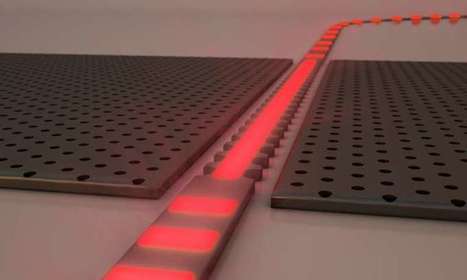
In 2015, researchers at the Harvard John A. Paulson School of Engineering and Applied Sciences (SEAS) developed the first on-chip metamaterial with a refractive index of zero, meaning that the phase of light could be stretched infinitely long. The metamaterial represented a new method to manipulate light and was an important step forward for integrated photonic circuits, which use light rather than electrons to perform a wide variety of functions.
Now, SEAS researchers have pushed that technology further - developing a zero-index waveguide compatible with current silicon photonic technologies. In doing so, the team observed a physical phenomenon that is usually unobservable—a standing wave of light.
The research is published in ACS Photonics. The Harvard Office of Technology Development has filed a patent application and is exploring commercialization opportunities.
When a wavelength of light moves through a material, its crests and troughs get condensed or stretched, depending on the properties of the material. How much the crests of a light wave are condensed is expressed as a ratio called the refractive index—the higher the index, the more squished the wavelength.
When the refractive index is reduced to zero the light no longer behaves as a moving wave, traveling through space in a series of crests and troughs, otherwise known as phases. Instead, the wave is stretched infinitely long, creating a constant phase. The phase oscillates only as a variable of time, not space.
This is exciting for integrated photonics because most optical devices use interactions between two or more waves, which need to propagate in sync as they move through the circuit. If the wavelength is infinitely long, matching the phase of the wavelengths of light isn't an issue, since the optical fields are the same everywhere.
But after the initial 2015 breakthrough, the research team ran into a catch-22. Because the team used prisms to test whether light on the chip was indeed infinitely stretched, all of the devices were built in the shape of a prism. But prisms aren't particularly useful shapes for integrated circuits. The team wanted to develop a device that could plug directly into existing photonic circuits and for that, the most useful shape is a straight wire or waveguide.
In a classical thermodynamic system, heat current flows from the hotter body to the colder one, or electricity from the higher voltage to the lower one. The same thing happens in quantum systems, but this state can be changed, and the flow of energy and particles can be reversed if a quantum observer is inserted into the system.
This is the main result obtained by the group led by Professor Ángel Rubio of the UPV/EHU and of the Max Planck Institute PMSD, together with collaborators at the BCCMS centre in Bremen. Their study has been published in npj Quantum Materials.
In macroscopic objects such as a current of water, observing the current does not affect the flow of the water and, in accordance with the laws of classical thermodynamics, this flow would take place from the upper to the lower part of the system. However, in quantum systems, "the process of observation changes the state of the system, and this makes it more likely that the current will be made to flow in one direction or another," says Ángel Rubio, a professor with the Hamburg-based Max Planck Institute for the Structure and Dynamics of Matter.
Rubio says this does not constitute "an infringement of any fundamental theorem of physics nor is energy created out of nothing. What happens is that inserting an observer into the system acts as an obstacle, as if you were to close off the channel in a pipeline through which the water is flowing. Obviously, if the load starts to build up, it would end up going in the opposite direction. In other words, the observer projects the state of the system onto a state that transmits the current or energy in opposite directions."
Rubio remembers his surprise when discovering that inserting the quantum observer caused the directions of the current and the transfer of energy to change: "Initially, we thought it was an error. We expected to come across changes and we thought it would be possible to halt the transport, but we didn't expect there was going to be a complete change of flow. These changes in the direction of the current can also be made in a controlled way. Depending on where the observer is inserted, the flow can be changed, but there are specific areas in the device in which, despite looking, the direction does not change," he says.
In this article the author explains the concept of Quaternions in an easy to understand way. Complex Numbers and Quaternions are explained in detail as well as all the different operations that can be applied to them. The author also compares applications of matrices, Euler angles, and tries to explain when you would want to use Quaternions instead of Euler angles or matrices and when you would not.
A UK-led group of European astronomers used the MUSE and X-shooter instruments on the Very Large Telescope (VLT) at ESO’s Paranal Observatory in Chile to study an ongoing collision between two galaxies, known collectively as IRAS F23128-5919, that lie around 600 million light-years from Earth. The group observed the colossal winds of material — or outflows — that originate near the supermassive black hole at the heart of the pair’s southern galaxy, and have found the first clear evidence that stars are being born within them [1].
Such galactic outflows are driven by the huge energy output from the active and turbulent centres of galaxies.Supermassive black holes lurk in the cores of most galaxies, and when they gobble up matter they also heat the surrounding gas and expel it from the host galaxy in powerful, dense winds [2].
“Astronomers have thought for a while that conditions within these outflows could be right for star formation, but no one has seen it actually happening as it’s a very difficult observation,” comments team leader Roberto Maiolino from the University of Cambridge. “Our results are exciting because they show unambiguously that stars are being created inside these outflows.”
The group set out to study stars in the outflow directly, as well as the gas that surrounds them. By using two of the world-leading VLT spectroscopic instruments, MUSE and X-shooter, they could carry out a very detailed study of the properties of the emitted light to determine its source. Radiation from young stars is known to cause nearby gas clouds to glow in a particular way. The extreme sensitivity of X-shooter allowed the team to rule out other possible causes of this illumination, including gas shocks or the active nucleus of the galaxy.
The group then made an unmistakable direct detection of an infant stellar population in the outflow [3]. These stars are thought to be less than a few tens of millions of years old, and preliminary analysis suggests that they are hotter and brighter than stars formed in less extreme environments such as the galactic disc.
As further evidence, the astronomers also determined the motion and velocity of these stars. The light from most of the region’s stars indicates that they are travelling at very large velocities away from the galaxy centre — as would make sense for objects caught in a stream of fast-moving material.
Co-author Helen Russell (Institute of Astronomy, Cambridge, UK) expands: “The stars that form in the wind close to the galaxy centre might slow down and even start heading back inwards, but the stars that form further out in the flow experience less deceleration and can even fly off out of the galaxy altogether.”
The discovery provides new and exciting information that could better our understanding of some astrophysics, including how certain galaxies obtain their shapes [4]; how intergalactic space becomes enriched with heavy elements[5]; and even from where unexplained cosmic infrared background radiation may arise [6].
Some 1,500 light years from Earth, a mystery of stellar proportions is playing out. A singular star out there captured scientists' and the public's imagination in September 2015 with its strangely fluctuating brightness. Ever since then, the scientific community has been observing this enigmatic character and sifting methodically through the data in search of an answer. Certain explanations are eliminated, while other likely suspects come to the fore. Meanwhile, the world has the chance to watch, as the scientific process and the mystery continue to unfold.
The star under scrutiny is officially known as KIC 8462852, but was nicknamed "Tabby's Star," for its discoverer, Tabetha Boyajian, an assistant professor of astrophysics at Louisiana State University in Baton Rouge. It first became famous when data from NASA's Kepler space telescope revealed that sudden and significant dips in its brightness had occurred in 2011 and 2013. The star's light dimmed by as much as a whopping 22 percent for days at a time. No other star out of more than 200,000 that Kepler measured during its original, four-year mission behaves in exactly this way.
"This [dimming] behavior was not something we were looking for or had trained our algorithms to find," Boyajian said. "In fact, we were first alerted to the star's unique activity by citizen scientists participating in the Planet Hunters program."
The internet's favorite theory to explain the strange phenomenon was that this could be a Dyson sphere—a hypothetical structure built by an advanced alien civilization to collect energy from its star. However, new data from NASA's Spitzer space telescope and the Swift mission, along with a Belgian observatory used by amateur astronomers, provide strong evidence against such a "megastructure."
These observers were looking at another type of enigmatic behavior from Boyajian's star: a less extreme, long-term dimming that is also difficult to explain. What they found tells us something about the sudden dips in the star's light, too: Their results show that a large, solid object like the hypothesized structure would not cause starlight to dim in the precise way the telescopes observed.
The scientific community has actually favored a number of more plausible explanations all along. These scenarios are subjected to the same rigorous assessment: a group of researchers leans toward a particular idea, they make observations of the star, analyze the data, compare their proposed scenario against the findings of other researchers worldwide, and see how it all adds up. So far, these investigations have led scientists to rule out multiple hypotheses for the behavior of Boyajian's star, at least pending any further developments. Yet it's this process of elimination – scientists working their way through the likely culprits, crossing names off their list, one by one – that will bring us closer to solving the mystery.
The most recent findings, based on the new data from Spitzer and Swift, point the finger at an uneven dust cloud orbiting the star to explain the long, slow dimming of the star, which may prove related to the short dips in brightness. As for the latter, one study has suggested that a star orbited by a ringed planet and clusters of asteroids could exhibit the same strange dimming behavior. Yet another has considered a planet being pulled apart and swallowed up by the star. These relative newcomers to the mystery have followed other explanations previously put on trial by scientists for the strange behavior of Boyajian's star.
It's possible to produce hydrogen to power fuel cells by extracting the gas from seawater, but the electricity required to do it makes the process costly. UCF researcher Yang Yang has come up with a new hybrid nanomaterial that harnesses solar energy and uses it to generate hydrogen from seawater more cheaply and efficiently than current materials.
The breakthrough could someday lead to a new source of the clean-burning fuel, ease demand for fossil fuels and boost the economy of Florida, where sunshine and seawater are abundant.
Yang, an assistant professor with joint appointments in the University of Central Florida's NanoScience Technology Center and the Department of Materials Science and Engineering, has been working on solar hydrogen splitting for nearly 10 years.
It's done using a photocatalyst - a material that spurs a chemical reaction using energy from light. When he began his research, Yang focused on using solar energy to extract hydrogen from purified water. It's a much more difficulty task with seawater; the photocatalysts needed aren't durable enough to handle its biomass and corrosive salt.
As reported in the journal Energy & Environmental Science, Yang and his research team have developed a new catalyst that's able to not only harvest a much broader spectrum of light than other materials, but also stand up to the harsh conditions found in seawater. "We've opened a new window to splitting real water, not just purified water in a lab," Yang said. "This really works well in seawater."
The seasteading movement is getting close to building its first prototype, an artificial archipelago where people will live, play and do research.
The view is unbeatable. To the right, steep volcanic mountains, draped in green, rise up from a beachside coconut grove. To the left, the Pacific Ocean glitters turquoise under the midday sun. It is here in this Tahitian lagoon that a group of entrepreneurs plans to build an artificial island — three-quarters of a hectare of floating housing and research space, made up of linked platforms. If the team is successful, the vision could become reality by 2020. But it would be just the first step, says self-described “seavangelist” Joe Quirk. The ultimate goal is to build whole sovereign nations on the open seas, composed of modular floating units.
“French Polynesia has all the stepping stones: lagoons, atolls, shallow waters right next to deeper waters,” Quirk says. Quirk, one of five managing directors for the company behind the project, and his colleagues propose that artificial islands could serve as laboratories for testing out new technologies and exploring different social structures, or act as life rafts for coastal peoples displaced by sea-level rise.
The non-profit Seasteading Institute was founded by former Google engineer Patri Friedman in 2008, and it has garnered support from influential people in the linked worlds of Silicon Valley, libertarian politics and the anything-goes desert festival, Burning Man. Most media reports have been sceptical, however. The project has been characterized as the dream of “two guys with a blog and a love of Ayn Rand”1 and “a hacker's approach to government with a Waterworld-esque conception of Manifest Destiny”2.
But the Seasteading Institute and the new for-profit spin-off, Blue Frontiers, have racked up some real-world achievements in the past year. They signed a memorandum of understanding with the government of French Polynesia in January that lays the groundwork for the construction of their prototype. And they gained momentum from a conference of interested parties in Tahiti in May, which hundreds of people attended. The project's focus has shifted from building a libertarian oasis to hosting experiments in governance styles and showcasing a smorgasbord of sustainable technologies for, among other things, desalination, renewable energy and floating food-production. The shift has brought some gravitas to the undertaking, and some ecologists have taken interest in the possibilities of full-time floating laboratories.
But the project still faces some formidable challenges. The team must convince the people of French Polynesia that the synthetic islands will benefit them; it must raise enough money to actually build the prototype, which it estimates will cost up to US$60 million; and once it is built, the group must convince the world that artificial floating islands are more than just a gimmick. Producing solid science and broadly useful technology would go a long way towards making that case.
We live in a world that is much more dependent on technology than most of us realize. An occasional power outage may help us grasp the inconvenience of doing without some of our favorite (or even essential) gadgets for a while, but the reality is so much more dire. Vision publisher David Hulme spoke with Peter Townsend, author of The Dark Side of Technology (2016) and emeritus professor at the University of Sussex, about the scope of our reliance on technology and the implications of its failure.
A theoretician, a hardware builder, and a project organizer share the honor.
From almost the moment their discovery was announced, everyone agreed that the first sighting of gravitational waves was going to win a Nobel Prize. The only questions were when and who would receive the honor. Both of those questions have now been answered. When is now, and who turned out to be three individuals who contributed to the project in very different ways.
Caltech's Kip Thorne, a theoretician who made sure we knew what a gravitational wave would look like when we saw it, was one honoree. He was joined by Rainer Weiss, an MIT scientist who helped build some of the first prototype detectors that would eventually inspire the LIGO design, and Barry Barish, another Caltech physicist who was put in charge of the LIGO collaboration and became instrumental in ensuring that the hardware was built and that a large international collaboration was present to operate it and analyze the results.
While LIGO was a stunning success, its history suggests that there were countless ways it and the entire field of gravitational wave physics might have failed. And those ways all lead back to the very person whose work suggested that space-time itself could experience ripples.
To get content containing either thought or leadership enter:
To get content containing both thought and leadership enter:
To get content containing the expression thought leadership enter:
You can enter several keywords and you can refine them whenever you want. Our suggestion engine uses more signals but entering a few keywords here will rapidly give you great content to curate.


 Your new post is loading...












An interesting development.