 Your new post is loading...

|
Scooped by
Linda Holroyd
October 21, 2015 1:59 PM
|
Using Digital Technology to Transform Business
Oct 21, 20157 views0 Likes0 CommentsShare on LinkedInShare on FacebookShare on Twitter
Leading Digital: Turning Technology Into Business Transformation by Didier Bonnet, SVP of Digital Transformation at Capgemini, and George Western and Andrew McAfee, from the MIT Initiative on the Digital Economy, defines digital mastery. There are 4 types of digital masters (Beginners, Conservatives, Fashionistas and Digital Masters) and 3 areas of digital mastery (how you engage with customers, exploring the power of core operational processes, new business models).
The authors showcase Burberry under Angela Ahrendt's tenure as a real life example of digital mastery in the customer engagement space. Customers had a different on-line and brick and mortar experience. Burberry decided to unite those to create a consistent brand experience for the customer. “It was critical for the company to have a single view of the customer in order to improve the experience across all channels, media, and platforms.”
Air France is an example of a company that explored the power of core operational processes. They converted pilot logs from paper (which had to be recopied into other logs) to digital. That gave everyone instant access to the pilots information without recopying and saved 70lbs of paper per flight.
The authors also tackle what the term business model reinvention means. There are 5 ways to reinvent business models and examples of each:
Reinvent industries by reshaping industry structure (platform economics such as iTunes, Liquid Space - like Airbnb for meeting spaces),
Substituting products or services (Fujifilm v Kodak and digital substitution for film)
Creating new digital businesses (Nike+, fuel band, watches, etc.)
Reconfiguring value delivery models (On Call in Volvo cars allowed Volvo to get closer to the customer and deliver value to them without adversely affecting the dealership)
Rethinking value propositions (Tokio Marine provides One–Time Insurance).
It's easy to see from this list that competition can come from any angle. The first half of the book focuses on what to do to transform. The last half of the book addresses how to drive transformation from employee engagement to governance models.
Each chapter closes with an action list. For example, one chapter checklist includes “Put customer experience at the heart of your digital transformation." and "Make data and analytics the lifeblood of your customer experience reinvention.” Another chapter checklist includes “Consider reconfiguring your delivery model by connecting your products, services, and data in innovative ways to create value.”
The main benefit of this book is that it provides frameworks to better find areas to transform the business using digital and a shared language to describe the business model changes that we see or want to drive for our businesses.
|
|
Scooped by
Linda Holroyd
October 20, 2015 11:19 AM
|
In the latest McKinsey Global Survey on M&A practices and capabilities, most respondents report that their companies regularly examine the portfolio for new opportunities—and many do so at least once a year.1 But if the blistering M&A pace of the past several years continues, as most respondents expect, then these responses also suggest that an annual review of portfolios may not be enough.
As of this writing, the value of M&A in 2015 is on track to rival last year’s, when deal-value announcements totaled about $3.4 trillion2 —levels not seen since 2008. That level of activity raises the stakes for companies reexamining their own business portfolios, as the shifting competitive landscape creates new opportunities—and threats. It may also explain why respondents who perceive their companies to be more successful at M&A are also significantly more likely to report looking for opportunities more often. Whether companies are successful because they look for opportunities more often or the other way around, we can’t say. But the correlation, combined with the fast pace of M&A activity in general, does suggest that more frequent portfolio reviews may be better.
These are among the findings of our newest M&A survey, which asked executives about underlying trends, what M&A capabilities their companies do (and don’t) have, and the effectiveness of their companies’ M&A programs relative to competitors. When we looked at what makes a company good at M&A, the results indicate that while it’s important to perform well at every step of the M&A process, the “high performers” differentiate themselves from others by evaluating their portfolios more often, moving faster through their due-diligence and execution processes, and building stronger capabilities for integration. According to the results, though, even the highest-performing companies could benefit from giving their M&A teams more effective incentives and from proactively connecting and building relationships with their potential targets.
Will the pace of M&A continue?
Among respondents whose companies considered acquisition targets in the past year, just over two-thirds report completing at least one deal. Of those that tried but failed to complete an acquisition, 52 percent indicate that their companies engaged with at least one potential target but, ultimately, did not close the deal.
Most executives expect the next year to bring as many or more deals as the past one. It’s too soon to tell whether market volatility in the late summer will affect M&A over the longer term, but at least as of May 2015, two-thirds of respondents expect the pace of activity over the subsequent 12 months to continue or increase—and nearly three-quarters expect these deals will be the same size or larger. Interestingly, those who anticipate a larger number of deals also expect their value to increase—and those who expect to do fewer deals expect their value to decline. Looking further ahead, respondents expect little change to their companies’ rationales for deals in the next five years, and the most frequently cited reasons all relate to growth: expanding offerings, entering new geographies, and acquiring new assets.
More specifically, respondents from high-tech and telecom companies are significantly more likely than those in every other industry to expect an increasing number of deals, though they were not more likely to expect larger ones. Consumer-company executives tend to expect fewer deals in the next year than their B2B peers.3
What high performers do differently
To better understand companies’ M&A performance overall and where the best-performing companies differentiate themselves most from their peers, we identified a group of high performers. Respondents in this group characterize their companies’ performance as having met or surpassed targets for both cost and revenue synergies in their transactions of the past five years. The low performers, by contrast, are respondents who report that their companies have achieved neither the cost- nor the revenue-synergy targets in their transactions.
The survey results indicate a few areas where the high performers do things differently than others. For example, these respondents are much more likely than the low performers to report that their companies evaluate their portfolios for acquisition, joint-venture, and divestiture opportunities multiple times per year, as opposed to once every one or two years. The inverse is also true: low performers are significantly more likely to say their companies look for opportunities once a year or less (Exhibit 1). Notably, the frequency with which companies (both high and low performers) evaluate their portfolios for divestiture opportunities is significantly less than it is for acquisitions or joint ventures.
On average, high- and low-performing companies tend to move through their due-diligence and deal-execution processes at about the same speed—up to a point. However, among companies where respondents report taking six months or more, the pattern diverges. More than one-quarter of low-performer executives say their companies take longer than six months to move from a nondisclosure agreement to a binding offer, nearly double the share of high performers that say they spend the same amount of time (Exhibit 2).
Finally, the high performers stand apart on the strength of their integration processes. We asked executives about their companies’ capabilities across the four areas of M&A, and those from the high-performing companies report proficiency more often in all four than their peers at low-performing companies do. But their skills are most differentiated in integration (Exhibit 3). Interestingly, the two integration capabilities with the largest percentage-point differences between high and low performers are also the two capabilities where, overall, respondents report the least proficiency: effectively managing cultural differences across organizations and setting synergy targets.
What all companies could do better
For all their best practices and the strength of their capabilities, even the high performers have room to improve. When it comes to incentives, the results suggest that many companies focus on earn-outs and retention packages for key talent in acquired companies—but often overlook their own M&A teams. Because there are often different owners throughout a company’s M&A process, it can be particularly tricky to put proper incentives in place for each one. So, incentives must balance the promotion of post-integration success with the successful execution of an individual’s role.
In practice, few executives report that their companies do this well. Less than half of all respondents indicate that the incentives of those involved in a given M&A transaction are closely aligned with the benefits the company extracts from it. Even among the high performers, only 57 percent agree that their companies are getting this right. For those that balance their incentives well, the potential for strong overall performance is striking: 93 percent of respondents who strongly agree that their companies’ incentives are aligned with their strategic goals are high performers, versus only 23 percent of respondents who strongly disagree.
Although the high performers have particularly strong internal processes to identify potential targets, they—and their lower-performing peers—are least effective at connecting and building relationships with these targets (Exhibit 4). For example, not even half of respondents at the high-performing companies (and just under one-third at the low performers) say their companies regularly conduct “road shows” or meetings to establish relationships with the most attractive companies. Executives at both the high- and the low-performing companies report similar results for using compelling pitch materials to support even very-early-stage outreach discussions with targets.
Looking ahead
Conduct frequent portfolio reviews. Companies that systematically evaluate their portfolios for acquisition, joint-venture, and divestiture opportunities set themselves up to execute their corporate strategies more effectively. In many strategies, the inorganic component is critical, and getting that piece right begins with building a sound business case to define which businesses a company wants—and does not want—in its portfolio.
Invest in building M&A capabilities. Companies that can build capabilities that support inorganic growth can enjoy a sustainable competitive advantage. This includes capabilities that are applicable to the earlier stages of M&A—such as efficient and effective due diligence and external outreach as part of proactive sourcing—as well as the core capabilities required to integrate a company.
Pay attention to governance and incentives. In our experience, many companies will focus on earn-outs and retention packages for acquired companies but will overlook ensuring that their own M&A teams have the right setup, governance, and incentives. These are the necessary foundations upon which distinctive M&A capabilities are built.
About the contributors
The contributors to the development and analysis of this survey include Rebecca Doherty, an associate principal in McKinsey’s San Francisco office, and Spring Liu and Andy West, a consultant and a director, respectively, in the Boston office.
They would like to thank Alvaro Aguero and Cristina Ferrer for their contributions to this work.
|
|
Scooped by
Linda Holroyd
October 15, 2015 11:54 AM
|
Our latest research on growth in software and online-services companies has some surprising findings about the benefits and risks of buying growth.October 2015 | by Brian Dinneen, Eric Kutcher, Mitra Mahdavian, and Kara Sprague Acquisitions, done well, can be a powerful tool to accelerate revenue growth. And pushing for gains is vital in software and online services, where the rate of growth typically determines whether a company thrives, survives, or dies. While 20 percent revenue growth is enviable in most industries, companies in software and online services are expected to deliver numbers that are markedly higher. In fact, we’ve found that software and online-services companies with revenue that grows by more than 60 percent annually when they hit $100 million in sales are eight times more likely to eventually pass $1 billion in annual revenue than players with revenue that grows by less than 20 percent annually.1 However, acquisitions, done episodically, can also stifle growth. Our research shows that acquiring companies infrequently may actually disrupt organic growth and slow overall revenue gains. We examined the acquisition activity of 578 software and online-services companies that surpassed $100 million in annual revenue2 and identified three lessons: - Low-volume acquisition programs disrupt growth; high-volume programs accelerate growth. The software and online-services companies whose revenue grew most rapidly had high-volume acquisition programs.
- Successful acquisition programs complement organic growth. Among software and online-services companies that reached $1 billion in annual revenue, acquisition efforts preserved or accelerated organic growth. These companies completed more deals, squeezed more growth out of each deal, and managed to preserve high organic growth while investing energy in finding and incorporating acquisitions.
- Successful acquisitions align with growth strategy. Companies that accelerate revenue growth through acquisitions don’t treat deals as an opportunistic event to capture cost synergies. They use several different deal archetypes—all linked to their fundamental growth strategy.
Low-volume acquisition programs disrupt growth; high-volume programs accelerate growth Some software companies rocket past $1 billion in annual revenue on organic growth alone. Yet for those that seek to supplement everyday growth with acquisitions, it’s not enough to check the box with a deal here and there. Our research found that companies making less than one acquisition per year on average have worse revenue growth than those that did no deals. By contrast, companies undertaking one to two deals a year had double the revenue growth of those doing no deals, and companies acquiring two or more companies a year averaged significantly higher growth (Exhibit 1). Successful acquisition programs complement organic growth The acquisition programs of companies that achieved $1 billion in annual revenue delivered organic growth superior to that of companies falling short of the $1 billion mark. As Exhibit 2 shows, companies that reached $1 billion in revenue had nearly twice as much growth from acquisitions as companies that did not, but they saw 31 times the organic-growth contribution. Successful companies drove results in three areas: preserving or enhancing business momentum (or organic growth), executing more deals, and translating each deal into more revenue growth. Let’s look at each element. First, and most important, a company needs to preserve its business momentum. Software and online-services companies that used acquisitions and successfully moved from $100 million in annual revenue to $1 billion were able to maintain rapid organic-revenue growth (31 percent a year); companies that did not reach the $1 billion mark achieved just 1 percent organic-revenue growth each year. Acquisition activity can distract management and direct resources away from the existing business, or it can preserve and even enhance growth in the core business. Successful companies achieve the latter. Second, companies that reached $1 billion in annual revenue undertook more deals each year (1.5 deals on average) than those that did not (0.9 deals). We found that executing more deals delivered an additional seven percentage points of revenue growth annually. The bottom line is that executing a successful acquisition program is not as simple as buying more companies. It requires a systematic, disciplined approach to deal discovery and execution that is improved over time. Trying to jam more deals through a broken process will only compromise organic growth and the chance of success.3 Third, companies that get to $1 billion in annual revenue can achieve more growth per deal—a compound annual growth rate of 13 percent, compared with 11 percent for companies that do not reach this threshold. Although a difference of two percentage points is small, the ability to capture more growth from deals adds up when combined with a greater deal volume. This means the acquisition programs of successful companies deliver annual revenue growth of 19 percent on average, almost twice the 10 percent of companies that are unable to reach the $1 billion level. So do the fastest-growing software and online-services companies use acquisitions? Yes. When we examined the fastest-growing 10 percent of companies, we found that they all used acquisitions—and that they all had high-volume acquisition programs, delivered the greatest average excess total return to shareholders,4 and achieved annual revenue growth of more than 100 percent (Exhibit 3). Our conclusion is that acquisition programs should be robust, and they must build on the core business. It’s the combination of organic and inorganic growth that allows companies to survive and delivers excess total return to shareholders. Successful acquisitions align with growth strategy It is no surprise that most deals in software and online services appear to be aligned with growth rather than costs. Yet this does not mean that all deals are the same. We identified four common deal archetypes and rationales aligned with accelerating growth: - Audience expansion or consolidation. Once a company has established a successful offering, growth can be supplemented by acquiring a target with an applicable audience or customer base. This can improve the scale of the offering, allow the company to reach new geographies, enhance the credibility of a product or service, and improve the value proposition for products that benefit from greater market share. One example of this is the combination of several audiences for travel websites (Expedia, Hotels.com, Hotwire, and TripAdvisor) under the umbrella of IAC. However, executing acquisitions poorly may drive away acquired customers and yield diminishing returns. In such transactions, it’s important to pay attention to both existing customers and new customer opportunities.
- Gap fills. A company may use acquisitions to fill gaps in its core product or service offering. For example, Salesforce.com’s acquisition of Jigsaw allowed it to automate the way it acquired and maintained business-contact data and to improve the value proposition of its core customer-relationship-management offering. A deep technical understanding is critical to ensure that the gap is successfully addressed by the target’s offering or intellectual property and that the target can be successfully integrated with the acquirer’s existing solutions.
- Speed to adjacency. Companies looking beyond their core offering for growth typically pursue opportunities in adjacent markets. In the fast-paced realm of software and online services, organic entry may be too slow. In such cases, companies often use acquisitions to speed their entry. Synopsys, for example, acquired Coverity to expand into the software-testing market. Adobe, Oracle, and SAP are serial adjacency acquirers. The risk of this type of acquisition is that the adjacent market or target company is not as attractive as expected, or that the company does not have what it takes to win in the new market after the acquisition. To address this, companies need to understand their core differentiators and where they have the familiarity to succeed.5
- Acqui-hire. These deals are focused on securing distinctive talent that can enhance the acquirer’s core offering, and the offerings of the target usually are discontinued. When Facebook bought FriendFeed, for instance, the deal brought on board several talented employees, including Bret Taylor, who went on to become Facebook’s chief technology officer. The central risks with this type of acquisition are not surprising: the inability to retain employees of the company that has been acquired, and the potential for the acquiring company to overestimate the individual capabilities of the acquired company.6
These archetypes illustrate the ways that acquisitions can accelerate revenue growth. Moreover, they show how opportunities could align with an acquirer’s growth strategy rather than emanating from a target’s current market price, a shared industry, or the opportunity to reduce overhead. Putting it all together Software and online-services companies thinking of doing one acquisition per year are actually better served doing no deals. To drive the type of growth required to thrive in the software and online-services sector, acquisitions must be done regularly and treated as a capability that fuels both organic and inorganic growth. Companies that successfully accelerate from $100 million to $1 billion in annual revenue typically undertake more than two deals per year, use acquisitions to accelerate their core organic growth, and deliberately align the deal rationale with their most pressing growth challenges. In short, what matters is not whether you do acquisitions. What counts is how you do them. About the authors Brian Dinneen is a consultant in McKinsey’s Boston office; Eric Kutcher is a director in the Silicon Valley office, where Mitra Mahdavian an associate principal; Kara Sprague is a principal in the San Francisco office. The authors wish to thank Yubing Ji, Rishi Kant, and Robert Uhlaner for their contributions to this article.
|
|
Scooped by
Linda Holroyd
October 2, 2015 6:01 PM
|
With the pace of change in the world accelerating around us, it can be hard to remember that the digital revolution is still in its early days. Massive changes have come about since the packet-switch network and the microprocessor were invented, nearly 50 years ago. A look at the rising rate of discovery in fundamental R&D and in practical engineering leaves little doubt that more upheaval is on the way.
For incumbent companies, the stakes continue to rise. From 1965 to 2012, the “topple rate,” at which they lose their leadership positions, increased by almost 40 percent1 as digital technology ramped up competition, disrupted industries, and forced businesses to clarify their strategies, develop new capabilities, and transform their cultures. Yet the opportunity is also plain. McKinsey research shows that companies have lofty ambitions: they expect digital initiatives to deliver annual growth and cost efficiencies of 5 to 10 percent or more in the next three to five years.
To gain a more precise understanding of the digitization challenge facing business today, McKinsey has been conducting an in-depth diagnostic survey of 150 companies around the world. By evaluating 18 practices related to digital strategy, capabilities, and culture, we have developed a single, simple metric for the digital maturity of a company—what might be called its Digital Quotient, or DQ. This survey reveals a wide range of digital performance in today’s big corporations (exhibit).
Our examination of the digital performance of major corporations points to four lessons in which we have increasing confidence:
First, incumbents must think carefully about the strategy available to them. The number of companies that can operate as pure-play disrupters at global scale—such as Spotify, Square, and Uber—are few in number. Rarer still are the ecosystem shapers that set de facto standards and gain command of the universal control points created by hyperscaling digital platforms. Ninety-five to 99 percent of incumbent companies must choose a different path, not by “doing digital” on the margin of their established businesses but by wholeheartedly committing themselves to a clear strategy.
Second, success depends on the ability to invest in relevant digital capabilities that are well aligned with strategy—and to do so at scale. The right capabilities help you keep pace with your customers as digitization transforms the way they research and consider products and services, interact, and make purchases on the digital consumer decision journey.
Third, while technical capabilities—such as big data analytics, digital content management, and search-engine optimization—are crucial, a strong and adaptive culture can help make up for a lack of them.
Fourth, companies need to align their organizational structures, talent development, funding mechanisms, and key performance indicators (KPIs) with the digital strategy they’ve chosen.
Collectively, these lessons represent a high-level road map for the executive teams of established companies seeking to keep pace in the digital age. Much else is required, of course.2 But in our experience, without the right road map and the management mind-set needed to follow it, there’s a real danger of traveling in the wrong direction, traveling too slowly in the right one, or not moving forward at all. We hope this article will help leaders steer organizations effectively as they make the transition to becoming more fully digital enterprises.
1. Getting the strategy right
Executives must arrive at a common vernacular for what “digital” means for them.3 Then, the starting point for success is developing a clearly defined, coherent digital strategy that’s fully integrated with the overall corporate one. Without this deep alignment, any subsequent intervention is bound to fall short. Yet companies struggle to get their digital strategy right. Among the 18 practices in our DQ diagnostic, those related to strategy show the biggest variance between digital leaders and more average-performing companies. (For more on the basic tenets of the Digital Quotient, see “Understanding your Digital Quotient,” a video with McKinsey’s Tanguy Caitlin. For more from Tanguy on how companies can build an effective digital strategy, see “What it takes to build your Digital Quotient.”) One obstacle is the exposure and publicity (and, commonly, the big market valuations) that surround the most visible players in today’s digital landscape. These companies include pure-play disrupters, such as Nespresso and Uber, and ecosystem shapers, such as John Deere and Schibsted. Impressive as disrupters and shapers might be, those two strategies are feasible for only a select few.
Video
Understanding your Digital Quotient
Play video
Companies get their digital strategy right by answering three important questions. First, where will the most interesting digital opportunities and threats open up? Second, how quickly and on what scale is the digital disruption likely to occur? Third, what are the best responses to embrace these opportunities proactively and to reallocate resources away from the biggest threats? The vast majority of companies will address this third question through more targeted strategic responses, including these:
A smaller-scale disruption of your own business model to enter a new space or redefine an existing one. Shenzhen-based Ping An Bank, for instance, founded the digitally centered Orange Bank to target younger consumers of financial services with simple, high-return products and a one-minute account sign-up—all without traditional branch networks or complex product portfolios.
Fast-following to ride the wave and capture some of the value created by an industry’s evolution. The UK department store John Lewis deployed thoughtful, targeted “clicks and mortar” levers to make it possible for a highly loyal and attractive customer base to order from its website and get deliveries at stores and company-owned grocery outlets in their local communities.
Aggressively reallocating resources from digitally threatened assets to more digitally interesting ones. Bauer Media Group, in Germany, has systematically reallocated resources away from potentially vulnerable analog media assets to develop a portfolio with a digital advantage. Its overall revenue base has shrunk, but its topline growth is materially higher, and its market capitalization has better equity multiples.
Boosting the effectiveness of existing business models through digital approaches and tools. To help visitors at Disney resorts and theme parks, the Walt Disney Company, for example, developed a suite of digital tools. These include the FastPass+ service, which allows visitors to reserve access to theme-park attractions, and the MagicBand, a tech-enabled wristband that facilitates reservations and customer routing at Disney World. Roughly 50 percent of Disney World’s visitors elect to wear it. The more efficient routing helped the resort’s Magic Kingdom to host about 3,000 more guests each day of the 2013–14 holiday season.4
Clearly defining the best-fitting digital strategies is important, in part, because successful ones give rise to differentiated management practices: if you get the strategy right, the managerial interventions become clearer and vice versa. Consider the following examples:
A bold long-term orientation counteracts short-term financial-performance imperatives and frees companies to take calibrated risks and to invest at scale in digital initiatives and the IT architecture.
Direct integration with the strategy puts digital at the center of the business, fostering natural forms of internal collaboration as well as corporate governance that places digital topics alongside other business requirements. Strategic priorities and investment decisions are now part of the same process.
A relentless focus on customer needs helps companies innovate constantly where it matters most. While data from early adopters sometimes does mislead businesses that try to serve them, more often than not their behavior soon begins permeating the mass market. That’s especially true if multigenerational links can be made through consumer use cases (for instance, direct consumer videoconferencing, texting, and e-chats).
Once companies have arrived at a clearly thought-out strategy, they must commit themselves to it wholeheartedly. The days of tinkering at the edges are gone.
2. Capabilities at scale
For digital success, certain capabilities—especially those that build foundations for other key processes and activities—are more important than others. Foremost among them are the modular IT platforms and agile technology-delivery skills needed to keep pace with customers in a fast-moving, mobile world. The IT platforms of most companies we surveyed have major gaps, reflecting (and reinforced by) a widespread failure to prioritize digital initiatives within broader IT and capital-expenditure investments.
What further separates high performers in our survey is their ability to engage customers digitally and to improve their cost performance in four areas.
Data-empowered decision making
High-performing digital companies distinguish themselves by keeping pace as their customers undertake the digital consumer decision journey.5 For example, they anticipate emerging patterns in the behavior of customers and tailor relevant interactions with them by quickly and dynamically integrating structured data, such as demographics and purchase history, with unstructured data, such as social media and voice analytics. These companies skillfully assess the available resources, inside and outside the business, and bring them to bear on issues that matter to their markets.
For example, in 2012, Reckitt Benckiser, a maker of popular cold and flu remedies, used search data from the medical website WebMD (with almost 32 million monthly visitors at that time) to track cold and flu symptoms across the country and anticipate where outbreaks were likely to occur. Then the company released targeted geography- and symptom-specific advertising and promotions (including an offer for free home delivery) in those places. Along with a strong cold and flu season, this initiative helped Reckitt Benckiser, during one four-week period, to increase its US sales of cough and cold products by 22 percent, compared with the previous year.6
Connectivity
A closely related skill is connectivity. Digital leaders embrace technologies (such as apps, personalization, and social media) that help companies establish deeper connections between a brand and its customers—and thus give them more rewarding experiences. Such connections can also deeply inform product development.
For example, Burberry’s Art of the Trench campaign, launched in 2009, encourages customers to visit its online platform and upload photographs of themselves in trench coats. Fellow shoppers and fashion experts then comment on the photos and “like” and share them through email, as well as social-media outlets. Users can also click through to the main Burberry site to shop and buy. These innovations are becoming ever more deeply embedded in the company.7 Burberry may not have gotten everything right, but, overall, this approach—combined with other innovations—helped the company to double its annual total revenue in six years.
Process automation
Top-performing digital players focus their automation efforts on well-defined processes, which they iterate in a series of test-and-optimize releases. Successful process-automation efforts start by designing the future state for each process, without regard for current constraints—say, shortening turnaround time from days to minutes. Once that future state has been described, relevant constraints (such as legal protocols) can be reintroduced.
Using this approach, a European bank shortened its account-opening process from two or three days to less than ten minutes. At the same time, the bank automated elements of its mortgage-application process by connecting an online calculator to its credit-scoring models, which enabled it to give customers a preliminary offer in less than a minute. This system cut costs while significantly improving customer satisfaction.8
Two-speed IT
Today’s consumer expectations put a new set of pressures on the IT organization as legacy IT architectures struggle with the rapid testing, failing, learning, adapting, and iterating that digital product innovations require. Our diagnostic shows that leading companies can operate both a specialized, high-speed IT capability designed to deliver rapid results and a legacy capability optimized to support traditional business operations.
This IT architecture and, in certain cases, the IT organization itself essentially function at two different speeds. The customer-facing technology is modular and flexible enough to move quickly—for instance, to develop and deploy new microservices in days or to give customers dynamic, personalized web pages in seconds. The core IT infrastructure, on the other hand, is designed for the stability and resiliency required to manage transaction and support systems. The priority here is high-quality data management and built-in security to keep core business services reliable.
One UK financial institution used this two-speed approach to improve its online retail-banking service. The bank opened a new development office with a start-up culture—an agile work process tested and optimized new products rapidly. To support this capability for the long term, the company simultaneously evolved its service architecture to accelerate the release of new customer-facing features.9
3. A fast, agile culture
While strong skills are crucial, companies can to some degree compensate for missing ones by infusing their traditional cultures with velocity, flexibility, an external orientation, and the ability to learn. While there is more than one way to build such a culture, many companies with high scores on the DQ diagnostic have succeeded by adopting test-and-learn approaches drawn from software-development movements such as DevOps, continuous delivery, and agile. Once, these were confined to the periphery of the business environment. Now they bring a cooperative, collaborative disposition to interactions between talented workers at its core. Previously siloed functions, departments, and business units can learn a new spirit of cohesiveness.
These test-and-learn approaches incorporate automation, monitoring, community sharing, and collaboration to unify previously isolated functions and processes into a fast-moving, product-oriented culture. By promoting shared ownership of technology initiatives and products, such environments democratize data, minimize complexity, facilitate the rapid reallocation of resources, and enable reusable, modular, and interoperable IT systems.10 To set this kind of culture in motion, executives can focus their efforts on four key areas.
External orientation
As companies develop their collaborative cultures, they position themselves to participate more meaningfully in broader networks of collaboration, learning, and innovation. The shaping role in these networks, or ecosystems, may be beyond the reach of most incumbent companies. But they can play other value-creating roles by performing specific modules of activity, such as production or logistics, within a more broadly orchestrated ecosystem.
Collaboration beyond the boundaries of companies need not occur only in a broadly orchestrated setting. Companies can also benefit from smaller-scale collaborations with customers, technology providers, and suppliers. In addition, they can mobilize workers they themselves don’t employ—the distributed talent in networks of shared interest and purpose. SAP, for instance, mobilized the user community it developed to help launch its NetWeaver software.
All this requires digital leaders to recognize what they’re good at themselves and what others might do better and to improve their ability to partner collaboratively with people and institutions. They must also be able to separate the real opportunities, threats, and emerging collaborators and competitors from hype-laden pretenders.
Appetite for risk
Our DQ research finds that digital leaders have a high tolerance for bold initiatives but that executives at laggards say their cultures are risk averse. Although established companies may not be likely to shape or orchestrate broad ecosystems, they must still face up to the implications of disruptive forces in their markets and industries—and the risks that arise in dealing with them. In a world of more data and less certainty, companies have to make decisions and respond to disrupters all the earlier and the more decisively.
Test and learn—at scale!
At the heart of agile cultures is the test-and-learn mind-set and product-development method, which can usefully be applied, or translated, to nearly any project or process that incumbents undertake. Instead of awaiting perfect conditions for a big-bang product launch or deferring market feedback until then, digital leaders learn, track, and react by putting something into the market quickly. Then they gauge interest, collect consumer reactions, and pursue constant improvements. Rigorous data monitoring helps teams quickly refine or jettison new initiatives, so that such companies fail often and succeed early.
Nordstrom’s Innovation Lab, for example, launches customer-facing initiatives in a series of one-week experiments. To build an app that helps customers shop for sunglasses, the innovation team set up temporary camp in the retailer’s flagship Seattle store. There, it mocked up paper prototypes and had shoppers tap through them as you would a live version. Customers shared feedback on the features they found most helpful and pointed out problematic or unintuitive elements in the prototype. Coders used that information to make real-time adjustments and then released a new live version of the app for customers to test-drive on the spot. After a week of continual tweaking and re-releasing, it was ready for the store’s sales associates.11
Internal collaboration
Teamwork and collaboration are important in any context, digital or otherwise. Wharton’s Adam Grant says the single strongest predictor of a group’s effectiveness is the amount of help colleagues extend to each other in their reciprocal working arrangements.12 But collaborative cultures take on even greater importance as companies look to boost their DQ, since many lack the established digital backbone needed to unify traditionally siloed parts of the organization, from customer service to fulfillment to supply-chain management to financial reporting.
Less than 30 percent of the 150 companies we’ve surveyed say they have a highly collaborative culture. The good news is that there’s plenty of room for improvement. Some of it comes from technology: by moving into cloud-based virtualized environments, for example, companies can provide appropriate contexts where teams come together and participate in collaborative experimentation, tinkering, and innovation. In this way, they can learn and make decisions quickly by evaluating data from customer experiences.
4. Organization and talent
Beyond strategy, capabilities, and culture, leading digital companies use a wide set of coherent practices in talent, processes, and structure.
Talent connections
High-DQ companies sometimes feel the need for a digital leader on the executive team who combines business and marketing savvy with technological expertise. But while executive leadership is important, the most critical thing is midlevel talent: the “boots on the ground” who can make or break digital initiatives and are ultimately responsible for bringing products, services, and offers to market.
In today’s environment, finding that talent isn’t easy. To facilitate the search, companies should recognize that, in many instances, digital competency matters more than sector knowledge, at least in the early stages of a digital transformation. Only 35 percent of digital talent in the companies we analyzed had digital experience outside them.
High-DQ companies are also creative about training and nurturing talent. A number of years ago, for example, P&G launched an employee swap with Google to shore up P&G’s search engine–optimization skills, while the Internet giant gained a deeper knowledge of marketing.13 Such opportunities build competency while expanding the methods and possibilities open to companies that take advantage of them.
Companies must also nurture digital talent with the right incentives and clear career paths. Here, some incumbents may have more advantages than they realize, since these young people seem eager to help iconic brands in fashion apparel, luxury cars, newsmagazines, and other categories to reach digital audiences. When that’s done well, companies establish a virtuous cycle: the nurturing of good talent attracts more of it, allowing organizations to build quickly on the initial foundation to secure a stable of digital leaders. That critical mass, in turn, serves to draw in similar candidates in the future.
Real-time monitoring
Leading digital companies track and communicate digital key performance indicators frequently—in some cases in real time. They measure those KPIs against digital priorities and make sure senior management reviews and manages their performance.
When Starbucks rolled out a new point-of-sale system, for example, managers videotaped transactions and interviewed employees to fine-tune the checkout process. That feedback allowed the company to trim ten seconds off any mobile or card-based transaction, allowing employees to process sales more quickly and saving customers 900,000 hours of time in line each year.14
Nontraditional structures
While no one answer works for all companies, high-DQ businesses carefully and deliberately build organizational structures that reflect where they are in the digital transformation. Some acknowledge that the core business cannot transform itself fast enough to capture new digital growth. For example, many successful traditional media organizations have carved out their digital businesses from more mature content operations.
Axel Springer used its digital business model as the dominant organizing principle in its recent reorganization—an approach that promotes the emergence of the distinct culture, performance-management system, and governance that growing digital businesses require. In the meantime, Axel Springer’s strong legacy businesses can adapt and evolve to master the new digital landscape separately.
Finally, some incumbents—such as L’Oréal and TD Bank Group—have created centers of excellence and appointed chief digital officers. Others, like Burberry, operate governing councils charged with thinking big and ensuring that senior leadership buys into the digital plans. These structures often change over time as companies evolve. What might start out as a newly incubated competency, such as social media, eventually matures and becomes integrated into the broader business.
The journey to digital maturity requires a whole-hearted commitment from a company’s leadership and a sustained investment in people, capabilities, technology, and cultural change. To get started, an organization must be honest about its DQ, clear about its long-term strategic opportunity, and open to iterating and refining solutions along the way.
To learn more about the Digital Quotient organizational assessment, please visit the McKinsey Digital site.
About the authors
Tanguy Catlin is a principal in McKinsey’s Boston office; Jay Scanlan is a principal in the London office, where Paul Willmott is a director.
The authors wish to thank McKinsey’s Juliette Valains for her contributions to this article.
|
|
Scooped by
Linda Holroyd
September 9, 2015 3:29 PM
|
The world’s biggest corporations have been riding a three-decade wave of profit growth, market expansion, and declining costs. Yet this unprecedented run may be coming to an end. Our new McKinsey Global Institute report,Playing to win: The new global competition for corporate profits, projects that the global corporate-profit pool, which currently stands at almost 10 percent of world GDP, could shrink to less than 8 percent by 2025—undoing in a single decade nearly all of the corporate gains achieved relative to the world economy during the past 30 years (exhibit). From 1980 to 2013, vast markets opened around the world while corporate-tax rates, borrowing costs, and the price of labor, equipment, and technology all fell. The net profits posted by the world’s largest companies more than tripled in real terms from $2 trillion in 1980 to $7.2 trillion by 2013,1pushing corporate profits as a share of global GDP from 7.6 percent to almost 10 percent. Today, companies from advanced economies still earn more than two-thirds of global profits, and Western firms are the world’s most profitable. Multinationals have benefited from rising consumption and industrial investment, the availability of low-cost labor, and more globalized supply chains. But there are indications of a very significant change in the nature of global competition and the economic environment. While global revenue could increase by some 40 percent, reaching $185 trillion by 2025, profit growth is coming under pressure. This could cause the real-growth rate for the corporate-profit pool to fall from around 5 percent to 1 percent, practically the same share as in 1980, before the boom began. (For more, see sidebar, “The future and how to survive it,” an excerpt from a companion article in the October 2015 issue of Harvard Business Review.) Part of the slowdown in profit growth will stem from the competitive forces unleashed by two groups of hard-charging competitors. On one side is an enormous wave of companies based in emerging economies. The most prominent have been operating as industrial giants for decades, but over the past 10 to 15 years, they have reached massive scale in their home markets. Now they are expanding globally, just as their predecessors from Japan and South Korea did before them. On the other side, high-tech companies are introducing new business models and striking into new sectors. And the tech giants themselves are not the only threat. Powerful digital platforms such as Alibaba and Amazon serve as launching pads for thousands of small and midsize enterprises, giving them the reach and resources to challenge larger companies. The competitive landscape has grown more complex, and the pace of change is accelerating. Profits are shifting from heavy industry to idea-intensive sectors that revolve around R&D, brands, software, and algorithms. Sectors such as finance, information technology, media, and pharmaceuticals—which have the highest margins—are developing a winner-take-all dynamic, with a wide gap between the most profitable companies and everyone else. Meanwhile, margins are being squeezed in capital-intensive industries, where operational efficiency has become critical. New competitors are becoming more numerous, more formidable, and more global—and some destroy more value for incumbents than they create for themselves. Meanwhile, some of the external factors that helped to drive profit growth in the past three decades, such as global labor arbitrage and falling interest rates, are reaching their limits. As profit growth slows, there will be more companies fighting for a smaller slice of the pie, and incumbent industry leaders cannot focus simply on defending their market niche. Our analysis of thousands of companies around the world shows that the top performers share three traits: they invest in intellectual assets, they play in fast-growing markets, and they have the most efficient operations. Companies that adapt quickly to these new realities can capture enormous opportunities. Over the next decade, rising consumption in the emerging world will create new markets. Technology will spur new products and services. Start-ups will be able to tap global investors, suppliers, and customers with little up-front investment. But companies will face intense pressure to grow, innovate, and become more productive—not only to seize these opportunities but merely to survive.
|
|
Scooped by
Linda Holroyd
September 9, 2015 2:24 PM
|
There are many reasons why the digital technologies hope to improve patient care as well as the state of healthcare itself. They include improving efficiencies, patient safety, and cost. We selected the Top 10 companies doing super innovative research and offering revolutionary services in digital health.
Note: These 10 are listed in a random order and not by any ranking.
1. Medisafe
MediSafe helps people integrate healthier behaviour into their daily lives with cloud-synced mobile medication management system.
MediSafe’s app and cloud-synced database allows family and friends to aid in the medical care of a loved one by being alerted as to whether or not an ageing father or mother, for instance, has taken their medication. This has significantly boosted prescription compliance: Last year, MediSafe revealed that Type 2 diabetic users of its technology boasted adherence rates of at least 26% higher than standard rates for long-term therapies.
2. Ginger.io
Ginger.io app uses sensor data collected through the phone and self-reported information to identify people who may need help.
Ginger.io‘s apps track the way patients use their phones—like patterns in communication and location—and employ a number of algorithms to alert caregivers to changes that may indicate symptoms or crises. The technology is currently being rolled out in Cincinnati Children’s Hospital and in North Carolina, through the provider network Novant. To date, Ginger.io has collected more than 6 million data points from patients, which will help the company refine its technology as its customer base grows.
3. Setpoint Medical
SetPoint Medical is dedicated to treating patients with debilitating inflammatory diseases using proprietary implantable neuromodulation devices.
Some of the most chronic diseases—such as rheumatoid arthritis, diabetes, and multiple sclerosis—are due to some form of inflammation. SetPoint‘s technology consists of a tiny implant in the vagus nerve of the neck that, when activated, helps reduce the inflammatory reflex—the physiological response that controls inflammation—via a pathway discovered by the company’s cofounder. SetPoint Medical, whose aim is to offer cheaper and less risky therapies for inflammatory diseases, is currently involved in clinical trials.
4. IBM
The advanced cognitive system is reading and analysing vast amounts of industry data, and answering even bigger questions.
There’s no denying that Big Blue’s Watson supercomputer holds promise to improve health care administration and, more crucially, cancer treatment. Its medical rollout began with insurance and provider giant WellPoint (to conduct administrative reviews) and at Memorial Sloan Kettering, where it is learning the finer points of cancer treatment from the world’s premier oncologists. By tapping into a nearly inexhaustible well of data to keep abreast of recent studies and trials, the computer will be able to give practitioners the keen edge of artificial intelligence to boost patient care.
5. Proteus Digital Health
Proteus Digital Health is working to create a new category of products and services with the potential to significantly improve the effectiveness of existing pharmaceutical treatments.
This summer, Proteus Digital Health announced that it raised $52 million, bringing its Series G investment round to more than $172 million. Proteus develops products it calls “digital medicines,” like its Helius digital health feedback system, which integrates regular pharmaceuticals with ingestible sensors. When swallowed, the sensor communicates the time of ingestion to a wearable patch, which also captures physiological responses and detects heart rate, activity, and rest. The system sends the information to a mobile device, then to health care providers or caregivers. Proteus is partnering with Otsuka Pharmaceutical and Novartis to develop and commercialise further digital medicines.
6. Doximity
Doximity is an online social networking service for U.S. physicians. Launched in March 2011, Doximity has over 400,000 verified physician members.
Doximity, the “LinkedIn for doctors,” has been steadily gaining momentum since its launch in 2011. The company in late April announced that it had taken a new $54 million round of funding, bringing its total up to $81 million. Doctors are using Doximity to exchange secure (HIPAA-friendly) messages about patients, send digital faxes, peruse profiles of specialists and general practitioners, stay in touch with friends from medical school, and even gain accreditation for their medical education.
Doximity’s Jeff Tangney says his company has seen its revenues quadruple thus far in 2014 compared to the same period in 2013. Tangney says his company is focused on growing membership now, but an IPO could be one eventuality for his company. He points out that it depends in large part on the market’s appetite for digital health IPOs in the next year.
7. Lift Labs
The stabilising handle includes built-in sensors, a computer, and motors that help to sense and counteract hand tremors.
Lift Labs, which makes a spoon designed to cancel the effects of tremors caused by neurodegenerative diseases, was acquired by Google for an undisclosed amount. Lift has also developed two apps — Lift Pulse and Lift Stride — to measure tremors and to help people with Parkinson’s disease prevent shuffling while walking. Members of the Lift Labs team joined Google X, where they will continue to develop Liftware and other technologies and tools.
8. Perfint Healthcare
Perfint Healthcare is a world leader in planning and targeting solutions for image guided interventional procedures.
Perfint Healthcare makes new technology, specifically robots for oncologists — doctors who specialise in cancer treatment. MAXIO is a robot assistant that was designed to help doctors with cancer diagnostics, treatment, and surgery. The robot is more accurate than a human in detecting exactly where a needle should be inserted into a tumour, for instance. Robio is another robot that helps target tumour treatment or therapy, and helps with drainage, biopsies, and pain management.
9. CliniOps
CliniTrial provides a host of innovative features such as Intelligent edit checks, workflow based design, and integration capabilities.
CliniOps is a company trying to digitise and transform clinical trials to make them more efficient. It’s an application that automates electronic document submission and sends reminders to patients participating in the trial. It does checks on patients, who can upload photos and videos to show progress, using a tablet application, and then uploads the information to the cloud. This way, it can analyse trends and problems with the research in real-time, rather than waiting until the end of the trial.
10. Evolent Health
Evolent Health helps progressive health care systems lead, build and own the path to value-based care.
Evolent Health became popular right around the time when the Affordable Care Act went into effect, and it’s still rapidly growing. The company sells software, advisory services, and information technology to hospitals and healthcare providers. The technology they use is called “Identifi” and it gathers and crunches relevant data about patients so that doctors can better treat them at lower costs.
Honourable Mention: Apple
Apple has announced “ResearchKit”, a software framework made for medical research. More specifically, ResearchKit is a solution for making iOS devices with HealthKit into tools for diagnosis. There are 5 apps that will allow people to contribute towards research of different diseases.
|
|
Scooped by
Linda Holroyd
August 21, 2015 1:41 PM
|
One of marketing’s key objectives is to drive demand. By the time customers interact with your sales team, they’ve already made judgments about what your brand represents. Most of these judgments are based on sources you do not control. In today’s connected and relationship-based world, customers do their own homework. What are the implications for today’s marketing exec? The Customer Journey Every customer is on a journey—a journey towards buying your product or service. The traditional journey begins on the day they first hear of your brand. This customer journey has four milestones: - Brand Awareness: “Name three companies in a particular space”
- Brand Familiarity: “What does the company offer, how is it different?”
- Purchase Intent: “Which companies are on your short list?”
- Brand Promoters: “You’re willing to recommend the company”
[Of course, this is just a simplified model of the world. It only exists to help marketers understand a typical purchase.] But the world has changed. The first time they hear of your brand may not be from you. So you can no longer assume that it’s youtelling them what your brand stands for. The new paths that have emerged put the customer in greater control: The new, self-directed journey starts differently: - Self-Identified Purchase Need: “I know I have a need”
- Self-Directed Solution and Brand Discovery: “I will search for options myself—including third-party opinions”
Your Customer Is Much More Self-Sufficient Today, there’s an alternate, accelerated path. Like so many other aspects of life, the customer’s search has been disintermediated: The Internet has “cut out the middleman.” The new lane of the customer journey begins with a purchase need that’s self-identified. Then it often continues into a phase of self-directed discovery, where customers do their own research into solutions and brands. This is today’s reality for marketers. Your comfortable model of the buying journey is as out-of-date as using floppy disks to store data. Prospects and customers control their own search. They often leap directly to brand familiarity—knowing what the company stands for—using search and social media. Implications For Marketers This means your point of leverage and investment is likely better spent at the Brand Familiarity milestone than at the Brand Awareness stage. So you need to find innovative ways to build familiarity. Seek to gain credibility in: - market presence,
- differentiation,
- relevance,
- knowledge and
- esteem.
Your Customers Are Active Researchers How you use your brand to differentiate your company is more important today than ever before. Customers aren’t passive consumers of information—reading a magazine, sitting in front of a TV, or looking at your online ads waiting to be told what to buy. Before a customer ever contacts your company or talks to a sales person, they’ve searched online for a product or service to meet their need. They’ve spent time reading blogs, articles and customer reviews. For example, 88% of customers are influenced by online conversations about your customer service, according to Dimensional Research. The Power Of Brand Building So your brand must be part of these online conversations to effectively drive demand. Potential customers talk to their friends—both in real life and virtually—asking for their experiences and recommendations. Incredibly, two-thirds of their buying journey has been completed before they ever talk to a salesperson, according to SiriusDecisions. This puts a huge emphasis on the role of branding and on the power it has to drive demand: - Gartner says that references that come directly from a company’s customers are extremely influential. In fact, they are the #1 marketing activity that influences an IT buyer’s purchase preference.
- McKinsey has found that a “word of mouth” recommendation is theprimary factor in up to half of all purchasing decisions.
Your brand must be capable of meeting customers in the places where they look for information. This can either be on the traditional journey path or through the path of self-directed research. The Bottom Line: Missing The Short List If you fail to adjust to the self-directed customer journey, your brand will not drive demand. You simply won’t be invited on to the short list. Recognize this new reality. Adapt your marketing activities to support both company-directed engagements and market-controlled conversations.
|
|
Scooped by
Linda Holroyd
August 17, 2015 1:00 PM
|
One of the biggest mega trends impacting the world today is population aging. By 2020, for the first time in history, the number of older people will outnumber the number of children younger than 5 years of age. In the next 25 years, the number of people older than 65 will double. The average life expectancy is expected to rise to 110 by 2030. Japan and Germany are officially termed “super aged.” Four more countries, Greece, Finland, Spain and Canada, are expected to enter the super aged category by 2020. Figure 1 illustrates the countries entering this category by year. According to the Global Age Watch Index, Norway has been nominated to be the most likely country to grow old out of 96 countries. As the number of senior people rises in many economies of the world, the need for long-term care and aging-in-place services will increase. This will escalate the burden on healthcare in many countries. There are some interesting models that are arising to meet the needs of this population. Many of these models are experiments, but they are proving to be highly successful in providing care, reducing cost and improving quality of life to this silver community. As people live longer, there will be a sharp increase in the number of people with dementias, such as Alzheimer’s disease (AD). In fact, 25% to 30% of people aged 85 and older have a high level of cognitive decline. Globally there are an estimated 47.5 million dementia sufferers, and the number is expected to increase to 75.6 million by 2030 and 135.5 million by 2050. European countries with significant prevalence of dementia are Germany (1.9%) and Italy (2.09%). AD is the most common form of dementia, affecting an estimated 5 million people older than 65 in the U.S. An interesting model to take care of dementia patients has emerged in a small town near Amsterdam. In the municipality of Weesp, the unique village of Hogewey is home to 152 seniors who suffer from dementia. The community has 23 residential units, each of which is shared by six to eight residents. Around-the-clock care is given by 240 “villagers” who are actually trained geriatric nurses and caregivers, and most of them are dressed in street clothes. What is interesting about this model is there is no perception of the village being an old-age home with uniform personnel and an antiseptic look or feel. To ensure the safety of the residents, Hogewey is a secured village where the residents are free to roam around and explore as much as they wish within its confines. This model has not only helped the residents remain active, but has also given them a purpose, which is usually absent in a traditional nursing home environment. Germany and Switzerland have studied the Hogewey village model and are expected to be the next set of countries to adopt and create their own dementia care villages. Replicating such a village globally can make a huge difference to the seniors with special needs, providing them with the security, love and personalization they require in these final years. Seniors do not have to be sick to move to a nursing care or community home. They can still live a “king-sized” life in theme-based homes. The U.S. and Australia are early markets that have created theme-based homes for seniors. It is expected in the next 10-20 years, these homes will take over the conventional form of community homes and the way people perceive “aged-care homes.” Some examples of theme-based homes are Aegis Gardens, an Asian-inspired retirement community in Fremont, Calif., which caters to seniors who speak Mandarin and Cantonese. Seniors at the Burbank Senior Artists Colony in Burbank, Calif., can attend the theater, use the creative art studios, and use a Hollywood-themed clubhouse for recreation and leisure. The world’s first groundbreaking aged-care facility for gays and lesbians is being built near Ballan, in regional Victoria, and will be replicated globally. Countries like Japan are struggling to move from hospital-centered medical care to community-oriented medical care. With declining birth rates and an increasing elderly population (people aged ≥65 years reached 25% in 2013 and is expected to exceed 30% in 2025 and 39.9% in 2060), Japan has invested heavily in robotics and is one of the first countries to be ready with products or prototypes in 2015. South Korea, the U.K., Germany, and China are closely behind in terms of manufacturing. These robots are ready to become part of the household soon. The question is, are seniors ready to share their house with a robot? The nursing robot, “Robear,” is an experimental nursing-care robot developed by the RIKEN-SRK Collaboration Center for Human-Interactive Robot Research and Sumitomo Riko Company. It can work as a nursing robot and can perform tasks like lifting patients from wheelchairs. Robear can become an alternative for nurses in care homes and independent homes. Currently, nursing homes are struggling with manpower shortage. These robots can help seniors manage their day-to-day activities in their own homes. Another example is Care Robot or “ChihiraAico” robot, which resembles a Japanese woman and is likely to be used to assist elderly people with conditions, like dementia, by connecting them to medical staff. Robo Chef has been programmed to assemble and chop ingredients, using the stove or oven to cook, and later can also finish up by cleaning the dirty dishes. The Robo Chef is expected to enter the market between 2017 and 2018 at a cost of $10,967 and can become a great support for elders living in their homes and who are unable to do some household chores. If Transformers from the movie can become a reality, then Giraffplus would definitely be one of them. These remote-controlled bots can connect elderly patients with their friends and family, as well as facilitate a virtual visit. At the same time, it comes with sensors outfitted around the home tracking where someone is and what they’re doing. These robots can transform into their social friends by connecting them with their loved ones through the Internet. A Melbourne nursing home is using robots to interact and play games with residents, as well as improve the quality of life of patients with dementia. Baby seal Palro, expected to be priced at $8,600, is an interactive model developed in Japan. This robot already passed a successful trial in 2014. With the U.S. moving toward becoming a super-aged nation, will Americans be open to adopting Palro? SoftBank’s Pepper has got its work visa and also would be available for service in the commercial market. Who is next? If these experiments and practices come to fruition, the new silver population will have lifestyles very different from what the world has seen before, and the health of nations will change dramatically in the future. This article was written with contribution from Siddharth Dutta, Industry Manager with Frost & Sullivan’s Transformation Health Program.
|
|
Scooped by
Linda Holroyd
July 28, 2015 11:22 AM
|
There is no art form more widely enjoyed by the human race than music. It's a staple in our minds, hearts and ears. It's the time machine of media, bringing you back to moments you heard the song. On the radio, online, television and movies it's a binding fabric of expression and emotion. And for many, many decades it was a cash machine. Then came the internet. Then came Napster. Then came YouTube. All was changed. The epitome of that overused word "disruption." While that change was happening a big debate began. Was music always worth what we were paying? Why should I have to buy an album when I just like the song? The business was also one dominated by major companies with forced scarcities and advantages. As the business grew and then declined we saw more consolidation at labels, publishers, venues, promoters and more. Distribution and promotion were changed for forever with social media and broadband. Streaming services have evolved and forever changed the economics of music while many artists and labels long for the "old days" that will never come back. As with all REDEF ORIGINALS, Liam Bolukand I discussed how we rarely see economic overviews of media industries by those in those industries. They are often blind to the what and the why as they operate and triage. So, we decided to plan a piece that starts to dig in. The music business is close to my heart. Since I was a little kid I wanted to to be in it and maybe run a record label. I was well on my way: - Interned at SBK Records for Charles Koppelman.
- Same at EMI Music Publishing for Marty Bandier and Jody Gerson.
- Online intern at Warner Bros. Records in college working for Todd Steinman.
- Sold my digital music sites to Viacom
- GM of SonicNet, still my favorite music site ever. R.I.P.
- Debated Steve Jobs on subscriptions
- Built digital music service, URGE, when I ran MTV Networks Digital
- And of course we have MusicREDEF
But the internet got me too and I moved on. That said, I still have music flowing through me on a 24-7 basis via Spotify, Beats 1 Radio, SomaFM, SiriusXM, SoundCloud and suggestions from Mark Ruxin, Scott Vener and the REDEF team. Here, Liam and I take a look at the disruption, where the money was, where it went and the possible future. There will be more, but this is a good start. Enjoy, comment and debate. It's not enough to be smart, you have to be curious. To stay up to date with the changing nature of media, tech, music, fashion, sports and more be sure to subscribe to REDEF and its newsletters here. – Jason Hirschhorn ----- The disruption of the music industry has undoubtedly benefited consumers, but for many on the inside, its consequences have been both profound and painful. Artists finally have direct connections to their audiences, but they must fight through more noise than ever before. Distribution is no longer constrained by shelf space or A&R men, but a stream or download generates royalties many artists decry as untenable. Audiences can now enjoy more music, more easily and in more places – yet the amount they spend is at an unprecedented low. Music may have been the first media format to be upended by digital, but it remains deeply challenged even as video, publishing and gaming continue their path forward (however modestly). If the industry hopes to restore growth and fix the problems with today’s streaming models, it needs to confront its evolution: how have ecosystem revenues – from albums sales to concerts, radio plays, digital downloads and streams – changed and been redistributed? What is the underlying value of music? Did streaming erode this value or correct it? What’s the logic behind streaming royalty models and where are its flaws and decencies? How can it be improved? After 15 years of declining consumer spend, it’s time to stop focusing on what was or “should” be. Industries don’t rebuild themselves. PART I: HOW WE GOT HERE: The Decline of Recorded Music Sales Since the RIAA began its comprehensive database of US music sales in 1973, the category has never commanded less in consumer spend than it does today. On an inflation-adjusted basis, sales have plummeted by over 70% (or $14B) since 1999 – even though the American population has grown by some 46M over the period. And this decline is likely to continue. Digital revenues have begun to fall and CDs, which still represent 30% of sales, are unlikely to rebound. In Q3 of 2014, Wal-Mart, which moves one in every four physical discs sold in the United States, nearly halved the shelf space dedicated to the format, as well as the number of unique records it carried. In a few years, Amazon may be the only mass market retailer of physical music, at which point prices will undoubtedly tumble further. What makes this decline particularly controversial is the fact that consumption of recorded music is greater than ever before. We listen to it wherever we go: on the subway, waiting in line, getting groceries and anywhere else we can. The soundtracks of our lives, so to speak, rarely stop. As a result, music executives often blame the collapse of revenues on iTunes’ 99¢ price points (and claim that the associated deal they struck with Apple arose only out of the extraordinary paranoia and confusion surrounding digital distribution and piracy in the early 2000s). However, much of the industry’s pre-iTunes value was inflated, held up only by bundle-based packaging (viz. albums), rather than consumer demand. Per track prices mattered, of course, but they’re also a distraction. The End of the Age of Ownership: First Albums, then Tracks The introduction of true a la carte music purchasing was bound to disrupt the music business. Everyone knew the album model had forced consumers to “own” tracks they didn’t want and prevented them from owning some of those they did, but how this would net out was impossible to predict. Nearly 15 years later, however, the answer has become clear. By 2010, the total number of tracks (including album track equivalents) sold in the United States each year had fallen by 57% (to roughly 4.6B). Though it’s convenient to blame piracy, NPD estimates that fewer than 340M tracks were pirated in the United States in 2010 (~17M pirates downloading an average of 20 tracks each). Even if every one of these illegal downloads represented a cannibalized sale, the industry would still be down more than 50%. The same is true if the number of pirated tracks were somehow twice as many as NPD had estimated. With fewer than 1.5M Americans subscribed to music streaming services in 2010, this explanation also falls short. The end of the album didn’t just bring about the end of unearned revenues, it revealed that the underlying demand for “owned” music was much lower than most believed. Recognizing this fact is critical. If the music industry hopes to increase sales and better support its artists, revenues will need to be generated outside of conventional unit sales. But first, it’s also important to note that the album-to-track conversion has been doubly bad for the most popular artists. In the album days, consumer spend was monopolized by a handful of $20 “must have” records released by the Beatles and Michael Jacksons of the world. Today, that same spend (or what’s left of it) can be spread across dozens of artists – with each one compensated only for the specific tracks a consumer picks. Concert Revenues: An Insufficient (but Well-Distributed) Savior As has been widely reported, declining unit sales led the music industry to refocus its efforts on concert revenues. Artists now spend significantly more time touring than they did in the pre-Napster days (estimates here vary) and command close to 35% more per ticket on an inflation-adjusted basis. As a result, the US concert industry has nearly tripled since 1999 (when recorded music sales peaked). Yet, what’s typically overlooked by this narrative is that the vast majority of this growth – 83% to be exact – has gone to non-Top 100 touring artists. In 2000, the Top 100 tours (which included ‘NSYNC, Metallica and Snoop Dogg & Dr. Dre) collected nearly 90% of annual concert revenues. Today, that share has fallen to only 44%. Furthermore, the Top 100 tours have faced stagnant revenues for close to a decade, with both ticket prices and sales largely flat: So in all, the pains and changes over the past 15 years have been unevenly distributed. - The most popular artists have seen their primary income stream, recorded music sales, collapse by more than 70% in inflation-adjusted terms since 2000 (~$14B), while their concert revenues have increased by “only” $600M (or 32%)
- Meanwhile, independents – the vast majority of whom never generated significant revenue from physical sales – are making considerably more from concerts than at any point in recent history (+$3.2B, or +1,150%) and capturing an increased share of what recorded sales remain
The redistribution of music revenue is, itself, positive. Much has been said about the increasing diversity of society’s musical interests, but our tastes are not inherently more diverse than they were a century or even a decade ago. Rather, the average person simply couldn’t access nearly the variety that they can today. Even still, the drop in music revenues has affected everyone inside and around the business. What’s more, declining total track volumes explain only two thirds of the total drop in revenues. The rest, many artists decry, stems from the deliberate commoditization of music by those who have no respect for the craft or its artists – only a desire to serve up ads, build a digital empire or hawk hardware. This, they argue, is why revenues have collapsed and indeed, why Jay Z and a who’s-who of industry 1%ers banded together in March to try and forcibly re-value music through Tidal. To answer the questions of “value” and “fairness” – two particularly important concepts in the streaming music era – we need to understand how music supply, demand and monetization have evolved. Why Music is Better, but Less Valuable than Ever Before
As has typically been the case with popular media, the move to digital shows that much of the industry’s ”value” stemmed not from the content itself, but from distribution. In a digital environment, the majority of distribution expenses (CD manufacturing, pressing and packaging, shipping, physical retail etc.) are reduced or eliminated, resulting in a significantly lower cost per unit of music sold. However, as any company that still includes an oil surcharge can attest, this change does not necessitate reduced prices. The value of music is, in theory, independent from its costs. In fact, one could argue that the ability to purchase individual tracks from a seemingly endless catalogue, at a moment’s notice – and then take these tracks anywhere – should have increased the value of music. Yet, the shift to digital resulted in a price drop far in excess of distribution-related cost takeout. Piracy fears played a part, but the sustained drop in per track and per album value reflects a core economic reality: digital has made music more competitive than ever before. This is at the heart of the changing value. "Music is art, and art is important and rare," Taylor Swift wrote in the Wall Street Journal in July of 2014 (months before pulling her catalogue from Spotify), "Important, rare things are valuable. Valuable things should be paid for.” Yet of all the mass media, music is perhaps the least rare, most substitutable and in many instances, the most imitable (just ask Max Martin or Dr. Luke)[1]. For nearly half a century, however, the major labels (and therefore their artists) have held a de facto monopoly on the music industry and its output – all by controlling distribution. The costs of recording, producing, distributing and marketing a studio album – not to mention getting a track played on national radio stations – were so significant that few could do so at scale without the major labels. Furthermore, the major labels had scale-related incentives that limited the number of artists they were willing to support. As a result, the supply of both artists and music was fundamentally constrained. Digital distribution ended this artificial scarcity, and with it the idea that music – even great music – was scarce.[2] Spotify, for example, counts more than 30 million tracks, each available anywhere and anytime. Because of this, music lovers can now listen to a much greater variety of music – not just the few albums they’ve bought or what’s on locally programmed radio (which is heavily influenced by the major labels, too). This competition has inevitable economic consequences: prices go down and average units sold per album, track and artist drop. This is particularly true for online streaming. Though every music listener has favorite artists, consumption of music tends to be more passive and voluminous than any other media category. The average Spotify user, for example, listens to more than 1,300 tracks per month. When consumption is that great, the value of any one stream becomes slight. The economics bear this out: if we focus exclusively on Spotify paid subscribers ($9.99/month), the implied value of any one stream was $0.0076 in Q1 of 2015. These jaw-dropping per stream economics can’t be solved by eliminating free listening, doubling subscription fees (e.g. TIDAL HiFi) or even by increasing royalty rates to a full 100% of revenue. Would Aloe Blacc have been satisfied with $10,000 – not $4,000 – for his share of (post-label) songwriter royalties for 168M Spotify streams? Would $342.33 (instead of $114.11) for 4.2M Pandora streams have beenenough for Bette Midler to “make a living”? While it’s hard for any artist to embrace these new economics, they can’t change the fact that the music industry has undergone a fundamental, structural shift in both supply and demand. As a result, the economics, business models and key industry metrics need to change. PART II: THE FUTURE OF MUSIC How Listening Hours Will Change and What That Means for the Industry Preparing for the future will require artists and labels to better understand not just how and why music revenues have eroded, but also the mechanics of the streaming business and the ways in which economics are likely to evolve. Oddly enough, the best place to start is terrestrial radio. For all the attention paid to Internet distribution, broadcast radio and owned music still represent roughly 42 minutes of every hour spent listening to music in the United States. Though they’re unlikely to go away entirely, we will continue to see more and more of this time shift to services such as Pandora, YouTube and Spotify, which represent only 16% of listening time today (or 10 minutes of every hour). This transition is meaningful in a few ways. Most obviously, the topline economics vary tremendously across the different services and technology types, with digital distribution currently underperforming by 50-75%. In addition, value is both captured and distributed very differently by channel. Spotify relies almost exclusively on subscription fees and pays rights holders a royalty on revenue, for example, while broadcast radio stations depend almost exclusively on advertising, are free to the consumer and pay a blanket fee for music rights. It’s worth highlighting, too, that performers typically[3] receive no compensation when their songs are played on AM/FM – only the writers and publishers do. The initial idea here, which is currently sustained by federal laws, was that broadcast radio provided performers with tremendous promotional value, which helped these artists sell records and concert tickets. Though writers and publishers benefited from the associated rights payments and/or royalties, regulators believed that radioplay value was overwhelmingly captured by the performers. As a result, the shift from AM/FM to satellite and web radio (both of which pay writers and publishers as well as performers) will have a profound effect on not only how much a “listen” or “play” generates in revenue, but who receives what portion of that revenue. Yet the real disruption will comes from the diminishing role of the medium when it comes to how music is discovered and made into a hit. Today, broadcast radio still drives an estimated 70% of music discovery, but this process is far from democratic. The majority of radio plays – especially for the biggest stations – originate from the promotional activities of the major labels. Though human-led curation is making a comeback online, most of the music discovered over the Internet comes from algorithmic recommendations, social sharing or independent bloggers – each of which is under significantly less influence from the major label system. Furthermore, the content listened to on on-demand streaming services is exclusively up to the user, not a disc jockey. Accordingly, the cannibalization of AM/FM listening by web streaming services will not only reduce the role of labels in the music value chain (and therefore the fees they deserve), but it will also limit the mass market “mindshare” currently monopolized by label-supported artists (as a group). However, the effects of government regulations go far beyond how revenue is passed through and whether performers receive a share. As the number of transmission types and interaction models have proliferated, the music industry has ended up with alabyrinthine set of regulations that, though designed to protect creatives, results in haywire compensation rates for the same core consumer service: audio entertainment. Until this is resolved, everyone involved in the music industry is likely to be frustrated by a sense of inconsistent and allegedly unfair treatment. Streaming is a particularly good example. As an “interactive on-demand streaming service”, Spotify (which primarily substitutes for music ownership, but cannibalizes radio time too) must form individual, voluntary deals with labels for the rights to their content and pays, by agreement, a 70% royalty on all revenues. “Non-interactive streaming services”, such as Pandora (which primarily substitutes for radio, but cannibalizes music ownership too), have content payments fixed by regulators and courts and use compulsory licenses to acquire content. In 2014, their content costs were only 48% of revenues and, unlike Spotify, can drop significantly as revenues scale. Even still, the on-demand future of music is becoming clear. Though Spotify had only a fifth of Pandora’s user base three years ago, it now challenges the company’s user count and nearly triples its total minutes delivered. The Logic, Math and Potential Behind Spotify’s Royalties Unlike Netflix (~10,000 titles) or Pandora (~1M tracks), the on-demand streaming value proposition is based on having all (or roughly all) the music a user might want. This has a defining effect on how rights holders are paid as individual services can’t acquire licenses to individual catalogues or titles at scale – it would be both contractually impractical and analytically infeasible. Netflix and Pandora, on the other hand, don’t need any specific content. They need titles that collectively optimize user engagement and retention relative to content spend. This doesn’t mean that certain artists and tracks aren’t more or less valuable to Spotify’s users, but comprehensiveness is paramount. As a result, Spotify establishes the “value” of every track in a consistent, straightforward fashion based on the share of total streams the track represents. If Drake's music represents 10% of total plays in July, his tracks will receive 10% of total July royalties (which in turn represent 70% of Spotify’s total July revenue). Tidal and Apple Music (both launched seven years after Spotify) pay roughly 72%. Though sensible, this approach results in numerous unique and initially confusing outcomes: - If Spotify users stream more music in August than July, but the same amount of Drake, Drake would see a smaller cheque for the same play count. This could even happen despite an increase in Spotify’s Monthly Revenue
- If Spotify’s Monthly Revenue is flat, but Drake’s stream count grows faster than total track volume, he could be paid less per stream but generate more revenue
- If revenues increase, Drake could see greater royalties even if stream counts drop
Though this variability – not to mention the microscopic per stream payments (typically between $0.006 and $0.0084 according to Spotify) – will inevitably irk artists, this payout structure best reflects the “value” of music in an era of abundant supply. Any song “hired” to entertain is “worth” the same as another; the question for artists is how frequently will their track be hired relative to all other options? At first glance, focusing on the per stream royalty metric makes sense. The music industry has always spoken about the number of units sold or radio spins (though notably, not radio listens, which would be more appropriate per stream analogue), but it’s clearly unsuited to the consumption and distribution models of today. Not only is the figure inevitably low, it’s essentially impossible to decipher or compare. Spotify may pay the same flat rate to labels, but how these royalties are passed through to songwriters and performers varies tremendously from artists to artist and even album to album. The value of these post-label payments is similarly affected by the allocation of rights. A cheque from a stream of "Jenny From the Block," which credits 11 writers, will inevitably fall short of those to singer-songwriters like Hozier at the same stream counts. Similarly, the per track royalties cited by the members of a group or band will be but a fraction of those received by a solo artist. As a result, the total values reported by individuals are not only unique, they’re misleading. Of course, the distribution of royalties across credited writers, composers, performers and copyright holders isn’t new – but the public discussion of these values is. When is the last time an artist publicized her proceeds from a platinum record, 10,000 radio plays or 1,000,000 listens? In addition, the “units” discussed have moved from tangible, high-priced albums to intangible, variably valued streams, making the conversation particularly challenging for those outside the business. More broadly, Spotify's royalty structure also requires artists to adapt to dramatically different compensation timelines and performance dependencies. When a consumer buys an album, the artists responsible would traditionally collect their total share of proceeds within the following months or quarters. Regardless of whether this album is played once, or becomes part of a daily routine for the better part of the decade, neither the amount paid by the consumer nor the amount received by the artists ever changes. And the revenue always comes up front and in a one-time payment. In a streaming environment, however, royalties are paid not only when (and to what extent) consumption occurs, but indefinitely. This has several consequences: (I) Even though streams, like unit sales, will be concentrated in the first weeks following a release, early payouts will be a fraction of what they used to be; (II) The financial success of an album may not be clear for several quarters or even years; (III) Records that drive sustained consumption can significantly out-earn those with more fleeting (or marketing-led) interest, even if the number of unique listeners (or those who would have previously bought an album) is identical. This change is particularly challenging for artists used to receiving big cheques for their hit albums, but it will also test those who feel their bank statement lags their newfound stardom. Accordingly, continued artist outcry is expected, even though the matching of revenue to engagement is hard to criticize.[4] It’s also worth noting, too, that Spotify’s 70% royalty model actually handicaps the company’s financial performance. “It’s unique in the media business”, Piper Jaffray analyst James March told Quartz earlier this year. “In every other media business I cover, if you sell more tickets, or get higher ratings, the operating leverage is massive, you don’t pay more [in licensing fees or royalties] for the TV show or movie. But in streaming music the more popular they get, the more royalties they pay.” Netflix, on the other hand, pays fixed fees for most of its content. Regardless of how much revenue the company generates (or doesn’t generate), the licensing costs stay flat – thereby creating the opportunity for outsized profits, as well as losses. The Spotify model is, by and large, good for the labels and their creatives. For every $10 subscription Spotify sells, the music industry will take home $7. This leaves considerable upside. In general, Spotify pays 2.5-3x more of its revenue to the music industry than the AM/FM radio industry does. Though the latter is in decline, it still generates nearly $15 billion a year – twice that of the recorded music industry today. Revenue rates per hour are presently roughly 50% lower on Spotify than AM/FM radio, but this still generates more in net revenue to the music labels and is bound to improve as advertisers shift more of their spend online. Even still, Spotify’s revenue share and right-headed payments model doesn’t mean its offering is perfect. Improving Spotify. Spotify has long argued its free service (which includes commercials and disables track selection on mobile devices) is essential to converting users to a paid model. In addition, the company points out that generating ad revenue – however nominal – from non-paying users is better than these same listeners resorting to piracy. Yet while this underlying logic is true, its net economic effect is unclear. Though Spotify’s unpaid subscribers represented 76% of the company’s active user base in 2014, they contributed a mere 9% of total revenue. Moreover, the value of these users has fallen by a third since 2010 (after adjusting for currency variations), to only $3.8 a year or $0.32 a month. Today, a paid user is an astounding 30x more valuable than a free one – up from 20x in 2010. And this has profound implications. For every free user Spotify is able to push to paid, the company could lose 29 other free users and still generate more net revenue – for Spotify, as well as labels, performers and composers. If Spotify came out with changes to its free service (e.g. increased ad loads, listening caps, no track selection for desktop use, fewer advanced features etc.) that convinced only 3% (or 1.8M) of its free users to go to paid, the company and its stakeholder partners would realize immediate financial benefits – even if the remaining 97% (53.2M) of free users abandoned the service entirely. In isolation, a free user that generates ad revenue may be better than one that pirates. But if satisfying that user erodes the value proposition of a paid service – especially one worth 30x more per user – a net disservice may have been done to the industry. How many would-be paid users have been convinced that the free service is “good enough"? Is there no way to convince that user to pay without losing (literally) dozens of free users? Over the past few years, Spotify has continually reduced the gap between its tiers (listening caps were dropped in January of 2012, for example) and improved the free option (introducing new features available to both paid and unpaid users. As a result, Spotify’s revenue economics have eroded even as consumption (and therefore consumer value) increased and Pandora’s revenue per hour doubled. There are a few potential explanations for this divergence. As a substitute for radio, Pandora is logically an advertising-first service (four out of every five dollars in 2014 revenue came from ads). Accordingly, ad loads and sales are likely of primary importance. Similarly, revenue per hour theoretically scales with usage (another hour played is another hour with ads). On the otherhand, Spotify’s reliance on fixed revenue (90% of grossings are from all-you-can-eat subscriptions) means that increased consumption will erode revenue per hour (just as is the case with Netflix or HBO), as well as payouts per stream. More broadly, revenue is likely of only secondary importance at Spotify when compared to growing Monthly Active Users. Not only are MAUs a key IPO metric (and therefore of primary concern to the company’s investors), but they enable Spotify to turn its service into a broader, more valuable entertainment platform (see its recentvideo announcement). In addition, a scaled user base helps the service insulate itself from existing competitors (Pandora) and ward off upstarts like Tidal, as well as giants like Apple and Google. These priorities and business model decisions are, rightly, Spotify’s prerogative. What’s more, the labels enter agreements with the company willfully, not through compulsory license. However, there are two potential problems here. First, the music industry is funding the majority of Spotify’s investment in user growth. When Spotify’s tiering strategy causes a subscriber to pick free service over a paid subscription, Spotify loses out on only $3 (or roughly $2 after tax), while the industry misses $7. While Apple Music (now) pays rights holders for music streams by users within their free three-month trial, Spotify simply works in free users’ streams into its artist payout calculation. They therefore get credit, but not paid. And the free usage never ends. Second, the ongoing availability of free-to-access music reiterates the idea that music is without value. It may not be worth what it used to be – or what artists wish it were – but it is worth something. And at only 32 cents per free user per month in ad revenue, B2B ad subsidization is far from enough. Even if free users listened to only a third as much music as paid users, per track revenue would be only $0.00044 (versus $0.0046 for paid, roughly 11x as much). With average per user consumption up 36% year over year (to 148 minutes a day), it’s clear that the service is valued by its users. And from increased value should come increased value capture. Spotify’s focus on users before revenue is typical with growth stage technology companies. And eventually, Spotify will need to shift from user acquisition to monetization – at which point having the largest possible user base is an obvious asset. To this end, Spotify claims that 80% of paid users start as free users – which could mean the company’s users-first strategy will ultimately be in the industry’s interest. However, this doesn’t necessitate unrestricted and unending fee service. Netflix did not need to give away its service to drive millions to subscribe – just a month-long free trial, low (and initially unprofitable) prices and a strong value proposition. Furthermore, starting free would likely have hindered the service’s ability to introduce paid-only access by normalizing the idea of costless Hollywood content. And this is already a serious problem in the music business: A year’s subscription to Spotify costs $120. Though it seems pricey today (which is exactly the problem), the sum is largely in line with what used to be spent on an individual purchasing level. For more than three decades, the average American over 13 spent more than $75 a year on recorded music – and received significantly less than Spotify offers today. At times, including much of the 1990s, the average spend was over $90. Today, however, such spend is far outside the norm – and more so each day. In 2014, the same demographic group’s spend (which includes streaming services) was only $24 – a 76% drop from 1999. At its current rate of decline (-7% CAGR over the past 5 years), this figure will drop below $20 in two years. At what point are the strategic advantages of a scaled user base offset by accrued losses in consumer willingness to pay? Not only is it notoriously hard to change the perceived value of a product or service, even the most successful efforts will take time. This does not mean unpaid subscriptions should be dropped entirely. The logic behind maximizing the number of music listeners also makes sense – it’s the best way to drive paid subscriptions and generate revenue from those who might otherwise pirate. However, Spotify should begin to move some of its more differentiating features, such as synchronized running, to its premium tier, increase the frequency of advertising (which hits only non-paying subscribers) and re-introduce listening caps that will force heavy users to pay for unlimited service. Alternatively, record companies and publishers could pressure Spotify to reconsider its focus on user maximization at the expense of revenue optimization by adjusting contract terms. As long as the service incurs no material costs for free subscribers (only a royalty on incremental revenue and server costs), it has a reduced incentive to drive paid adoption or maximize royalty payments. To correct this, labels could require fixed payouts per unpaid subscriber on either a per-stream or per month basis. Without Changes to Label Agreements, Artist Upside Will Remain Marginal So far, we’ve discussed the first three sections of the streaming payout model: revenue (which is up to the streaming services and users), royalty payments (regulators and the streaming services) and payment structures (streaming services and labels). In many ways, the remaining function, label payouts, is the most pressing problem – especially where streaming is concerned. The figures quoted by artists when criticizing the “unlivable” royalties paid out by streaming services, for example, are after their labels take their share. Though the dataset is limited to France, Ernst & Young reported that Spotify and Deezer retained only 21% of gross revenue last year. Labels took home more than twice that amount – and nearly three times as much as artists, songwriters and publishers combined. Put another way, labels retained 73 of every 100 cents paid out by Spotify and Deezer, while the tens of thousands of artists and songwriters collected only 11 and 16 cents, respectively. One could argue the distribution is even more skewed than payout rates suggest, as Sony, Warner and Universal own a reported 25% of Spotify. Today, that stake is worth more than $2B (up from $1B in Q4 2013) – a sum that nearly matches the total value of all royalties paid by Spotify to date – and will be retained in its entirety by the three labels. What makes this distribution particularly problematic is its resilience. Over the past 15 years, the music industry has been transformed in almost every way, yet the rates paid by labels to their artists remain largely unchanged. This needs to be corrected. Labels are still important – and by far the best pathway to mainstream success – but their role in the music value chain is continually diminishing and is significantly less essential than it was even ten years ago: - Physical distribution, including manufacturing, fulfillment, logistics, etc., remains valuable, but its importance is in terminal decline
- Social media, social music networks and direct-to-fan engagement are slowly disintermediating the A&R process and chipping away at corporate mass marketing campaigns and radio promotional activities
- Falling equipment costs means many artists now use or own private recording studios
- The concert industry has also become exceptionally streamlined, bearing little resemblance to the hyper-fragmented roadshows of the 70s and 80s
The most concrete example of the declining role of music labels, as I wrote two years ago, is Macklemore: In 2013, Macklemore became the first unsigned artist in nearly 20 years to have a number-one single in the United States, “Thrift Shop”. The track was a grassroots success story born on social music sites such as SoundCloud and Hype Machine, rather than in state of the art studios and ad agency lofts. And if “Thrift Shop” didn’t scare music labels, Macklemore quickly gave them a second reason to be. Three months later, he proved he was no “one hit wonder” with another chart topper: “Can’t Hold Us”. A third track, “Same Love” hit #11 shortly thereafter. Macklemore’s success doesn’t mean that music studios and labels don’t add value. Breaking out of obscurity – let alone to Macklemore’s newfound fame – remains exceedingly difficult. “Thrift Shop” was actually the fifth single from his album “The Heist”, which was released more than 18 months before the single appeared on the Billboard charts. But if obscure artists can have a multiplatinum record without label support, what must the Katy Perrys and U2s of the world be thinking? Artists typically receive less than 15% of the revenue from an iTunes sale (after Apple’s 30% distribution cut), with the rest going to the record label and to a lesser extent, songwriters. U2 is a large operation, to be sure, but they’re also a reliable and routine one. Rather than hand over usurious portions of their music sales to a record company, why can’t they pay salaried team to manage their concert tours, contracts, studio sessions and retail distribution (the last of which Macklemore hired Warner Music Group for)? Many of the more complex studio responsibilities, such as retail negotiations and managing manufacturing and fulfillment contracts, are quickly becoming anachronisms in the age of digital distribution and flat prices. The need for changes in the artist-label contract isn’t new. But with revenue down more than 70% and an unprecedented number of artists competing for the remainder, the business can no longer afford the financial structures of yesteryear. Indeed, this is why many believe Spotify will begin signing artists directly, disintermediating labels just as Netflix has done to television networks.[5] Going Beyond the Record Music, itself, may be commoditizing – but as concerts have shown, there are opportunities to expand musical content into new experiences and products. Last year, Deadmau5 launched a paid app ($5/month or $50/year) that gives subscribers access to exclusive music, videos and intimate behind-the-scenes reports. Taylor Swift took on a role as New York City’s official global brand ambassador and served as a one-time Victoria’s Secret Angel. Private performances and Las Vegas residencies have also become more popular and lucrative in recent years. In 2011, for example, Jay Z and Kanye West were paid $3M each for a private show in Dubai. Though their ultimate share of this revenue is private, it would have taken 500,000 albums (enough for gold certification) or a 5x platinum single to match this topline. A number of celebrity musicians have even parlayed their fame into significant cross-industry successes, from clothing to beverages, venture investing and sports franchises. This type of brand extension dominates the video and news industry today. The core product is transformed from a profit center into a platform or brand upon which additional products can be sold, be it theme parks or wine tours. Even still, compressed economics tend to make cost structure a key competitive advantage. Those willing and able to survive on less revenue tend to be fine – and in many cases can establish an empire (e.g. Maker or BuzzFeed). For those who grew in an era of plentiful consumer spend and limited competition, this transition is tough, but for indies – many of whom gave away free CDs to drive awareness – the playing field has become more level. TUNING IN The role of music in modern civilization is hard to overstate. Music punctuates our daily life, crosses cultural and national boundaries with ease and is unmatched in its ability to transform our mood or transport us decades into the past. The idea that the category is losing value is tragic, whatever the cause. Yet the decline, which began long before the emergence of ad-based or subscription streaming models, doesn’t need to be terminal. Services such as Spotify, Pandora and Tidal have the opportunity to reverse 15 years of declining consumer spend and B2B revenue. Their models will likely need to evolve, but most key metrics continue to improve even as the major services have scaled their user bases. However, many musicians – especially those sitting atop the industry today – will need to come to terms with the fact that their music could be worth less than they believed and that they’ll need to find new revenue opportunities outside the recording studio. This outcome is far from unique – it’s affecting publishing, gaming, television and film. Most importantly, however, artists must recognize that without new label agreements, their tide will never turn.
|
|
Scooped by
Linda Holroyd
July 28, 2015 11:16 AM
|
Bold predictions based on intuition are rarely a good idea. Margaret Thatcher, as Education Secretary in 1973, famously asserted that the United Kingdom would not have a woman prime minister in her lifetime. IBM’s president, Thomas J. Watson, declared in 1943 that there was “a world market for perhaps five computers.” And, when movies with sound made their debut in 1927, Warner Brothers’ Harry Warner asked, “Who the hell wants to hear actors talk?” Today it's even more dangerous to make pronouncements about the future using intuition shaped by the past. Four powerful forces are disrupting the global economy and throwing many of our old assumptions into question. Each one of these disruptions would be transformational in its own right. But they are happening simultaneously and amplifying each other. Together they are producing fundamental and unpredictable change on a scale the world has never seen. This will force everyone – but especially business leaders -- to discard old ways of thinking about the world. The first great disruption is the shift of economic activity to emerging-market cities. As recently as 2000, 95% of the Fortune Global 500 was headquartered in developed economies. By 2025, nearly half of the Fortune Global 500 companies will be based in emerging economies, with China home to more of them than the United States or Europe. Cities are at the vanguard of this shift. Nearly half of global GDP growth from 2010 to 2025 will come from 440 emerging-market cities, many of which Western executives may not even know exist. They are places like Tianjin, a city southeast of Beijing with a GDP that is practically on par with Stockholm’s today – and could equal all of Sweden’s by 2025. The second great disruption is the acceleration of technological change. While technology has always been transformative, its impact is now ubiquitous, with digital and mobile technologies being adopted at an unprecedented rate. It took more than 50 years after the telephone was invented for half of American homes to have one, but only 20 years for cellphones to spread from less than 3% of the world’s population to more than two-thirds. Facebook had six million users in 2006; today, it has 1.4 billion. The mobile Internet offers the promise of economic progress for billions of emerging-economy citizens at a speed that would otherwise be unimaginable. And it gives entrepreneurial upstarts a greater chance of competing with established firms. But technological change also carries risks, especially for workers who lose their jobs to automation or lack the skills to work in higher-tech fields. The third disruption is demographic. For the first time in centuries, our population could plateau in most of the world. Indeed, population aging, which has been evident in the developed world for some time, is now spreading to China and soon will reach Latin America. Thirty years ago, only a few countries, home to a small share of the global population, had fertility rates substantially below the replacement rate of 2.1 children per woman. In 2013, about 60% of the world’s population lived in countries with sub-replacement fertility rates. As the elderly increasingly outnumber working-age people, pressure is building on the labor force, and tax revenues, needed to service government debt and fund public services and pension systems, are diminishing. The final disruption is the world’s increasing interconnectedness, with goods, capital, people, and information flowing ever more easily across borders. Not long ago, international links existed primarily among major trading hubs in Europe and North America; now, the web is intricate and sprawling. Capital flows among emerging economies have doubled in just ten years, and more than one billion people crossed borders in 2009, over five times the figure in 1980. The resulting challenges – a host of new and unexpected competitors, volatility stemming from faraway places, and the disappearance of local jobs – are already overwhelming workers and companies. Of course, this interconnectedness also offers important opportunities; but an implicit bias toward the familiar is impeding the ability of workers, firms, and even governments to take full advantage of them.
This is especially true for companies. According to McKinsey research, from 1990 to 2005, US companies almost always allocated resources on the basis of past, rather than future, opportunities. Firms that succumb to such inertia will probably sink, rather than swim, in the new global economy.
Some firms, however, will adapt, taking advantage of unprecedented opportunities to remain agile. Instead of, say, building a new headquarters, renting a storefront, or purchasing a restaurant – traditional requirements that demanded large amounts of up-front capital – they can open a satellite sales office, create an online store, or launch a food truck. Flexibility and responsiveness will enable such firms to thrive. The pace and scale of the current economic transformation is undoubtedly daunting. But there is plenty of reason for optimism. Inequality may be on the rise within countries, but it has dropped dramatically among them. Nearly a billion people were lifted out of extreme poverty from 1990 to 2010; another three billion will join the global middle class in the next two decades. In 1930, at the height of the Great Depression, John Maynard Keynes declared that the standard of living in “progressive economies” would increase 4-8 times over the subsequent 100 years. His prediction, which was regarded as hopelessly Pollyannaish at the time, has turned out to be correct, with the improvement likely to be at the top of his projected range. Keynes, unlike many of his contemporaries, recognized the forces at work in the economy, adjusted his thinking, and, crucially, was not afraid to be optimistic. We must do the same. To test your intuition take the No Ordinary Disruption quiz. http://intuitionreset.com
|
|
Scooped by
Linda Holroyd
July 15, 2015 1:33 PM
|
In five years, it’s projected that there will be more than 33 billion Internet-connected devices on earth – that’s about 4.3 devices for every person! These devices will connect people on social networks, appliances in our homes, cars on our streets and smart grids in our cities. All of these connected devices drive huge volumes of data and transform how people can engage with each other, from how doctors engage with patients to how businesses engage with customers. To harness this tsunami of data for competitive advantage, organizations are inventing new ways to apply technology. In the process, three key requirements for success have emerged: - Insight
- Agility
- Personalization
Insights provide the complete picture Insights are critical in any endeavor. If you don’t have a complete picture of a given situation, it’s like operating with your hands tied behind your back. In today’s digital economy, analytics deliver the essential insights. Analytics show exactly how much energy we use in our homes per individual appliance, time-of-usage and the specific power source. Analytics can show retailers precisely how much inventory they have remaining with up to 99 percent accuracy, reducing out-of-stock situations and shrinkage. And analytics give businesses insight into customer behaviors. Organizations need a complete buyer picture to operate successfully in the connected age. With on-demand access to the Internet and social media, customers have more knowledge about companies, products and services. This requires a new approach to engage with customers who are further along in the buyer process. Real-time insights delivered through powerful analytics give businesses a more comprehensive picture of the customer and show where they are in the buyer journey. Personalization transforms engagement Forrester Research finds that nearly 80 percent of executive buyers say sales reps don’t understand their issues. Armed with insights, organizations can tailor interactions. According to Aberdeen Group, nearly half of best-in-class companies personalize the customer experience. To be most effective in the connected age, engagement must be personalized. Analytics provide the depth of knowledge needed to deliver that personalization. Emerging sales analytics tools give deep insight into customer behaviors, so organizations can see exactly where a buyer is in the customer journey. They can see what page of a proposal has been viewed and how long, so they can customize follow-up to meet a prospect’s specific interests. Automated processes increase agility Organizations that combine real-time insights with automated processes can achieve enormous productivity gains, increasing their agility in areas where they can deliver the biggest benefit to their business. Doctors that leverage Google Glass to record their appointments, for example, don’t need to spend time taking notes and can instead focus their full attention on patient care. Inside sales reps can write up to 30-40 emails per day. Sales teams that automate email processes, using email templates or group emails, have more time to spend engaging with customers rather than cutting and pasting or rewriting emails. Organizations that leverage both analytics and automation can react more quickly to: - Address problems as they occur
- Respond to their customers at their moment of need
- Move faster than the competition
The biggest opportunity in the connected age lies in its ability to strengthen customer relationships. With real-time insights, businesses can provide a more personalized experience and respond faster to customer needs. Businesses can deliver more value, improving existing processes and enhancing customer engagement. Suresh Balasubramanian is CEO for LiveHive, Inc., whose sales acceleration platform automates sales follow-up to increase buyer engagement insights that power repeatable sales processes. Suresh is a seasoned software industry executive with more than 20 years of operations and senior management experience. Before LiveHive, Suresh served as CEO for Armor5, and GM worldwide at Adobe Software. You can reach Suresh at ceo@livehive.com and follow on Twitter.
|
|
Scooped by
Linda Holroyd
July 14, 2015 11:28 AM
|
When LinkedIn suggested "How I Lead" as the topic for this month’s Influencer series, I had to pause to consider how my thinking has evolved on the subject. How did I lead earlier in my career? How do I lead today? What has changed? What has remained constant? How do I synthesize what has worked particularly well?
I have founded and run four companies since 1994. In each case, I had a mission for value creation that was big, bold, important, clear, and I always made sure the mission was communicated to everyone on my team and to the external world with utmost authenticity.
When I started DAIS in 1994, my mission was to jumpstart a technology industry in Calcutta, using my MIT Computer Science background to plug that my birthplace into the global startup eco-system. My team of ~50 understood that mission well. I also got the media to root for us, inspiring them with that vision. This helped us tremendously in recruiting talent at a time when "startup" and "Calcutta" were incongruous concepts.
Three years later, in 1997, with more experience and perspective, I envisioned Intarka, a product company that would be built out of India with deep ties into Silicon Valley, drawing from the Valley’s Venture Capital industry. This was a time when Indians were primarily body shopping, and the now world-famous Indian IT Services industry was just gathering early momentum. "Product" was far from anybody’s mind. My team, however, got inspired by this bold, futuristic vision, and helped me deliver a beta product in nine months. The technology had core IP (Artificial Intelligence, again, way before its time), and I did raise venture capital in Silicon Valley from NEA. The story didn’t end well, because we made a hiring error in bringing an incompetent CEO on board, and he fired me.
In 1999, I envisioned Uuma, one of the first-ever personalized online fashion brands focused on busy professional women. I was, once again, way before my time. However, the clarity of the mission was unquestionable. I had no difficulty recruiting high-quality team members, including Bruce Baas whom I hired out of Bergdorf Goodman as our VP of Merchandising. And once again, because of the clarity and boldness of our vision, we were able to get tremendous media coverage in the fashion industry, close important deals with top designers, and eventually catch Ralph Lauren’s attention as an acquisition target.
Today, I run One Million by One Million (1M/1M), the first and only global, virtual accelerator in the world. The mission is clear and bold: to democratize entrepreneurship education and incubation. To help a million entrepreneurs reach a million dollars and beyond in annual revenue. To help build a trillion dollars in global GDP. We are, once again, somewhat ahead of our time. However, we have been able to communicate our vision with tremendous clarity and focus, and build momentum behind the concept. I am willing to give this endeavor the next 30 years to make it successful. That clarity, that focus, that commitment, that conviction is compelling. My team, our customers, our community, our partners – all find it inspiring.
So, to net it out, my humble advice to all those who are trying to learn leadership, is to achieve clarity in your own mind, first, on what you want to achieve. Clarity is the highest form of human intelligence. It is very hard to achieve. Human mind is a cluttered place. Sifting through that clutter and finding a core mission isn't an easy endeavor.
Once you have clarity in your own head, the next thing to learn is how to communicate that vision to your stakeholders. What is the narrative you build around the vision that helps you inspire people around you?
And finally, of course, execution. Not one day. Not one week. Not one month. You need to execute every day, week after week, month after month, year after year. It’s a marathon, not a sprint. Persistence, resilience, staying power – ultimately, these strengths win over market challenges. I didn’t always have staying power in my career. Earlier on, I had visa challenges as an immigrant on H1B. This put me in a corner when I got fired from Intarka. I could not control that externality. I could not fight back. Over time, however, I have acquired staying power, and today, I am able to stand before you and say that I will give my vision for 1M/1M 30 years of my life.
One of my great weaknesses, as you may have noticed in reading this article, is timing. I am generally ahead of my time. I am aware of this weakness. This is why, for my work to achieve its full actualization, staying power is super important. To develop and educate the market and tackle the timing issue, I need to give my vision a chance over a longer horizon. My choice not to take venture capital is an important one in acquiring this longer runway.
At the end of the day, brilliance will only get you so far. Leadership and brilliance are not the same. Leadership requires the willingness to do mundane things, paying attention to details that many brilliant people would consider beneath them.
My interest is in fully seeing my vision through to fruition, however long it takes. I conceptualize with clarity and boldness, I communicate with authenticity, and I execute with focus.
It works, more or less.
|
|
Scooped by
Linda Holroyd
July 13, 2015 12:22 PM
|
Companies, events and characters have all changed over time due to digital. Today’s leaders are have seen some of the highest turnover rates as a result of that evolution. The consumer is now in control across any and every brand and market, whether they are the customer, provider or both. To reach and engage with the digital consumer of today is a top priority, and ongoing understanding and conversation is required in the always-on world we operate within. For many organizations, this will require change and innovation from within. In order to truly innovate we should be looking into what is unknown and has not been tried before. It might be a calculated risk, something we know will not scale to the broader business or market today, but worth evaluating for what might be and where we should go next.
In order to be successful with bringing Innovation into your organization, I would highlight the following three focus points: Context, Complexity and Courage – all critical for success and strength going forward.
Context
Strong leaders gather a variety of inputs and experiences from different priorities and preferences in the organization. Operating in the old manner of top down hierarchical leadership will not succeed for innovation. Understanding the organization, its business, technology and inner workings is critical to drive success with creativity and innovation. Those in the organization who stay on top of the latest trends (such as growth hacking and digital) methods of operation (such as agile and creativity) will likely be the best equipped to derive, develop and especially execute something that is feasible.
If this is ignored, the ideas and opportunities will likely struggle within the powers and influence in the broader team, regardless if the initiatives are being drafted by inside or outside parties.
Complexity
Organizational environments will vary, among companies, departments and management teams. Innovation requires the flexibility to allow the employees to be more creative, and not simply tactical and execution focused. This requires investment by the leadership team to maximize alignment with the employee and area of focus in order to create a win-win with a supportive work environment. If they are not personally interested and aligned with their work, the organization will not likely notice the maximum return or result.
In order to generate significant ideas and exploration, the management teams must allow flexibility and room for consideration of the new ideas with a thoughtful response, even if it is a no-go decision at the end. This is especially true in the matrixed environment that many of us operate within today, where there are opportunities, but also barriers to implementing innovation.
Courage
While the organizational settings must be in place for innovation to move it also requires the courage and agility of the innovation team to continue on their mission and objectives while understanding the present operating models and organizations. Thinking beyond the short term needs is a must, along with support from stakeholders across the business. Clearly strategy without execution is a waste of both time and money. We can all dream into the clouds and broader universe, but then the business reality and existing priorities or business models brought us to where we are today, and they cannot be ignored in an existing business (clearly a small early stage startup organization would be different).
True leaders know what they know and do not – and realize that there are others who can impact their organization to help it move to the next level. Whether it is a topic, technology or technique, we all know there is area for growth and improvement. This applies in across all business disciplines and regions on a global scale. The understanding and ability to be open to all perspectives and backgrounds is what leads to success in innovation.
|
|
|
Scooped by
Linda Holroyd
October 20, 2015 1:41 PM
|
Top Corporate Mergers: The Good, The Bad & The Ugly
By Megan Ruesink on 9/28/2015 16 Comments
Without mergers and acquisitions, many of the most well-known brands and companies would not be where they are today. Some merged companies are so successful we can’t remember a time when the two were distinct. Where would Disney be without Pixar, or J.P. Morgan without Chase?
At the same time, the history of mergers and acquisitions has had its fair share of failures. It’s sometimes shocking to discover why one company has suddenly disappeared after being acquired and run into the ground by another. Some of the most famous mergers are those that have lost billions, left executives plagued by their failures and even caused companies to go bankrupt.
As someone with an interest in business, it’s important to have a grasp of what makes these mergers and acquisitions successful and what causes them to flop. Take a moment to get up-to-speed with these examples of the good, bad and ugly corporate mergers and acquisitions.
The good…
Disney & Pixar
Mickey and Nemo. Pinocchio and Buzz Lightyear. Cinderella and Lightning McQueen. The merger of the legendary Walt Disney and “everything-we-create-kids-adore” Pixar was a match made in cartoon heaven. Disney had released all of Pixar’s movies before, but with their contract about to run out after the release of “Cars,” the merger made perfect sense. With the merger in 2006, the two companies could collaborate freely and easily.
Did the merger work? Well, take a look at the successful movies that Disney-Pixar has given birth to since: WALL-E, Up, Brave and Inside Out. The merger didn’t just enable the two to collaborate, but also helped to breath new air into Disney’s other divisions. First Tangled and more recently Frozen have garnered huge attention at the box office and beyond, with Frozen becoming the fifth-highest grossing movie ever!
Sirius & XM radio
In July of 2008, satellite radio officially had one provider when Sirius Satellite Radio joined forces with rival XM Satellite Radio. The merger was officially announced more than a year prior, but the actual merger was delayed due to one tiny problem – when satellite radio first began in 1997, the FCC granted only two licenses under one condition: that either of the holders would not acquire control of the other.
Oops! So Sirius and XM filed the proper paperwork with the FCC, allowed the FCC to investigate the merger, and waited patiently for the approval they needed. Today, 70 percent of new cars come with SiriusXM pre-installed and a free 3-month trial and net income and revenue continue to increase.
Exxon & Mobil
Big oil got even bigger in 1999, when Exxon and Mobil signed an $81 billion agreement to merge and form ExxonMobil. Not only did it become the largest company in the world, it reunited its 19th century former selves, John D. Rockefeller’s Standard Oil Company of New Jersey (Exxon) and Standard Oil Company of New York (Mobil). The merger was so big, in fact, that the FTC required a massive restructuring of many of Exxon & Mobil’s gas stations, in order to avoid outright monopolization (despite the FTC’s unanimous approval of the merger.)
ExxonMobil remains the strongest leader in the oil market, with a huge hold on the international market and dramatic earnings. So was the merger a success? Absolutely! Some even predict that after Shell’s recent acquisition of BG Group, that ExxonMobil is about to make yet another big move in oil by merging again. Only time will tell!
The bad…
New York Central & Pennsylvania Railroad
Corporate mergers don’t always work out, and in the history of mergers and acquisitions, Penn Central sticks out as one of the poorest. In 1962, a time when transportation trends were shifting towards super highways and air-travel, the Pennsylvania Railroad Company and the New York Central Railroad Company decided to merge and form Penn Central. The merger was officially approved in 1968, only for it to file for bankruptcy just two years later.
With 4.6 billion in assets at the onset, it seemed shocking this could happen. But strict regulations, inflating labor costs and executive clashing all came together like a corporate Bermuda triangle. Thousands were affected by the bankruptcy, and it’s safe to say this was one merger that utterly flopped.
Daimler Benz & Chrysler
In 1998, Mercedes-Benz manufacturer Daimler Benz merged with U.S. auto maker Chrysler to create Daimler Chrysler for $37 billion. The logic was obvious: to create a trans-Atlantic, car-making powerhouse that would dominate the markets. But by 2007, Daimler Benz sold Chrysler to the Cerberus Capital Management firm, which specializes in restructuring troubled companies, for a mere $7 billion.
So what happened? It may be another case of corporate culture clash. Chrysler was nowhere near the league of high-end Daimler Benz, and many felt that Daimler strutted in and tried to control the folks on the Chrysler. Such clashes tend to undermine a new alliance. Combine that with dragging sales and a recession, and you have a recipe for corporate divorce and another example of a less-than-stellar corporate merger.
Yahoo & Facebook (almost!)
Sometimes bad mergers or acquisitions can be avoided, with one company choosing to stick it out on their own. In 2006, Yahoo saw the blossoming Facebook as a youngster with a promising future. Yahoo made an offer to acquire the company for $1 billion, but Facebook gave a hard no. CEO Mark Zuckerberg was just about to launch Facebook’s newsfeed and anticipated the company would be worth much more than Yahoo’s offer.
He couldn’t have been more right. Today Facebook is worth around $38 Billion, earning $12.47 billion in 2014 alone!
The ugly…
Sears & Kmart
Towards the end of the 20th century, department store legend, Sears, found itself struggling to stay afloat amidst the successes of big-box stores like Target and Walmart, and high-end department stores like Saks Fifth Avenue. Hedge-fund investor Eddie Lampert, whose hedge fund controlled Kmart, decided to acquire Sears and merge the two companies. The merged companies became Sears Holdings in 2005 and seemed to be a promising endeavor at the time.
However, the two merged companies continued their downward spiral, with some blaming Sears’ “identity crisis” as a carrier of clothes, home-goods and appliances with no strong niche or brand. Others say their strategic investments for the future were lacking, rendering their strategy unsustainable.
Whatever the causes, it’s clear the acquisition has been a failure so far, and the future doesn’t look promising. Sears Holdings is speculated as the next big retail failure, having lost 7 billion over the past four years.
AOL & Time Warner
At the height of the Internet craze, two media companies merged together to form (what was seen as) a revolutionary move to fuse the old with the new. In 2001, old-school media giant Time Warner consolidated with American Online (AOL), the Internet and email provider of the people, for a whopping $164 billion. It was considered a combination of the best of both worlds – but boy was that false!
Though on paper the merge occurred, the cultures of these two dynamically different companies never did . The dot-com bubble burst and the decline of dial-up Internet access spelled disaster for the future. In 2003, AOL/Time Warner reported a $45 billion dollar write-down which lead to a $100 billion dollar yearly loss.
Finally, in 2009, the two companies finally split in a sort of corporate divorce.
Quaker & Snapple
In 1994, grocery store legend Quaker Oats acquired the new-kid-on-the-block, Snapple, for $1.7 billion. Fresh from their success with Gatorade, Quaker Oats wanted to make Snapple drinks their next success story. Despite criticisms from Wall Street that they paid $1 billion too much for the fruity drink company, Quaker Oats dove head-first into a new marketing campaign and set out to bring Snapple to every grocery store and chain restaurant they could.
However, their efforts failed miserably. Snapple had found its niche in small, independent stores and gas stations, backed by a quirky and fun advertising strategy. Quaker didn’t seem to grasp the Snapple identity and after just 27 months, sold Snapple for $300 million. For those of you doing the math, that’s a loss of $1.6 million for each day that the company owned Snapple – OUCH!
Big business decisions
You’ve now been educated on examples of successful and unsuccessful corporate mergers and acquisitions. Sometimes joining forces makes perfect sense and they reap the rewards. Other times it can be too good to be true, ending in despair.
It’s clear that business leaders have a difficult job in making strategic decisions to drive the future of their respective companies. Do you think you have what it takes to join their ranks? Learn more about the Top Management Positions for Future Business Leaders.
AUTHOR’S NOTE: This article was originally published in Sept. 2009. It has since been updated to reflect information relevant to 2015.
|
|
Scooped by
Linda Holroyd
October 19, 2015 1:22 PM
|
Digital currencies have come a long way since Satoshi Nakamoto’s original whitepaper on Bitcoin in 2008. Until recently, the potential has been largely championed by developers and startups. Suddenly, it seems, the world’s leading banks, tech companies, governments, and organizations are now discussing how Bitcoin’s underlying technology – blockchain – has the potential to solve real problems across financial services and beyond.
Many view Bitcoin as synonymous with digital currency but are less familiar with blockchain, the underlying distributed ledger technology that powers digital currency and a wide range of other use cases outside of financial services. Blockchain makes a ledger of records and transactions accessible across a network, whether it’s a network of people (as it can account for individuals using Bitcoin) or a network of institutions (such as banks clearing and settling large cross-border transaction flows).
Blockchain technology is compelling because of its ability to radically simplify customer experiences and improve existing financial infrastructure. For example, blockchain applications can expedite payments for consumers and offer improved security of transactions. For businesses, it can improve flows in supply chain finance and payroll by increasing speed and reducing costs. And, it can help governments distribute welfare and foreign aid transparently and securely, decreasing their reliance on intermediaries, fees and cash. Today, customers in every segment of banking want seamlessness, efficiency, and transparency –and blockchain has the potential to deliver all of this, and possibly much more.
At CoinDesk’s inaugural conference in September on blockchain – Consensus 2015 – many attendees likened today’s exploration of blockchain to the early days of the Internet. The funding and enthusiasm around blockchain’s future possibilities are increasing exploration across financial services. Blockchain is now poised to gain mainstream momentum, and I predict we’ll look back at 2015 as a significant turning point. What are the signals?
1. The types of players getting involved are broad and diverse
For several years, cryptocurrencies were written off as a payments novelty, used by seemingly shady characters. Some remained hesitant to embrace Bitcoin because of its price volatility and the high cost of creating, or “mining,” new Bitcoin. Recently, however, an unprecedented number of talented entrepreneurs, seasoned financial executives, and large institutions have stepped into the blockchain ecosystem to explore its potential to solve problems in financial services, fueling a jump in research.
2. Big names are now in the mix
Over 600 people attended Consensus 2015, from thought leaders (Blythe Masters of Digital Asset Holdings, Hans Morris of Nyca Partners) and entrepreneurs (Adam Ludwin of Chain, Wences Casares of Xapo, Greg Maxwell of Blockstream), to executives of leading financial institutions (Barclays, Visa, NASDAQ, Fidelity, Santander, Citi) and large governmental and nonprofit entities (U.S. Department of Justice, U.S. Treasury, FBI, IRS, Bill and Melinda Gates Foundation, the World Economic Forum), all with the common goal of discussing the global opportunities and challenges of blockchain. The breadth and depth of people involved is an important sign of something big.
3. Significant investment is flowing
According to CoinDesk, almost $900 million in early-stage venture capital has been invested in Bitcoin and blockchain startups since 2012, with a range of players providing funding, from core venture capital firms like Andreessen Horowitz and Khosla Ventures to Goldman Sachs and other corporate investors. While all this investment did not flow in during 2015 alone, this year certainly represents a tipping point in terms of the cumulative investment directed to blockchain.
4. Cross-industry and cross-sector partnerships are forming
Players from many sectors and industries, including banks, have started to collaborate and jointly explore a diverse range of potential use cases. Over time, I expect more partnerships will evolve. This is fueling significant learning about which applications can deliver real-world value, allowing the industry to explore and create in ways that a single company wouldn’t be able to alone.
Citi partnered with design firm IDEO, as well as Chain.com, Fidelity, Intercorp, and NASDAQ on the Bits + Blocks Lab, where students from Harvard, MIT, and Rhode Island School of Design co-researched and co-created new blockchain-based ventures. We’ve also joined the R3CEV consortium along with over 20 other banks to drive collaboration around blockchain research and experimentation in the capital markets space.
5. Experiments are proliferating
At this point, we all have more questions than answers, which underscores the critical importance of experimentation to validate concepts and shape the future direction of blockchain. This discovery process is underway across startups and large institutions alike, to determine how and where blockchain technology can best be applied to solve real problems in new ways. Though blockchain clearly has the potential to significantly improve core financial systems, I expect we’ll see innovation happening first at the edges of our networks, or perhaps in developing economies and adjacent markets.
The road ahead
Blockchain is still a nascent technology today. There are many important challenges ahead that we need to explore, including the potential obstacles to its widespread adoption, such as earning the trust of consumers and ensuring its security. As an underlying technology, blockchain will also require institutions to examine and potentially redesign existing systems, processes, and economic models.
None of this will happen overnight, but I’m very excited to see where it goes in 2016 – will we still be talking about its potential and promise, as we are today? Or, will there be tangible evidence by this time next year of how blockchain is fundamentally changing the future of financial services and other industries?
|
|
Scooped by
Linda Holroyd
October 14, 2015 6:53 PM
|
In June 2015, Marketo commissioned a study to identify the emerging trends CMOs felt will significantly impacted their future. B2B and B2B2C Chief Marketing Officers (CMOs) were qualitatively interviewed from companies ranging in size from the Fortune 10 to early stage start-ups.
As CMOs look forward, five emerging trends are shaping their marketing strategy and teams:
Customer Co-Created Marketing
It can be said that the ‘age of the customer’ is maturing. An increasing number of CMOs have surrendered to the fact that the buyer is in full control of vendor relationships, not just of the purchase cycle. The result is the rise of customer-dictated marketing.
Customers will not just dictate how vendor digital properties should function but also their expectations of content, products, marketing programs, sales methodology and customer-facing processes. Brands that listen and open their four walls will see customers even influence their cultures. One can see the seeds of this trend today in the rise of storytelling and how customers engage, or not, with brands. This trend is a core driver of other emerging trends and has far reaching implications beyond just marketers. Companies must learn how to surrender yet capitalize on their customers’ desires if they expect to survive.
Surrendering to customers and adopting a co-creation approach to marketing that intimately involves the customer is a path forward. It enables marketers an effective approach to understanding how, when and with what to build enduring customers relationships. Supported by deep data analysis, modeling, and hyper-personalization brands will be able to build credibility and trust by treating each customer as an individual, on their terms, at scale.
Darwinism of Marketing Organizations
In this environment of volatility and velocity, traditional marketing organization structures are too rigid and stifling to support the internal and external expectations of the function. CMOs are finding they and their teams lack key new competencies especially in areas where technology what thought to be an effective compensator.
The accelerated adoption of social and digital engagement, criticality to revenue of consistent value-based customer experience, shift to visual story-messaging, hyper-personalized user generated content, real-time data-driven pattern recognition, and heightened revenue accountability demands a change in how marketing works.
A significant portion of CMOs are in-sourcing new and traditional competencies ranging from data scientists and behaviorists to videographers, media relations and recruiting. Three drivers fueling this turnaround after decades of out-sourcing are: Need for super-agility, deep in-house customer understanding, and the inability of agencies to be true sources of innovation at competitive prices.
To gain more agility CMOs are organizing their teams less along functional reporting lines and more around the competencies of their employees. They are achieving this by merging groups, deepening digital demand generation and branding, analytics/modeling, content management, and marketing technology. There is also a rise of Marketing Centers of Excellence (“COE”), especially digital demand centers and content, as a way to build critical mass in competencies and bring together related disciplines.
The Recruiting/Retention Crisis
CMOs looking to hire find the climate challenging. While the pool of candidates is large, finding the right candidate for the role who is interested in joining the company is difficult.
In attracting candidates larger, established or traditional companies, face the obstacle of not being considered ‘hot’ enough. That reduces the pool of candidates substantially for key positions in analytics, data science, modeling and digital marketing. Mostly comprised of Millennials, candidates feel their creativity, mobility, opportunities and need for flexibility would be restricted by joining large or mature companies. To be competitive CMOs of established companies are evolving their culture and structures as much as possible to meet the expectations of candidates. Even with these changes CMOs find they have to invest a lot of time in selling the vision of the company, their marketing strategy and the position.
CMOs of companies with brand cache have the reverse problem. Retention is a persistent problem. Their employees are constantly being recruited away with lucrative offers creating, in one case, 20 percent turnover. This is fueling a debilitating cycle where ‘hot’ companies are constantly recruiting from each other. Tactics CMOs use to retain top talent include constantly moving people between roles and managing them differently by increasingly offering more latitude, responsibility and opportunities to do new things.
Speaking Finance
The rising sophistication and transparency of metrics to report on conversion and marketing ROI is enabling every CMO’s desire to have a credible seat at the management table. Marketing has real, hard data to prove its contribution to the pipeline and topline – as long the language the CMO speaks is financial.
The metrics Boards expect from CMOs are revenue pipeline and predictability. While Marketing may present dashboards on the conversion rates of campaign-to-close funnels, win rates, and customer segment metrics, the only thing that boards and CEOs care about is pipeline.
By talking about marketing programs, investments and initiatives in financial terms, CMOs have seen an unprecedented level of alignment occur across the organization especially with Sales. The Sales conversation is not about leads but pipeline, customer engagement, conversion and close rates.
In an ideal world CMOs would like to have more strategic conversations with their CEOs and boards about the value of activities and impact of investments that are not directly tied to revenue. Reputation, awareness, customer experience, the performance of cohort customer groups, pipeline by channel, influence of communities/digital properties, and how marketing plans to drive growth are a few topics on the CMO wish list. But having been burned in the past, CMOs keep the conversation strictly on revenue.
Lonesome Leaders
For any executive staying on top of their “game” is hard. While the expectation is that CMOs are ‘out in front’ of their field, reality is quite different. Just as customers are overwhelmed and fatigued by the constant bombardment of information, so too is the CMO. Sorting through a constantly overflowing inbox of emails, scanning multiple feeds and publications for relevant articles, staying current on thought leaders and culling all that down to daily reading list is unrealistic. CMOs don’t do it, not from lack of interest or motivation, but from a lack of time. Their days are spent on managing relationship with key internal and external constituents, customers, as well as revenue related metrics.
CMOs let relevant content come to them. There are a handful of publications, print and digital, that CMOs regularly scan including Fast Company, Harvard Business Review, Forbes and McKinsey reports. There is no set list topics that interests each CMO, it varies based on the issues facing them and the company.
So how do CMOs stay on top of their game?
Most rely on their teams to keep them informed on best practices, news and relevant developments. Their reliance on teams to stay current ups the ante on the hiring process; it’s career-critical that the best qualified and cultural fit candidate be brought into the organization.
Sadly, the number of CMOs that have trusted relationship with their CEOs is in the minority, which leaves CMOs on their own to navigate their careers and companies. CMOs are increasingly turning to independent professional coaches and small networks of trusted former leaders for business and career advice.
The bottom-line is that this is a lonely role for the top marketer who is responsible for navigating the white waters of turbulent times.
|
|
Scooped by
Linda Holroyd
October 2, 2015 5:51 PM
|
Let’s face it: business models are less durable than they used to be. The basic rules of the game for creating and capturing economic value were once fixed in place for years, even decades, as companies tried to execute the same business models better than their competitors did. But now, business models are subject to rapid displacement, disruption, and, in extreme cases, outright destruction. Consider a few examples:
Bitcoin bypasses traditional banks and clearinghouses with blockchain technology.
Coursera and edX, among others, threaten business schools with massive open online courses (MOOCs).1
Tencent outcompetes in Internet services through microtransactions.
Uber sidesteps the license system that protects taxicab franchises in cities around the world.
The examples are numerous—and familiar. But what’s less familiar is how, exactly, new entrants achieve their disruptive power. What enables them to skirt constraints and exploit unseen possibilities? In short, what’s the process of business-model innovation?
For incumbents, this kind of innovation is notoriously hard. Some struggle merely to recognize the possibilities. Others shrink from cannibalizing profit streams. Still others tinker and tweak—but rarely change—the rules of the game. Should it be so difficult for established companies to innovate in their business models? What approach would allow incumbents to overturn the conventions of their industries before others do? Our work with companies in telecommunications, maritime shipping, financial services, and hospitality, among other sectors, suggests that established players can disrupt traditional ways of doing business by reframing the constraining beliefs that underlie the prevailing modes of value creation.2 This article shows how.
Reframing beliefs
Every industry is built around long-standing, often implicit, beliefs about how to make money. In retail, for example, it’s believed that purchasing power and format determine the bottom line. In telecommunications, customer retention and average revenue per user are seen as fundamental. Success in pharmaceuticals is believed to depend on the time needed to obtain approval from the US Food and Drug Administration. Assets and regulations define returns in oil and gas. In the media industry, hits drive profitability. And so on.
These governing beliefs reflect widely shared notions about customer preferences, the role of technology, regulation, cost drivers, and the basis of competition and differentiation. They are often considered inviolable—until someone comes along to violate them. Almost always, it’s an attacker from outside the industry. But while new entrants capture the headlines, industry insiders, who often have a clear sense of what drives profitability, are well positioned to play this game, too.
How can incumbents do so? In a nutshell, the process begins with identifying an industry’s foremost belief about value creation and then articulating the notions that support this belief. By turning one of these underlying notions on its head—reframing it—incumbents can look for new forms and mechanisms to create value. When this approach works, it’s like toppling a stool by pulling one of the legs.
The fuller process and the questions to ask along the way look like this:
1. Outline the dominant business model in your industry. What are the long-held core beliefs about how to create value? For instance, in financial services, scale is regarded as crucial to profitability.
2. Dissect the most important long-held belief into its supporting notions. How do notions about customer needs and interactions, technology, regulation, business economics, and ways of operating underpin the core belief? For instance, financial-services players assume that customers prefer automated, low-cost interfaces requiring scale. Because the IT underpinning financial services has major scale advantages, most of a provider’s cost base is fixed. Furthermore, the appropriate level of risk management is possible only beyond a certain size of business.
3. Turn an underlying belief on its head. Formulate a radical new hypothesis, one that no one wants to believe—at least no one currently in your industry. For instance, what if a financial-services provider’s IT could be based almost entirely in the cloud, drastically reducing the minimum economic scale? Examples of companies that have turned an industry belief on its head include the following:
Target: What if people who shopped in discount stores would pay extra for designer products?
Apple: What if consumers want to buy electronics in stores, even after Dell educated them to prefer direct buying?
Palantir: What if advanced analytics could replace part of human intelligence?
Philips Lighting: What if LED technology puts an end to the lighting industry as a replacement business?
Amazon Web Services: What if you don’t need to own infrastructure yourself?
TSMC: What if you don’t need to develop your own process technology or invest in your own infrastructure?
Amazon Mechanical Turk, TaskRabbit, and Wikipedia: What if you can get stuff done in chunks by accessing a global workforce in small increments?
4. Sanity-test your reframe. Many reframed beliefs will just be nonsense. Applying a reframe that has already proved itself in another industry greatly enhances your prospects of hitting on something that makes business sense. Business-model innovations, unlike product and service ones, travel well from industry to industry: Airbnb inspires Uber inspires Peerby. So look again at the reframes described in step three above. All of them have broad application across industries.
5. Translate the reframed belief into your industry’s new business model. Typically, once companies arrive at a reframe, the new mechanism for creating value suggests itself—a new way to interact with customers, organize your operating model, leverage your resources, or capture income. Of course, companies then need to transition from their existing business model to the new one, and that often requires considerable nerve and sophisticated timing.3
Four places to reframe
Executives can begin by systematically examining each core element of their business model, which typically comprises customer relationships, key activities, strategic resources, and the economic model’s cost structures and revenue streams. Within each of these elements, various business-model innovations are possible. Having analyzed hundreds of core elements across a wide range of industries and geographies, we have found that a reframe seems to emerge for each one, regardless of industry or location. Moreover, these themes have one common denominator: the digitization of business, which upends customer interactions, business activities, the deployment of resources, and economic models.
Innovating in customer relationships: From loyalty to empowerment
Businesses should strive for customer loyalty, right? Loyal customers tell their friends and contacts how good a company is, thereby lowering acquisition costs. Loyal customers stick around longer, keeping the competition at bay. Loyal customers provide repeat business, a bigger share of wallet, and more useful feedback about problems and opportunities. No wonder companies in so many industries emphasize locking in customers by winning their loyalty.
But the pursuit of loyalty has become more complicated in the digital world. The cost of acquiring new customers has fallen, even without loyalty programs. Customers—empowered by digital tools and extensive peer-reviewed knowledge about products and services—now often do a better job of choosing among buying options than companies do. Switching costs are low. Most significant, the former passivity of customers has been superseded by a desire to fulfill their own talents and express their own ideas, feelings, and thoughts. As a result, they may interpret efforts to win their loyalty as obstacles to self-actualization.
Instead of fighting that trend, why shouldn’t companies embrace the paradox that goes with it: the best way to retain customers is to set them free. The invention company Quirky, for example, lets the ideas and votes of its online community guide the products it designs and produces. MakerLabs, an interactive design–build collective, provides its members with the tools and expertise they need to build what they want.
Established companies can also make the switch from loyalty to empowerment. Consider the pension and insurance industry, long governed by the belief that complex investment decisions are best made by experts (companies or intermediary financial advisers) on behalf of account holders. A multinational insurance and pension provider reframed that belief by proposing the opposite: what if customers preferred to make their own investment decisions, even if they didn’t have the credentials of investment professionals? The company now provides customers with web-based investment information and decision-making tools, along with appropriate risk warnings. These enable customers to invest a percentage of their funds directly in businesses of their choice. This effort is in its early days, but customer pick-up and the profitability of products are promising.
Innovating in activities: From efficient to intelligent
One of the most dominant beliefs governing today’s big companies is that improving efficiency is the most reliable way to increase profits. Especially if market requirements change only gradually, companies have plenty of time to minimize the production costs of their existing products. Today, of course, constant efficiency improvements are a prerequisite for a healthy bottom line.
They may be necessary, but they’re not sufficient. In today’s rapidly changing markets, many products become obsolete before they have been “leaned out,” so managers get less time to optimize production processes fully. Companies are therefore building flexibility and embedded intelligence directly into the production process to help them adapt quickly to changing needs. Embedded intelligence can, over time, help companies to improve both the performance and the value-in-use of products and services and thus to improve their pricing. In essence, digitization is empowering businesses to go beyond efficiency, to create learning systems that work harder and smarter.
Consider how a web-based global hotel-booking platform used quick feedback cycles to reframe the focus of its business model from efficiency to user satisfaction, thereby opening new revenue opportunities. The hotel-booking industry’s central belief has been that success depends on two things: negotiating power with hotels and a reliable web interface for customers. The company reframed this dominant belief by asking if customers booking a hotel room might look for more than convenience, speed, and price. It tested this reframe through a series of iterations to its website. Even minor changes—such as the use of photographs, a warmer (or sometimes cooler) tone for the site’s text, and the inclusion of testimonials from happy customers—raised the click-through rate. This insight confirmed the reframe: a booking site is more than just a functional service; it can also become an engaging customer experience.
As a result, the company has integrated constant feedback loops and daily experiments into its key activities, creating a true learning system. Now it improves and adjusts its site daily to boost customer engagement and increase revenue. It may well be on its way to becoming the industry’s global standard.
Innovating in resources: From ownership to access
One widespread premise in business is that companies compete by owning the assets that matter most to their strategy. Competitive advantage, according to this belief, comes from owning valuable assets and resources, which tend to be scarce and utilized over long time periods, as well as firm and location specific. Thus ownership (rather than, say, leasing) frequently appears to be the best way to ensure exclusive access.
But what if assets are used infrequently or inconsistently? In these cases, digital technology, by increasing transparency and reducing search and transaction costs, is enabling new and better value-creating models of collaborative consumption. As a result, ownership may become an inferior way to access key assets, increasingly replaced by flexible win-win commercial arrangements with partners. On the consumer side, the examples include Peerby, an app that allows neighbors to share tools and other household items that would otherwise sit idle in garages, and Uber, which allows any driver with a qualified vehicle to provide taxi service. House- and room-sharing programs apply the same thinking to underused real estate. In every case, consumers opt to access rather than own these assets.
Big companies are following suit—for example, by reducing sourcing costs through “cradle-to-cradle” approaches that collect and repurpose what they previously considered waste.4 Instead of buying (and thus owning) the raw materials needed for products, companies access these materials in previously sold products and repurpose them. Similarly, the global sourcing firm Li & Fung limits risk, increases efficiency, and enhances flexibility by using broad networks focused on access to (rather than majority ownership of) suppliers. The software maker Adobe Systems no longer licenses new versions of its products to customers through one-time sales; instead it provides access to them through monthly subscriptions. (For more on Adobe’s transition to its new business model, see “Reborn in the cloud.”)
The move from ownership to access mirrors a more broadly evolving societal mind-set toward open-source models. For example, in 2014 the electric-vehicle company Tesla made all of its intellectual-property patents freely available in an effort to encourage the manufacture of clean vehicles.
These possibilities penetrate deeply into traditional industries. Consider how a big European maritime port embarked on a large-scale land-management program. The industry belief reframed by the port was that large liquid-bulk-load ships valued private access to storage tanks. The underlying assumption was that shipping companies wanted the ability to deliver their bulk loads anytime and therefore required entry to their tanks at close range.
In response to this perceived need, most maritime ports have developed jetties to which they provide individual shipping companies private access—essentially the equivalent of “ownership.” As a result of each company’s varying schedules and traffic, many jetties ended up being mostly unused, but others weren’t sufficient for peak times. Seeing this problem, the port’s management reframed the industry belief by asking if customers cared more about access on demand than exclusivity. The port now intends to help all customers use any jetty to access any fuel tank, by developing a common-carrier pipe connecting them. Just as Peerby in effect shifts a neighborhood’s “business model” by increasing the utilization of underused assets, so the maritime port is making more of underutilized jetties and storage tanks by shifting the business model so that shipping companies pay for access to jetties and storage rather than the exclusive use of them. In the future, this model may evolve into a dynamic multiuser slot-booking system that matches the real-time availability of jetties with demand for liquid-bulk-carrier ships.
Innovating in costs: From low cost to no cost
According to historian Peter Watson, humans have been trading goods and services for more than 150,000 years. During that time, we’ve always believed that to sell more of an offering you had to produce more of it. The underlying notion was that a single unit of a given product or service could be used only by one customer at a time. Any increase in production therefore required a commensurate increase in labor, resources, and equipment. While volume advantages did translate into lower average costs per unit, economies of scale could never get the average cost down to zero.
Digitization is reframing this ancient belief in powerfully disruptive ways. In fact, of all the reframes discussed here, this one has had the most devastating effect, since it can destroy entire industries. What’s driving prices to zero is the reframe that multiple customers can simultaneously use digital goods, which can be replicated at zero marginal cost. Massive open online courses, for example, provide a nearly zero-marginal-cost education.
Consider the implications for telecommunications, where the dominant belief has been that value is best captured through economies of scale—the more telephone minutes sold, the lower the unit cost. As a result, the larger the mobile-phone plan, the lower the cost per minute. One telecommunications company is upending this belief by making customers an “all you can eat” offer. It realized that unlimited use of voice and texting units comes at no additional cost to itself, so it can compete against emerging voice-over-IP competitors. As a result, the telco started to offer unlimited texting and voice plans by focusing its economic model on making money from data usage and from its investments in a huge data network and storage capacity. Such plans eliminate confusion among customers and increase their satisfaction. As soon as the network has reached its planned return on investment, incremental data service will also be free.
Big companies have traditionally struggled to innovate in their business models, even as digital technology has brought business-model innovation to the forefront of the corporate agenda. Yet big companies can be disruptive, too, if they identify and overcome common but limiting orthodoxies about how to do business.
About the authors
Marc de Jong is a principal in McKinsey’s Amsterdam office, and Menno van Dijk is the cofounder and managing director of the THNK School of Creative Leadership and a former director in the Amsterdam office.
The authors wish to thank Karim Benammar, Berend-Jan Hilberts, and Saskia Rotshuizen for their contributions to this article.
|
|
Scooped by
Linda Holroyd
September 9, 2015 2:27 PM
|
We live in an age of disruption – and that's a good thing.
Industries will be transformed. Major companies will fall.
Old systems will collapse as entrepreneurs figure out how to optimize and reinvent inefficient businesses, products, and services to provide consumers (us) with all things better, faster and cheaper.
According to the Olin School of Business, 40% of today's Fortune 500 companies will be gone in the next 10 years.
This blog is a quick look at three industries (Healthcare, Finance and Insurance) that are ripe for disruption this decade due to big data and artificial intelligence.
Clearly big data and AI will change almost every industry this decade... but none more than these.
Healthcare
Healthcare is so massively broken, that its disruption will come easy and happen fast. Hundreds of startups are working to make you the 'CEO of your own health' -- to augment (or replace) doctors and hospitals.
I expect new AI-enabled healthcare options to be free or near-free, and so much better, that people will forgo traditional medical care in favor of these superior options. This will cause today's healthcare system to crater.
Think libraries in an age of Google... Think traditional wired landlines in an age of mobile telephony... Think taxis in an age of Uber… Think long-distance in an age of Skype… the list goes on.
So what's coming?
The $10M Qualcomm Tricorder XPRIZE will give birth to devices (i.e. the Star Trek Tricorder) that allow you, the consumer, to self-diagnose, anytime, anywhere.
Sick of going to the hospital? Companies like Walgreens and CVS are working to become your healthcare center.
My company Human Longevity Inc. (HLI) will sequence all 3.2 billion letters in your genome, plus your microbiome and compare your data to a massive database of millions of consumers.
Such data mining will allow you (your AI or your physician) to know in advance which diseases threaten you, and make your healthcare proactive and preventive.
HLI's goal is to enable "n of 1" care, where the medicine prescribed for you is the perfect medicine just for you. HLI's goal is also to add 30+ healthy years onto your life, making "100 years old the new 60."
Beyond genomics, there's a revolution in Stem Cell science unfolding, which to quote my friend and HLI co-Founder Dr. Bob Hariri, "will allow us to rejuvenate the regenerative engine of our body." Rather than treating chronic organ disease, we are not far off from growing a replacement lung, liver, heart or kidney.
As powerful as genomics and stem cells are, there is an equally important revolution in biometric sensors under development. If you can’t measure it, you can’t effect it, and companies like Google, Apple, Samsung and dozens of other companies are investing billions to lead the way.
These sensors will constantly monitor your health… heart rate, blood pressure, blood glucose, and even small molecules released from cancers or cardiac trauma.
Coupled to your genomics, this sensor data will be uploaded seamlessly to your health app, giving you the needed warning to stop disease or damage before it happens. To quote SU professor and friend Dr. Daniel Kraft, think of this as "OnStar for your Body."
Who will pay for it? Probably not you. Probably your insurance company, which makes a lot more money when you stay out of the hospital and live longer (they collect more fees and pay out far less).
Finance
Finance is another trillion-dollar industry that is in for a lot of interesting times ahead.
The days of a middleman financial advisor or broker will diminish this decade.
Big data-enabled AI is going to make everything cheaper, faster and better for you, the consumer.
As just one example, my friends at IBM Watson have been developing finance applications for the Watson ecosystem which, in my opinion, are excellent.
Imagine a service that can read through your social media posts from the past couple of years and determine from sentiment analysis which industries and values you like and which you don't. You love tech and fashion, but hate alcohol and violence. You love Europe, but are not a fan of Russia, etc.
In an age of millennials where what you stand for is as important as the profits you make. This gives the upper hand to an AI that can sort through 10,000 possible companies and recommend to you those investments which are most aligned with your values on a risk-adjusted basis.
Plus, it can monitor your social media and the global marketplace and adjust your portfolio as often as you wish.
Another revolution upon us are AI firms (Sentient Technologies is just one example) that are using advanced machine learning and data mining techniques to perform algorithmic trades on the stock market that no human will ever match.
Even better is AI trading based on massive bid data. We’re heading towards a world of a trillion sensors, riding on top of a world filled with 100 billion connected devices.
This will give your AI a 'god-like knowledge,' allowing you (or your AI) to know anything, anytime, anywhere...
What do you I mean? Today there are companies that are using satellites to image and count cars in the Toys-R-Us or Home Depot parking lots every day, and based on that knowledge project the company's revenues ahead of quarterly earnings reports.
Now extend this concept of ubiquitous knowledge to everything (and I mean everything) and you can see how finance might change.
Insurance
Insurance is an old business that deals with probabilities and imperfect knowledge. But in an era of 'perfect knowledge', a lot is going to change. Here are just a few examples.
Health and Life Insurance…
Today Progressive Automotive Insurance will offer you a rate discount (Snapshot) if you allow them to install a sensor in your car that reports speed and acceleration -- basically the data to show if you're a good or bad driver.
Now imagine the same for your body... Want cheap insurance? Allow the insurance company to monitor your health and sequence your genome.
Again, this is not about denying you insurance or giving you a higher rate if you have bad genes (there's actually a law against that called the Genetic Information Nondiscrimination Act of 2008, the GINA law, which prohibits prejudice again a single individual on behalf of their genome). This innovation is about giving you a discount if you'll allow the insurance company to assist you in living healthier and longer. A total Win-Win.
Here's another BIG scenario that could see the collapse of today's insurance industry.
Let's say that I have a genome relatively free of major disease, I don't smoke, I eat healthy and I work out every day.
Let's also say that I publish this information (validated by my sensors) to my social graph and say, "Hey, anyone else with good genes, healthy eating and workout habits who wants to self-insure along with me, let's do it… We're a low-risk partnership!"
If this was to happen, and the top 10% of the insurance pool pulled themselves out of the marketplace, this would crush the economics of the industry.
Up until now, this kind of knowledge and "peer-to-peer insurance" would never have been possible. It is now.
“Hold it,” you say… “There’s regulation that will stop you.” Yes, sure, there is, for the moment. But just like Uber versus the taxi industry, regulation can only be a stumbling block for so long.
Eventually the buggy-whip manufacturers die off as the automobile comes on the scene.
Automotive Insurance…
Above I already mentioned Progressive Snapshot Sensor Program, but imagine the next step...
In an era of autonomous cars, there may be no more need for auto insurance.
Autonomous cars don't (rarely?) crash, so why insure?
Even worse for the insurance industry, people will stop buying cars altogether.
You won’t own a car any more, but instead you’ll have access to a 24x7 autonomous car service. Just like companies today that don't own their servers anymore; instead, they use the cloud from Amazon or Google.
If you don't own a car, there's nothing to insure.
Farming/Crop Insurance…
Lastly, let's focus on farming and crop insurance. The following also applies to many other types of insurance that I haven't mentioned.
Today, when crops are insured for hail damage (for example), the process of assessing damage is expensive and inaccurate. It involves farmers or insurance assessors walking out into the fields and taking photographs.
But in an age of ubiquitous imaging (i.e. low-Earth orbit satellites and drones) and ubiquitous sensing (in-field sensors), this assessment is global, instant and effectively free.
An explosion of startups accurately and cheaply gathering massive amounts of data will reinvent every aspect of this particular niche, and in fact, every aspect of the insurance industry as a whole.
Join Me
If you are an entrepreneur, I encourage you to try to tackle problems in these industries that are ripe for disruption.
Remember, the world's biggest problems, are the world's biggest business opportunities.
This is the sort of conversation we discuss at my 250-person executive mastermind group called Abundance 360.
The program is highly selective and we're almost full, looking for a few last CEOs and entrepreneurs who want to change the world. You can applyhere.
Share this email with your friends, especially if they are interested in any of the areas outlined above.
Best,
Peter
|
|
Scooped by
Linda Holroyd
September 1, 2015 11:20 AM
|
A cow's eyes are on the sides of their head, whereas a human's eyes are in front, so naturally, a cow would have a different view of the world. As a human, consider viewing the world from the perspective of that other person, be that a difficult customer, a deviant coder, an aloof and disengaged boss, or a wayward partner. Indeed, adopting the point of view of someone not like you will help you and your company better serve customers in an Age of Personalization. Below are tips for adopting that other perspective. 1. Pause the judgement and the emotions. It will make you more open-minded toward that other point of view. 2. Try to *like* that other person, even if it's difficult at first. Embracing viewpoints of people who are different than you will help keep you fluid and flexible. 3. With that said, you don't _have_ to like everyone and everything. But it's important to get along. 4. Be curious about why they have another perspective and why they think and act the way they do. It may help you think and act differently and more flexibly in other situations. 5. Imagine if everyone else thought like this other person. How are _you_ the one a little off? 6. Embrace every different point of view as a potential new learning, a potential new opportunity. 7. Ask yourself how this new way of thinking helps you think differently about other things as well. 8. Pay attention to your little life routines and do some of them backwards. Your actions may help you put your thoughts on its head - which could be a good thing. 9. Honor the people who have touched you and helped you to think, speak and act differently - for they have helped you see and respond to the world in a different light. 10. Remember that thinking differently about the same or a new problem is the heart of all innovation, so embrace every opportunity to think and act differently, and fold others into your work and life who could help you to do so. May we all see the world a bit more from the cow's point of view!
|
|
Scooped by
Linda Holroyd
August 20, 2015 12:37 PM
|
Api.ai, a developer of AI and natural language tech that enables developers to add Siri-like conversational interfaces to their apps, has raised $3 million in additional funding. The round is being led by SAIC Capital, the U.S.-based venture capital arm of China’s largest automaker, SAIC Motor.That’s noteworthy given that SAIC Capital is another backer with ties to the automotive industry, where voice driven interfaces make a lot of sense. Previous investors Intel Capital, and Alpine Technology Fund also participated, along with Motorola Solutions Venture Capital. However, the biggest news is perhaps that the additional investment is allowing api.ai to drop the fees for developers using its API, as the company switches to a business model based on large enterprise consulting and support, customisation and on-premise or private cloud installation and licensing. Naturally, the startup will also continue investing in the development of api.ai’s “deep learning methods for speech recognition, intent classification and dialog management,” which points to one of the main drivers behind moving to a largely free-to-use model. In a call, api.ai co-founder and CEO Ilya Gelfenbeyn told me that since the startup’s AI and language engine uses machine learning it essentially becomes smarter the more data and use cases are fed into it. And, given that making usage free will likely significantly increase developer uptake, the product api.ai sells to enterprise customers, such as those in the automotive or Internet of Things(IoT) and consumer electronics space will become greater in value as a result. Gelfenbeyn says they now have more than 8,500 developers using api.ai to add conversational interfaces to their apps. That’s up from 5,000 or so since we covered the startup in May with regards to its renewed emphasis on making its API easier to use, not least for developers operating in the IoT space. The company’s own consumer app, Speaktoit, a voice and AI-driven assistant for Android that is similar to Apple’s Siri, also brings in revenue, hence the total api.ai has raised (and presumably its run-rate) has been kept pretty lean. Api.ai has also put together an interesting board of advisors, however superficial these things can be. It boasts Stephen Wolfram, CEO and Founder of Wolfram Alpha, the ‘knowledge engine’ that in part powers Apple’s Siri and its ability to answer questions; VP & Project Leader of Project Loon at Google, Mike Cassidy; and Dariusz Paczuski, Head of Growth at Yahoo who also previously oversaw product and marketing efforts for Microsoft’s voice platform, TellMe.
|
|
Scooped by
Linda Holroyd
August 10, 2015 10:51 PM
|
From Geoff Colvin of Fortune Magazine, some provocative thoughts about Peter Drucker’s famous question, “What business are you in?” Recent news makes you realize how hard it is to answer in a tech-dominated economy. Nokia has just sold its digital mapping business, Here, to Germany’s Big Three automakers, BMW, Daimler, and Volkswagen. What business are they in? Cars? I guess. Transportation? Sounds more like it. But software? Just five years ago, did BMW chief Harald Krueger, Daimler’s Dieter Zetsche, or VW’s Martin Winterkorn imagine they’d be buying a digital mapping business from a Finnish telecom company for $3 billion? I strongly suspect not. Yet now they’re in that business, and not just through their own use of the technology; non-auto companies including Amazon, Baidu, and Facebook buy data from Here, and the German automakers will now be selling to them. The hottest topic at last winter’s Geneva Auto Show was the increasing likelihood that Google and Apple would introduce cars of their own by 2020 or so. What business are they in? Could even geniuses like Larry Page and Tim Cook have foreseen it five years ago? The three Detroit carmakers just reported excellent July sales after a strong first quarter. Which is wonderful, but aren’t they in the same business as the German companies? If GM, Ford, and Fiat Chrysler don’t want to rely on Apple or Google for mapping (because doing so could give those companies too much customer information and control)—and if these companies don’t want to buy it from the Germans, and if Apple, Google, and Here have the best mapping tech available—then as cars increasingly become apps with engines, what business will the Detroiters be in? Let’s not forget Nokia. It has answered Drucker’s question more flexibly than almost any other company, over its history making wood pulp, cables, rubber boots, chemicals, cell phones, and much else. For the moment, its main business is telecom networking equipment. Meanwhile, in another industry, Comcast is investing billions in the Universal Studios theme parks it got when it bought NBC Universal from GE. Nobody expected Comcast to keep the parks. But now this company that started in cable TV, then bought a broadcast network under CEO Brian Roberts, is also in the very different business of real-time, in-person entertainment. In case you haven’t asked yourself lately: What business are you in?
|
|
Scooped by
Linda Holroyd
July 28, 2015 11:17 AM
|
Influential people have a profound impact on everyone they encounter. Yet, they achieve this only because they exert so much influence inside, on themselves. We see only their outside. We see them innovate, speak their mind, and propel themselves forward toward bigger and better things. And, yet, we’re missing the best part. The confidence and wherewithal that make their influence possible are earned. It’s a labor of love that influential people pursue behind the scenes, every single day. And while what people are influenced by changes with the season, the unique habits of influential people remain constant. Their focused pursuit of excellence is driven by nine habits that you can emulate and absorb until your influence expands: 1. They think for themselves Influential people aren’t buffeted by the latest trend or by public opinion. They form their opinions carefully, based on the facts. They’re more than willing to change their mind when the facts support it, but they aren’t influenced by what other people think, only by what they know. 2. They are graciously disruptive Influential people are never satisfied with the status quo. They’re the ones who constantly ask, “What if?” and “Why not?” They’re not afraid to challenge conventional wisdom, and they don’t disrupt things for the sake of being disruptive; they do it to make things better. 3. They inspire conversation When influential people speak, conversations spread like ripples in a pond. And those ripples are multidirectional; influencers inspire everyone around them to explore new ideas and think differently about their work. 4. They leverage their networks Influential people know how to make lasting connections. Not only do they know a lot of people, they get to know their connections’ connections. More importantly, they add value to everyone in their network. They share advice and know how, and they make connections between people who should get to know each other. 5. They focus only on what really matters Influential people aren’t distracted by trivialities. They’re able to cut through the static and clutter, focus on what matters, and point it out to everyone else. They speak only when they have something important to say, and they never bore people with idle banter. 6. They welcome disagreement Influential people do not react emotionally and defensively to dissenting opinions—they welcome them. They’re humble enough to know that they don’t know everything and that someone else might see something they missed. And if that person is right, they embrace the idea wholeheartedly because they care more about the end result than being right. 7. They are proactive Influential people don’t wait for things like new ideas and new technologies to find them; they seek those things out. These early adopters always want to anticipate what’s next. They’re influential because they see what’s coming, and they see what’s coming because they intentionally look for it. Then they spread the word. 8. They respond rather than react If someone criticizes an influential person for making a mistake, or if someone else makes a critical mistake, influential people don’t react immediately and emotionally. They wait. They think. And then they deliver an appropriate response. Influential people know how important relationships are, and they won’t let an emotional overreaction harm theirs. They also know that emotions are contagious, and overreacting has a negative influence on everyone around them. 9. They believe Influential people always expect the best. They believe in their own power to achieve their dreams, and they believe others share that same power. They believe that nothing is out of reach, and that belief inspires those around them to stretch for their own goals. They firmly believe that one person can change the world. Bringing It All Together To increase your influence, you need to freely share your skills and insights, and you must be passionate in your pursuit of a greater future.
|
|
Scooped by
Linda Holroyd
July 15, 2015 1:37 PM
|
Most companies are seeking growth outside their core business, according to a new survey. But few have made revenue gains as a result—or have the right capabilities to support it.July 2015 A clear majority of executives say their companies are pursuing growth in categories outside their core business—and report a strong belief that doing so has created company value. But a McKinsey Global Survey suggests that over time, companies’ aspirations to grow through these activities have produced only modest results and that few companies have the right practices in place to support such growth.1 These are the key findings from a survey on how companies expand into product or service categories beyond their core business. Nearly nine in ten respondents say that in the past five years, their companies have either pursued at least one activity in a new category, have considered it, or plan to do so in the next five years. Companies are most likely to pursue new activities through investments in organic growth and with long-term interests in mind. Executives at emerging-economy companies report greater paybacks than their peers at developed-economy firms—but few respondents overall say that over time, the activities have added much to company revenues. This could be because, according to the results, there’s much room for improvement in the ways that many companies identify and evaluate new opportunities. Significant value at stake—and modest results At most companies, pursuing growth in new product or service categories outside the core is already on the agenda. Three-quarters of respondents say that over the past five years, their companies have pursued at least one business activity in a new category. Another 14 percent say their companies have either considered pursuing this growth or plan to do so in the next five years. For many of these companies, growth beyond their core business is a long-term play. Among C-suite executives (who respondents most often say are responsible for evaluating these opportunities), only one in ten say their companies consider new activities for short-term returns. C-level respondents also say their companies are equally likely to consider such a move to access new profit pools as to strengthen their core business (Exhibit 1). No matter the reason, though, few executives report significant top-line results over time from diversifying activities. Only one-third of all respondents say their companies’ moves beyond the core generate more than 10 percent of their revenues today. The share of revenues increases with the number of activities that companies pursue. But even at firms that are active in more than ten product or service categories, 35 percent of executives say these activities make up more than 10 percent of revenue. What’s more, when asked about the biggest revenue-generating activity of the past five years, respondents most often say this move has created just some financial value for their companies.2 The emerging-economy advantage At the same time, executives also report notable differences in the value that developed-economy and emerging-economy companies see from these growth activities beyond the core. At companies based in emerging economies, respondents are about 1.4 times more likely than their developed-economy peers to say their biggest move in a new category has created significant value for their companies—likely due to structural advantages in their home markets (Exhibit 2). When asked what gives their companies a distinctive advantage over those based in developed economies, emerging-economy respondents most often cite greater opportunities to reinvest retained earnings in new businesses—easier to do than in developed economies, where relative growth is much slower—and a greater ability to leverage their local knowledge and relationships. Best practices for expanding beyond the core business Across regions, respondents at emerging-economy and developed-economy firms agree on the approaches their companies use to grow in new areas: investments in organic growth are cited most often by both groups, followed by mergers and acquisitions.3 Both groups are likeliest to identify their executive teams and boards as the ones responsible for evaluating opportunities in new categories. There is also consensus among both groups that new activities shouldn’t stray too far from the core business. When assessing a move’s value potential, nearly two-thirds of all respondents say unique links between the activity and the existing business are the most important criteria their companies consider. When asked about different steps in the process of pursuing growth in new categories,4few executives say their companies follow the best practices that make this growth successful. According to executives, firms most often struggle to scan for new opportunities, evaluate those opportunities, and integrate new activities into the core business (Exhibit 3). But respondents at companies that get the practices right are much likelier than others—about twice as likely for each of these three steps—to report that their biggest move in the past five years has created significant company value. More specifically, the responses in these three areas (scanning, evaluation, and integration) suggest which individual practices link most closely to value creation. When executives say their companies have a clear strategy for expanding into new activities, for example, they are four times more likely than those whose companies have no such strategy to report significant value creation (Exhibit 4). With respect to managing new activities, respondents are also four times more likely to report value creation when their companies actively and regularly review the performance of these activities. Looking ahead - Understand the market context. The results indicate that a company’s opportunity to grow successfully beyond its core business differs across regions, with respondents reporting that growth in new categories pays off more in emerging economies than in developed economies. We have also seen that diversifying activities can benefit companies in some industries more than others. For companies looking to expand into new activities, it’s important to understand first the extent to which growth beyond the core in their region and industry is either an opportunity or a risk.
- Find growth close to home. When asked about the criteria their companies use to assess a new activity’s potential value, the largest share of executives say unique links between the activity and the core business are most important. Companies would do well to follow suit and start identifying growth opportunities that are close to home—in other words, ideas or opportunities where they can leverage existing capabilities and skills in their core business.
- Build the right capabilities. Most respondents report that their companies lack the capabilities (or even a clear strategy) to grow beyond the core, so it’s no wonder that most companies see only modest contributions to revenue as a result of such activities. However, companies with the capabilities to scan, evaluate, and integrate opportunities have a much higher chance to create value with these moves. When planning to pursue new opportunities outside of their core business, leaders should assess their companies’ capabilities to make sure the right processes and practices are in place to maximize the value that new activities can add.
About the authors The contributors to the development and analysis of this survey include Francisco Caudillo, a specialist in McKinsey’s Miami office; Skief Houben, an associate principal in the Amsterdam office; and JehanZeb Noor, a principal in the Chicago office.
|
|
Scooped by
Linda Holroyd
July 15, 2015 1:30 PM
|
Like a number of commentators, I’ve been struck by how people on the right know, just know, that Obamacare has been a dismal failure. More than 15 million Americans have gained coverage, costs are well below predictions, and employment growth has accelerated since the “job-killing” law went into effect — but they know none of that, because all they hear from their preferred information sources is tales of disaster. Some things I’ve been reading lately remind me that there’s another major Obama initiative that is the subject of similar delusions: the promotion of green energy. Everyone on the right knows that the stimulus-linked efforts to promote solar and wind were a bust — Solyndra! Solyndra! Benghazi! — and in general they still seem to regard renewables as hippie-dippy stuff that will never go anywhere So it comes as something of a shock when you look at the actual data, and discover that solar and wind energy consumption has tripled under Obama. True, it started from a low base, but green energy is no longer a marginal factor — and with solar panels experiencing Moore’s Law-type cost declines, we’re looking at a real transformation looking forward. You can argue about how much this transformation owes to federal policy. But only a combination of rigid preconceptions and sheer ignorance can explain the way right-wingers still go around sniggering about Obama’s green-energy promotion. Far from being a bust, that policy was at least a contributing factor to an energy revolution.
|
|
Scooped by
Linda Holroyd
July 14, 2015 11:23 AM
|
As LinkedIn founder Reid Hoffman has pointed out, “adaptability is the new stability.” I can’t think of a better way to describe the current state of the financial services industry, where disruption is yielding optimism and new possibilities.
At the Milken Institute’s Annual Conference earlier this year, I had the opportunity to hear former U.S. Treasury Secretaries, Tim Geithner, Hank Paulson and Bob Rubin. They all commented on the volatility and uncertainty evident across industries, especially in financial services. This paints some of the picture of what’s happening in our industry today.
Markets are global and increasingly interconnected, opening up tremendous opportunity and creating more unknowns and ambiguity. Against this backdrop, growth for banks is increasingly elusive; it is not coming from traditional sources.
Disruption and democratization
We’ve never heard more talk about the unbundling of banking. New companies are offering products and services that, until now, were only provided by financial institutions. Take financial advisory. This was once reserved for the highly affluent, conjuring up images of wood-paneled rooms where bankers provided exclusive advice to customers. Today, algorithms are democratizing this investment advice, making it available to anyone with an interest and internet access. Our team has invested in Betterment – but there is also Wealthfront and a variety of online financial advisors that are delivering this service in a new way to broader audiences.
New products and capabilities driving disruption and change is nothing new in Silicon Valley. However, the way that emerging technologies are upending traditional growth sources across financial services is new. These new financial technologies – “FinTech” startups – are aimed at broad consumer bases: millennials, emerging markets, the underserved. They offer user-friendly experiences including mobile, personal and transparent offerings.
A report by Accenture shows global investment in FinTech tripled to $12 billion in 2014 from $4 billion in 2013. Investors and entrepreneurs around the world recognize the potential for new banking experiences built on today’s digital technologies, and they are jumping all over this.
Even so, we’re just scratching the surface of the opportunity. And, banks, too, can envision a new future for our industry. This requires looking externally to conceive new products, new partnerships and new systems.
Opening new markets
So, if we’re looking at the state of financial services, is it important to focus beyond FinTech investing trends? Do we need to spend time thinking about companies like Pinterest, Airbnb or Uber? My short answer: yes. Today’s startups do more than bring a fresh perspective to addressing customer pain points; they are creating new markets, which has dramatic implications for the future of banking.
One example: the photo and idea-sharing platform, Pinterest, recently announced it would add a “buy button,” facilitating purchases via PayPal. Consumers can now make one-click purchases seamlessly on a social-share site. The future of commerce looks dramatically different from an in-store purchase experience. This omnichannel reality has clear implications for how banks will support customers – from consumers to merchants – in the future. Think about what this means for global commerce in five years. Would it be recognizable today?
Other examples: Uber and Airbnb. Airbnb features a million rooms available— and nearly 1 in 6 “hotel” rooms in New York are booked through Airbnb. Uber has outgrown most local taxi markets—in San Francisco, there are nearly ten times as many Uber drivers as cab drivers.
These startups connect buyers and sellers directly via mobile, effectively removing or changing traditional intermediaries such as regulators – when doing something as simple as getting a taxi ride or reserving a hotel room. Both companies have created new mobile-based markets and engaged people who didn’t previously participate in these markets – this has dramatic implications for how consumers will want to bank in the future, and how financial services companies can think about their own markets.
Optimism and opportunity
All the change and uncertainty could raise questions and concerns about the future. Fortunately, entrepreneurs run on the bold optimism that is clearly evident in Silicon Valley today. Optimism drives entrepreneurs and empowers them to envision new possibilities. At Citi, it is part of the mindset we are embracing.
Financial services companies have scale, global market expertise, and long-standing relationships, all of which position us to understand the potential for new technologies. Banks can embrace the change and champion entrepreneurs. We can understand the potential of a new security technology and invest in areas critical for the safety and soundness of the broader financial ecosystem.
At Citi, we have a network of Global Innovation Labs that embrace rapid experimentation and a test-and-learn approach. Our teams are exploring the impact of blockchain and crypto-currencies, which have the potential to significantly reduce banks’ overhead costs over the next decade. As an open ledger system, blockchain enables new ways for parties to transact that extend beyond payments. In these early days, banks can play an important role in helping governments, regulators, businesses, and consumers understand the opportunities and concerns around blockchain technology and digital currencies.
We can actually turn uncertainty upside-down by capitalizing on the new and the unexpected. What customer need or unanticipated market keeps you up at night? Where do you see the greatest potential?
Change is happening across our industry on all levels— and we are excited about the possibilities.
|


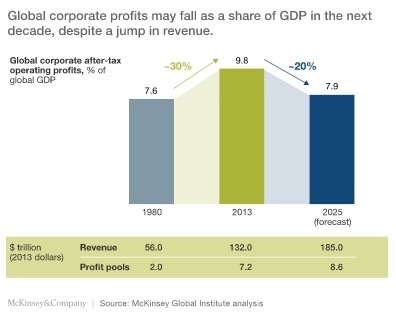











Business Model Reinvention: