


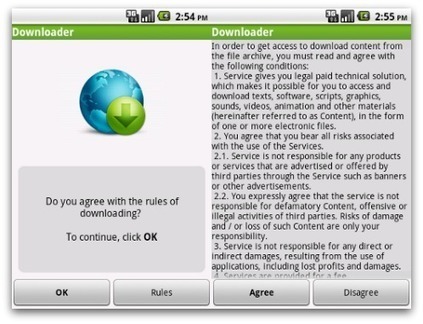

Android malware! On Facebook! Caught on camera! If you're using Facebook on your Android smartphone, you should be just as careful clicking on links as you would (hopefully) be on a desktop computer.

 Your new post is loading...
 Scoop.it! Android malware! On Facebook! Caught on camera! If you're using Facebook on your Android smartphone, you should be just as careful clicking on links as you would (hopefully) be on a desktop computer. No comment yet.
Sign up to comment
Scoop.it!

By Dancho Danchev
Here’s an up-close look at some of the nasty tactics today’s hackers are using—and why security vendors can’t stop them with yesterday’s approach.
Gust MEES: #Internetsafety, #Onlinesafety and #itsecurity are part of 21st Century Learning!
check out also
http://gustmeesen.wordpress.com/2012/01/05/pc-security-howto-secure-my-pc/
Scoop.it!

The LISA Stopline project aims to provide a structure enabling illegal Internet content to be reported anonymously and to deal with these reports in collaboration with the relevant national and international authorities.
Through its website, LISA Stopline therefore offers the public a way of taking civic action against illegal content on the Internet.
Gust MEES: #Internetsafety, #Onlinesafety and #itsecurity are part of 21st Century Learning!
Scoop.it!

Just as U.S. companies are coming to grips with the threats to their computer networks emanating from cyber spies based in China, a noted expert is highlighting what he says is an even more pernicious vulnerability in smartphones.
Scoop.it!

How can you maintain information superiority in today’s reality? As a network defender you need to have a clear baseline of your environment in order to protect it.
Whether we’re engaging foes in warfare or protecting our computer networks, having information superiority is essential to success.
Defined in the US Army Vision 2010 doctrine as “the capability to collect, process, and disseminate an uninterrupted flow of information while exploiting or denying an adversary’s ability to do the same,”
===> Information superiority is identified as “the key enabler in 21st century operations”. <===
Scoop.it!
Hi, Why ICT Security?
Don't fear,it’s not like on school, you will learn on an easy way, on a way as you would ask me a question and I would answer on a way that you will understand it…
Scoop.it!

IT professionals play an important role in protecting an organization's resources from malicious attackers and software.
Microsoft, as part of its Trustworthy Computing initiative, is committed to providing information and guidance for customers who use a wide range of computing devices and services.
We know that home computer users often have different needs than IT professionals or developers, so we provide resources tailored to meet specific customer needs.
Choose from any of the roles below to learn how you can enhance your security and privacy while enjoying your online experience.
Scoop.it!

Find out all of the latest news and events from the South West Grid for Learning and keep up to date with the latest national developments in ICT in education.
Scoop.it!

Many schools are beginning to use social media to send out information to parents. Examples include twitter feeds and facebook pages. These initial forays into social media are a first step.
Scoop.it!

MITx will offer a portfolio of MIT courses for free to a virtual community of learners around the world. It will also enhance the educational experience of its on-campus students, offering them online tools that supplement and enrich their classroom and laboratory experiences.
The first MITx course, 6.002x (Circuits and Electronics), will be launched in an experimental prototype form. Watch this space for further upcoming courses, which will become available in Fall 2012.
Scoop.it!

A Notre Dame study finds that iPads are useful additions to college classrooms but also bring challenges.
Scoop.it!

Comprendre et enseigner l’identité numérique 10/02/2012
Scoop.it!
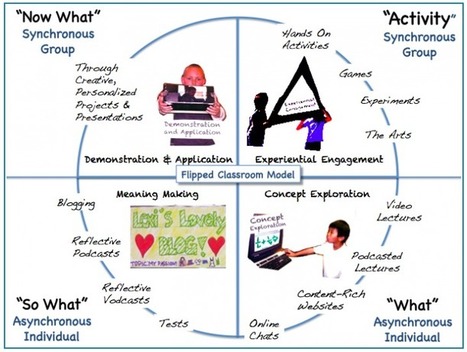
Flipped Classroom is an inverted method of instruction where teaching and learning take place online outside of the class while homework is done in the classroom. Advocators of this approach believe that this is the ideal method of instruction in our digital age. They basically build their judgement on the following facts Via Nik Peachey, Donna Murdoch |
Scoop.it!

Here you can find out the latest advice on how to use the internet and new technologies safely and responsibly.
Also find a range of practical resources, news and events focussing on the safe and responsible use of the internet and new technologies.
Scoop.it!

The official Microsoft Security Blog provides in-depth discussion of security, cybersecurity and technology trends affecting trust in computing, as well as timely security news, trends, and practical security guidance.
Attackers’ motivations have changed since 2004 and now ===> financial gain is a primary motivation for the activity we see in the threat landscape. <===
Attackers have had to broaden the repertoire of tactics they use to attempt to compromise systems; most of the attacks we see today rely on social engineering - trying to get users to bring badness from the Internet through their host based firewalls via web browsers, peer to peer networks, document parsers, email, social networks, etc.
Gust MEES: #Internetsafety, #Onlinesafety and #itsecurity are part of 21st Century Learning!
Scoop.it!

The Internet has had a massive effect on all aspects of human life and interactions since its inception. The world has shrunk considerably and the speed of life has increased dramatically.
But one specific aspect that the internet has had an enormous effect on is education. It’s changing education for good and for the good of all.
Scoop.it!

Anonymisier-Tools schützen beim Surfen auf dubiosen Sites und digitale Daten sind unvergänglich – wir decken solche und andere Irrtümer auf und geben Tipps.
Scoop.it!

Since MIT’s Lifelong Kindergarten group released Scratch in 2007, kids ages 8 to 13 have built more than 2.2 million animations, games, music, videos and stories using the kid-friendly programming language.
Scratch allows kids to snap together graphical blocks of instructions, like Lego bricks, to control sprites—the movable objects that perform actions. Sprites can dance, sing, run and talk.
Scoop.it!

Information security awareness and training are critical for any organization’s information security strategy and supporting security operations.
It is, therefore, important to ===> educate <=== workers on what your organization considers appropriate security-conscious behavior and on the security best practices they need to incorporate in their daily business activities.
Demonstrate to your organization how to be secure rather than telling them what they can or cannot do.
===> Gust MEES: This also applies to #education! Especially for #BYOD and #BYOT <===
Please check also:
Scoop.it!

How do you stay creative? (Image by AFP/Getty Images via @daylife) It’s easy to watch a hotshot young executive – or poet, painter, or filmmaker – and wonder if creativity is the province of the young.
But Jonah Lehrer, author of the new Imagine:
===> How Creativity Works <===, doesn’t buy it: “There’s nothing inevitable about a decline of creativity over time,” he said in a recent interview. Instead, any executive can take steps to ensure their ideas stay fresh, vital, and relevant.
Scoop.it!

"It's really important that parents understand how the Internet works and how young people are using it.
There's no point to having a conversation with your child about how they use social networking sites if you have no idea what Facebook, MSN or instant messenger is.
It's not about taking over their world or spying on them. It's about understanding and appreciating it."
Scoop.it!

Tweet TweetOK, these skills are not actually “new” – they’ve always been present – but perhaps they have not always been as visible as they should have been, as ...
Scoop.it!
A look at some of the principles of critical thinking.
===> Gust MEES: Very informative, A MUST READ! <===
Scoop.it!

Our standardized approach to education has a siloed understanding of what it means to be creative. Here's what schools should be teaching instead... Via Ana Cristina Pratas
Scoop.it!

Personal Learning Networks, or PLNs, have been around forever. Originally, they were your family and friends, maybe other educators you worked with, but as the internet and web 2.0 tools have become nearly ubiquitous, PLNs can include tons of different communities – social networking sites like Facebook, blogs, Twitter, wikis, social bookmarking tools, LinkedIn, and so many more. Basically, anyone that you interact with is apart of your PLN, whether they are social contacts, professional peers, or experts in their field. Most of the ‘learning’ takes place on-line now, because it is simple to find and connect with others with similar interests from around the world. Via Dr. Susan Bainbridge, Didier Preud'homme (Logicamp), Frédéric DEBAILLEUL 
Dr. Susan Bainbridge's comment,
February 25, 2012 11:45 PM
Thanks for the re-scoop Giselle. Hope you continue to find useful information. Susan

Jennie Finafrock's curator insight,
July 6, 2014 1:17 PM
This blog offers sevral web 2.0 tools that can be used to expand a PLN such as: social networking, microblogging, wikis, webinars, etc... |





