


Via Paulo Simões

 Your new post is loading...
  Scoop.it! No comment yet.
Sign up to comment
Scoop.it!

Chris Kennedy is the Superintendent of Schools / CEO with the West Vancouver School District (West Vancouver, BC). He has taught secondary English and Social Studies, and been both an elementary and secondary school principal.
Some assumptions for the next 5 years:
Teachers and schools are status quo (sense of community/social-emotional learning)
Read more on his blog and watch the slideshare, very informative...
Scoop.it!

It’s quite clear from research on the effects of emotion and learning, that an emotional connection can be generated through instructional strategies and creative treatments. These have the potential to facilitate learning and performance.
Scoop.it!

Cognitive scientists define emotions as powerful, usually short-lived experiences that are a reaction to a specific stimulus. As part of the human evolutionary legacy, emotions arise from a rapid appraisal of an object or event’s significance in order to prepare us for action—similar to an alert system.
===> facilitate social communication and interaction. <===
That’s because we read the emotions of others through their facial expressions, bodily postures, gestures and tone of voice. Via juandoming
Scoop.it!

Find development costs for an hour of Elearning based on a survey. This post will give you a good metric when budgeting for your next Elearning project.
===> Use this also to show your superiors and other people the time needed for 1 hour preparation of #elearning! <===
Scoop.it!

Students have an array of introductions to computer programming, which develops critical thinking skills...
Scoop.it!

European Commission...
Great news today as the Commission starts the process of providing human rights guidance to the ICT sector – kicking off a process to make it easier for makers and users of ICT products and services to know the impact their technology has on Human Rights across the world.
Scoop.it!

The latest advice from the Information Security Forum discusses the nature of existing and emerging cyber threats as well as the potential risks and rewards at stake for everyone.
Cyber criminals are more business-minded than you might expect, and their financial rewards and power are increasing rapidly, according to new research from the Information Security Forum, a global independent organization dedicated to investigating information security and risk management.
Scoop.it!

Students use smartphones to study more, and more efficiently.
Scoop.it!

We discovered ‘The Ten Commandments of eLearning” as elucidated by Cath Ellis and Clive Shepherd.
Scoop.it!

Free Higher Education News, Jobs, Career Advice and Events for college and university faculty, adjuncts, graduate students, and administrators.
Scoop.it!

FULL marks to Apple for devising ways to improve how science, mathematics and other topics are taught in primary and secondary schools across America.
This is what Sir Ken Robinson, a leading authority on education reform, calls the “industrial model” of education. As professor of education at Warwick University, Dr Robinson led a national commission on creativity, education and the economy for the British government, and has spent the past decade trying to prevent education authorities from stifling their students’ inner passions.
===> In his view, creativity is as important in education as literacy—and should be given equal emphasis. <=== |
Scoop.it!

Quacquarelli Symonds (QS) released a list of the top 50 Best Student Cities in the World for 2012 and the results may be welcome by those who enjoy bashing education in America.
Scoop.it!

AVG Security evangelist talks to ABC News Radio Australia about how safe people feel when asked to submit your personal details online...
Here are few tips on how to recognize a safe place that you can trust with your information: Make sure you know what company is operating the website and whether it is legitimate.
Scoop.it!

Over the past few decades, research has shown that emotions have an effect on many of the processes involved in learning. It’s safe to say that emotions are an influence on perception, attention, motivation, and the encoding and retrieval of information.
Part 2: for part 1 see http://www.scoop.it/t/21st-century-learning-and-teaching?tag=Emotions-and-Learning
Scoop.it!
The economy of the future is digital. Already today it’s hard to think of many jobs where familiarity with computers and the Internet is not helpful: in the near future, 90% of jobs will require some level of digital literacy.
The answer is for every member state to have their own “digital champion” – a high-profile, dynamic and energetic individual responsible for getting everyone in their country online and improving digital skills. They would work with education authorities, industry, and grassroots activists; independent of central government, but reporting to it.
Scoop.it!

Got a minute? Literally just one minute? Take a close look at this new infographic from our partners over at Online Universities.
It’s a great way to quickly look at the tools affecting major change in classrooms around the world...
Scoop.it!

Posted by the Stop. Think. Connect. Campaign Cyber predators are real. They use the anonymity of the Internet to target victims, especially today’s youth, with unwanted solicitations, harassment, and fraud.
It’s important that parents discuss ways to stay safe online with their children, particularly before they use social networking sites....
Scoop.it!

Salman Khan has made a name for himself for producing bite-sized videos that explain everything from fair value accounting to how the Hawaiian Islands were formed on the free online Khan Academy.
Here, Khan uses his trademark “chalkboard” sketching approach to explain how the idea of blended learning — combining technology like online videos and software with classroom instruction — works.
Scoop.it!

Massachusetts Institute of Technology, one of the world's top universities, has revealed its first fully automated, accredited course which can be studied without charge.
Scoop.it!

Communiquer à l’heure d’Internet : Livre pour comprendre et apprendre http://t.co/Liln6S8o... Via NetPublic
Scoop.it!

This ninth edition describes annual findings from the NMC Horizon Project, a decade-long research project designed to identify and describe emerging technologies likely to have an impact on learning, teaching, and creative inquiry in higher education.
Six emerging technologies are identified across three adoption horizons over the next one to five years, as well as key trends and challenges expected to continue over the same period, giving campus leaders and practitioners a valuable guide for strategic technology planning.
Scoop.it!

Hi, Why ICT Security?
Scoop.it!
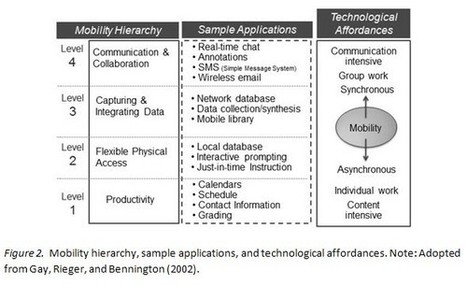
A pedagogical framework for mobile learning: Categorizing educational applications of mobile technologies into four types...
IRRODL "The International Review of Research in Open and Distance Learning" |






