Your new post is loading...

|
Scooped by
Gust MEES
April 10, 2012 11:11 AM
|
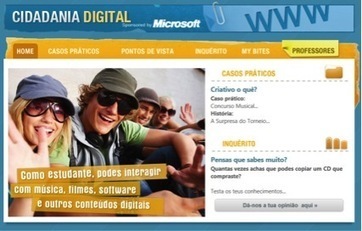
Being the month when we celebrate World Intellectual Property Day (WIPO), it’s the perfect time to dedicate some thought to intellectual property online and intellectual property rights. The fluidity of contents on the internet, and the sophistication of information and communication technologies, allow access opportunities never seen before, but alongside this is often a disregard for the rights of those who created the content. This sometimes happens deliberately, but most of the time it is simply because the user doesn’t think about it! In Portugal, in order to raise awareness on this theme, Microsoft, in a partnership with the Ministry of Education (both partners in the Portuguese Safer Internet Centre), created the Cidadania Digital website. This resource offers a curriculum tool to be used by teachers with students in 8th and 10th grade on how to be a good digital citizen. ===> This includes using/sharing creative content, while respecting intellectual property. <===
|
|
Scooped by
Gust MEES
April 10, 2012 11:04 AM
|
The German Awareness Centre, klicksafe, offers a range of materials on the topic of copyright, personality rights and other legal aspects of internet use. With the brochure “Not everything that’s possible is allowed!” [DE: „Nicht alles, was geht, ist auch erlaubt!”] klicksafe has since 2008 been providing information on copyright and personality rights in a compact 10-page-resource, with a focus on web 2.0 content.
|
|
Scooped by
Gust MEES
April 10, 2012 10:54 AM
|
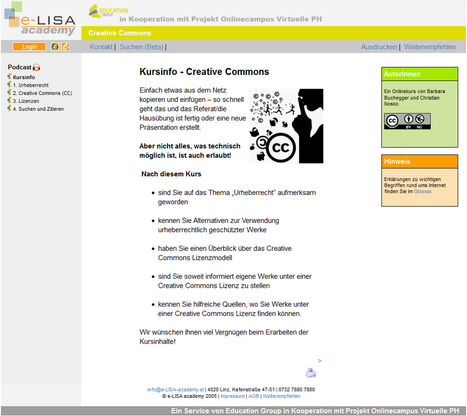
It has always been the case that teachers collect content for their classroom activities. In Austria, there is a saying: “Teachers are collectors and hunters”. They collect all usable content and hunt for the best bits in order to reuse it for their classroom activities. This, of course, has never quite complied with copyright laws. But in pre-internet times this was not a major concern as teachers’ materials were almost never published outside of the classroom. Now, however, teachers’ ability to ‘hunt and collect’, and the boundless opportunities to share their material online, make it necessary to look for new strategies and at the same time raise teachers’ awareness about copyright issues. Some schools in Austria have actually received cease-and-desist orders from lawyers for copyright violations, for example using copyright protected pictures on their websites. Read more...
|
|
Scooped by
Gust MEES
April 10, 2012 4:16 AM
|
Education must focus on the quality of teaching and learning.
|
|
Scooped by
Gust MEES
April 9, 2012 2:49 PM
|
Recent brain imaging studies reveal that sections of our brains are highly active during down time. This has led scientists to imply that moments of not-doing are critical for connecting and synthesizing new information, ideas and experiences. ===> Dr. Michael Rich, a professor at Harvard Medical School put it this way in a 2010 New York Times article: “Downtime is to the brain what sleep is to the body.” <===
|
|
Scooped by
Gust MEES
April 7, 2012 9:19 AM
|
BitDefender has prepared this wonderful and a very informative Infographic on the history of computer viruses starting 1970. The history of malware is rife with incidents that allowed viruses to morph ...
|
|
Scooped by
Gust MEES
April 6, 2012 7:49 PM
|
Positioning the Security Team Through Influence Part 1
The essential approach to enhancing the role of security professionals is to enhance their organizational influence.
|
|
Scooped by
Gust MEES
April 6, 2012 7:09 PM
|
How to avoid identity theft, phishing scams, viruses and spyware when you use social networking sites.
|
|
Scooped by
Gust MEES
April 4, 2012 4:02 PM
|
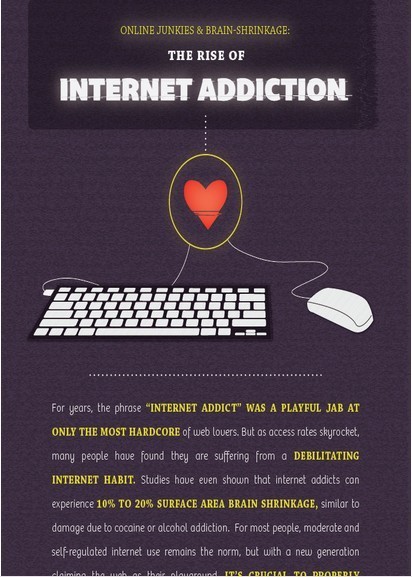
Has the internet become a drug? One study titled “Microstructure Abnormalities in Adolescents with Internet Addiction Disorder” from PLoS One concluded that adolescents with Internet Addiction Disorder: Had multiple structural changes in the brain. The gray matter atrophy and white matter FA changes of some brain regions were significantly correlated with the duration of internet addiction. These results may be interpreted, at least partially, as the functional impairment of cognitive control in IAD. The prefrontal cortex abnormalities were consistent with previous substance abuse studies, hence we suggested that there may exist partially overlapping mechanisms in IAD and substance use. We hoped that our results will enhance our understanding of IAD and aid in improving the diagnosis and prevention of IAD. Read more...
|
|
Scooped by
Gust MEES
April 1, 2012 11:01 AM
|
Accelerated learning helps you learn faster and remember more.
Network Security and More
Don Knezek, executive director of the International Society for Technology in Education (ISTE), notes that starting a BYOD program means making adjustments when it comes to security, especially protecting a district’s proprietary and secure data. That function, he says, used to be handled by an effective firewall that kept out unwanted users and their devices.
“Nowadays, you have to have a layer past the firewall that we didn’t have to deal with when we simply said no to user-owned devices,” he says. “Now all of a sudden, you have multiple points of entry at different levels of access, and that requires more diligence.” One key to maintaining adequate security, Knezek and other experts say, is to have multiple networks: one for Wi-Fi traffic, one for district business and for other secure information for teachers and administrators only, and one for students and outside users of the district’s Web site.
|
|
Scooped by
Gust MEES
March 30, 2012 9:05 AM
|
Is this your first time visiting the Internet Safety Project? Don’t worry we were once new too. Here are a few tips to get you started! Just look for the phrase that best describes you. I want advice from Internet Safety Experts
Read our blogs here. All of our guest bloggers are Internet safety experts who give great practical advice! You can also listen to our podcasts! We interview experts and talk about current Internet safety issues.
Every podcast we record is available online for free. Click here to see the full selection.
You can also access blogs and podcasts using the tabs at the top of the site. I am an Educator or Parent looking for Internet safety resources
You’ve come to the right place! You can search for articles from the main wiki page here for articles on Internet Safety. Or just use the search bar in the upper right hand corner. You can also look at the resources other Internet safety organizations (See a complete list of Internet Safety Organizations and Products here). Some sites even include curriculum or volunteer programs that you can implement in your community or school. Check out the categories below to get started: - Organizations for Parents
- Educational Organizations
- I want to know what’s going on in Internet and Technology news right now!
- Read some of our Newswire Reports ( The box on the right side of the site). We post a new report everyday on current internet safety and technology issues. You can also follow us on twitter and Facebook. We’ll let you know what’s going on in the Internet world, and when our new blogs and podcasts are up. - I just want to know more about the Internet and the issues out there. Where should I start?
You can search our Internet Safety Project Wiki (search bar in the upper right hand corner), but if you're not even sure what to look for you might want to start by browsing some of our popular pages.
Try starting with our list of wiki articles on Internet basics. These are things that you will probably stumble across in normal computer use, such as: acronyms, browsers, e-mail, and search engines.
Here are articles on some of the bigger safety issues we cover:
- Pornography
- Online Games Addiction
- Identity Theft
- Malware
- Viruses
- Social Networking
- Cyberbullying
- Online Predators
- Texting
Link: http://www.internetsafetyproject.org/
|
|
Scooped by
Gust MEES
March 28, 2012 3:42 PM
|
Creativity has taken center stage in recent years, with a slew of books, articles and TED talks extolling the virtues of imagination and exhorting young and old to go out and exercise their creative muscle. ===> The future belongs to "creators and empathizers, pattern recognizers and meaning makers," declared author Daniel Pink in the introduction to his best-selling book "A Whole New Mind: Why Right-Brainers Will Rule the Future." <===
|
|
|
Scooped by
Gust MEES
April 10, 2012 11:07 AM
|
In Luxembourg, every 7th grade secondary school class (pupils aged 12-14) participates in a BEE SECURE training session. For all other grades, BEE SECURE training can be organised on demand. On average, 500 training sessions are held each year. The topic of intellectual property online is emphasised within the sessions in a special way. Although the Luxembourgish legislation on intellectual property has existed since 1975 and corresponds to the laws of the neighboring countries, lots of youngsters seem to have very little information about the topic, if any at all! Obviously one of the subjects that concerns young people most is file sharing, especially regarding music files. Although illegal file sharing hasn't officially been persecuted in Luxembourg until now, most young people are nevertheless unaware of the fact that they could get into trouble. Hardly any youngsters know that music artists can sue them from every part of the world.
|
|
Scooped by
Gust MEES
April 10, 2012 10:59 AM
|
In this article, Ando Urbas, IT journalist, consultant of media and marketing, and trainer for the Tiger Leap Foundation’s ‘Smartly on the Web’ programme in Estonia, shares his views* on teaching copyright to children and young people: “Teaching copyright at school should be done calmly and without emotions, on the contrary to some copyright organisations’ rhetoric, which balances on the fine line of good practice and legality.
|
|
Scooped by
Gust MEES
April 10, 2012 10:12 AM
|
What is copyright? Copyright gives people the legal right to decide how original work that they have created can be used once it has been published. Contrary to popular belief, a copyright notice does not need to be attached to a piece of work for it to be copyrighted – as soon as the work is published, then copyright applies. In other words, aside from a few notable exceptions (some of which we will touch on later) somebody owns the copyright to pretty much everything that has ever been published on the Internet. ===> It is not a free resource bank that people can dip into and use however they see fit! <=== - What is fair use? Read more in the article... - What about quoting from blog posts or online articles? Read more in the article... - What is meant by the term ‘public domain’? Read more in the article... - Where can I find resources that I can use for free? Read more in the article... - What is creative commons? Read more in the article... - Where can I find creative commons resources? Read more in the article... - Tips for good practice when re-using other people’s work: Read more in the article... - What is plagiarism? Read more in the article... - What can I do if someone copies my work without permission? Read more in the article... (by Sue Lyon-Jones) – Teaching Village
At the moment, there are more than 100 million Mac OS X users around the world. The number has grown switfly during the past years we expect this growth to continue.
|
|
Scooped by
Gust MEES
April 9, 2012 12:35 PM
|
The skills that are pivotal to achieve the 21st century pedagogy goals are :
- Critical thinking
- Active learning
- Problem solving skills
- Communicating, making connections,creating and expressing oneself in a variety of ways
- Contextualized knowledge. As you can see in the learning pyramid , uncontextualized and non-activity based learning could result in a low retention rate.
- Collaborative team work. This is mainly achieved through web2.0 technologies and social networking tools . If you have read the UNESCO’S publication “ The four pillars of education “ you would realize that collaboration is the core element of the four pillars which are :
-Learning to know
- Lerning to do
- Learning to live together
- Learning to be
===> We need also in 21st Century (May 2012) to add #itsecurity + #cybersecurity knowledge to that list! <===
|
|
Rescooped by
Gust MEES
from Transformational Leadership
April 6, 2012 7:55 PM
|
Tom Kelly, general manager of IDEO, the world-renowned design firm, likes to quote French novelist Marcel Proust, who famously said, "The real act of discovery consists not in finding new lands but in seeing with new eyes." What goes for novelists... Today, the challenge for leaders at every level is no longer just to out-hustle, out-muscle, and out-maneuver the competition. It is to out-think the competition in ways big and small, ===> to develop a unique point of view about the future and help your organization get there before anyone else does. <=== Which is why a defining challenge of leadership is whether you can answer a question that is as simple as it is powerful: Are you learning as fast as the world is changing?
Via Dr. Susan Bainbridge
|
|
Scooped by
Gust MEES
April 6, 2012 7:41 PM
|
Education is Supposed to Produce Independent Thinkers, Not Answering Machines. The second in the series of letters to teachers from students. This time, a young man in Grade 12 talks about how we are missing the point of education by obsessing on marks and assessments.
|
|
Scooped by
Gust MEES
April 6, 2012 6:59 PM
|
Joe McVeigh and Ann Wintergerst describe ways ot integrate the teaching of culture and social identity. ===> This is very IMPORTANT for cross-border education and education with a lot of different nationalities and cultures! <===
|
|
Scooped by
Gust MEES
April 3, 2012 4:34 PM
|
What is going in the teen brain? Quite a bit. They are dramatic, irrational and scream for seemingly no reason. And they have a deep need for both greater independence and tender loving care. There is a reason this description could be used for either teens or toddlers: After infancy, the brain's most dramatic growth spurt occurs in adolescence. Here are 10 facts every parent should know: read more...
|
|
Scooped by
Gust MEES
April 1, 2012 10:53 AM
|
Comprendre les modèles pédagogiques est essentiel pour toute personne exerçant bénévolement ou professionnellement dans les domaines de la sensibilisation, l’apprentissage et la formation au numérique (ou à d’autres aspects, d’ailleurs). Le portail FOAD Spirit propose un dossier de 25 pages, gracieusement téléchargeable (en pdf) : le mini-guide pédagogique qui propose une présentation des différents courants, méthodes et démarches pédagogiques ainsi que les types de savoirs.
|
|
Scooped by
Gust MEES
March 31, 2012 11:04 AM
|
Thomas Edison's creative thinking lessons. By Michael Michalko... 1. CHALLENGE ALL ASSUMPTIONS. 2. QUANTITY. 3. NOTHING IS WASTED. 4. CONSTANTLY IMPROVE YOUR IDEAS AND PRODUCTS AND THE IDEAS AND PRODUCTS OF OTHERS. 5. TURN DEFICIENCIES TO YOUR ADVANTAGE. 6. RECORD YOUR IDEAS AND THOUGHTS. Read more...
|
|
Scooped by
Gust MEES
March 28, 2012 4:14 PM
|
Tips to help you and your family become safer online. Online Safety Tips. ===> Share this please! <===
|