http://www.ted.com Career analyst Dan Pink examines the puzzle of motivation, starting with a fact that social scientists know but most managers don't: Tradi...
http://www.ted.com Career analyst Dan Pink examines the puzzle of motivation, starting with a fact that social scientists know but most managers don't: Traditional rewards aren't always as effective as we think. Listen for illuminating stories -- and maybe, a way forward.
TEDTalks is a daily video podcast of the best talks and performances from the TED Conference, where the world's leading thinkers and doers give the talk of their lives in 18 minutes. TED stands for Technology, Entertainment, Design, and TEDTalks cover these topics as well as science, business, development and the arts. Closed captions and translated subtitles in a variety of languages are now available on TED.com, at
This course is made with a lot of available videos (visual)
One could also include "podcasts" in each of the courses above... and NOT to forget the "Curation" which could get used by the learners to organize themselves their interests on a certain Topic which they need to learn and which they want also to learn ...
Also PowerPoint presentations and a lot of new online tools make it more interesting for learners to get the maximum of needed information by being engaged and also having some fun to learn...
See also my curation "21st Century Tools for Teaching-People and Learners" who shows you the existing tools:
Smartphones and tablet computers are radically transforming how we access our shared knowledge sources by keeping us constantly connected to near-infinite volumes of raw data and information.
Up until now, most people relegated “education” to a finite time in their lives: entering school at around five years old and attending school institutions all the way to university. Education had an expiration date, then working life began. This model, which has its roots in the industrial era, is quickly becoming less relevant or applicable to the way we live our lives in the connected age.
The world is full of manipulation, lies, and unreasonable thought. We all know we can’t believe everything we read, but people still get manipulated and charlatans occasionally make a fortune...
Possible instructions for educators on how they can work together with the learners. Knowing the tools for 21st Century Learning is primordial to give quality courses.
One very important knowledge who needs to get taught is “Critical Thinking”; it brings out also new ideas and the courage to become an engager and helps to try to build a better world in both worlds: “Real World” and “Virtual World” (Internet)!
When talking about #criticalthinking then automatically we should talk also about #responsibilities!
Critical thinking is the disciplined art of ensuring that you use the best thinking you are capable of in any set of circumstances. The general goal of thinking is to “figure out the lay of the land” in any situation we are in. We all have multiple choices to make. We need the best information to make the best choices.
What is really going on in this or that situation? Are they trying to take advantage of me? Does so-and-so really care about me? Am I deceiving myself when I believe that…? What are the likely consequences of failing to …? If I want to do …, what is the best way to prepare for it? How can I be more successful in doing…? Is this my biggest problem, or do I need to focus my attention on something else?
Successfully responding to such questions is the daily work of thinking. However, to maximize the quality of your thinking, you must learn how to become an effective "critic" of your thinking. And to become an effective critic of your thinking, you have to make learning about thinking a priority.
To test your mental acuity, answer the following questions (no peeking at the answers!): 1. Johnny’s mother had three children. The first child was named April. The second child was named May. What was the third child’s name?
Possible instructions for educators on how they can work together with the learners. Knowing the tools for 21st Century Learning is primordial to give quality courses. Learning and teaching ...
How-To do it and who to do it?
I suggest, if possible, to do this by any teacher, educator on the beginning of a new school year: There are no special technical skills needed and it takes ONLY 5-10 minutes to show the learners how-to use this application! If there are summer camps where some of the learners are present, do it also and ask them to share it with their class over Social Medias, such as Facebook, Twitter and others…
Talk also to your System Administrator on School to install this FREE application on any used computer and tablets to have the same standard in the school! Your and your students #virtuallife (Internet) would become more secure…
===> Less stress to find trustworthy web sites is also more time for teaching and learning! And you will help the COMMUNITY to surf more secure also… <===
For people who want to go a step further and understand the threats your smartphone faces, we’re going to take a quick look inside the F-Secure Mobile Threat Report Q1 2012. What you’ll find is a Android landscape where threats are quickly maturing.
Depuis 2007, le portail américain Common Craft coordonné par Lee and Sachi LeFever propose des vidéos courtes et simples à comprendre construites avec comme support un tableau blanc et des éléments en papier découpés et positionnés ; une pédagogie de la monstration qui explicite des dispositifs techniques du Web d’aujourd’hui, des modes d’échange relationnels.
Educators share their secrets to choosing apps that are both fun and informative.
...
Gust MEES: Interesting, BUT what I almost need to say; don't forget to give advice about #itsecurity! Update your lists and blogs with the following text please: Download Apps ONLY from the main Stores from Apple (iPhone, iPad and i...), for Android ONLY from Google Play web site and... If you want to use other Apps so refer to PC Magazines and Mac related magazines who will give you advice...
This curriculum is designed to give teachers a comprehensive set of tools to educate students about copyright while incorporating activities that exercise a variety of learning skills. Lesson topics include: the history of copyright law; the relationship between copyright and innovation; fair use and its relationship to remix culture; peer-to-peer file sharing; and the interests of the stakeholders that ultimately affect how copyright is interpreted by copyright owners, consumers, courts, lawmakers, and technology innovators.
The lesson plan concludes with a mock trial that tests the students' understanding of copyright and its limitations and encourages them to consider the positions of each party involved.
Extrinsic motivation, in contrast, is the daily pressure we feel from outside incentives – grades, salaries, and promotions – put in place to encourage output. Here’s the question: Is creative output the product of intrinsic or extrinsic motivation? Do we need a reason to work? Or is passion enough?
L’éducation aux médias et au numérique est un enjeu pour bien des acteurs de la société (EPN, associations, établissements scolaires…) qui mettent en place des actions auprès des publics de différents âges sur cette thématique de recul critique, d’analyse de dispositifs et donc d’être un citoyen à part entière.
L’association Les Petits Débrouillards de Bretagne a conçu des contenus pédagogiques opérationnels à partir de l’animation d’ateliers d’éducation aux médias (télévision, journaux, radio, internet…) qui donnent lieu aujourd’hui à la publication (en Creative Commons) du classeur Educomédias téléchargeable gracieusement en pdf (76 pages).
Le dossier Educomedias comprend des jeux et des activités créatives sur la thématique de l’éducation aux médias.
Use these guides to help facilitate a conversation with parents about Internet safety. The guides include open-ended questions as well as short vignet...
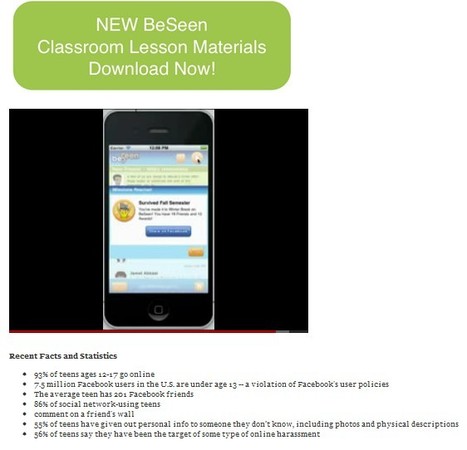
BeSeen is provided by Carnegie Mellon University and Web Wise Kids to teach youth how to be responsible in social networks by securing their private and personal information, protecting their online reputation and defending their peers.
This online safety mobile application is a single-player game that simulates a social networking website. The player creates a profile and starts earning “friend” characters and interacting with them. They learn about others through their posts and help them through challenges in order to win awards and make new friends.
In BeSeen, the ultimate quest is to make friends. At first, that is a matter of getting involved in school activities, but as more friends join a social circle, they bring their problems with them.
To keep friends and make more, it’s important not only to be involved but to be a good friend. Who is up for the challenge?
Web Wise Kids' President Judi Westberg Warren discusses how their BeSeen app, like Web Wise Kids' other games, teaches youth ===> how to think critically about the decisions they make online and on social networks. <===
Systems thinking is the process of understanding how a group of interacting, interrelated, interdependent components influence each other within the whole. Rather than viewing each problem as an independent entity, it must be considered in the context of its relationship to other parts of the system. Systems thinking teaches students how to solve problems, communicate, use data, and design policies for greater success.
Possible instructions for educators on how they can work together with the learners. Knowing the tools for 21st Century Learning is primordial to give quality courses.
One very important knowledge who needs to get taught is “Critical Thinking”; it brings out also new ideas and the courage to become an engager and helps to try to build a better world in both worlds: “Real World” and “Virtual World” (Internet)!
Can YOU drive a car (and this also safely) ONLY by getting theoretical courses and advice? YOU would surprise me, seriously, a BIG LOL for that. So how YOU will expect that someone could surf secure with his computer as it is “visually seen” the “vehicle” with whom users are driving on the “Data High Way” (Internet)!???
There is a need for practice, how!?
Find out more ideas, critical thinking and practice:
Thanks very much to spread this #criticalthinking and hopefully we will see in next future practical courses about #itsecurity ;) Have a nice week:
Gust
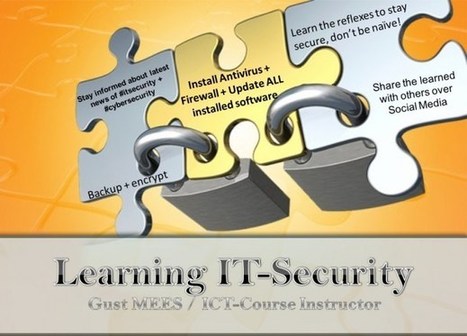
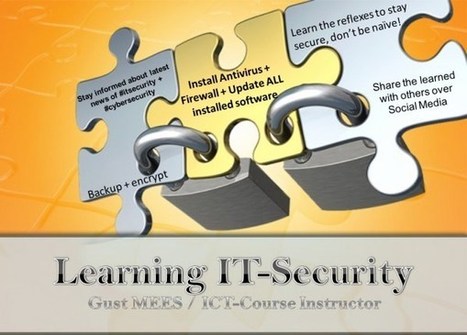
For most people it is very difficult to understand IT-Security and also the need to apply it…. To me it looks sometimes like that people see a computer as a modern typewriter and/or a game console, but that’s not the case.
I will try to explain to you a computer in a visual manner so that you might able to understand better why there is a need to protect your computer and also why a computer is in danger to get a virus, trojan, and other malware infections.
Why a computer could become a possible Cyber-Weapon who is attacking web-sites and perhaps also your Government’s web-sites!
You will find also an free Online-Glossary about #IT-Security terms and a free Online-Health-Check for your computer!
Read more and watch the videos to understand more and better:
A website providing a rigorous introduction to critical thinking.The purpose of this website is to provide a rigorous source of critical thinking information of value to many different communities. CriticalThinking.NET has been developed by Robert H. Ennis and Sean F. Ennis.
i love it! thank you so much. I will use it in my class.. this summer, I am teaching "Freakonomics" to them, and it is perfect time to introduce the site..
To get content containing either thought or leadership enter:
To get content containing both thought and leadership enter:
To get content containing the expression thought leadership enter:
You can enter several keywords and you can refine them whenever you want. Our suggestion engine uses more signals but entering a few keywords here will rapidly give you great content to curate.


 Your new post is loading...