21st Century Learning and Teaching
791.7K views | +8 today
21st Century Learning and Teaching
Related articles to 21st Century Learning and Teaching as also tools...
Curated by Gust MEES
Your new post is loading...

Popular Tags

Scooped by Gust MEES
May 24, 2012 11:23 AM
Scoop.it!

Are we at the intersection of an education revolution?

Are we at the intersection of an education revolution? | 21st Century Learning and Teaching | Scoop.it
Education revolution, these are buzz words that prompted me to think about what it means, and the implications on Higher Education, K-12, and even corporate education and training. The recent bloss...


Read more, very interesting...

http://suifaijohnmak.wordpress.com/2012/05/24/are-we-at-the-intersection-of-an-education-revolution/


No comment yet.
Rescooped by Gust MEES from Digital Delights
May 24, 2012 10:28 AM
Scoop.it!

Build your Personal Learning Environment

Presentation at the JTEL Summer School 2012.


Read more:

http://www.slideshare.net/alexmikro/build-your-personal-learning-environment?from=new_upload_email


Check also: http://www.scoop.it/t/21st-century-learning-and-teaching?q=PLE


Via Ana Cristina Pratas
No comment yet.
Scooped by Gust MEES
May 22, 2012 7:34 AM
Scoop.it!

A new solution for authenticating BYOD

A new solution for authenticating BYOD | 21st Century Learning and Teaching | Scoop.it
New start-up SaaSID today launches a product at CloudForce London that seeks to solve a pressing and growing problem: the authentication of personal devices to the cloud.


Read more:

http://www.infosecurity-magazine.com/view/25911/a-new-solution-for-authenticating-byod/?utm_source=twitterfeed&utm_medium=twitter


No comment yet.
Scooped by Gust MEES
May 22, 2012 6:58 AM
Scoop.it!

The power of proactive thinking

The power of proactive thinking | 21st Century Learning and Teaching | Scoop.it
The power of proactive thinking, Creativity & Innovation.


Read more:

http://www.management-issues.com/2010/3/9/opinion/the-power-of-proactive-thinking.asp


No comment yet.
Scooped by Gust MEES
May 21, 2012 5:37 PM
Scoop.it!

Come the Revolution: Coursera, world-class learning

Come the Revolution: Coursera, world-class learning | 21st Century Learning and Teaching | Scoop.it
Through ventures like Coursera, world-class learning is coming at bargain-basement prices.


These top-quality learning platforms could enable budget-strained community colleges in America to “flip” their classrooms. That is, download the world’s best lecturers on any subject and let their own professors concentrate on working face-to-face with students. Says Koller: “It will allow people who lack access to world-class learning — because of financial, geographic or time constraints — to have an opportunity to make a better life for themselves and their families.”


When you consider how many problems around the world are attributable to the lack of education, that is very good news.


===> Let the revolution begin. <===


Read more:

http://www.nytimes.com/2012/05/16/opinion/friedman-come-the-revolution.html?_r=2&amp;ref=columnists


No comment yet.
Rescooped by Gust MEES from ICT Security-Sécurité PC et Internet
May 21, 2012 4:31 PM
Scoop.it!

Social Networking Security in the Workplace

Social Networking Security in the Workplace | 21st Century Learning and Teaching | Scoop.it
At any given moment today, on-the-clock employees are updating their social media status, reading feeds and networking on business media sites.


Remember that hackers now target mobile devices such as smartphones and tablet PCs. Businesses should specify whether employees are permitted to access social networking sites from these devices and which apps may be used to do so.


Once policies are established, it may be necessary to reinforce them with a carefully considered combination of network monitoring and data protection technologies. In some cases, these technologies may already be in place as part of standard IT security measures.


===> If so, they should be configured to include social networking controls. <===


Read more:

http://www.computerworld.com/s/article/9227325/Social_Networking_Security_in_the_Workplace?source=rss_security&amp;amp;utm_source=feedburner&amp;amp;utm_medium=feed&amp;amp;utm_campaign=Feed:+computerworld/s/feed/topic/17+(Computerworld+Security+News)


No comment yet.
Scooped by Gust MEES
May 20, 2012 12:06 PM
Scoop.it!

3 Approaches to Ethics: Principles, Outcomes and Integrity

3 Approaches to Ethics: Principles, Outcomes and Integrity | 21st Century Learning and Teaching | Scoop.it
The social world is messy and ethics helps us muddle through. By Arthur Dobrin, DSW...


All of morality aims at the same thing but there are several basic ways to get there. If you prefer, each approach is like a different tool—a hammer, a nail, a level. Using the right tool for the right job makes it easier to do your work and increases the chances that you’ll wind up with a quality product.


If you can grasp the basic ideas of each of the different approaches to ethics, you will be in a better position to make a sound ethical decision.


There are other ways in which moral philosophy and philosophers can be categorized, but establishing ethical theories into their three schools is a useful way to understand ethics.


Read more... 

http://www.psychologytoday.com/blog/am-i-right/201205/3-approaches-ethics-principles-outcomes-and-integrity


No comment yet.
Rescooped by Gust MEES from Innovations in e-Learning
May 17, 2012 9:18 AM
Scoop.it!

The Fallacy of Information Overload | Brian Solis

The Fallacy of Information Overload | Brian Solis | 21st Century Learning and Teaching | Scoop.it

Excerpted from this article by Brian Solis:


"Information overload isn’t a new phenomenon by any means. The sensation of being overwhelmed by information has been linked to every media revolution. With every new innovation and the mass adoption of disruptive technology, the volume of information available to us grows exponentially.


With media now so pervasive and portable, information, of any focus, is available, on demand, and more importantly, resides in our hands to create and consume at will. We are, for better or for worse, always on. And this is both part of the problem and part of the solution for how we evolve as individuals and as an information society.


Social media has gifted us a new democracy. And with it, the ability to connect to people around the world and create, share, and devour knowledge, entrainment, and irrelevant information at will. It’s as intimidating as it is beautiful.


There is a very real human cost of social connectivity. But, the symptoms of information overload are only a reflection of our inability or lack of desire to bring order to our chaos. See, we are the engineers of the media levees that prevent overflow.


The challenge lies not in the realization that we are empowered to curate our social streams and relationships, but in the consciousness of what is and what could be. Meaning, that we must first understand that how we’re connecting, consuming, and creating today is either part of the problem or part of the solution. We, and only we, are in control of information overload and everything begins with acceptance.


Information overload is a real phenomenon, but it is I believe, by design. It either works for us or against us and it is our choice as to which way the stream flows. To be clear, information overload is a symptom of over consumption and the inability to refine online experiences based on interest and importance.


Access to information and people is intoxicating. Creating an online portrait of who we are or who we want others to see is equality alluring. But without direction, governance, and discipline, we are at risk of giving ourselves to the very networks we value rather than managing the platforms to our advantage.

Our participation must be inspired by purpose and parameters. No, we are not obligated to connect with everyone who connects with us. We are obligated to maintain balance in who we are, what we value, and equally the value we invest in the communities in which we participate.


As Clay Shirky once observed, “There’s no such thing as information overload — only filter failure.”
My take? “Information overload is a symptom of our desire to not focus on what’s important.” It’s a choice.


Perhaps said another way, information overload is a symptom of our inability to focus on what’s truly important or relevant to who we are as individuals, professionals, and as human beings..."


Read full interesting article here:
http://www.briansolis.com/2012/05/the-fallacy-of-information-overload/


Via Giuseppe Mauriello, k3hamilton
Katie Muirhead's curator insight, August 19, 2014 12:05 PM

This article is very important as it brings up a more fundamental question when examining the information overload we experience in the digital age. It questions whether this overload is a result of lack of curation, or whether it is in fact a choice and as a society we are actively changing the way we seek to experience media.

Rescooped by Gust MEES from ICT Security-Sécurité PC et Internet
May 17, 2012 6:51 AM
Scoop.it!

IT managers see BYOD benefits but worry about risk - survey

IT managers see BYOD benefits but worry about risk - survey | 21st Century Learning and Teaching | Scoop.it
More than 80pc of IT managers think enterprises with a bring-your-own-device (BYOD) policy have a competitive advantage over other organisations, research commissioned by BT suggests.


Security concerns come with BYOD
The survey shows there is a caveat to BYOD, however, and that pertains to security.


Thirty-nine per cent of enterprises have experienced a security breach due to employees bringing in unauthorised devices – most commonly in the fast-moving consumer goods (FMCG) and pharmaceuticals sectors, according to the survey.


Read more...


No comment yet.
Scooped by Gust MEES
May 17, 2012 6:32 AM
Scoop.it!

European network for the integration of Web2.0 in education and work , ED2.Work | eLearning

European network for the integration of Web2.0 in education and work , ED2.Work | eLearning | 21st Century Learning and Teaching | Scoop.it

Ed2.0Work is a European Union funded education project that has two missions:
To create a network that spans education and the world of work and is designed to improve the use of Web2.0 tools in both fields.


To create a set of tools for the empirical evaluation of Web2.0 tools


The project will create a network between stakeholders in the education and work sectors that will examine how both should be using Web2.0 in the education and work environments.


Read more...


No comment yet.
Scooped by Gust MEES
May 17, 2012 4:59 AM
Scoop.it!

Your Digital Footprint — iKeepSafe

Your Digital Footprint — iKeepSafe | 21st Century Learning and Teaching | Scoop.it

Understanding how to manage your online reputation or “digital footprint” is tricky business, even for those of us who have been using the internet for a long time.


Almost everyone at one time or another has been guilty of sharing too much information or posting a photo that later makes us cringe. To complicate matters further, it’s not just our own online actions we need to worry about—what others say and post about us also contributes to our digital footprint.


Read more...


No comment yet.
Scooped by Gust MEES
May 15, 2012 6:51 PM
Scoop.it!

Where's the Courseware Revolution? What If STUDENTS Created Public, Online Courses For Others?

Where's the Courseware Revolution? What If STUDENTS Created Public, Online Courses For Others? | 21st Century Learning and Teaching | Scoop.it

Author: Cathy Davidson
Posted: 5/10/2012 - 8:24am


As I've said before, if we professors can be replaced by a computer screen, we should be: meaning, if we offer nothing more or other than a computer, why not make ourselves available more conveniently, to a wider audience, and more economically? However, I believe there is so much more that a great teacher offers to students than simply content.


That "something more" is what is tragically missing from online courseware and from the premature excitement (especially by commercial vendors) to get into this market.


Gust MEES: Life experience, teaching about How-To use the taught for profit in real life  is the magical formula, don't forget that! A good teacher, educator, instructor will know How-To bring over the right message to the learners...


No comment yet.
Rescooped by Gust MEES from Voices in the Feminine - Digital Delights
May 14, 2012 10:56 AM
Scoop.it!

How writers can learn to accept criticism

How writers can learn to accept criticism | 21st Century Learning and Teaching | Scoop.it
These tips are intended help novice writers learn to take criticism from instructors, peer reviewers and editors.


Start with the assumption that your work can be improved


The biggest mistake writers make is assuming that once they have submitted a piece of writing, that is finished… and perfect. This assumption sets the writer up for a frustration and anger when it is returned with a request for revisions. It can be helpful to approach your writing from the point of view there is always room for improvement.


Read more...


Via Ana Cristina Pratas
No comment yet.
Rescooped by Gust MEES from Social Media and its influence
May 24, 2012 11:15 AM
Scoop.it!

7 Steps to Safer Social Media in the Classroom

7 Steps to Safer Social Media in the Classroom | 21st Century Learning and Teaching | Scoop.it
How to create guidelines for responsible use of social tools.

...

1. Examine your school culture. Gain an understanding of how your community feels about social media.


2. Organize a team. Include both educators who use social media in the classroom and those who do not.


3. Research. Evaluate policies already in place at your school. Look around at other schools. See what they’ve done. Get a sense for what works and what doesn’t.


4. Write a draft and solicit feedback. This is the hard part, says Anderson. Gather the information you’ve collected and ask others to weigh in. Schedule meetings and talk to stakeholders face to face.


5. Have the draft vetted by the school attorney and school board. Make sure your policy does not violate any current laws, policies or ordinances.


6. Introduce the policy to the community. Every team member should be tasked with reaching out to different stakeholder groups, says Anderson. It’s important to be open and transparent.


7. Conduct periodic reviews. Your new social media policy should be “a living document that is revisited often.”


Gust MEES:


8. teachers and Educators need to learn the basics of #itsecurity also to understand why those 7 points were created, check out also:


- http://gustmees.wordpress.com/2012/05/05/get-smart-with-5-minutes-tutorialsit-securitypart-5-not-only-internetsafety-also-it-security/


- http://gustmees.wordpress.com/category/get-smart-with-5-minutes-tutorials/


Via Ana Cristina Pratas, Gust MEES
No comment yet.
Suggested by Jennifer Stahl
May 23, 2012 12:50 PM
Scoop.it!

Sweet Search; A Search Engine for Students

Sweet Search; A Search Engine for Students | 21st Century Learning and Teaching | Scoop.it

Great search engine for students! Contributed by Mr. Kelly, Social Studies teacher 6-7th grades.


Read more:

http://www.sweetsearch.com/socialstudies


No comment yet.
Scooped by Gust MEES
May 22, 2012 7:03 AM
Scoop.it!

Four steps to leadership heaven

Four steps to leadership heaven | 21st Century Learning and Teaching | Scoop.it
Four steps to leadership heaven, Leadership. Training & Development.


Read more:

http://www.management-issues.com/2006/8/24/research/four-steps-to-leadership-heaven.asp


No comment yet.
Scooped by Gust MEES
May 22, 2012 6:35 AM
Scoop.it!

Developing a Bring Your Own Device Policy

Developing a Bring Your Own Device Policy | 21st Century Learning and Teaching | Scoop.it
So you may have heard of this term: Bring Your Own Device (BYOD). If you haven’t come across it, it simply refers to individuals taking their own smartphones, laptops and tablets to work to connect and ‘sync’ them with the company network.


Read more: http://blogs.avg.com/business/developing-bring-device-policy/?utm_source=AVG+Blogs&amp;amp;utm_medium=twitter


No comment yet.
Rescooped by Gust MEES from ICT Security-Sécurité PC et Internet
May 21, 2012 4:43 PM
Scoop.it!

Stop Think Connect-USE SECURITY SETTINGS TO CONTROL ONLINE IDENTITY.

Stop Think Connect-USE SECURITY SETTINGS TO CONTROL ONLINE IDENTITY. | 21st Century Learning and Teaching | Scoop.it

When you cross the street, you look both ways to make sure it’s safe. Staying safe on the Internet is similar. It takes some common sense steps.


- STOP: Before you use the Internet, take time to understand the risks and learn how to spot potential problems.


- THINK: Take a moment to be certain the path ahead is clear. Watch for warning signs and consider how your actions online could impact your safety, or your family’s.


- CONNECT: Enjoy the Internet with greater confidence, knowing you’ve taken the right steps to safeguard yourself and your computer.

Protect yourself and help keep the web a safer place for everyone.


The Anti-Phishing Working Group (APWG) and National Cyber Security Alliance (NCSA) led the development of the STOP. THINK. CONNECT. campaign. The U.S. Department of Homeland Security provides the Federal Government's leadership for the STOP. THINK. CONNECT. campaign.


Read more and watch the videos:

http://www.stopthinkconnect.org/


No comment yet.
Scooped by Gust MEES
May 21, 2012 12:40 PM
Scoop.it!

W3Schools Online Web Tutorials

W3Schools Online Web Tutorials | 21st Century Learning and Teaching | Scoop.it
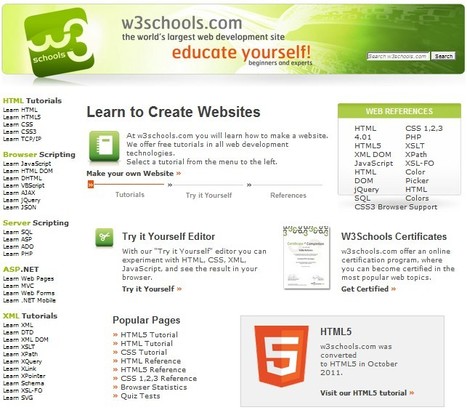
HTML XHTML CSS JavaScript XML XSL ASP SQL ADO VBScript Tutorials References Examples...


At w3schools.com you will learn how to make a website. We offer free tutorials in all web development technologies.


Select a tutorial from the menu to the left.
Make your own Website »


Read more:

http://www.w3schools.com/


No comment yet.
Rescooped by Gust MEES from Digital Delights
May 20, 2012 3:42 AM
Scoop.it!

Connectivism - Emerging Perspectives on Learning, Teaching and Technology

Connectivism - Emerging Perspectives on Learning, Teaching and Technology | 21st Century Learning and Teaching | Scoop.it

Via Ana Cristina Pratas
No comment yet.
Scooped by Gust MEES
May 17, 2012 7:31 AM
Scoop.it!

Teachers and Social Media –Do’s and Don’ts:

Teachers and Social Media –Do’s and Don’ts: | 21st Century Learning and Teaching | Scoop.it
This new digital age has everyone engaging in some form of social media -including teachers.  With the growing interest of educators in...
No comment yet.
Scooped by Gust MEES
May 17, 2012 6:38 AM
Scoop.it!

Prepare for BYOD in your organization

Prepare for BYOD in your organization | 21st Century Learning and Teaching | Scoop.it
Jacob Bradshaw discusses a few ideas and considerations that you should chew on while building your battle plan to handle the BYOD invasion.


Here are a few questions to consider:


- Will there any chance that the employee can use or attempt to use your organization’s intellectual property on their device?
- Is that type of access going to be allowed? If not, how will it be blocked?
- As an employee with a new device, how much control do you want to let your organization have over it?
- As an IT admin, how much control do you need to have over that mobile device?
- How big of a security threat is that mobile device to your network, and can your current infrastructure handle that much bandwidth and overhead?
- How much security is enough from an IT standpoint, and how much is too much from a user’s standpoint?
- Once the company is managing that device, how much end-user support is going to be rendered to the user?


Read more...

http://www.techrepublic.com/blog/tablets/prepare-for-byod-in-your-organization/1369?tag=nl.e101


No comment yet.
Rescooped by Gust MEES from Digital Delights
May 17, 2012 5:33 AM
Scoop.it!

Ethnography Matters

Ethnography Matters | 21st Century Learning and Teaching | Scoop.it
Exploring what it means to be an ethnographer today...

...


Via Ana Cristina Pratas
No comment yet.
Scooped by Gust MEES
May 15, 2012 7:39 PM
Scoop.it!

How to Use the Internet Wisely, for Your Health and Your Country's

How to Use the Internet Wisely, for Your Health and Your Country's | 21st Century Learning and Teaching | Scoop.it
There's a lot of bad information out there online. This guide can help you avoid the crap and become a savvier citizen of our digital age.


Gust MEES: Become a GOOD Digital Citizen #eCitizen by following the right way...


Read more...


No comment yet.
Scooped by Gust MEES
May 15, 2012 8:44 AM
Scoop.it!

Leedu - EUN's Learning Platform

Leedu - EUN's Learning Platform | 21st Century Learning and Teaching | Scoop.it

Welcome to the SMILE online learning course - thank you for joining us!


By joining this online learning course, you will be participating in six units covering a variety of aspects on the use of social media in learning and education - see the course timetable to the left.


For each unit, you will be given an introductory video to view, along with a written commentary and additional sources of information. You will also have a list of links to explore and reflect on, and examples of interesting practice taken from both the education sector and beyond.


At the end of each unit are a series of tasks to help you deepen your understanding, and gain practical experience of many of the issues discussed.


Read more...


No comment yet.