 Your new post is loading...

|
Rescooped by
Jim Lerman
from :: The 4th Era ::
June 20, 2013 8:46 AM
|
Featuring the stories most discussed via social media. Another way of checking out what resonates with the audience and, by checking the comments, finding out why. Currently offering US, UK and AU options. From the site: "The Wall covers the latest breaking news with links to the best articles, pictures and videos as they are published."
Via helpingmedia, Jim Lerman
|
|
Rescooped by
Jim Lerman
from Into the Driver's Seat
June 20, 2013 8:37 AM
|
From the site: "Booktype is a free, open source platform that produces beautiful, engaging books formatted for print, Amazon, iBooks and almost any ereader within minutes. Create books on your own or with others via an easy-to-use web interface. Build a community around your content with social tools and use the reach of mobile, tablet and ebook technology to engage new audiences."
Via helpingmedia, Jim Lerman
|
|
Rescooped by
Jim Lerman
from Higher Education Research
June 20, 2013 1:14 AM
|
Scaffolding student research and writing: A win-win solution. Workshop prepared for the Writing Across the Curriculum Institute.
Via Professor Jill Jameson
Different from other presentation apps, 30hands Mobile focuses on the power of storytelling. Like pages in a book, photos or images are dragged around the desktop into the order of the story. Next, the teacher or student records audio over each image. Finally, the story or presentation can be published to the device’s photo area or uploaded to a 30hands collaborative learning site.
Via Baiba Svenca
|
|
Rescooped by
Jim Lerman
from English teaching resources
June 16, 2013 11:24 PM
|
Journal Writing Prompts: These high-interest prompts will encourage kids to describe, explain, persuade, and narrate every day of the school year.
Via Kath Lok
|
|
Rescooped by
Jim Lerman
from The Browse
June 16, 2013 12:21 PM
|
Websites & mobile apps for digital storytelling, such as Toontastic, VoiceThread, StoryKit, Xtranormal, Puppet Pals, Pixton, Storybird, Comic Master, etc.
Via Stacey Py Flynn
|
|
Rescooped by
Jim Lerman
from Digital Delights for Learners
June 16, 2013 12:47 AM
|
|
|
Rescooped by
Jim Lerman
from Into the Driver's Seat
June 15, 2013 11:57 PM
|
Why teachers should ask students to explain their answers Teachers can help students learn by asking them to explain their work -- rather than memorize and repeat answers -- researchers...
|
|
Rescooped by
Jim Lerman
from Into the Driver's Seat
June 14, 2013 2:04 AM
|
Collections of all the lesson plans published via the NY Times Learning Network, grouped by curriculum area: 1. Language Arts, Journalism, and the Arts 2. Science, Health, Technology and Math 3. Social Studies, History, Georgraphy, and Civics 4. A collection of 182 Student Opinion questions, from this school year, all still open to comment on our blog. Each asks students to read a short, high-interest nonfiction piece from The Times, then write in a response.
|
|
Scooped by
Jim Lerman
June 12, 2013 12:38 AM
|
from the website "Do your students struggle to write with detail? Are their descriptions limited, lacking in specifics or uninformative? If so, you can help your students write more engaging and elaborate pieces by teaching the following strategies for elaboration. Elaboration: 7 Writing Strategies"
|
|
Scooped by
Jim Lerman
June 11, 2013 5:06 PM
|
By Lisa Nielsen "If you're an innovative educator, by now, you have probably tried Google Hangouts which let you conduct a video conference with up to ten people / locations FOR FREE! This by itself has terrific potential for teaching and learning tool. I explained here ways the following ideas could be put to use in the classroom:1) Take a class without having to be in the same place. 2) Invite an audience to a performance. 3) Invite others to perform/discuss with you. What you may yet to have tried is livestreaming your Hangout and capturing it via YouTube. This is known as Google Hangouts On Air which takes something that was already awesome, and makes it even better. You can see what it is here:"
|
|
Scooped by
Jim Lerman
June 11, 2013 12:25 AM
|
by alanthefreisen "Next year, we’re planning on implementing a new SIS and gradebook at our school. Groundbreaking news, eh? The kicker is that our new gradebook supports individual assignments for individual students. "Think about that for a second. "For the first time, I can build assignments that are specific to an individual student, and not have to worry about the hassle of reporting said assignments in a gradebook designed for assignments given out to the entire class. "This makes me excited. Thrilled, even! I’ve been differentiating for a few years now, as best as I can, but my efforts have been hampered by the need to create the same assignments for each student. Sure, Tracey’s got an essay and Mark’s working on a short story, but they both need to be out of 35 and according the gradebook they’re both due on the same day, even though that’s not true and the short story shouldn’t really be out of 35, anyway. No more! It also means that I can lessen the impact of competition in my class. I handed back a set of essays today, and instead of the students listening to me about how they can make their next essay better, they spent most of the time quietly asking each other who got the highest mark, and slipping a calculator from one hand to the other to figure out what the score at the bottom of their detailed rubric meant. Yes, real learning was happening today in my class, folks. "So, here’s the question, and one of the reasons I’m posting today: how do I make individualised instruction, true individualised instruction, work? I teach English Language Arts and I’d like to pilot this process with a single group of senior high English students. I’d also like students to be exploring texts which interest them instead of assigning a single book for an entire group of learners, for instance, as well as allowing them the opportunity to demonstrate their knowledge in forms they choose. "This is my first draft:"
|
|
Scooped by
Jim Lerman
June 10, 2013 1:45 AM
|
Description by TeachThought "Rhetorical simulations (Rhet Sims) are interactive texts designed to teach students how to think critically about their own habits of mind when writing. Participants are given a writing prompt and then are asked to create a short text by selecting among a series of paragraph options. A short document is created and then students are asked to explain why the document they created best addresses the need of the assignment. Rhet Sims help students develop a critical awareness of how their choices shape their writing."
|
|
|
Rescooped by
Jim Lerman
from Top sites for journalists
June 20, 2013 8:39 AM
|
From the site. "TrustMedia has a variety of training materials for journalists, from those who are new to the profession to veterans who want to expand or refresh their skills. Our collection of digital training manuals ranges from basic skills like reporting, writing and cultivating sources to new-media training, such as our guide for citizen journalists.These manuals provide information, case studies and tools to learn the basics or advanced skills of journalism."
Via helpingmedia
|
|
Rescooped by
Jim Lerman
from :: The 4th Era ::
June 20, 2013 8:35 AM
|
from the website About the FJP "The Future Journalism Project explores disruption, opportunity and innovation across the media landscape. We do this through a mix of original thinking and reporting, curation and the use of various platforms that best fit the type of content that we’re working with. "To date, our most visible effort has been FJP Global, a blog that looks at media and technology issues from around the world, and FJP Latin America, a recently launched edition that focuses on what’s happening from Mexico to Tierra Del Fuego with additional attention paid to the Hispanic media in North America and developments in Spain. About This Site "On this site you’ll find interviews with — and articles by — people from the business, editorial, technology and educational sides of the industry. The primary themes we’re exploring are: Journalism EducationJournalism Business ModelsJournalism Practice and TechnologyJournalism and Society" - See more at: http://thefjp.org/about/#sthash.33dQgySP.dpuf
Flowboard is a storytelling and presentation app that allows creating side-scrolling publications with the help of photos, videos, text and photo galleries. Whether you are looking to tell your story in the form of your personal photo collection, wish to share ideas or require creating and presenting a presentation right from your iPad, Flowboard can help you get the job done without requiring the use of PowerPoint or Keynote.
Via Baiba Svenca
|
|
Rescooped by
Jim Lerman
from :: The 4th Era ::
June 18, 2013 5:42 PM
|
by Jordan Shapiro "Upper One Games is the first indigenous owned video game company in the United States. "Announced at the 2013 Games For Change Festival, the partnership between E-Line Media and Cook Inlet Tribal Council aims to make “meaningful and scalable social impact by creating world-class games and game-based learning infused with Alaska Native values and culture.” "Their first consumer game will be a top line indie game to be released on major consoles. And Upper One Games is not holding back. They’ve handpicked top commercial talent who are excited to be working on games for impact."
|
|
Rescooped by
Jim Lerman
from The Browse
June 16, 2013 12:22 PM
|
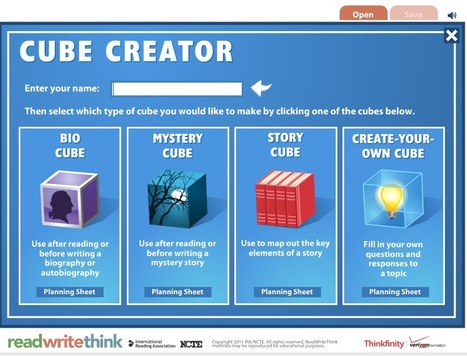
This interactive cube creator will help your students to start their own story writing. It breaks the writing process into six distinct parts which will guide students to write their own biographies, mystery stories, short stories, and free planning of story, a blank template that they can customize.
Via Inma Alcázar, Stacey Py Flynn
|
|
Scooped by
Jim Lerman
June 16, 2013 1:00 AM
|
"Once again this shows the power of the mind to create a story to make sense of its surroundings. Your brain is happier to believe there are connections between the things that it sees. This is a vital insight for your brand experience. If you do not control the story, your audience will find their own and maybe it’s not the story you want to tell."
|
|
Rescooped by
Jim Lerman
from Eclectic Technology
June 15, 2013 11:59 PM
|
In 2008, Fran Simmons, an English teacher at NewDorpHigh School in New York—at that time one of the lowest-performing secondary institutions in the nation— devised a simple test for her students in an effort to keep district officials from pulling the plug. First, she asked her freshman class to read Of Mice and Men. Then, using information from the novel, she asked them to answer the following prompt in a single sentence: “Although George …” She was looking for a sentence like: Although George worked very hard, he could not attain the American Dream. What Simmons received was alarming in the truest sense of the word. Some students wrote passable sentences, but many could not manage to finish the line. More than a few wrote the following: “Although George and Lenny were friends.”
Via Beth Dichter
|
|
Rescooped by
Jim Lerman
from Into the Driver's Seat
June 15, 2013 11:14 AM
|
by Sarah Brown Wessling "You can start with the overview video and then move on to the three separate lessons that provide a detailed look at Ms. Brewer’s approach.
Analyzing Texts: Brainstorming Before Writing
Analyzing Texts: Putting Thoughts on Paper
Analyzing Texts: Text Talk Time
"Whether you’re an ELA teacher or using nonfiction in whatever discipline you teach, Ms. Duvoor’s video will make contextualization clear!"
|
|
Rescooped by
Jim Lerman
from Into the Driver's Seat
June 12, 2013 9:28 AM
|
By Maryellen Weimer "Here's a great story. A graduate student is attending a lecture being given by one of her intellectual heroes, the Brazilian educator and theorist Paulo Freire. She takes notes furiously, trying to capture as many of his words as possible. Seeing that she is keenly interested in what Freire had to say, his translator asks if she would like to meet him. Of course! She is introduced and he begins by inquiring about her work. Then he graciously agrees to respond to a set of questions she and her colleagues hoped they would get the chance to ask him. She is impressed beyond belief, but time prevents her from asking one last, difficult question. They meet accidently once more at the event and he wonders if she asked all her questions? No, there is one more. "Given your work, we want to know 'where is the hope'?" Without hesitating he moves toward her, takes her face in his hands, looks into her eyes, and replies, "You tell them, 'you are the hope, because theory needs to be reinvented, not replicated ... it is a guide. We make history as we move through it and that is the hope."
|
|
Rescooped by
Jim Lerman
from Into the Driver's Seat
June 12, 2013 12:27 AM
|
"As a creative practitioner, you're probably familiar with twitter as a key social media platform for marketing your projects to today’s internet-savvy audiences.But did you know it’s also a great storytelling tool "But did you know it’s also a great storytelling tool? "Fiona Milburn, from Transmedia NZ, gives us five examples from storytellers who have embraced twitter as either a standalone story platform or as part of a wider story world."
|
|
Rescooped by
Jim Lerman
from Into the Driver's Seat
June 11, 2013 4:55 PM
|
"Making Learning Connected (#clmooc) is a collaborative, knowledge-building and sharing experience open to anyone who’s interested in making, creativity and learning. As we design and then engage in “makes” that tap into our personal (and professional) interests, share what we’ve done with the Making Learning Connected community, learn from each others’ experiences, and reflect on our own growth, we’ll be agents in the recursive creation and re-creation of this experience known as a Massively Open Online Collaboration (MOOC). Throughout the MOOC, we’ll engage with and employ Connected Learning principles as they relate to making and learning. "All are welcome to engage at whatever level and to whatever extent makes sense. Making Learning Connected includes pathways – for making, for connecting, for sharing – that allow for greater and lesser degrees of independence and guidance. Follow a linear thread through the six weeks of this MOOC or dip a toe in at one place or another, to create a unique path. For more information, visit the Making Learning Connected FAQs."
|
|
Scooped by
Jim Lerman
June 10, 2013 1:34 PM
|
By Maria Popova "The secrets of good writing have been debated again and again and again. But “good writing” might, after all, be the wrong ideal to aim for. In About Writing: Seven Essays, Four Letters, and Five Interviews (public library), celebrated author and literary critic Samuel Delany — who, for a fascinating factlet, penned thecontroversial 1972 “women’s liberation” issue of Wonder Woman — synthesizes his most valuable insights from thirty-five years of teaching creative writing, a fine addition tobeloved writers’ advice on writing. One of his key observations is the crucial difference between “good writing” and “talented writing,” the former being largely the product of technique (and we know from H.P. Lovecraft that “no aspiring author should content himself with a mere acquisition of technical rules”), the other a matter of linguistic and aesthetic sensitivity:"
|















Thanks for this one today. I appreciate a great find.