Your new post is loading...

|
Scooped by
Jim Lerman
July 6, 2013 7:21 PM
|
by Patrick Ross writing about Lawrence Sulin "-We all want to write understated prose–to introduce drama in our narrative without being melodramatic–but “a good understated writer is a virtuoso pianist,” knowing exactly which details to provide and when. Most of us are not virtuosos, so we end up leaving out material the reader needs to fully understand the dramatic moment. "-Aristotle in Poetics said the key to drama is that it conveys pity and terror. When a writer is brave enough to invoke both empathy and fear in a writer, regardless of genre, they are doing the reader a favor. When the reader makes it through to the other side they experience a catharsis, which is pleasurable to the human psyche. “-We keep hoping when we write about others that they’ll like what we’ve written about them,” Larry said. “I find that hilarious.” “You’re going to have to have the right to your artistic vision,” he said. Nothing sucks drama out of prose like trying to protect the people you write about. He wasn’t saying we should rip people apart or exact revenge on those in our lives. He was saying we should write about everyone–including ourselves–as you understand them, with what Aristotle called “exactitude.” When you do this, there is no issue with melodrama. "-You don’t have to tie up the drama at the end of the work in a neat little bow. “Resolution is facing the truth of what you’ve created,” he said: “It can be satisfying and messy.” The key is that the narrative lines you’ve woven come together at the end. That doesn’t mean all of the answers are there as well."
|
|
Rescooped by
Jim Lerman
from :: The 4th Era ::
July 6, 2013 6:30 PM
|
by John J. Viall "Washington, D. C.) In a surprise news conference today U. S. Secretary of Education Arne Duncan and National Football League Commissioner Roger Goodell announced plans to improve NFL performance in coming seasons.
"Unlike news conferences on education, which draw sparse crowds, representatives from hundreds of newspapers, television and radio networks, and ESPN, ESPN 2, ESPN for Kids and ESPN Tales from the Crypt were in attendance.
"Mr. Duncan spoke first. “We are pleased to announce a partnership involving the U. S. Department of Education and the NFL,” he explained. “We will call this new effort to improve pro football ‘Race to the End Zone.’ All the leading school reform experts insist this approach will dramatically improve the quality of football play.”
“Frankly,” Commissioner Goodell admitted, “this joint effort developed out of a concern for failing NFL franchises. We have watched the brilliant successes wrought by Mr. Duncan and others like him in recent years and believe it is time to adopt a variety of sports reforms, similar to school reforms, and introduce them in our league. We believe with such changes in place the Cleveland Browns can finally reach the Super Bowl and win.”"
|
|
Rescooped by
Jim Lerman
from Into the Driver's Seat
July 6, 2013 5:07 PM
|
by Alan Levine "It was not long ago that producing multimedia digital content required expensive equipment and deep levels of technical expertise. We are at the point now where anyone can create and publish very compelling content with nothing more complex than a web browser.
"The point is not that these are professional level production tools, but that the barrier of entry to content creation can be drastically low. And you should find a new mode of creativity when the tool have some limits as to what they can do-- and find that the core of the story is much more important than a widget.
"What makes for a "story" here consists of more than one type of media (images + text, audio + images, etc) that are assembled on the web, and can be presented on the web or embedded into other web sites.
"And I am using the word "story" in a most general sense; it may be a deeply personal one of the digital storytelling variety, it may be a tale of a travel trip, a report on a project, or just a silly cartoon-- it is what you make. It's your story.
"This is a new version of the original 50+ Web 2.0 Ways to Tell a Story that was created in 2007. As of May 20, 2013 9:11 pm 34 are in the new site and some 30 are waiting in the wings!"
|
|
Scooped by
Jim Lerman
July 6, 2013 4:16 PM
|
Steven Levitt, an economist hailed as one of the finest minds of his generation, says he’s never been good at math and finds much of his life’s work “embarrassing.” The University of Chicago professor is not just being...
|
|
Rescooped by
Jim Lerman
from Writing Rightly
July 6, 2013 3:58 PM
|
|
|
Rescooped by
Jim Lerman
from iPads in Education Daily
July 5, 2013 9:17 PM
|
Resume Designer, the useful app which allows users to create, edit, and share resumes while on the go, has received an important update.
Via Jon Samuelson
|
|
Rescooped by
Jim Lerman
from Technology for Student Writing
July 5, 2013 3:13 AM
|
Writing is a detailed process which requires a lot of practice to perfect. Writing requires streamlined skills, experience and expertise in the different writing styles. This is because no writing styles or audience demand the same things.
Via BobbiJames
The site promotes the innovative and creative use of film in language learning. All of the lesson plans revolve around the use of video and film to teach English. The site promotes cineliteracy, the ability to analyse moving images, and considers cineliteracy as a 21st century skill which our students need to learn.
Via Nik Peachey, Dilip Barad
|
|
Rescooped by
Jim Lerman
from Dirty Little Writing Secrets
July 4, 2013 3:12 AM
|
|
|
Scooped by
Jim Lerman
July 4, 2013 3:06 AM
|
|
|
Scooped by
Jim Lerman
July 4, 2013 2:52 AM
|
These are links to the lessons and materials I use when I perform my "Seven Elements of a Differentiated Writing Lesson" teacher workshops.
|
|
Rescooped by
Jim Lerman
from Visual*~*Revolution
July 4, 2013 12:31 AM
|
Ken Shelton shared a slidedeck that he made about the use of visuals in storytelling. He made the presentation on Haiku Deck.
Via Andrea Zeitz
|
|
Scooped by
Jim Lerman
July 3, 2013 6:13 PM
|
by Emily Short "Interactive fiction tells you the beginning of a story. Then it puts you in charge and lets you decide what your character should do. You type commands for the main character to carry out, and the story replies by telling you what happens next. Think of the rooms as your setting, and the objects you find as the props. "Part of your role is to help the main character overcome obstacles to his progress: solving problems, working out what is going on in the story, discovering ways to reach new locations and tools. That aspect of interactive fiction is like a game. "And part of your role is to help him make decisions. Interactive fiction may have multiple endings, subject to your choices. That aspect is like a story — but an open-ended one. "If you enjoy interactive fiction, you’ll find a wide variety of free works available to you. These come in many styles, some more like games, some more like stories; some are challenging, some very easy; some are serious, emotionally demanding pieces, while others explore the lighter side of life. And, like books, works of interactive fiction come in assortment of genres: fantasy, mystery, horror, and science-fiction, romance and historical, surreal and slice-of-life. "To try a few well-known, novice-friendly interactive fiction works now, check out this site."
|
|
|
Scooped by
Jim Lerman
July 6, 2013 6:37 PM
|
Blog produced by Mia Wenjen Guest post by Susan Stepehson "Are you looking for ways to arrest the summer slide? Are you interested in encouraging your children to write stories? I’d like to suggest you check out Storybird. What is Storybird? "Storybird is a fantastic website that encourages us to use artwork created by Storybird’s real-life illustrators in the stories (or storybirds) we write. It’s free to register and use, with options to buy print books or upgrade for special features. All stories and comments are pre-moderated, and completed storybirds can be shared. Why is Storybird helpful to children? "The stunning artwork and variety of digital books, many created by kids just like them, motivates kids to read and write. When we parents share the storybird creation process initially with our kids, they hear us “thinking aloud” about our own story-making process. This teaches them a lot about writing, in a natural, relaxed way. After that, many kids want to go on and create their own digital books at Storybird."
|
|
Scooped by
Jim Lerman
July 6, 2013 5:09 PM
|
|
|
Rescooped by
Jim Lerman
from Into the Driver's Seat
July 6, 2013 4:55 PM
|
"Show rather than tell to motivate supporters to care, then act. If you take away just one thing from this post, make it this—You want your listener to take action because they want to—not because they’ve been told to. When you craft your stories to ensure listeners to connect your info with what they already know (test it), you’re far more likely to build trust and rapport with them. In turn, this group relationship is most likely to be transformative, motivating their desire to take action, now and in the future, and to spread your stories/messages to friends and family." Read the full article to see a before and after example.
Via Kim Zinke (aka Gimli Goose), Jim Lerman
|
|
Rescooped by
Jim Lerman
from Writing Rightly
July 6, 2013 4:00 PM
|
Celebrated authors, editors and illustrators write advice to young writers on their hands for " Shared Worlds ," a two-week creative writing summer camp at Wofford College.
Via Penelope
|
|
Rescooped by
Jim Lerman
from Writing Rightly
July 6, 2013 12:59 PM
|
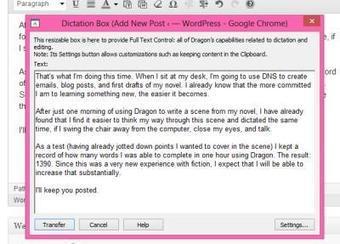
"Authors are pressed for time. What if we could "dictate" our novels instead of typing them?"
Via Penelope
|
|
Rescooped by
Jim Lerman
from iPads in Education Daily
July 5, 2013 9:16 PM
|
|
|
Rescooped by
Jim Lerman
from Technology for Student Writing
July 5, 2013 3:11 AM
|
Here's a selection of tools that you can use online and off to capture your best ideas in writing and save them for future use! (RT @melissadonovan: Thanks for tweeting!
Via BobbiJames
|
|
Rescooped by
Jim Lerman
from Into the Driver's Seat
July 4, 2013 5:52 PM
|
by Mike Brown "Whether creating social media content for yourself or for an organization you support, here’s an easy-to-use strategic thinking exercise for generating relevant topic ideas. Consider three vital areas: -What do you Think? -What do you Know? -What do you Do? "Consider your target audience’s needs and interests as a backdrop. Then use Think, Know, and Do as starters for three mind maps to help explore a range of social media content ideas." - See more at: http://brainzooming.com/social-media-content-ideation-think-know-do/5705/#sthash.qBp3YO7N.dpuf
|
|
Rescooped by
Jim Lerman
from Dirty Little Writing Secrets
July 4, 2013 3:10 AM
|
Editor's note: The excerpt below comes from a book published in 1875: A Gentleman's Guide to Etiquette by Cecil B. Hartley. Hartley's rules may be over 100 ye
Via David M. Daniel
|
|
Scooped by
Jim Lerman
July 4, 2013 2:55 AM
|
By AMANDA CHRISTY BROWN and KATHERINE SCHULTEN "The Times has recently published a few features that we consider gifts to English teachers everywhere, including a summer “How To” section of the Sunday Book Review, and a new series, called “Draft,” on the art of writing, which features essays by grammarians, historians, linguists, journalists, novelists and others. "Below, we collect some “rules” we’ve derived from these features and from other pieces on the Times site, along with links and related activities we hope writers at any stage will find fun or useful — or both."
|
|
Rescooped by
Jim Lerman
from Technology in K-12 Education
July 4, 2013 12:32 AM
|
|
|
Rescooped by
Jim Lerman
from An Eye on New Media
July 4, 2013 12:27 AM
|
"There is work. There is life. There is no balance" --Sheryl Sandberg
Via Ken Morrison
|