


When I started a blog, I thought it was kind of a useless activity, but when I immersed myself in it, I found it to be the best thing that I have ever done for my own professional development.
Via Nik Peachey

 Your new post is loading...
 Scoop.it! When I started a blog, I thought it was kind of a useless activity, but when I immersed myself in it, I found it to be the best thing that I have ever done for my own professional development. Via Nik Peachey 
Scoop.it!

by Med Kharbach "Back again to Twitter but this time with a wonderful collection of more than 50 ideas and tips on how to put this popular social networking and microblogging tool to work in your classroom. Teachers and educators from all around the world have been experimenting with it and each one has something new to add to our knowledge about the importance of using not only Twitter but social media in general in education. The ideas below are organized onto different categories, check out the one that you are interested in and start exploring what it has to offer you. Enjoy" Via Dr. Susan Bainbridge

KB...Konnected's curator insight,
October 11, 2013 2:02 PM
I love browsing thru posts like this. Don't you? Awesome ideas shared by teachers. 
Mary Glynn's curator insight,
October 13, 2013 11:30 AM
This tweet provides interesting ways to bring the 21st century into the classroom, and presents some good ideas on how to get the children more engaged and involved in class. I have to say that I never really saw how Twitter could be useful in schools. I thought that it was just a way for people to express their immediate feelings and thoughts, and to see what celebrities are doing. I never thought that Twitter could be applied in the classroom in so many different ways! Using Twitter as a bulletin board is a great way to reach children. I didn't even realize that the University of Maryland and many universities utilize Twitter for this purpose. For example, when there severe weather and there is a school delay or closing, President Wallace Loh tweets to the UMD community letting them know whether or not classes are cancelled. Twitter can also be used to send out mini quizzes to students which they can answer for bonus points. Honestly, I never thought that students and teachers could communicate through Twitter in all of these ways! Truly brilliant! The tweet also describes how Twitter hash-tags can be used for organizing information in the classroom. By creating a classroom hash-tag, students can see other classmates' thoughts on class and teachers can look for questions students have. I think using the hash tag can be very beneficial because it's a space where everything can be piled together connected by a single hash-tag. However, it can be a disorganized pile if there is not structure and directions on what the hash-tag should be used for. I think if students are given a guideline on what the teacher is looking for in on the hash-tag (questions, thoughts on today's readings), then the classroom will profit from having a classroom hash-tag. There are so many more amazing ways Twitter can be used in school! This tweet really opened my eyes to the academic ways of using Twitter. I have become more accepting to having forms of social media in the classroom after reading this tweet. I think it is all about the way you use technology in the classroom. If you use it properly, it can change the way we teach and truly bring education into the 21st century.
Scoop.it!

by Hugh Hart "Jeff Vandermeer's Wonderbook: The Guide to Creating Imaginative Fiction is jammed with storytelling wisdom from some of world's top fantasy writers. Here's some of it. "What the hell is a Story Lizard? In Wonderbook: The Guide to Creating Imaginative Fiction (Abrams Books, October 15), Story Lizards join Prologue Fish and other infographic helpmates designed to banish dry textual analysis in favor of a kicking, screaming, slithering approach to storytelling creativity. "Author Jeff Vandermeer, a three-time Fantasy World Award-winning novelist who co-directs the Shared Worlds teen writing camp, says "The way we're taught to analyze fiction is to break down and do a kind of autopsy. But I think writers need to be more like naturalists or zoologists when they study story because then you're looking at how all the elements fit together."
Scoop.it!

by Audrey Stokes "It's Top-Pick List Friday! This week we are featuring great tech for writing and blogging. In this 24/7 digital world, many kids are keeping online diaries, sharing stories they've written, and even updating their own blogs. What better way to teach writing skills than to meet them where they are? Check out this list of some of our favorite apps and websites for teaching writing skills. "Here are just a few of the great tools you can find on our Top-Picks List "Great Tech For Writing and Blogging." Click through to read more!"
Scoop.it!

How different, truly, is writing a blog from being an author and diving into that next novel? I love blogging, particularly because it involves a different kind of writing than fiction. The process...
Scoop.it!

Mary Westcott's curator insight,
March 1, 2016 10:14 AM
Maybe a tad too complex for our young students, but still a nice way of understanding the foundations of storytelling!! 
Marisa d's curator insight,
March 11, 2016 12:22 AM
Maybe a tad too complex for our young students, but still a nice way of understanding the foundations of storytelling!! 
Salena Argar's curator insight,
May 17, 2017 6:31 AM
Seven steps to the perfect story is a great visual representation of how to build a story. This clearly explains the process of how students can construct their narrative and the types of characters they will use. I would definitely use this in my classroom to help students understand the process of creating a narrative.
Scoop.it!

"Last week, my teaching partner Sarah and I decided that we would start our procedural writing unit. I always love to teach procedural writing because there are so many fun lessons to do with procedural writing. Last year students took pictures of each other eating gingerbread cookies and they had to write out how they ate their gingerbread cookie. They completed the assignment with using the pictures that were taken and the text that they wrote to create a procedural writing video. Here is one from last year:"
Scoop.it!

by Miguel Guhlin "Did you know that it’s incredibly easy to offer feedback to students on their writing? Make a screencast--less than 5 minutes--that captures critical feedback for students regarding their writing (View an example - http://bit.ly/bsgVQQ). Those videos can be hosted in a variety of locations, such as Evernote, YouTube, Dropbox, Box.net, GoogleDrive and the link easily shared with students. "This kind of feedback can connect with auditory learners who may prefer to get their feedback in another format besides cryptic comments on a post-it attached to their piece of writing. The teacher reviews student writing online, offering specific feedback, recording the feedback as a video recording. The teacher reports taking only 5-8 minutes to record feedback that would normally take 20 or more minutes to write out as feedback. Again, you can easily snap a picture of a piece of student writing, drop it into Explain Everything and then offer critical feedback the student as writer needs to grow on."
Scoop.it!

"MyCreate is an iPad app that teachers and students (grades K-12) can use to create stop-motion animations. Taking advantage of the built-in camera in the iPad 2 or 3, students can solely focus on the creative direction of the project -- building scenes, editing the sequences, and overlaying the audio. It was developed based on the same research from Tufts University used to create SAM Animation, iCreate To Educate’s first product. "The goal of iCreate To Educate is to put students at the center of learning by encouraging them to construct and represent knowledge both in physical pictures and models (through crafts), as well as through stop-motion video. As a result, iCreate To Educate pairs myCreate with activity guides and rubrics for teachers, originally developed for the SAM Animation software, for teaching units in science, math and language arts to English language learners. "The activity guides (which are available for free) are not comprehensive but intended to "seed ideas" for hands-on projects, says iCreate To Educate CEO, Melissa Pickering. "The app is available for $4.99 on the App Store and is also available for volume education pricing.

Sandra Carswell's curator insight,
October 8, 2013 10:26 PM
Sounds like it is worth $5 to try it out.
Scoop.it!

Welcome! Plot & Structure Subcategories: Techniques Characters Writing Process Dialogue Grammar...
Scoop.it!

by Geoff Mulgan "Stories are, by their nature, neither logical nor analytic. Jim Lerman's insight: Very good analysis of 5 types of stories that deal with the future: -Scenarious and scenario planning -"What if..." stories" -New hybrids -Backwards stories -Stories that ask why and offer answers
Scoop.it!

Dear Readers: This is a real job posting. Please share with your networks and bring this opportunity to the attention of anyone you think might be interested and qualified. ---------------------------------------------------------------------------- PROGRAM DIRECTOR 21ST CENTURY COMMUNITY LEARNING CENTERS GRANT KEAN UNIVERSITY - COLLEGE OF EDUCATION Kean University seeks a Program Director to manage all components of an NJDOE 21st Century Community Learning Center Grant called Kean University Learning Adventures. The program is located at Walter O. Krumbiegel Middle School in Hillside, NJ and is an after school program that runs Monday to Friday from 3:15 to 6:20 pm. There is also a summer component. The Director is responsible for -exercising general management and supervision over the program’s staff (which includes teachers, Kean interns, Kean faculty) -implementing the grant program’s goals, policies and procedures ·-developing and evaluating program activities ·-completing program reports for the NJDOE and Office of Licensing for Child Care Centers as required to maintain program license -working with parents and community partners (such as Boys and Girls Club and NJSPAN). The Program Director reports to the Dean of the College of Education. Position requires a minimum of Bachelors Degree with a Master’s Degree preferred. Experience in Program or School Administration and/or Supervisor’s certification preferred. Technical skills and data entry experience also required. This is a full-time, 12-month position, which includes health benefits and sick and vacation time. Salary is competitive. The program is funded by the Federal 21st Century Community Centers program, administered through the NJ Department of Education . Contact: Gail Hilliard-Nelson at gnelson@kean.edu, 908-737-3866
|
Scoop.it!

By Rob Montgomery Some of the most vibrant writing I ever received from my ninth grade students came courtesy of the Neighborhood Map, a writing activity I first learned about through my involvemen...
Scoop.it!

Via Darren Burris

Dr. Dea Conrad-Curry's curator insight,
October 12, 2013 10:50 AM
Although this website is intended for university instructors, the advice given fully applies to middle and high school teachers as well.
Scoop.it!

Recently I read a paper written by Dr. Roskelly entitled “What Do Students Need to Know about Rhetoric?” In this paper, Roskelly (n.d.) submitted that as high school students become conscience of h... Via Darren Burris
Scoop.it!

by Audrey Stokes "It's Top-Pick List Friday and this week we are featuring Noteworthy News Sites. On these sites, students can get different perspectives on key current events while reading articles at levels they can understand. News sites like these provide a great way to increase engagement and add extension activities for hungry learners."
Scoop.it!

Storytelling is a very useful skill. It helps kids reel in listeners and requires them to remember material by heart. Use these fun apps and sites to help kids find their unique voice as storytellers, orators, individuals.
Jim Lerman's insight:
13 apps, rated and described
Scoop.it!

The Digital Rocking Chair's insight: Bryce J. Renninger: "Take a look at these eight films that show off what people are trying to do with GoPros and iPhones on quadcopters and other unmanned aerial vehicles (UAVs)." And, if you're feeling inspired, you might also like to check out Indiewire's follow-up article, A Beginner's Guide to Drone Filmmaking: 5 Step Via The Digital Rocking Chair, Jim Lerman

The Digital Rocking Chair's curator insight,
October 8, 2013 3:02 PM
Bryce J. Renninger: "Take a look at these eight films that show off what people are trying to do with GoPros and iPhones on quadcopters and other unmanned aerial vehicles (UAVs)." And, if you're feeling inspired, you might also like to check out Indiewire's follow-up article, A Beginner's Guide to Drone Filmmaking: 5 Steps
Scoop.it!
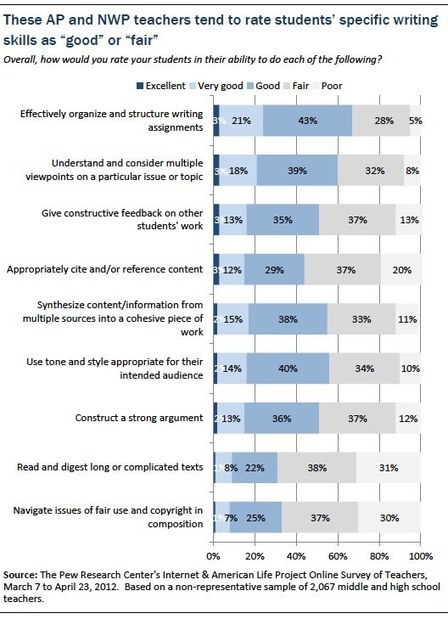
These teachers see the internet and digital technologies such as social networking sites, cell phones and texting, generally facilitating teens’ personal expression and creativity, broadening the audience for their written material, and encouraging teens to write more often in more formats than may have been the case in prior generations. At the same time, they describe the unique challenges of teaching writing in the digital age, including the “creep” of informal style into formal writing assignments and the need to better educate students about issues such as plagiarism and fair use. Via Nik Peachey, ke hones

Tina Jameson's curator insight,
November 6, 2014 5:24 PM
Highly recommended reading - some stats and perceptions on the impact of digital tools on writing standards (some positive and some negative). 
CECI Jean-François's curator insight,
November 10, 2014 2:49 AM
Enquête sur la litteracie numerique, des chiffres intéressants... 
Pamela D Lloyd's curator insight,
January 12, 2015 9:46 PM
This study provides insight into the issues teachers see, positive and negative, regarding the ways in which digital tools impact student writing. Overall, they see many benefits, but there are specific areas of concern.
Scoop.it!

by Troy Hicks "Last night, I was invited to be on the second episode of the new webcast hosted by Heidi Perry from Subtext, the Reading Room. It was a great conversation about tips and tools for digital reading and writing, and I was pleased to have the chance to talk with Heidi and Sydnye Cohen, a high school library media specialist. Heidi and the team at Ed Reach are really trying to give this new show some legs, so check it out here, or subscribe viaiTunes or Stitcher."
Scoop.it!

These are the apps that have stood the test of time with my fourth grader. Each one of them different, but helping to cultivate the love of science and inquiry with the iPad. Via Jon Samuelson
Scoop.it!

The iPad is such a boon in education. It is making a slow but steadfast revolution in the way instruction is both delivered and received. Via Dr. Joan McGettigan

Jan Eade's curator insight,
September 22, 2013 6:42 PM
I know most of these apps, but there are a few new to me. Thanks for this excellent article.
Scoop.it!

"For students who dread writing class, a blank page can look a lot like a ten-foot monolith; an imposing, empty slate towering over their homework list. Visual storytelling is one way to break students out of writer’s block, and storyboarding apps are a pre-packaged strategy you can use to bring images to the narrative. Whether your students are afraid of writing or you’re simply looking for a way to break up a brainstorming session, these 10 storyboarding apps for iOS and Android devices can help inspire–and organize–students of any age. "The best part might be the flexibility of these apps. While they can be used for strict storyboarding in the creation of fiction, they can also be used for other tasks, including documenting project-based learning, sharing assignments, or capturing research notes."
Scoop.it!

What is new and different in the Common Core? When it comes to the writing standards, a heavy emphasis on audience for one thing, and this is very good news.
|








Blogging is a good way to share ideas, insights, and experiences.
Blogging provides a reflective stance. It is an energizing exchange of ideas. I find it empowering.