

From 24 April 1958, speaking at the University of Virginia.

Scriveners' Trappings
111.0K views |
+6 today
Aids and resources for creators and teachers of writing, interactive fiction, digital stories, and transmedia
Curated by
Jim Lerman
 Your new post is loading...
 Scoop.it!
A Digital Creative Writing Project • Presenters: Amalia Zavacopoulou and Stavi Dimas • Coach: Steve Medeiros.

Scoop.it!

Posted October 6, 2014 | by Kim Kautzer | in Writing Games & Activities
Scoop.it!
From
medium

Blogging every day forces you to notice the details of your life. You need fodder for the day’s post. And you’ll scour your world to get it. You become hyper-aware. You find ways to turn little subtleties into big ideas. You start writing with questions only to be faced with answers by the time you reach the end of the post. Your headspace literally becomes transformed.
Scoop.it!

Most of the time, however, the student work we're looking at is not important in and of itself, but rather for what it can tell us about students—what they can do now, what they might be able to do in the future, or what they need to do next. Looking at student work is essentially an assessment process. We give our students tasks, and from their responses we draw conclusions about the students and their learning needs.
Jim Lerman's insight:
Very thoughtful and instructive article, with numerous examples from a variety of disciplines. Well worth reading.
Scoop.it!

As educators, we give feedback to students on their work all the time: in the moment, daily, weekly, and at the end of a unit or year. And research about formative assessment tells us that feedback is a foundational practice that makes a difference in student learning. But how can we make sure our guidance truly encourages our students' learning and growth at each interval? The literature includes some practical ideas to help us get there. It tells us that there is a continuum of feedback, which starts at one end with a focus on what's right or wrong. At the other end of the continuum, the type and amount of information provided turns the feedback into instruction. Let's take a look at three different feedback models derived from the literature and the insights we can take away from each one.
Scoop.it!

Five Card Flickr generates five random images from Flickr or it lets you to choose your five pictures and then asks you to write a story about these five pictures by putting them together. When you choose your pictures, you can start writing your story by making a connection among the five pictures. When you are done, you can tweet or mail your story. You can also get an embed code to use it on your blog.
Jim Lerman's insight:
This is a neat idea, however, since the images are generated randomly, it can be rather challenging to string them together into a story that makes sense. I'd suggest changing the instructions a bit and asking students to select 3 of the 5, while indicating the story needs to have a minimum length.
Scoop.it!

The Supreme Court on Monday refused to revive a challenge to Google’s digital library of millions of books, turning down an appeal from authors who said the project amounted to copyright infringement on a mass scale.
Scoop.it!

Mycoted is a company dedicated to improving Creativity and Innovation for solving problems worldwide, with that in mind, we provide a central repository for Creativity and Innovation on the Internet as a summary of tools, techniques, mind exercises, puzzles, book reviews etc, that is open to all - and can be written by all. Via Jim Lerman

Jim Lerman's curator insight,
April 15, 2016 2:21 PM
A fantastic collection of excellent resources for teaching creativity, innovation, and creative problem solving. Whether you are a beginner - just starting out to try to make your teaching more creative - or an expert, you are sure to find great resources here. Don't miss this site!
Scoop.it!

From
reedsy
The Reedsy Book Editor is a free online writing tool allowing any author to format and create professional ePub and print-ready files in seconds. Via Nik Peachey

Nik Peachey's curator insight,
April 10, 2016 9:27 AM
Nice tool for getting your students to create ebooks and stories for the eReader.
Scoop.it!

Description by The Scout Report
"Engaging students and teachers outside of the classroom is one of the most effective - and challenging - practices for increasing learning outcomes. Remind makes the process simple and safe. With the educational app, teachers can send one-way messages to parents and teachers without revealing their own personal contact information and without ever knowing the contact info of families and students. Signing up takes less than a minute. Educators may then add up to 10different classes for free. From there, students and parents send a text message to a particular number with a message that includes a class code. Once parents have signed up, educators can be in touch with them as much as needed to keep everyone informed and working together."
Scoop.it!
Description by The Scout Report
"This guide to essay writing, composed by Cambridge University visiting lecturer Vivien Perutz, is helpful indeed. The 24-page monograph is split into two broad sections: structure and organization, first, and then style and clarity. The first section takes readers through the basics of essay structure and introduces six stages of essay writing, including analyzing the question, planning, using the plan to guide research, refining the plan, drafting, and editing. In addition, Perutz introduces key concepts in the style and clarity section, including academic writing style, descriptive writing, argumentative writing, evaluative writing, citing references, and using personal experience, among others. In all, this is a pithy and helpful guide to essay writing that is perfectly designed for advanced high school students and college students."
Scoop.it!

Why are we giving kids problems to solve? Why don’t we help them learn to find their own problems? George Couros left an Innovation Day wondering if the kids tried to solve new problems or if they just copied what they saw other kids do. Did the kids see problems and did they see themselves […]
Jim Lerman's curator insight,
April 8, 2016 2:23 AM
A major step in cultivating creativity among students is to build their skills at finding problems that need to be addressed. |
Scoop.it!
Recorded on 03/17/2016 11:17 PM UTC by iteachtvnetwork Live viewers: 49 Heart count: 812 https://www.periscope.tv/iteachtvnetwork
Scoop.it!

And each day there have been moments I’ve desperately wanted to capture. These are moments you know you’ll never forget. It’s walking into a refugee camp in Greece, knowing your life will never be the same. It’s holding hands for the first time in a foreign city, wondering what it all means. It’s hugging someone goodbye at the airport, not knowing the next time you will see them.
Scoop.it!

From
writeshop
"The idea of a timed essay can strike fear into the heart of any student. If your homeschooled teens plan to take the SAT in the next year or so, don’t wait to prepare for the essay section. Help your high schoolers become familiar with the SAT format and scoring well in advance. Then, guide them through writing lessons and extra-curricular activities that will build their skills and boost their confidence.
Scoop.it!
From
medium
To embrace You are what you do means examining whether you’re living your purpose. Is it fear that’s holding you back, much like it was for me? If it is, then it’s time to understand why and let it go. There is no reason to live a life that isn’t a reflection of your whole self. This doesn’t mean quitting your day job if it means keeping a roof over your family’s head and food on the table. Rather, it means looking at the core of how you live your life and asking yourself is everything that I do and engage in a reflection of how I love myself? If you can answer yes, then you’re living your dream.
Scoop.it!
As educators, we give feedback to students on their work all the time: in the moment, daily, weekly, and at the end of a unit or year. And research about formative assessment tells us that feedback is a foundational practice that makes a difference in student learning. But how can we make sure our guidance truly encourages our students' learning and growth at each interval? The literature includes some practical ideas to help us get there. It tells us that there is a continuum of feedback, which starts at one end with a focus on what's right or wrong. At the other end of the continuum, the type and amount of information provided turns the feedback into instruction. Let's take a look at three different feedback models derived from the literature and the insights we can take away from each one. Via Jim Lerman
Scoop.it!
|


|
Rescooped by
Jim Lerman
from Leadership
April 19, 2016 2:11 PM
|
Scoop.it!

German novelist and playwright Gustav Freytag wanted to understand how storytelling impacted the human psyche. He wondered, “What makes a story so engaging that it changes a person’s behavior?” After studying William Shakespeare’s work, Freytag designed a map of storytelling—a key that explained why the man considered ‘the greatest writer [...]
Via Anne Leong

Jerry Busone's curator insight,
January 24, 2015 8:33 AM
Storytelling is the key to any delivery. Great stories trump content any day. Get off the bench and out there and find your stories to engage your team to higher performance.

Matthew Farmer's curator insight,
January 27, 2015 1:53 AM
Powerful stories are told with conviction and the most powerful are often told on the basis of personal experience.
Learning to articulate your powerful personal learning experiences as stories will not only help you to reflect on your learning and therefore make it more powerful, but also help you share your learning with others and influence them to take action. Leadership indeed!
|
|
Rescooped by
Jim Lerman
from Into the Driver's Seat
April 18, 2016 11:35 AM
|
Scoop.it!
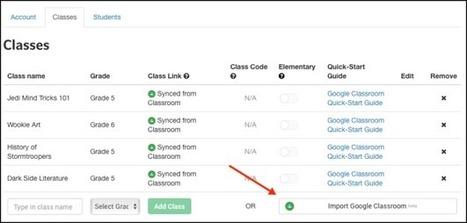
Newsela brings current events into your classroom. Newsela takes current news articles and changes the readability based on lexile level. New articles are provided daily at 5 different reading levels. Students can take assessments based on the news articles.
Google Classroom
Providing links to news articles through Google Classroom brings the world to students. Linking to Newsela articles helps to differentiate for different reading abilities of your students.
Automatically Create Newsela Accounts
Newsela syncs with Google Classroom class rosters. Updating Google Classroom automatically will update the Newsela account roster.
|
|
Rescooped by
Jim Lerman
from Into the Driver's Seat
April 15, 2016 1:39 PM
|
Scoop.it!

Jim Lerman's insight
Many have heard of the 4 Cs of 21st Century Education -- Creativity, Communication, Collaboration, and Critical Thinking. This conceptual collection was popularized by the Partnership for 21st Century Skills, which published much of its work in the early aughts.
This page contains links to numerous resources that illustrate how Creativity can be defined and taught.
Via Jim Lerman
|
|
Rescooped by
Jim Lerman
from Tools for Teachers & Learners
April 10, 2016 4:50 PM
|
Scoop.it!

Use DataMaid app to capture experiences as they are happening. Choose from photo, video, audio, text or combine all media.
Via Nik Peachey
Nik Peachey's curator insight,
April 9, 2016 12:47 AM
A nice tool for creating stories on the go. Great for class trips or projects.

|
|
Rescooped by
Jim Lerman
from Into the Driver's Seat
April 9, 2016 6:51 PM
|
Scoop.it!

Description by The Scout Project
"For readers who love short films, this website, which features Academy Award winning short films spanning several decades, will present itself as a welcome discovery. Here readers will find films ranging from comic to tragic, from the 2014 Dutch heart warmer, Helium, to the comically bizarreFranz Kafka's It's a Wonderful Life from 1995. In addition, anyone who loves the irreverent, antic comedy of the eccentric Steven Wright will find 26 minutes of delight waiting for them in the 1988 extended comedy sketch that is The Appointments of Dennis Jennings. Here Wright is at the height of his powers as he sees a hilariously unethical and incompetent psychiatrist, played by Rowan Atkinson. With over a dozen Academy Award winning shorts to watch, this site can provide hours of entertainment."
Jim Lerman's insight:
Short films can be great for those 43 minute periods. Make sure you view the film before asking your students to!
Jim Lerman's curator insight,
April 9, 2016 6:49 PM
Short films can be quite useful in those 43 minute HS periods. Make sure you watch the film before giving it to your students!

Rosie's curator insight,
September 30, 2019 9:02 AM
This website is very comprehensive, it provides a range of short films which shows that there is a huge interest in the short film genre and, very importantly, that they can receive more than critical recognition, they can also win awards. The short film, Curfew, as an example.
This is site is an excellent source of information to help me decide to make a film about. however, the disadvantage is it does not actually allow you to view the films.

Georgie Clements's curator insight,
October 1, 2019 4:39 AM
This website on 'Filmsshort', provides us a huge variety of different genres. This will help us with our genre research, when exploring in depth each genre types. We will investigate each genre and see which we most likely prefer. We will also include what the audience as a whole prefer or if certain generations have a preference.
|
|
Rescooped by
Jim Lerman
from Writing Rightly
April 9, 2016 3:02 AM
|
Scoop.it!

Are your students going to write short story, film script or novel in the near future? Then send them to the Plot Generator for some inspiration! This free web tool features generators for various kinds of writing projects in a wide range of genres including fantasy, mystery, romance, teen... http://elearningfeeds.com/spark-creativity-with-the-plot-generator/
Via Christopher Pappas, Penelope




