


Well that works out well....
Image source: Imgur via Reddit

 Your new post is loading...
 Scoop.it! Well that works out well.... Image source: Imgur via Reddit 
No comment yet.
Sign up to comment
Scoop.it!

by Suzannah Windsor Freeman
"How strong is your writing?
"No matter how good you think it is, there’s always room for improvement. In most cases, plenty of room. Luckily, there are some amazing websites that’ll help you improve your writing, and take it to the next level.
"Want to strengthen your story, empower your performance, and beef up on the publishing business?
"Here are 23 sites (in no particular order) I look to for daily inspiration and advice:"
Scoop.it!
Scoop.it!

Five excellent web 2.0 sites that are great for supporting and publishing student stories. -JL
Scoop.it!

"When it came to giving advice to writers, Kurt Vonnegut was never dull. He once tried to warn people away from using semicolons by characterizing them as “transvestite hermaphrodites representing absolutely nothing.” In this brief video, Vonnegut offers eight tips on how to write a short story:"
Scoop.it!

MiddleWeb interviews Donalyn Miller about writing (and speaking) while being a full-time teacher. -JL
"Donalyn Miller is a full-time teacher in Keller, Texas (near Ft. Worth) and a popular writer, speaker and advocate on behalf of joyous reading and plenty of it. Her first book, The Book Whisperer: Awakening the Inner Reader in Every Child (Jossey-Bass), has been a top seller at Amazon since in first appeared in the spring of 2009. Donalyn was a finalist for 2010 Texas Elementary Teacher of the Year and has been a consulting teacher for the National Writing Project. For a wild ride, keep up with her GoodReads page. As we learn in this recent interview, she’ll be pursuing another adventure this fall: moving from 6th to 4th grade!"
Scoop.it!

From BBC News Summary by SmartBrief on EdTech
"A primary-school student in the United Kingdom has drawn more than 5 million views to her blog on school lunches. In the blog, NeverSeconds, Martha Payne rates her school lunches and posts photos of the meals. The blog has been in the spotlight since a local council banned Martha from posting the photos. It has since lifted the ban, and Martha has raised more than $114,000 for charity through her blog."
Scoop.it!
Wow. Somebody or some team worked very hard to create this effective video for helping students learn the importance of how to decode media messages. KM Colors, camera angles and logos in the media can all prompt immediate associations with emotions, activities and memories. Via Ken Morrison, Jim Lerman

Ken Morrison's comment,
June 19, 2012 5:20 PM
Thank you for the rescoop. I really like this message.
Ken
Scoop.it!

By Gabriella Sannino
"Before I get deep in to the hows, wherefores and whys of curation and Scoop.it, I deeply feel that it’s important to touch on the what. Scoop.it is not just another place to drop your RSS feed. It could be, but then it’s just another content aggregator.
"Content curation, on the other hand, is much like museum curation. The objects in a museum have value, for whatever reason – historical and artistic beauty are just two I can think of off the top of my head. These objects are carefully displayed, carefully picked over – less than half of what comes in to museums actually gets shown for public consumption.
"As a content curator, you should be treating the content you display with the same amount of exactitude. For example, if you’re starting a Scoop.it entitled “The Best Infographics on the Web”, not every infographic will do (some infographics really are horrible, I’m sorry to say). If you’re curating the topic of content strategy, like we are, you don’t want to have miscategorized articles cropping up about journaling."

Robin Good's comment,
June 17, 2012 5:37 AM
Thanks Jim for sharing this and for using the image of my article here: http://www.masternewmedia.org/online-content-curation-the-key-to-building-visibility-authority-and-value/
Much appreciated, Robin
Scoop.it!

I THINK THIS ARTICLE IS VERY IMPORTANT. -JL
"Over the last couple of years, I’ve come to think of my role as a teacher as that of a curator of ideas" says Corinne Weisgerber who teaches Social Media and Communication at St Edwards Unniversity in Austin, TX (if you haven't yet, check out her great prez here).
As she explained in this post, the Curation Project was about getting her students "to set up a network of online mentors using social media tools" and "to identify experts in their field and connect with them in order to build a personal learning network (PLN)."
The idea behing the PLN is to help them discover valuable information through social search that they wouldn't have discovered otherwise.
Interesting project and read.
And great work by the students who used various curation platforms for the project, including Storify and Scoop.it (links in the post) Via Guillaume Decugis, Jim Lerman

Ileane Smith's comment,
April 17, 2012 8:56 AM
I love this presentation and I'm going to take a look at what the students are doing on Scoop.it.

Guillaume Decugis's comment,
April 17, 2012 3:29 PM
Glas you like it Ileane. And yes, they've done impressive work: check it out!
Scoop.it!

From
io9

From the website:
"On Twitter, Pixar storyboard artist Emma Coats has compiled nuggets of narrative wisdom she's received working for the animation studio over the years. It's some sage stuff, although there's nothing here about defending yourself from your childhood toys when they inevitably come to life with murder in their hearts. A truly glaring omission."
Scoop.it!

Originally by Mohamed ( Med ) Kharbach
"Digital storytelling, the practice of combining narrative with digital content, is gaining more ground in the educational field.Many schools and educational centres all around the globe are including learning method in their curriculums and the results are really promising : more of students engagement and a bigger degree of motivation." Via Andrea Zeitz
Scoop.it!

Vanessa Medina is an English teacher, freelance ELT consultant and writer. Here she explores using videos to teach different writing structures. As teachers, we have all heard about the benefits of using new technologies such as computers and internet in the classroom. Via Leonardo Ornellas
|
Scoop.it!
Scoop.it!

by Suzannah Windsor Freeman
"A while back, I posted a list of 23 websites and blogs that make your writing stronger.
"The post was, and still is, a favourite with readers.
"Since writing the list, I’ve subscribed to a number of other sites that continue to help me in my writing journey. They cover fiction, freelance writing, blogging, publishing, and more.
"If you want to learn more about writing or enhance your natural strengths, check out the following resources (in no particular order.)"
Scoop.it!

by Erika Enigk
"At some point, someone is going to ask you to review or edit a document. Maybe a friend admires your writing and wants you to proofread a paper she’s working on for school. Maybe your boss needs you to finish a report started by someone who has left the company. The task can be a challenge. You may have trouble figuring out what changes to make, and the writer may be unhappy with your choices. Good editing takes finesse, but with practice and the tricks that follow, it gets easier."
Scoop.it!

by Sam Parker
"In truth, writers are no more likely to give up their practical expertise for free than your average mechanic or bank clerk. But sometimes, perhaps when their powers have reached such a height it no longer makes a difference, they'll let some nugget slip.
"And it's these nuggets - 22 of them in fact - that we present to you here. Actual insight into the process of writing offered up by people who did it best. So print 'em out, pin 'em to your wall and remember: a little guidance and some self-discipline means you don't have to be divinely gifted to write well. Though we're sure it must help."
Scoop.it!

by Corey Eridon
"A comprehensive, high-quality blog post doesn't have to be long. In fact, shorter is often sweeter for your readers who have limited time to devote to reading the massive amounts of content on the web. But well-written blog posts should include three sections, which you may be familiar with if you close your eyes and think back to elementary school writing classes: the introduction, the body, and the conclusion. Here's what's included in each."
Scoop.it!

by Elizabeth Mosier Summary by MiddleWeb SmartBrief
"Students in Toughkenamon, Pa., recently participated in their school's annual Young Writers Day by visiting with author and adult-literacy advocate Elizabeth Mosier. "Writers are archaeologists," Mosier explained to her fourth-grade hosts. "We dig up a piece of experience and study it, then we put what we've learned into words." She then asked students to study a number of "artifacts" she'd collected and use sensory detail and metaphor to describe what they saw."
Scoop.it!
From
list
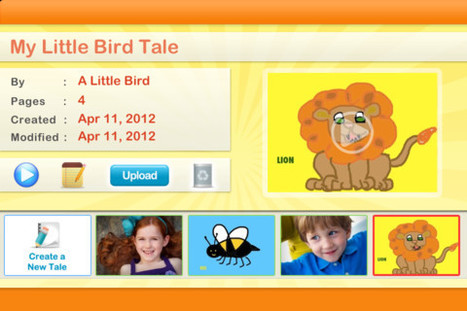
A nice list of 31 sites/apps, briefly described, to support students in digital storytelling. Primarily for the K-8 set. -JL Via David Miller
Scoop.it!

By Maria Popova
"The Top Ten: Writers Pick Their Favorite Books asks 125 of modernity’s greatest British and American writers — including Norman Mailer, Ann Patchett, Jonathan Franzen, Claire Messud, and Joyce Carol Oates — “to provide a list, ranked, in order, of what [they] consider the ten greatest works of fiction of all time– novels, story collections, plays, or poems.”
"Of the 544 separate titles selected, each is assigned a reverse-order point value based on the number position at which it appears on any list — so, a book that tops a list at number one receives 10 points, and a book that graces the bottom, at number ten, receives 1 point."
Scoop.it!

By Miguel Guhlin
Guhlin describes how he has started using Evernote to gather images he likes and includes some excellent quotes from Joyce Valenza (don't miss the link to her outstanding site for Teacher Librarians) and Clay Shirkey.
I used the late, lamented Google Notebook (gosh, how I loved that product!) to gather images (among other things) and can readily see why Guhlin would like Evernote for this purpose (Evernote being the most widely used successor to Google Notebook.).
If you like to harvest images from the web, Evernote is certainly a great way to do it. -JL
Scoop.it!

By Jeff Grabill Summary by The Accomplished Teacher
"In this blog post, Jeff Grabill, a professor of rhetoric and professional writing, suggests ways in which digital-writing instruction can be improved. This writing often is collaborative, such as that found on platforms such as Wikipedia or Facebook, and there are various digital resources available to make writing easier, Grabill says. The fundamentals of writing instruction, however, remain the same, including the use of direct instruction and practice and revision, he writes."
Scoop.it!
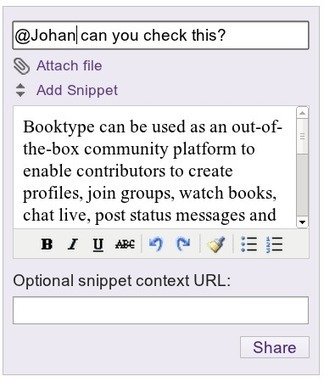
Booktype is a free, open source platform that produces beautiful, engaging books formatted for print, Amazon, iBooks and almost any ereader within minutes. Create books on your own or with others via an easy-to-use web interface. Build a community around your content with social tools and use the reach of mobile, tablet and ebook technology to engage new audiences Via Pippa Davies @PippaDavies , Karen LaBonte
Scoop.it!

From the website
"Blogs are primarily text-based but usually multimodal, or comprised of additional modes such as images, videos, and hyperlinks, typography, layout and more. Some of the teen blogs I have surveyed contain not just text-based entries narrating their day-to-day lives, but also poetry and song lyrics, embedded video culled from video sharing sites like YouTube, and images which they drew or found online, as well as photographs taken with cellphone cameras.
"When you compose with multimedia, is that “writing”? What about when you produce a new text using content not originally “yours” that you remix?" Via anna smith
|






