


Fascinating resource for teachers looking to integrate so-called "nonfiction*" into their writing instruction. (CCSS)
Via Karen LaBonte, anna smith

 Your new post is loading...
 Scoop.it! Fascinating resource for teachers looking to integrate so-called "nonfiction*" into their writing instruction. (CCSS) Via Karen LaBonte, anna smith 
No comment yet.
Sign up to comment
Scoop.it!

Dr. Nellie Deutsch will be giving a 2-week fully online introductory workshop on Moodle starting August 19: http://www.integrating-technology.org/course/view.php?id=409
Scoop.it!

From Mindshift By Shelley Wright: BLOGGING AS A SKILL Students definitely need to understand how and why the mechanics (and style) of blogging are different. The solution? Blogging needs to start earlier, much earlier. I read recently of a kindergarten teacher who blogs with her students. Great idea. There’s a teacher in my division who does amazing things with her grade one class. Via Andrea Zeitz
Scoop.it!

By Artur Ferreira
"Most of us had to deal with years of grammar and composition lessons and never really understood why we had to read books and write short stories, essays, and poems. And, today, with school long-gone, some of us still don’t like to read, and we rarely write anything other than business reports and emails.
"Going even further, most of us have no idea how to tell a story. We know we enjoy good stories (the movie theaters are filled with viewers night after night all over the world). But we have no idea how a good story happens.
"According to Isaac Asimov, one of the world’s great science fiction writers, there are no real ‘suggestions’ as to how to tell stories, but he does provide four key tips to help a young writer":
Scoop.it!

By David Sebek
"Students I taught were very productive using the Osborn Model. But you can structure your students creativity in other ways. By changing your academic lens or perspective you can take your content area objectives and revise student output using the structures of literature.
"My sixth graders work on a lengthy creative writing project. Before we start I give them a map to help them find their way; avoiding the pitfall of "I don't know what to write next." The structure of the Hero's Journey allows students to remain productive while creating."
Scoop.it!

By Susan Lucille Davis Summary by MiddleWeb SmartBrief
"What we teach our students should be authentic and purposeful, writes veteran English/language arts teacher Susan Lucille Davis. In this blog post, Davis shares a list of 16 contemporary writing forms she believes need to be addressed by today's writing teachers. That list includes professional texts, photo captions, reviews, collaborative documents and citizen journalism."
Scoop.it!

How to read a picture; lesson plan and protocol. -JL
"Images, photos, and pictures stimulate the mind. For the viewer, they offer a chance to connect and question. They also offer potential for play and imagination, and pulling the observer into purposeful messages.
"Most often, newspaper and magazine readers take a quick glance at photos and their captions. With this YES! lesson plan, you and your students can luxuriate—and pause—to truly understand an image, its message, and why it’s interesting (or not)."
Scoop.it!

by Matt Wilson
"Ann Wylie has good news and bad news to share with communicators.
"First, the bad: People don't read as well as you or your bosses think they do.
"Executives and the people who approve our copy believe that readers will wade through whatever we put down on paper," said Wylie of Wylie Communications, in addressing attendees of her session at the International Association of Business Communicators World Conference on Wednesday. "We all know that's not true."
"The good news? Communicators can access lots of free online tools—StoryToolz, for example—to improve the readability of what they write. They just have to know what to look for.
"If we make our copy easier to read—this is such a shock—more people will read it," Wylie said."
Scoop.it!

by Barbara O'Neal
"Interviews, in person, on site, can be one of the most powerful tools in a fiction writer’s arsenal. A novelist does not need to be an expert to appear to be one, to fool even an astute reader. We just need really, really good details—and an interview can provide more details in an hour than a dozen books on any given subject."
Scoop.it!

by John Jones
"The challenge facing writing instruction is how to teach students to write -- ethically, effectively -- in the network environments that they face, both now and in the future. A Twitter conversation will never be an op-ed in The New York Times. But the reverse is also true. I am not advocating that we should abandon teaching traditional writing genres to our students, but teaching students different techniques for writing in different genres will make them better writers, with more tools at their disposal for addressing unique writing situations."
Scoop.it!
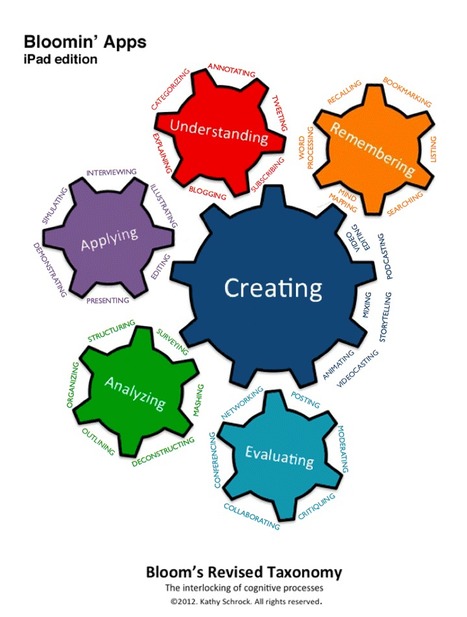
Kathy Schrock has developed a new visual representation of Bloom's revised taxonomy of cognitive objectives and linked each level to a collection of apps and websites for iOS and Android. In fact, she has done this for both the older and revised versions of Bloom.
This new display provides a conceptualization of the levels as intimately connected and related, rather than the hierarchy depicted by the triangle, or pyramid, usually used for this purpose. Perhaps this will assist educators to move more seamlessly from level to level, recognizing that one does not need to go through analyzing to get to creating from applying, for example.
The selected websites and apps are certainly very helpful to educators working to diversify and differentiate their learning environments. This is a very rich resource. -JL
Scoop.it!
by Kelly Tenkely
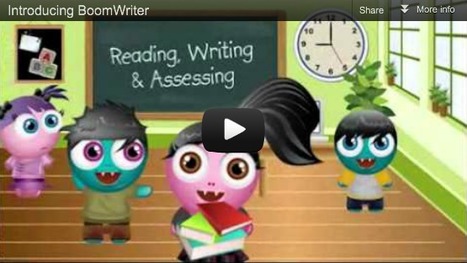
"I just learned about this fantastic site from fellow edublogger @dkapuler, thanks David! Boom Writer is a fun site that gives you a new way to engage your students in creative writing, and will have them assessing themselves in a new way. Using Boom Writer, you (the teacher) choose or produce your own story starter. Each student follows this prompt letting their imagination take over. One chapter at a time, student write, read and vote on the submissions they like the most. The winning chapter gets added to the story and the process continues. You can determine how many chapters will be completed. When the collaborative story is finished, the book can be read online or published and turned into a published print copy."
|
Scoop.it!

"What does it mean to learn and develop as a writer? What is a multimodal text? How is writing different in the age of the internet and mobile phone, particularly in relation to teaching, assessing and researching writing? Via anna smith
Scoop.it!

Writing Kit, one of the contenders in our App Showdown of writing apps, has just been updated with a host of improvements. Via Jon Samuelson, Jonathan Jarc
Scoop.it!

"This is a guest post by educational bloggers, Linda Yollis (Los Angeles, USA) and Kathleen Morris (Geelong, Australia).
"The long-time blogging buddies met face to face for the first time before the ISTE 2012 conference in San Diego. They presented together on educational blogging and global collaboration. This post summarizes their presentation.
"Linda and Kathleen are both passionate about integrating technology in the classroom and have been heavily involved in educational blogging since 2008.
"In early 2009, Linda came across Kathleen’s class blog and from just one comment a rewarding friendship and collaborative adventure began.
"The unique relationship has now spanned over three years and connected eight different cohorts of students. Throughout this time, the classes have moved from isolated to integrated, irregular to frequent, and from the superficial to rich global collaboration.
"Despite being physically positioned in opposite hemispheres, Mrs. Yollis’ class and 4KM (formerly 2KM) connect each week via blogs, Skype, and other online tools. The two classes have worked on many collaborative projects together, some of which have included other classes around the world."
Scoop.it!

By Anindita Basu Sempere Summary by ASCD SmartBrief
"Schools often provide students with summer reading lists, says Anindita Basu Sempere, executive director of TheWritingFaculty.com, but students need to practice writing during the summer, too. Sempere offers eight summer writing activities to help build students' critical-thinking and writing skills. The exercises include writing essays, blogs, screenplays, journals and reviews. "Through writing, children and adolescents can develop their unique voices while working through questions that interest them," Sempere writes."
Scoop.it!

At ISTE, I had the pleasure of presenting in the Google theatre on Writing with Google Docs. It was a short presentation aimed at demonstrating how educators can use Google Docs to foster writing in its various stages. Via kathymcdonough
Scoop.it!

From the website Video interview
"Writing is a public act,” says New York teacher Ileana Jimenez, who encourages her students to blog. Rather than having them write a paper and hand it in only for the teacher to read, waiting for some kind of assessment, Jimenez offers a different perspective in this interview with the Atlantic at the Aspen Ideas Festival: “Writing should be public, it should give a sense of urgency and visibility… for students to feel that their writing has a voice in the world.”
Scoop.it!

by Maria Popova
"Orwell begins with some details about his less than idyllic childhood — complete with absentee father, school mockery and bullying, and a profound sense of loneliness — and traces how those experiences steered him towards writing, proposing that such early micro-traumas are essential for any writer’s drive. He then lays out what he believes to be the four main motives for writing, most of which extrapolate to just about any domain of creative output."
Scoop.it!

From the website
"Michigan State University professor Jeff Grabill recently brought my attention to the topic through his Edutopia.org post, Why Digital Writing Matters in Education. Grabill states that the concept of digital writing "challenges what counts as writing and reveals the gap between how writing works in the world and how we teach it in schools." From my perspective, while somewhat biased as an online instructor and blogger, the range of what can be considered writing in education is changing to include many formats in addition to the typical research paper. That paper is also evolving and may now include embedded links to cited sources and made available as a PDF file, as well as part of a printed publication.The skills required to effectively use these new, technology-driven formats are also changing and found in class and the workplace."
Scoop.it!

by Michelle Schusterman
"I AM A WRITER and I like technology. Interestingly, I get a pretty decent amount of flack for it. That fancy novel writing software? Please, a simple word processor works just fine. Oh, a computer? No, I absolutely must write by hand. Somewhere out there is a writer who insists on pounding The Great American Novel out with chisel and stone.
"I still write by hand, and sometimes I use a word processor, too. But if there’s technology out there that will make my project easier – and dare I say, even better – then I’m going to give it a shot.
"These apps aren’t all designed specifically for those working on books and writing/photography projects, but they definitely help make the task more manageable."
Scoop.it!

by Shelley Wright Summary by Accomplshed Teacher
"High-school English teacher Shelley Wright in this blog post questions whether the five-paragraph essay is the best method for teaching students how to write. Instead, she suggests, blogging might be a better option -- providing a new take on the persuasive essay. In a blog, students must write in different ways and in an different voice but still provide fluidity and coherent thought. To help students become familiar with blogging, Wright suggests students learn to write blogs at an early age."
Scoop.it!

From the website
"Teen Ink is a national teen magazine, a book series, and a website devoted entirely to teenage writing, art, photos and forums. Students must be age 13-19 to participate, register and/or submit work.
"Distributed through classrooms by English teachers, Creative Writing teachers, Journalism teachers and art teachers around the country, Teen Inkmagazine offers some of the most thoughtful and creative work generated by teens and has the largest distribution of any publication of its kind. We have no staff writers or artists; we depend completely on submissions from teenagers nationwide for our content.
"We offer teenagers the opportunity to publish their creative work and opinions on the issues that affect their lives - everything from love and family to teen smoking and community service. Hundreds of thousands of students have submitted their work to us and we have published more than 45,000 teens since 1989.
"The Young Authors Foundation, Inc. is a nonprofit 501(c)3 organization that supports all Teen Ink publications. The foundation is devoted to helping teens share their own voices, while developing reading, writing, creative and critical-thinking skills. All proceeds from the print magazine, website and Teen Ink books are used exclusively for charitable and educational purposes to further our goals."
|






