Your new post is loading...

|
Scooped by
Jim Lerman
January 30, 2020 9:03 AM
|
"Here are 3 Writing Ideas to Kick Off the New Year: "1. Dream Big – Like a New Year’s Resolution, this writing assignment is filled with questions to consider and write about in hopes that what’s important to them at this moment rises to the top. The Dream Big writing prompt allows students to not only voice what is important to them but identify the steps necessary to accomplish their goal(s) and a timeframe in which to aim.
New Year, Dream Big…
"2. One Word – Instead of having a lengthy dream or resolution, why not have students identify and write about their One Word for the new year. Every year, educators and students alike choose and share their One Word publicly, but where do you start? And How do you help students identify their One Word? Once done, I always had my students create a visual to post on their blogs sharing their #OneWord or #OneWord2020...
"3. Habits – Finally, many argue that resolutions are pointless and are quickly forgotten, and it is habits that we need to focus on. Habit tracking helps people identify the small consistent things they do daily that amount to a larger change."
|
|
Scooped by
Jim Lerman
January 24, 2020 8:33 AM
|
"Welcome to our fourth writing unit of the school year. Below you will find a detailed description of each element, as well as ways to put them together to make your own custom unit. To learn more, visit our writing curriculum overview." Unit overview "Of the three broad types of writing that the Common Core State Standards emphasize — argument, informational/explanatory and narrative — informational writing may be the category that gets the least love from writing teachers. "Sure, students are writing explanatory pieces all the time, whether in response to questions, in notebooks , in formal papers and on tests. They are also doing this kind of writing across subjects, perhaps in science or history class as much as in English. But as former teachers ourselves, we have found that writing instructors tend to shine the spotlight more brightly on the two sister genres. "After all, making a strong argument and telling a compelling story might feel like more interesting tasks than just explaining something clearly and accurately. "But informational writing is the style of writing that dominates The New York Times as well as any other traditional newspaper you might read, and in this unit we hope to show students that it can be every bit as engaging and compelling to read and to write as other genres. Via thousands of articles a month — from front-page reporting on politics to news about athletes in Sports, deep data dives in The Upshot, recipes in Cooking, advice columns in Style and long-form investigative pieces in the magazine — Times journalists find ways to experiment with the genre to intrigue and inform their audiences. "For this unit, however, we are focusing on just one broad area of informational writing — that with a STEM theme. Not only can students find daily models in The Times’s Science, Tech and Health sections, but we have also teamed up with Science News and Science News for Students as a partner for our contest so we can provide an even bigger range of writing examples at different reading levels. "But if you’re a humanities teacher and you’re feeling left out, please know that this contest and our four mentor-text lesson plans are relevant to you, too."
|
|
Scooped by
Jim Lerman
January 22, 2020 11:03 AM
|
Analysis rhymes with paralysis, I have discovered: Too often in the past, the texts I asked my freshman English students to analyze left them frozen, detached from their own thoughts and feelings. They scratched at the surface of literature that was not particularly meaningful or accessible to them. The result was cold, inauthentic writing, and I dreaded teaching analysis.
... I read Allison Marchetti and Rebekah O'Dell’s book Beyond Literary Analysis and decided to use their approach. Marchetti and O’Dell uncouple the task of analysis from traditional literary texts and instead invite students to delve into a broader definition of text: “anything that has a beginning, middle, and end and can be broken down into smaller pieces and studied.”
Songs, movies, sports events, and personal experiences are all texts for our students. Marchetti and O’Dell argue persuasively that the keys to strong analysis are passion, ideas, structure, and authority. Students do their best analytical work with texts they know and love....
Before setting up blogs, my ninth graders created heart maps, as suggested by Marchetti and O’Dell—they drew large hearts and filled them with illustrations and words about their interests and passions. I nudged them in this process by asking them what they would do if I gave them 20 minutes to look up a topic on the internet. What did they want to know more about? What topics fascinated them?...
We read mentor texts, including movie and video game reviews, to explore how professional writers analyze their topics. In addition, students wanting to follow their mentor texts by enlivening their posts with photos learned about open source licenses and photo attribution, and formatting the blog posts gave students practice with transferable tech skills....
My students’ passion blogs resulted in creative, voice-filled analyses on wide-ranging topics such as the 19th Amendment, the best local hiking trails, why Austin Forkner is an amateur Kawasaki legend, a student’s cataract surgery, ways school kills curiosity in students, a weekend of pheasant hunting, the Sturgis Motorcycle Rally, an Across the Universe movie review, hunger strikes, a grandfather’s escape from Iran, and the Best of Iowa competition at the county fair. Jim Lerman's insight: The full article offers numerous additional ideas. I highly recommend these creative and clearly expressed suggestions from the author, Allison Berryhill.
|
|
Rescooped by
Jim Lerman
from Into the Driver's Seat
January 20, 2020 11:37 PM
|
"Over the last couple of weeks I've published some lengthy blog posts about classroom blogging activities and tools for classroom blogging. Those posts were excerpts from a longer piece that I've been working on. That longer piece is almost done. For lack of a more creative title, I'm calling it A Mostly Complete Guide to Classroom Blogging.
"In A Mostly Complete Guide to Classroom Blogging you'll find a glossary of blogging terms, a comparison of blogging platforms, a list of K-12 blogging activities, and some suggestions for classroom blogging ground rules.
"You can get a Google Docs copy of A Mostly Complete Guide to Classroom Blogging right here."
|
|
Rescooped by
Jim Lerman
from Into the Driver's Seat
January 10, 2020 12:53 PM
|
"In September, we challenged teenagers to write short, powerful stories about meaningful life experiences for our first-ever personal narrative essay contest.
"This contest, like every new contest we start, was admittedly a bit of an experiment. Beyond a caution to write no more than 600 words, our rules were fairly open-ended, and we weren’t sure what we would get.
"Well, we received over 8,000 entries from teenagers from around the world. We got stories about scoring the winning goal, losing a grandparent, learning to love one’s skin and dealing with mental illness. We got pieces that were moving, funny, introspective and honest. We got a snapshot of teenage life.
"Judging a contest like this is, of course, subjective, especially with the range of content and styles of writing students submitted. But we based our criteria on the types of personal narrative essays The New York Times publishes in columns like Lives, Modern Love and Rites of Passage....
"The winning essays we selected were, though, and they all had a few things in common that set them apart:
"They had a clear narrative arc with a conflict and a main character who changed in some way. They artfully balanced the action of the story with reflection on what it meant to the writer. They took risks, like including dialogue or playing with punctuation, sentence structure and word choice to develop a strong voice. And, perhaps most important, they focused on a specific moment or theme — a conversation, a trip to the mall, a speech tournament, a hospital visit — instead of trying to sum up the writer’s life in 600 words.
"Below, you’ll find these eight winning essays, published in full. Scroll to the bottom to see the names of all 35 finalists we’re honoring — eight winners, eight runners-up and 19 honorable mentions. Congratulations, and thank you to everyone who participated!" Jim Lerman's insight: Whether one terms it a hard skill or a soft one, the ability to communicate effectively is arguably, singularly important to success in life. The student essays presented here inspire in their accomplished style and execution; they serve as excellent mentor texts in numerous teaching/learning situations.
|
|
Rescooped by
Jim Lerman
from Cultivating Creativity
January 6, 2020 8:59 AM
|
"This educational resource is a collection of student centered activities, featuring fairytale themed computational thinking, makerspace and unplugged coding literacy experiences. I am hoping these resources will provide guidance, support and inspirational ideas to differentiate your instructional approaches with today’s diverse groups of K- 5 learners. Enjoy!"
Via Jim Lerman
|
|
Scooped by
Jim Lerman
December 30, 2019 10:48 AM
|
"From websites to extensions to games, there are many ways to talk about and use media literacy in the classroom. From single lessons, to longer units, I typically start off with a game that provides a launch into the inquiry. I have found that games in the classroom provide rich simulations in which students learn content and hone skills. In the case of teaching Media Literacy, this is no different. These games focus on the consumption of digital information and place students in a variety of situations to evaluate epic headlines, analyze misinformation, or even use strategies to gain influence and followers just as an online troll would do."
|
|
Scooped by
Jim Lerman
December 30, 2019 10:12 AM
|
Plotting the story – a common stumbling block for even the most seasoned storyteller. The options seem endless. But what if there were just 7 universal plots underpinning all stories? What if finding the right one could bring your message alive and captivate your audience every time?
In The Seven Basic Plots: Why We Tell Stories, Christopher Booker explains how our best-loved stories throughout history fall into only 7 distinct story types. He follows in a long line of theorists who have tried to explain why storytelling is such a universally powerful means of communication.
Here I'll outline those 7 basic plots for you. This isn't a foolproof list by any means – but just try to think of a book, film or play that doesn't fit one of these plot types.
|
|
Rescooped by
Jim Lerman
from Into the Driver's Seat
December 20, 2019 11:49 AM
|
We believe in the power of human stories in science to inspire, engage, connect, and build new bridges of understanding between science and society. Description by The Scout Report "Launched in 2016, the Journal of Stories in Science is a publishing platform and citizen science project managed by the Boston-based STEM Advocacy Institute. Among its goals, this unique project aims "to understand people's connections and journeys in science [and] to publish inspiring and thought-provoking stories in science from around the world." On the main page, visitors can scroll down to see the project's most recently published stories, as well as examples from North America, South America, Africa, Europe, and Asia. As of this write-up, the Stories in Science Project has published more than 160 accounts from contributors worldwide. In addition to browsing the stories from the main page, visitors can also use the Search page to filter the collection by fields such as gender, career stage, location, type of science, and more. This database of diverse stories may be of particular interest to STEM educators in search of authentic stories to offer their students about real people in science, the challenges they've encountered, and how they overcame those challenges. For those interested in writing about their own science story, the Submit page provides detailed guidelines and helpful advice."
|
|
Rescooped by
Jim Lerman
from :: The 4th Era ::
December 19, 2019 10:10 AM
|
The 2019 Global Learning Landscape is an open source taxonomy for mapping innovation in learning and talent. Combining machine learning with a global community of experts, we analyzed over 50,000 organizations, 500,000 apps and considered the 3 million schools, colleges and universities around the world. Using the classical top-down / bottom-up design methodology, the 2019 Global Learning Landscape was built around 50 core clusters along a learning journey. From knowledge and curriculum to engagement, assessment, workforce and talent, the Global Learning Landscape is inspired by design thinking, following the learner from early childhood to lifelong learning.
Licenced under Creative Commons and as an open source project, the taxonomy is available for anyone to support their own work in education innovation, to identify an area of focus, or to locate their organization and their peers on the landscape. Jim Lerman's insight: A goldmine of resources for anyone who works to research and develop learning/teaching resources from "early childhood to lifelong learning." Truly an impressive and dynamic body of work. Not to be missed.
|
|
Rescooped by
Jim Lerman
from Into the Driver's Seat
December 17, 2019 10:38 PM
|
"KQED, the National Writing Project and PBS NewsHour Student Reporting Labs are co-hosting the KQED Media Challenge: Let’s Talk About Election 2020. This challenge will reignite the call for young people to investigate and share about the issues that matter most to them. Through the submission of audio and video commentaries, students will use media to persuade America how to ensure the best future for us all. The Election 2020 media challenge will open in January. "In taking on this work, we understand that young peoples’ understandings of the world around them are a work in progress. They are actively struggling with the world — attempting to make meaning from complex inputs while simultaneously seeking out where they might fit. We must do a better job of both encouraging the development of their voice and supporting them in growing their capacity for and interest in engaging in civic life. Their voices provide insight into the lives our young people are leading, what they care about, what they worry about and, importantly, their vision for a better future. Furthermore, students supported in engaging in discussions of important local, national or global issues report that they are more engaged in school, more interested in politics, better communicators and critical thinkers and have a greater likelihood of engaging in civic life as adults. "Because of these profound benefits, and especially in light of the differences in civic engagement opportunities experienced in classrooms between white students and students of color, we need to provide many opportunities for students to practice civic engagement. At minimum, this includes supporting all students to: 1) identify and understand the problems around them and how those problems impact themselves, their families and their communities, 2) build communication and technical skills necessary to share their position and reasoning effectively with others in face-to-face and online spaces and 3) engage with and respond to others in ways that support dialog and understanding rather than conflict and division. Additionally, because the competencies needed to develop and nurture these skills cannot be assumed, it is important to support educators on this journey towards civic media literacy, too."
|
|
Rescooped by
Jim Lerman
from Cultivating Creativity
December 10, 2019 1:43 PM
|
SPEAK Mentorship program seeks to fill 2 positions (NYC)
Qualified and interested candidates are invited to apply for 2 positions currently available at the SPEAK Mentorship program in New York City: These opportunities are ideal for recently retired educators Immigrant and first-generation youth daily confront the challenge to straddle a vast divide between the old and the new. SPEAK Mentorship bridges this divide: it affords immigrant and first-generation girls the social and cultural capital required to become future workforce leaders. SPEAK’s dynamic design of interaction among high school girls with numerous visible role models increases girls’ self-efficacy, enables them to access otherwise hidden knowledge and opportunities, and inspires them toward successful and fulfilling post-secondary pathways -- all through cultivation of potent networks made up of peers and culturally responsive mentors. In the last school year, SPEAK Mentorship’s programs operated in 3 cities, connecting over 200 mentors with over 500 students. Its outstanding performance and growth were recognized by the L’Oreal Paris Women of Worth initiative. At a recent ceremony, SPEAK’s Founder and Executive Director, Hetal Jani, was presented by Oscar-winning actor Helen Mirren with a 2019 L’Oreal Paris Woman of Worth award and SPEAK itself received a donation of $10,000. Interested applicants, please send resume and cover letter to: info@speakmentorship.org Consideration of applications will begin immediately and continue until the positions are filled Please feel free to post this notice to any social media apps/sites to which you may be subscribed or forward to individuals whom you think may be interested. (12/12/19)
Via Jim Lerman
|
|
Rescooped by
Jim Lerman
from Cultivating Creativity
December 6, 2019 8:58 AM
|
Starting a podcast has been one of the best decisions I have ever made. (I'll tell you why in a little bit.) In this complete tutorial, you're going to learn, step-by-step, how to start a podcast.
Thank you to the thousands of people who have emailed me and also those who have let me know in person that this is the very tutorial that helped you get started. That's why I do what I do, so let's get right to it! Jim Lerman's insight: Here's an article from the NY Times about Flynn and the remarkable success he has enjoyed from his podcast and related social media. This tutorial is excellent.
Via Jim Lerman
|
|
|
Rescooped by
Jim Lerman
from Into the Driver's Seat
January 29, 2020 11:13 PM
|
"Given the political, racial and social climate in which we are operating, teaching about black history in 2018 might be frightening, controversial even. You might be unsure of how to talk about race with your students, especially if your race or ethnicity differs from theirs. Or you might be concerned about responses from other educators, people in the community and even your students' families. Rest assured that you are not alone, but remember that one of the most powerful ways to change a society-and particularly to change racist stereotypes, beliefs and mindsets-is to teach children that they can be change agents.
"Black History Month is an excellent time to highlight this power in young people, something I hope you're doing all year. One way to do this is to center black history instruction on the contributions of African Americans. All of our children need to know about Mary McLeod Bethune, George Washington Carver, Dr. Mae Jemison, Daniel Hale Williams, The Tuskegee Airmen, Katherine Johnson, Josephine Baker, Maya Angelou, Marian Anderson and Garrett Morgan. And the list goes on.
"The question is where to begin. The Harlem Renaissance, which writer, scholar and educator Alain Locke called "The New Negro Movement," is a great place to start. This movement lends itself well to a number of age groups: It offers a diverse range of text types and the ability to tap into multiple learning styles. It's also socially relevant today, with its roots in reclaiming black dignity and black bodies during an era when African Americans were barely regarded as human. And it's another example of a time when, in the battle for their own rights, African Americans greatly enriched American culture and society."
Via Jim Lerman
|
|
Rescooped by
Jim Lerman
from Into the Driver's Seat
January 24, 2020 8:29 AM
|
"Sunset over the Atlantic Ocean, viewed from the International Space Station in 2014. Read a related article from the Trilobites column.Credit...JSC/NASA" "We invite students to choose an issue or question in science, technology, engineering, math or health that interests them, then write a 500-word explanation that will engage and enlighten readers.
|
|
Rescooped by
Jim Lerman
from Cultivating Creativity
January 22, 2020 10:52 AM
|
"I teach multigrade, theme-based courses like Spirituality in Literature and The Natural World in Literature to high school sophomores, juniors, and seniors. And like most English language arts teachers, I’ve taught courses built around the organizing principles of genre (Introduction to Drama), time period and geography (American Literature From 1950), and even assessment instrument (A.P. Literature). "No matter what conceptual framework guides the course I’m teaching, though, I begin and anchor it with what I call a thinking inventory. THINKING INVENTORIES AND ESSENTIAL QUESTIONS "Essential questions—a staple of project-based learning—call on students’ higher order thinking and connect their lived experience with important texts and ideas. A thinking inventory is a carefully curated set of about 10 essential questions of various types, and completing one the first thing I ask students to do in every course I teach. "Although a thinking inventory is made up of questions, it’s more than a questionnaire. When we say we’re “taking inventory”—whether we’re in a warehouse or a relationship—we mean we’re taking stock of where things stand at a given moment in time, with the understanding that those things are fluid and provisional. With a thinking inventory, we’re taking stock of students’ thinking, experiences, and sense-making at the beginning of the course."
Via Jim Lerman
|
|
Rescooped by
Jim Lerman
from :: The 4th Era ::
January 14, 2020 8:28 AM
|
|
|
Scooped by
Jim Lerman
January 6, 2020 9:01 AM
|
In this guide you will be inspired to design, make and program your own talking paper dolls. You will then program and record your voice storyline, or an interactive dialogue of a character creation with Scratch!
|
|
Rescooped by
Jim Lerman
from Digital Delights for Learners
December 30, 2019 10:52 AM
|
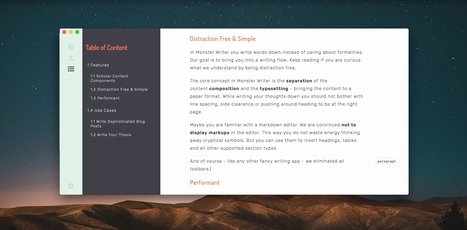
"MonsterWriter - Don't be bothered by formatting content, moving headings from one page to another, manual creation of bibliographies; MonsterWriter provides a distraction-free writing environment optimized for scholarly writings"
Via Ana Cristina Pratas
|
|
Scooped by
Jim Lerman
December 30, 2019 10:42 AM
|
"Here are 3 writing ideas to kick off the new year " Jim Lerman's insight Clever, brief list -- with good suggestions for how to elaborate
|
|
Scooped by
Jim Lerman
December 20, 2019 12:08 PM
|
Via The Scout Report "Readers interested in learning about the stories and experiences of children who migrated to East London between 1930 and the present day may enjoy Child Migrant Stories. The project was launched in 2016 with inspiration from Dr. Eithne Nightingale's research on "life stories of departure, arrival, and settlement [in East London]." Through pictures, films, and biographies, this website explores the meaning of "home" and the multi-cultural narratives that shape it. Users may want to begin by navigating the East London Stories tab (under the Stories drop-down menu), which will bring them to a database of images. By clicking on each image, users can read the story of a child who migrated to Hackney, Tower Hamlets, or Newham, East London, sharing their origin and the reasons for their journey. The stories encapsulate a spectrum of feelings, from "poignant [to] powerful [to] sometimes very funny." The website also features several short films, which depict migrant experiences "through images, music, and art." Teachers may find the Learning Resources provided to accompany these films particularly useful, as they include film guides with context and key words. Finally, under Worldwide Stories users can explore tales of migration from other corners of the globe, from Norway to New Zealand." Jim Lerman's insight: An outstanding collection of original stories, with obvious uses with immigrant and/or first-generation students, as well as others. Contains teaching resources for educators as well.
|
|
Scooped by
Jim Lerman
December 19, 2019 1:15 PM
|
In schools across the nation we have visited over the past 15 years, we have started to see a shift in understanding of how children learn and develop as whole human beings and how schools, families and communities partner to support the optimal growth of young people. We hear school leaders talk about creating school cultures and climates where every student is known and counts. We see principals and teachers greeting every student by name at the schoolhouse door and taking responsibility for student success. We also see morning meetings and responsive classrooms where students are at the center of their own development and learning: defining issues, asking questions, marshaling relevant facts and engaging classmates with divergent views in thoughtful conversations.
We see teachers and students working in teams and in small groups, learning not only academic content but also how to work well with others, solve problems, express empathy and share different perspectives. And we have seen hundreds of research studies showing that well-implemented social and emotional learning (SEL) is a booster rocket to nearly everything we already measure in school — attendance, grades, test scores, ability to get along well with others, high school graduation, college enrollment and attainment, and success in work and civic life.
School leadership matters immensely in creating these environments, so we decided to take the pulse of school principals across the nation on how they view the value of SEL, how it is being cultivated it in schools and districts and what they recommend in terms of steps for the future.
|
|
Scooped by
Jim Lerman
December 17, 2019 10:42 PM
|
"In November, we read Samuel Jaye Tanner’s stories as a call to action for white English educators to investigate and dismantle white supremacy. He shares his experiences teaching—and teaching explicitly about race—at two different high schools with very different demographics, varying commitments to antiracism, and notable systemic challenges that he encountered as an educator. Tanner’s article is inspired by equity work advanced by scholars of color, and in particular scholars who have contributed to critical whiteness studies in English education. He wonders about the ways in which whiteness creates challenges for white educators to overcome in order to foster more equitable schools and learning opportunities. "Tanner’s article echoes a “second wave” of critical whiteness studies that departs from an exclusive focus on white privilege and, rather, moves toward a better understanding of the problems inherent to whiteness that prevent antiracist education. Tanner reflects on the impact of white silence and the over-reliance often placed upon people of color to initiate and sustain educational equity efforts and conversations about race. His observations are intermixed in this powerful piece with details from his teaching experiences investigating whiteness with white students, and thinking about his whiteness while discussing race with students of color. Tanner’s article challenges readers to think about the ways whiteness damages white people, and names the work white educators must embrace in order to enact antiracist and more equitable learning futures. Join the Annotated Conversation "We invite you to read “Whiteness is a White Problem: Whiteness in English Education,” and annotate the text with your own thoughts, reactions, and questions. Annotations may be added using the web annotation tool Hypothesis. To add your own annotations, as well as to respond to others, sign up for your free account."
|
|
Scooped by
Jim Lerman
December 17, 2019 10:29 PM
|
"Our December text for the 2019-20 Literacy, Equity + Remarkable Notes = LEARN Marginal Syllabus examines how a book, Miles Morales: Spider-Man, by Jason Reynolds, exemplifies possibilities for a new type of literary canon. In an award-winning piece written for English Journal, authors Mario Worlds and Henry “Cody” Miller argue for the inclusion of this new, non-traditional story in secondary English classrooms in order to open conversations among young readers about racism and the school-to-prison pipeline. Worlds’ and Millers’ writing surfaces the importance of rethinking text selection as a means of critiquing racial hierarchy in the curricular canon and dismantling white supremacy."
|
|
Rescooped by
Jim Lerman
from Into the Driver's Seat
December 6, 2019 11:43 AM
|
Find great books for kids, reading strategies, age-specific book lists, exclusive author content, and more. Description by The Scout Report "Parents, caregivers, and educators looking to foster a love of reading in young people may want to check out Brightly. Launched in 2015, Brightly aims to provide resources to help adults "raise kids who love to read," and also "to keep kids connected to books through every age and stage of life." Visitors have several options for exploring the site's content beyond the most recent articles on its main page. Under Ages & Stages, visitors can begin by selecting the age group that best fits their audience, where they can then peruse Brightly's "book picks, reading tips, and activities," for that age group. Visitors can also browse Brightly by Popular Topics, which includes numerous lists of book recommendations along with categories such as Educator Resources; DIY and Family Activities; Parenting and Advice; and Science and STEM. While Brightly focuses primarily on books for younger readers, it also brings adults along for the ride with a monthly roundup of the Best Grown-Up Reads. Brightly was co-founded by Amanda Close and Christine McNamara, who are both veterans of the publishing industry and parents of young children, in partnership with Penguin Random House."
|