 Your new post is loading...

|
Scooped by
Jeff Domansky
September 19, 2015 5:11 AM
|
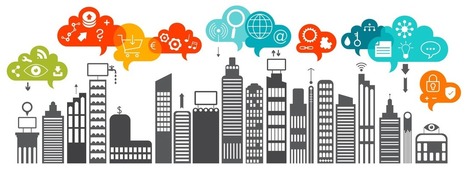
While many have speculated positively on the value of the Internet of Things, a report from the McKinsey Global Institute projects an even more hopeful future for the catchall term for connected devices than previously predicted, especially in regards to local retail.
The report covers the full extent of IoT’s potential, projecting anywhere from $3.9 to an astounding $11.1 trillion dollar global economic impact by 2025. Of that, roughly $410 billion to $1.2 trillion will impact the retail industry and how local businesses and services interact with their customers
.Automated checkout systems alone could add up to $380 billion in potential value but combined with the many other retail uses of IoT, McKinsey believes the value could be anywhere from $410 billion to $1.2 trillion by 2025....
|
|
Scooped by
Jeff Domansky
September 18, 2015 3:42 AM
|
The Internet of Things will impact different people in different ways.
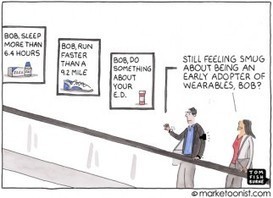
A good example comes from the new announcement that Under Armour is teaming with retailer Sports Authority to link together workout activity and customer loyalty.Under Armour’s MapMyFitness app, which can track activity from various fitness tracking devices from companies including Fitbit, Jawbone and Garmin, will include regular challenges for its users.
The first challenge issued was to run 10 miles or do three workouts in a week for a chance to win a gift card or points in the Sports Authority loyalty program.
Of course, anyone not using a fitness tracking device won’t be involved, but no matter.
The key is that this program neatly links together the value chain of consumer, wearable device, reward and brand....
|
|
Scooped by
Jeff Domansky
September 1, 2015 11:20 AM
|
The Internet of Things (IoT) isn’t going to arrive one day with a big bang.Rather, it’s evolving through the introduction of many small connected things.
That is, at least in the case of what matters to brands, agencies and marketers.
For industrial things, the IoT is rolling through like a freight train, with sensors to track imminent rainfall, automatic regulation of heating, air conditioning and lighting, tracking of health and maintenance of commercial equipment and vehicles and countless other aspects that save energy.
Those solutions tend to be at a grand scale with immediate payback in savings....
|
|
Scooped by
Jeff Domansky
August 27, 2015 1:17 AM
|
A lot of intelligent people believe that a platform like Apple’s HomeKit will be the way we control the smart home of the future. But I'd bet on it looking a lot more like the new wireless dimming kit from the Philips Hue line—subtle technology that eliminates the need for electricians and apps at the same time.
Each kit runs $40, and it includes a white Hue bulb and a dimming remote. All you have to do is screw in the bulb to install it - and up to ten others can piggyback on this same network. The remote uses the ZigBee radio protocol to control them in tandem, and it promises to last a minimum of three years, or 50,000 uses, before it needs its battery replaced....
Just over half of marketers expect the Internet of Things, with ubiquitous, embedded devices constantly conveying real-time data, to revolutionize marketing by 2020. Along with this they see the power of real-time personalized mobile communication as one of the biggest trends.
Here are the trends that marketing executives see as having the biggest impact on marketers within five years: - 51% -- Internet of Things
- 50% -- Real-time mobile personalized transactions
- 29% -- Wearable technology
- 26% -- Virtual/augmented reality
- 13% -- Privacy backlash...
|
|
Scooped by
Jeff Domansky
August 24, 2015 10:15 PM
|
UOW's Institute for Superconducting and Electronic Materials (ISEM) has successfully pioneered a way to construct a flexible, foldable and lightweight energy storage device that provides the building blocks for next-generation batteries needed to power wearable electronics and implantable medical devices.
The conundrum researchers have faced in developing miniature energy storage devices, such as batteries and supercapacitors, has been figuring out how to increase the surface area of the device, to store more charge, without making it larger.
"Among all modern electronic devices, portable electronics are some of the most exciting," ISEM PhD student Monirul Islam said. "But the biggest challenge is to charge storage in a small volume as well as being able to deliver that charge quickly on demand."...
|
|
Scooped by
Jeff Domansky
August 23, 2015 12:59 AM
|
Wearable skin patches are becoming more and more present within the wearable market. They can be used for sports, drug-delivery, or patient monitoring. Skin patches are ideal because they can be hidden under clothing, do not interfere with movement and therefore can record more accurate data.
Wearable patches are not removable patches for clothing, or wraps that hug the skin, instead they are stick adhesives that may or may not contain a medication or sensor. But they do incorporate a way of sticking on the skin for duration of time and all use electrons to work. Check out a few of WT | Wearable Technologies favorite patches below!...
|
|
Scooped by
Jeff Domansky
August 5, 2015 2:37 AM
|
People don’t want connected watches and glasses as much as they would want their bodies online, a new study suggests.
The study was carried out by Element14, a distributor of technology products and solutions for electronic system design, maintenance and repair. Named ‘Engineering a connected world,’ the study asked 3,500 adults living in Australia, Asia, Europe and North America how the connected devices of the future will impact the way we interact with the world around us.
This report uncovers consumer attitudes towards the current and future direction of the Internet of Things, highlighting the areas of our lives where people believe technology and innovation should be focused, the report says, adding that the technology should be focused on healthcare, renewable energy and the environment....
|
|
Scooped by
Jeff Domansky
July 28, 2015 10:34 AM
|
I heard recently that the average person checks their mobile 150 times a day. From a marketer’s perspective, that’s a lot of potential touch points — both in collecting data and in messaging. But it pales in comparison to the staggering world of wearables.
Technology is giving unparalleled access for marketers to understand consumers, and to reach them in a highly relevant and targeted way. But we’re going to be in the Wild West for a while. It’s not clear what marketing will be welcome and what will be considered invasive. There’s a fine line between relevant and creepy. If you think retargeting ads that follow you across the web after viewing a lamp on Amazon are annoying, just wait for when wearables are mainstream....
|
|
Scooped by
Jeff Domansky
July 3, 2015 2:52 AM
|
My interest in the topic was peaked once again during our recent Adobe Summit EMEA conference, during which Brian Solis talked about the importance of marketing the customer and not the channel, and David Shing sharing why it’s important to tap into the behavior of humans in the wild. The common theme in those presentations is the focus on the customer, not brand products and services or the number of channels you’re trying to cover.
The human API is, theoretically, the ultimate data set that will disruptively innovate how we market people … well, in truth, how we make people the product of our efforts. The human body is your data set, not click through rates or impressions, or how long a visitor stays on your website. If you want to know the answer, get it from the source....
|
|
Scooped by
Jeff Domansky
May 7, 2015 5:51 PM
|
Although Apple hasn’t revealed any official sales numbers—and says it doesn’t plan to—several unofficial estimates claim that Apple has at least cracked the 1 million sales mark. Google's Android Wear platform only shipped 720,000 units in all of 2014, according to Canalys.
Just as it did with smartphones and tablets, Apple has essentially created the smartwatch market. But don't write off Android Wear just yet. Through a series of seemingly low-key changes, Google is quietly positioning itself for a stronger second act....
The Internet of Things, IoT as it has been dubbed, is a topic that every marketer is talking about. But, what does it mean, and more specifically, what does it mean to marketers? These smart, connected devices are ringing in a new and exciting era for marketing. IoT provides endless opportunities for marketers and advertisers to listen and respond to the needs of their audience based on behaviors. And your audience is eager to improve their lives with these devices and provide marketers with information for more personalized communications.
The possibilities for IoT in the future are endless! Picture this: down the road your car might be able to know when it’s getting a flat tire and send out a signal (via beacons) to the nearest auto shop. Based on your calendar, the shop can send a push notification to your phone offering an appointment at a 30% discount. Another example could be that health insurers start incentivizing their customers based on real-time data. For example, based on a patient’s lifestyle choices and habits, such as daily exercise and sleep patterns all tracked on a wearable, insurance companies can incentivize customers who have healthier lifestyles—giving them a discount on premiums.
Forget the days of trying to figure out what people want; IoT presents opportunities for real-time engagement and customer service. It’s time to approach marketing in a new and improved way. Check out our latest infographic to learn all about what IoT means for marketers....
With the iPad, the notion of technology getting out of the way meant designing a computer so easy to use that the apps took center stage. But the result was in some sense counterproductive; we've become so sucked into our phones and tablets that technology is actually getting in the way of the real world.
It's not going to be like that forever. In talking to leaders from some of the most innovative companies in consumer electronics, it's clear that the next five years will represent an attempt to bring us back to reality. This may seem paradoxical, but a proliferation of wearable devices, smart-home gizmos, smart cameras, and augmented-reality systems will exist largely to save us from our screens....
|
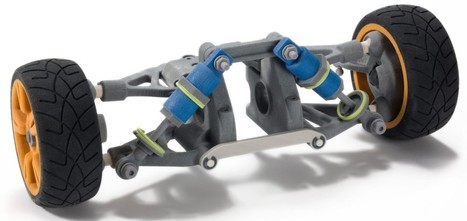
Manufacturers and suppliers up and down the value chain will be affected as the use of 3D printing expands over the next decade. As barriers to entry fall, smaller companies will challenge larger manufacturers with new business models that create a competitive advantage. To counter that, larger manufacturers should start preparing now with a situational assessment:Determine the drivers for 3D printing in your industry
Calculate the effects 3D printing could have on the supply chain, manufacturing, assembly, and other areas of the business.
Decide which components will benefit from being redesigned to take full advantage of additive manufacturing approaches.
Not every manufacturing application will be a fit, but companies need to build a strategy, find the sweet spots, and begin exploiting 3D printing within their own unique business contexts before the industry begins changing around them....
|
|
Scooped by
Jeff Domansky
September 3, 2015 12:13 PM
|
Beacons are primarily for customer interactions in one way or another while RFID tags typically are used to track products and affect pricing based on inventory and online pricing.
Leading retailers using the IoT are poised to gain a market advantage as they generate an ecosystem for IoT connections and interactions, according to Juniper.
Combining IoT revenue and cost savings, Juniper estimates the IoT opportunity to reach $300 billion by 2020.
The overall number of IoT devices installed is projected to increase from 13 billion devices this year to 39 billion within five years....
|
|
Scooped by
Jeff Domansky
August 31, 2015 1:09 PM
|
Despite the arrival of strong competitors such as Apple and Xiaomi, Fitbit has retained the lead in the global wearables market in the second quarter of 2015. The maker of fitness tracking devices shipped 4.4 million units between April and June, an increase of more than 150 percent over last year's June quarter. Fitbit's focus on fitness tracking functionality appears to resonate well with customers who value simplicity over the added functionality of competing devices....
|
|
Scooped by
Jeff Domansky
August 27, 2015 1:10 AM
|
The Martian Voice Communicator tries hard make you think it’s not a smartwatch. The model I tested, a black faux diver with a non-working bezel and quartz movement, looks more like a drugstore Timex than a piece of precision electronics. However, hidden inside the normal-sized case is one of the better notification systems I’ve used.
The company has been making smartwatches since the dawn of the wearable revolution. Originally a solid competitor to Pebble, Martian has slowly moved into a position of power in the “I want a watch that looks like a watch” camp. By offering what are essentially slightly thicker quartz watches, they succeed consistently at this goal....
For all the posturing that’s gone on surrounding wearable technology in recent years, there’s an unlikely front runner: Ralph Lauren is about to put its sexy black PoloTech on sale for $295, ready to transmit your every workout move straight to your iPhone.
While other companies, including Adidas, Athos and Victoria’s Secret, already market products using similar technology, the PoloTech is the first luxury fashion brand to enter the space, proving that technology doesn’t have to look dorky.
For more than a decade, tech and athletic companies have been tinkering with wearables that target “elite, and even professional, athletes,” says Angela McIntyre, research director at Gartner, who follows wearables and connected apparel. “What I get excited about is fashion-forward companies like Lauren even acknowledging that smart garments can move away from the more serious fitness buff to everybody, and into mainstream fashion.”...
|
|
Scooped by
Jeff Domansky
August 24, 2015 9:22 PM
|
Wearable computing is going more mass market.
We’re not talking just about smart watches or fitness trackers, but actual clothing that’s being made ‘smart,’ thanks to embedded technologies.
Like fitness trackers, smart clothing generally needs a companion mobile app so the wearer can receive information captured by the smart thing being worn.
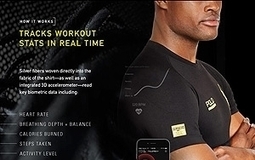
One latest example of smart clothing is the Ralph Lauren polo shirt that can transmit workout information to a smartphone.
But wearables can be a range of things, including sensor-infused devices, clothing that reads biometric data off a body, a body mounted camera or smart glasses....
|
|
Scooped by
Jeff Domansky
August 19, 2015 1:15 AM
|
Orchestrating social media can be likened to herding cats or catching greased pigs – there are so many sites, so many activities and so many connections to be made. Where do we focus, and why?
Focus on dedicated platforms – see Facebook and Parse below – or API’s for smart hardware. Why? Is it really a need for IoT and Social Media mix?
Most social media companies are already in advanced collaborations with IoT companies.
Commanding Attention. Social messaging apps are where many of us spend most of our mobile “screen time”. Through integration with wearable devices this bond will only grow stronger. It also positions the social app as not only the main communication interface, but as an alert and device control interface as well....
|
|
Scooped by
Jeff Domansky
August 3, 2015 10:34 AM
|
The IoT promises to add intelligence to everything from commonplace consumer items such as cars, light bulbs, and refrigerators, to industrial items such as machinery, railroad ties, and agricultural fields. Those “things” can collect and broadcast data across networks, enabling the data to be analyzed to add more value.
Consumer and industrial products will be valued increasingly not just for their standalone functionality, but also for how well they work within the digital ecosystem.In the consumer realm, companies’ marketing success will depend on their ability to connect with, and creatively exploit, the interdependent network of apps, devices, and services....
|
|
Scooped by
Jeff Domansky
July 22, 2015 3:27 AM
|
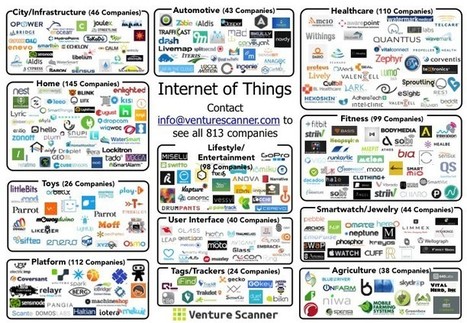
The six IoT visuals below help make sense of this dynamic market:Market Overview: Breakdown of IoT into categories.Number of Companies Per Category: Bar graph summarizing the number of companies in each IoT category.Average Funding By Category: Bar graph that summarizing average company funding per IoT category.Venture Funding in IoT: Graph comparing total venture funding in IoT to the number of companies in each category.Global Breakdown of IoT: Heat map indicating where IoT exist.Median Age of IoT Categories: Bar graph of each IoT category by median age.
|
|
Scooped by
Jeff Domansky
June 24, 2015 10:57 PM
|
Looking to enhance the experience—and productivity—of the engineers and technicians working in the plant and on the factory floor, APX Labs this week announced a new version of its Skylight software for wearable technology that adds work management streams, voice commands, and support for smart watches.
Skylight is designed to enable hands-on workers to access the information, applications, and systems necessary to do their jobs, without the interruption of turning away to use computers, phones, or paper manuals. The Skylight technology was originally used in military applications, such as on smart helmets worn by soldiers. In recent years, APX has been designing smart glasses applications for manufacturing and field service and has customers in the automotive, aerospace, oil and gas and energy industries....
Over the next five years, the number of Internet of Things devices will grow nearly tenfold — from 2.5 billion in 2014, to nearly 24 billion by 2019, according to BI Intelligence estimates.
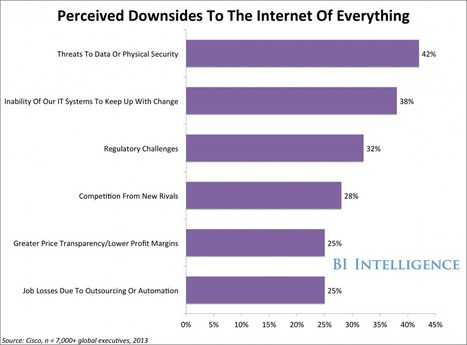
However, one of the biggest barriers currently preventing widespread IoT adoption are security concerns. Business executives, government officials, and consumers are rightly worried that by installing IoT devices within their business, city, or home they are exposing themselves to a hacker who could either use their IoT device in a malicious way and/or steal the data associated with the device....
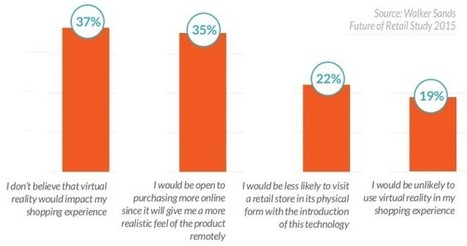
According to the survey, 35 percent of consumers said that the introduction of virtual reality will make them more open to purchasing more online since it will give them a more realistic feel of the product. In addition, 22 said virtual reality will make them less likely to visit a physical retail store....
|

























Retail can't ignore Internet of Things, worth up to $1.2 trillion by 2025.