Well it seems that – even though we are 12 years into the 21st Century – we are still having trouble getting our heads around what it all means to us as TEACHers and, perhaps more importantly, to our students and classrooms.
An emerging group of leaders in Canadian education has attracted thousands of followers. They’ve made Twitter an extension of their lives, delivering twenty or more tweets a day that can include, for example, links to media articles, research, new ideas from education bloggers, or to their own, or simply a personal thought. The power of Twitter is not Twitter itself; it’s the connections it facilitates. Those connections can break the sense of professional isolation that many teachers feel within the walls of their own schools while reinvigorating their lesson plans by exposing them to a daily global idea exchange.
Google has launched a free tutorial website, Search Education, which will help students learn how to better use Google Search for learning and academic research. The site is aimed at both at teachers and at individual users.
Ask this question of a group of second-graders, and about 95 percent of them will answer “Yes.” Three years later, when the kids are in fifth grade, that proportion will drop to 50 percent—and by the time they’re seniors in high school, it’s down to 5 percent.
Sir Ken Robinson has spent his life grappling with the fundamental question: what is creativity? Here, he offers Think Quarterly vital insights into the answer.
“The future is here,” William Gibson once quipped. “It’s just not evenly distributed.” Gibson, the sci-fi writer who coined the term “cyberspace” back in 1982, could easily have been describing the state of technology in today’s K–12 classrooms.
Classic Jello recipes like you have never seen before and hope to never see again! Love the texture and colour of the photos and creative combos (creamy fig pudding anyone?!).
John Hunter puts all the problems of the world on a 4'x5' plywood board -- and lets his 4th-graders solve them. At TED2011, he explains how his World Peace Game engages schoolkids, and why the complex lessons it teaches -- spontaneous, and always surprising -- go further than classroom lectures can.
What’s the coolest thing about watching Game of Thrones? Baby dragons? Boobs? Tyrion being awesome? All good choices but the answer I was looking for was the opening sequence.
As we expect more from technology, do we expect less from each other? Sherry Turkle studies how our devices and online personas are redefining human connection and communication -- and asks us to think deeply about the new kinds of connection we want to have.
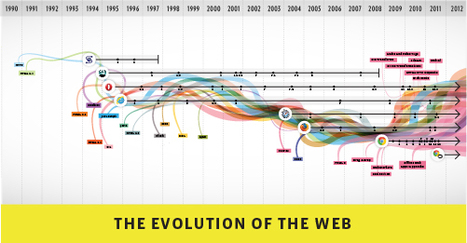
The web today is a growing universe of interlinked web pages and web apps, teeming with videos, photos, and interactive content. What the average user doesn't see is the interplay of web technologies and browsers that makes all this possible.
Check out this Interactive infographic about the evolution of browsers and the web.
Many principals deliver remarks at graduation; some principals, heads of schools, and superintendents may find themselves needing to deliver not one but several addresses over the space of just a few weeks. For many, surely, these opportunities are nothing but a delight; for others, perhaps, they can be the source of stress.
Offered here are some suggestions for principals preparing such remarks.
Schools used to be gatekeepers of knowledge, and memorization was key to success. Thus, we measured students’ abilities to regurgitate facts and formulas. Not anymore. As Seth Godin writes, “If there’s information that can be recorded, widespread digital access now means that just about anyone can look it up. We don’t need a human being standing next to us to lecture us on how to find the square root of a number.”
All great teachers do great work. And not only that, but they also do different work. Great teachers are always looking to improve practice, steal ideas and try new things -- all in order to meet the needs of their students. PBL teachers are no exception. Any teacher who is truly doing PBL would also agree that it's different. There is something about being a PBL teacher that requires different work, and work that is especially capitalized when implementing a PBL project
Even with all of the benefits of technology in the classroom, however, educators must use caution to ensure that students are focusing on the lesson and not giving in to distractions. Here are seven ways that teachers can use to help students pay more attention when using technology
All education is self-education. Period. It doesn’t matter if you’re sitting in a college classroom or a coffee shop. We don’t learn anything we don’t want to learn. If you’re interested in learning something new, this article is for you. Broken down by subject and/or category, here are several top-notch self-education resources
With insights and outlooks on the digital future, Think Quarterly is a snapshot of what Google and industry leaders are thinking about and inspired by today. This issue is on Creativity.
Mark Powell from London uses a standard big biro pen to draw amazing portraits of elderly people on the backs of old envelopes. His works are as evocative as his canvas is unusual. Regardless, the results of his creative efforts are amazing.
How many media do today's students use in regular communication? SMS, telephone voice, e-mail, Facebook, Twitter, written language... the list is quite long, and they certainly use more modes of communication than those that were available to us when we went to university. It therefore follows that they need to learn more forms of literacy. For Shortis (2009) the term technoliteracy is used to describe how adept a user is in communicating through any given device.
3DTOAD.com is 3D/360 website that allows parents, students and teachers free access to 3D images of a variety of educational subjects. Items that once could be viewed only in the classroom are now available 24 hours a day via any internet connection.
It is the first company to successfully pivot from computer maker to device maker. And its devices are now ubiquitous, its annual new product releases are among the most anticipated in the world and it recently announced it would begin issuing a dividend to its stock owners expected to generate $10 billion in the first year alone.
I’m a freelance illustrator and designer from the UK working in the realms of vector illustration, photo montage and manipulation, and mixed media. My work is influenced by contemporary graffiti and lowbrow art, along with almost anything from the natural world. As well as the great outdoors, I gain inspiration from the more bizarre world of humans. Walking around antiques shops is a favourite. It’s like a sensory overload a lot of the time.
To get content containing either thought or leadership enter:
To get content containing both thought and leadership enter:
To get content containing the expression thought leadership enter:
You can enter several keywords and you can refine them whenever you want. Our suggestion engine uses more signals but entering a few keywords here will rapidly give you great content to curate.


 Your new post is loading...