


Ever wondered what the top Educational App is in iTunes? What's the most popular subject? Well look no further. They've put together an Infographic about the educational apps in the ITunes store for August 2012.

 Your new post is loading...
 Scoop.it! Ever wondered what the top Educational App is in iTunes? What's the most popular subject? Well look no further. They've put together an Infographic about the educational apps in the ITunes store for August 2012. 
No comment yet.
Sign up to comment
Scoop.it!
From
vimeo

Nicolas Ménard"s animated short starring small machines drawn with crayons. Everything started on the kitchen's table, when Pierre-Nicolas showed him how to draw a car in two easy steps!
Scoop.it!
From
art
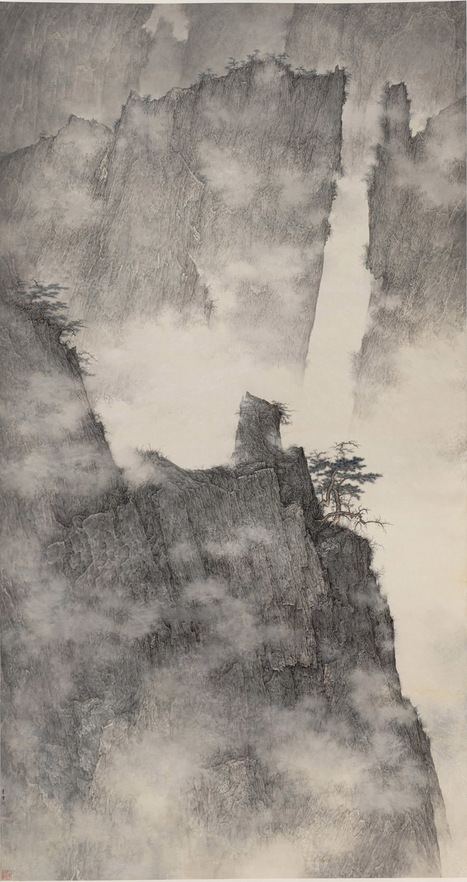
Li Huayi fuses a traditional Chinese painting style with modern American abstraction to create ethereal, misty landscapes. Trained as a painter from a young age, Li was forced into a “worker artist” job during the Cultural Revolution before relocating to San Francisco, where the dramatic scenery of trees, rivers, and cliffs would inspire his distinguished style. Li draws a parallel between Chinese painting—and the underlying “chi” energy that informs its marks and compositions—and Abstract Expressionism, channeling both in his dynamic abstraction-verging arrangements and bold areas of light and dark.
Scoop.it!
From
vimeo
Metropolis is a quirky and very abridged narrative history of the city of Charlotte, North Carolina. It uses stop motion video animation to physically manipulate aerial still images of the city (both real and fictional), creating a landscape in constant motion.
Scoop.it!

Medal-winning long jumps on a more familiar scale Here are all the medal-winning jumps of the Olympic Games since 1896 (including the Intermediary Games of 1906) drawn at the same scale as an N.B.A. basketball court. All but seven gold medals belong to the United States.
Scoop.it!

Food is a key factor in our heath, wellness and weight. Replacing processed, canned and frozen foods with fresh foods has a solid impact on your health. Today’s infographic is a handy little chart that informs you of what produce is in season. The chart is very well designed, it is perfect to print out to hang in your kitchen, or to bring along to the store. This summer, be on the look out for some fresh raspberries, strawberries, pomagranates, peaches, cucumbers, basil, lemons, grapes and figs, just to name a few.
Scoop.it!

These textiles are a collection of woven and knit blankets whose patterns are generated from images taken with short circuited cameras. Artist Phillip Stearns uses electronics to create phenomenological works of light and sound. These blankets are layered with irony: a digital photographic image, made with an intentionally broken (rewired) camera, is mechanically woven or knit into a photoblanket, an object commonly advertised as a kitsch memento. In this project, a keepsake for cherishing one’s memories now becomes a platform for fashioning corrupted memory, the cold logic of digital systems into soft, warm blankets.
Scoop.it!

This article examines the differences between reading in print and reading online, and proposes some tools and strategies to help aid students' reading comprehension and information literacy in online environments.
Scoop.it!

As a parent, it’s your job to look ahead and plan for the future, whether that means packing lunch or creating a roadmap for college. Perhaps one of the most important things parents can look ahead to is education. School reform, college, and getting involved as a parent are all important topics for parents to stay on top of, and these blogs all offer great ways to do so. We’ve discovered 25 of the best education blogs for proactive parents, and we encourage you to check them out.
Scoop.it!

Ranking nations by total Olympic medals isn't really the best way to judge relative success at the London Olympics. Some countries have a lot more people — or a lot more money — than others. With 530 athletes representing the United States and just two in London on behalf of Somalia, context is important. See what the world map of winners looks like when we take population or GDP into account.
This map is updated every time a medal is awarded. Hover on a country to see more.
Scoop.it!

Inspizine looks at 15 Informative Olympic Infographics that all provide different and sometimes surprising statistics and information.
Scoop.it!
Find out how to energize an audience, become comfortable with improvisation during Q&A, and make explanations of complex diagrams fluid. Most people use PowerPoint in a way that exaggerates their weaknesses instead of playing to their strengths. The dirty little secret is that we all present differently. There are six “Presenter Types.” Knowing yours is the secret to effectively engaging your audience and becoming better on your feet.
Scoop.it!

Nowadays, public speakers, consultant or conference workshop leaders are not the only ones “presenting” to an audience. Kindergarten students are becoming presenters, as they are showing their work to a global audience on platforms such as their classroom blog or even their own blogfolios. In the age of youTube, Flickr and Slideshare, anyone can be a presenter with a click of an upload button. Let’s teach students (and model for them in our own presentations) the following three basic points: Less Text… More Visuals… More Storytelling
|
Scoop.it!

According to the Wall Street Journal, Facebook is “developing technology” that would allow children 12 years of age and younger to poke, post, and friend with parental supervision. The real point is, though, that kids of these ages are already on Facebook. Read here are the pros and cons of letting anyone under the age of 13 into Facebook:
Scoop.it!

A nice list of 7 briefly described online learning spaces, intended primarily for post-high school and adult learners. Now familiar names such as Coursera, Udacity, and TED-Ed appear here, along with lesser known ones such as Open Culture, Memrise and Learnist. Love the image.-JL
Via Jim Lerman
Scoop.it!

Here are four excellent case studies produced by the Joan Ganz Cooney Center, an independent research laboratory that supports research and development in educational digital media technologies. The first case study shows Joel Levin, a school technology integrator, using MinecraftEDU with second graders at Columbia Grammar and Preparatory School in New York City. Joel leads his class through structured game-based scenarios that emphases self-directed learning, collaboration between students, and positive social interactions. The second case study shows how Ginger Stevens, a 6th grade special-education teacher at Quest2Learn in New York City, utilizes the intentionally game-like environment of her school to maximize learning for students with special needs.
Scoop.it!

Twitter and Facebook might soon replace traditional professional development for teachers. Instead of enduring hours-long workshops a few times a year, teachers could reach out to peers on the Internet in real time for advice on things like planning a lesson (or salvaging a lesson that’s going wrong), overcoming classroom management problems, or helping students with disabilities.
Scoop.it!

If you come to Águeda, a municipality in Portugal, during the month of July, you may see hundreds of colorful umbrellas floating above some streets. They are hung over promenades giving pedestrians a nice shade and something cool to look at. The street looks amazing, doesn’t it?
Scoop.it!

Polish artist NeSpoon weaves strings to make crochet-like creations, then installs them all over Poland. He has even – as these pictures show – unleashed them on the coast of the Baltic Sea. There is an impalpable air of mystery that seems to surround these cobweb-like creations.
Scoop.it!

This is the first instalment in a three-part series. Part 2. I tweet, therefore I become Part 3. The call of the crowd The French philosopher Michel Foucault (1926-1984) has a set of insights that can help clarify how social media affects us on a psychological level. Foucault died before the advent of the internet, yet his studies of social conditioning and identity formation in relation to power are applicable to life online. Seen from a Foucaultian perspective, social media is more than a vehicle for exchanging information. Social media is a vehicle for identity-formation. Social media involves ‘subjectivation’.
*Noun 1. panopticon - an area where everything is visible
Scoop.it!

Google is big. Google is bigger, Google is huge, Google is massive! But how massive are they really? Let's take a look.
Scoop.it!

Choose from over 70 types of poetry. Then just add words to generate a customized poem of your own!
Scoop.it!

An interesting discovery from working with people on their leadership skills is that they tend to work against their motivational needs. As a result, they are demotivating themselves and running out of gas. Working with people takes a lot of patience so we need to reverse this trend to stay energized and keep the tank full.
Scoop.it!

From
oedb
Everyone seems to flock toward Pinterest these days, delighted by its numerous boards allowing them to bookmark Internet ephemera they find valuable and worth sharing. Numerous libraries — be they specialty, public, or affiliated with a school — have harnessed its popularity to push education and literacy causes to the digital generation. Such a strategy thankfully seems to be succeeding swimmingly. Some of the best-curated Pinterest accounts out there fuse old and new into a spectacularly informative feast for the mind.
Scoop.it!
Educators have come a long way since the cave drawings of 30,000 B.C.E. and the dial-up Internet connections of the mid-1990s. But while the tools have changed, the approach, in many ways, has not. Teachers and professors should look at technology as a way to engage students and prepare them for real-world skills. If that means learning to communicate by drawing on the wall of cave, then teachers 32,000 years ago were onto something!
|




