Your new post is loading...

|
Scooped by
Ed Rybicki
February 22, 2012 3:49 AM
|
While an estimated 30 HIV vaccines are being tested around the world, one trial in Canada promises to be unique. After decades of research, development, and high hopes, scientists at the University of Western Ontario are ready to test a new type of vaccine known as SAV001 that they hope will prevent HIV infections. What makes this trial different, said lead researcher Chil-Yong Kang, Ph.D., is that this is the first preventive vaccine to use a “killed whole” HIV-1 virus to activate a person’s immune system. This version of the virus, however, would be genetically altered so it would not be able to cause HIV infection. For insurance, the virus is also inactivated by using chemicals and radiation.
|
|
Scooped by
Ed Rybicki
February 22, 2012 3:15 AM
|
In a poetic turn of virology, the scientist who discovered hepatitis C in 1989 has now also discovered a vaccine that will hopefully treat and prevent the disease. Just shows you: stick with a thing for 20+ years....
|
|
Scooped by
Ed Rybicki
February 20, 2012 9:43 AM
|
These findings are the first to utilize the Sendai virus to achieve cytosolic, targeted intracellular binding of Qdots within Human brain tumor cells. The results are significant to the continued applicability of nanoparticles used for the molecular labeling of cancer cells to determine tumor heterogeneity, grade, and chemotherapeutic resistivity. It is to like: using liposomes fused to inactivated Sendai to deliver Qdots. Vironanotech rules!
|
|
Scooped by
Ed Rybicki
February 20, 2012 6:09 AM
|
A vaccine made of an adenovirus prime and a modified-pox-virus boost was best at stopping infection. Three-quarters of the monkeys that received no vaccine developed SIV after one exposure, whereas only 12% of the animals that got the best vaccine did so. Prime-boost studies and a good infection model...nice virology and vaccinology. And a possible route to a human HIV vaccine
|
|
Scooped by
Ed Rybicki
February 20, 2012 4:44 AM
|
"The norovirus has affected about 85 students this week, according to the GW University Student Health Service. Although experts are still unsure of where the virus originated, most of the cases have been found at the Foggy Bottom campus." To be renamed the Soggy Bottom campus?? Sorry, couldn't resist...B-)
|
|
Scooped by
Ed Rybicki
February 20, 2012 4:39 AM
|
I'm assuming this is in Vietnam, seeing as details are a little sketchy, but this could be getting serious.
|
|
Scooped by
Ed Rybicki
February 19, 2012 3:16 PM
|
A major milestone in the history of HIV is underway and may forever change the face of the disease. Interesting...suddenly AIDS becomes just another African chronic disease. Because of course, everyone has access to ARVs. Yeah, right.
|
|
Scooped by
Ed Rybicki
February 19, 2012 3:08 PM
|
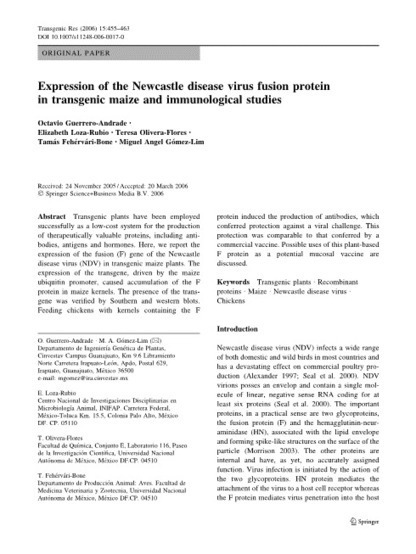
Here, we report the expression of the fusion (F) gene of the Newcastle disease virus (NDV) in transgenic maize plants. The expression of the transgene, driven by the maize ubiquitin promoter, caused accumulation of the F protein in maize kernels. The presence of the transgene was verified by Southern and western blots. Feeding chickens with kernels containing the F protein induced the production of antibodies, which conferred protection against a viral challenge. This protection was comparable to that conferred by a commercial vaccine. Possible uses of this plant-based F protein as a potential mucosal vaccine are discussed. Going green: some day, all vaccines that matter will be made this way...B-)
|
|
Scooped by
Ed Rybicki
February 18, 2012 3:48 PM
|
Some 90 percent of people are exposed to the Epstein Barr virus (EBV) at some point in their life. Even though it is quickly cleared from the body, the virus can linger silently for years in small numbers of infected B cells.
|
|
Scooped by
Ed Rybicki
February 18, 2012 11:07 AM
|
(Adds source close to U.S.biosecurity board, WHO quotes)By Stephanie Nebehay and Kate KellandGENEVA/LONDON, Feb 17 (Reuters) - Two studies showinghow scientists mutated the H5N1 bird flu virus into... My take on this: "Asked about the potential bioterrorism risks of his and the U.S. team's work, Fouchier said "it was the view of the entire group" at the meeting that the risks that this particular virus or flu viruses in general could be used as bioterrorism agents "would be very, very slim". "The risks are not nil, but they are very, very small," he said."
|
|
Scooped by
Ed Rybicki
February 18, 2012 7:23 AM
|
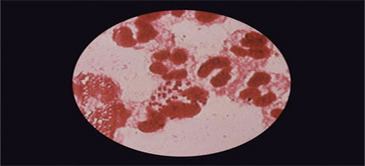
'Gonorrhea, one of the most common sexually transmitted diseases in the United States, is increasingly showing resistance to one of the last known effective antibiotic treatments, leading researchers from the Centers for Disease Control to 'sound the alarm" about potentially untreatable forms of the disease.' OK, so it's not a virus, but everyone should be scared of this: coming soon to a sexually promiscuous person near you....
|
|
Scooped by
Ed Rybicki
February 18, 2012 7:13 AM
|
Experts have delayed a decision about whether controversial research into the H5N1 bird flu virus should be published. And do it grinds on...meanwhile, so does the virus
|
|
Scooped by
Ed Rybicki
February 17, 2012 2:02 AM
|
The nervous system has evolved rather complicated barriers that facilitate access to nutrients and contact with the outside world, but block entry of pathogens and toxins [1]. However, when these barriers are reduced for any number of reasons, nervous system infections are possible. When they occur, they can be devastating and, even with good antiviral drugs, difficult to manage. EXCELLENT review of a very interesting topic. Edited by Vincent Racaniello, who obviously has more than one job B-)
|
|
|
Scooped by
Ed Rybicki
February 22, 2012 3:49 AM
|
|
|
Scooped by
Ed Rybicki
February 22, 2012 3:15 AM
|
Hepatitis C-related deaths outpace HIV deaths, study says | From … http://t.co/iP0ktxnz... ...but not in Africa or Asia, I'd be willing to bet.
|
|
Scooped by
Ed Rybicki
February 20, 2012 9:34 AM
|
ARCHIVES OF VIROLOGY
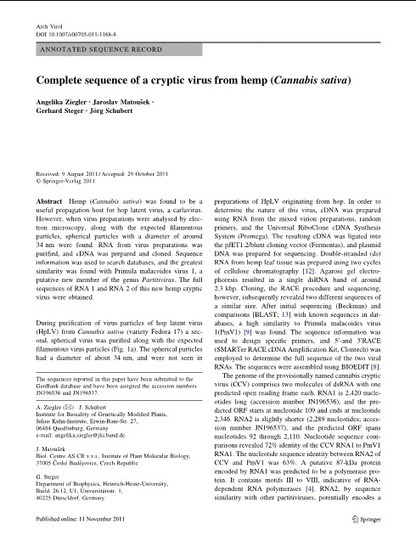
Volume 157, Number 2, 383-385 Hemp (Cannabis sativa) was found to be a useful propagation host for hop latent virus, a carlavirus. However, when virus preparations were analysed by electron microscopy, along with the expected filamentous particles, spherical particles with a diameter of around 34 nm were found. RNA from virus preparations was purified, and cDNA was prepared and cloned. Sequence information was used to search databases, and the greatest similarity was found with Primula malacoides virus 1, a putative new member of the genus Partitivirus. The full sequences of RNA 1 and RNA 2 of this new hemp cryptic virus were obtained. Hey, man...this weed's like, cryptic, man...B-) Can we now expect Cannabis mosaic, Cannabis leaf curl, Cannabis mild mottle and Cannabis reality distortion viruses?
|
|
Scooped by
Ed Rybicki
February 20, 2012 4:48 AM
|
OSLO, NORWAY--(Marketwire -02/15/12)- Bionor Pharma (Oslo: BIONOR.OL - News) News Summary Final review of phase IIb data confirms statistically significant 64% reduction of viral load set point (average of the last two viral load measurements... And here come more therapeutic vaccine interventions for AIDS patients: the gates are opening....
|
|
Scooped by
Ed Rybicki
February 20, 2012 4:42 AM
|
TEHRAN, Iran (AP) — A senior Iranian intelligence official says an estimated 16000 computers were infected by the Stuxnet virus. The powerful virus targeted Iran's nuclear facilities and other industrial sites in 2010, and ... ViroBlogy readers will know I think computer viruses are quite legitimate life forms - and should we be more worried about this, which is a genuinely engineered infectious agent, than H5N1?
|
|
Scooped by
Ed Rybicki
February 20, 2012 4:36 AM
|
Egypt - Report of H9 influenza in poultry in 9 provinces - more than 50% mortality rate Egypt... Interesting - as much for the machine translation as for anything else, which renders the content pretty much inscrutable. But bottom line: H9N2 in Egypt and causing a problem in poultry. Like the Twitter revolution, this may spread and spread....
|
|
Scooped by
Ed Rybicki
February 19, 2012 3:13 PM
|
Interesting account of the papers that are ATTEMPTING to describe how researchers made H5N1 viruses that were aerosol transmitted in ferrets
|
|
Scooped by
Ed Rybicki
February 19, 2012 3:04 PM
|
Science and Nature have papers that describe a version of the avian flu that spreads among mammals. The World Health Organization has now weighed in with its thoughts on whether they should be published. One comment: "The publication of the full details of the paper would allow anyone with a reasonable level of molecular biology skill to order up the requisite DNA and produce a copy of the newly evolved virus. That raises the risk that the virus could be spread by a lab that doesn't have the requisite containment expertise, or by someone who intentionally uses it as a weapon." Utter bullshit! The lab would have to ALSO have the skills in reverse genetics to be able to engineer ss(-)RNA segment expession in a context that would allow reassortment with a live flu virus, in order to make something at all!!
|
|
Scooped by
Ed Rybicki
February 18, 2012 11:29 AM
|
News, video, background information and discussion on the spread of the Schmallenberg virus in the UK... Sometimes you need to get news about viruses that is relevant to people whose living is affected...farmers, in this case
|
|
Scooped by
Ed Rybicki
February 18, 2012 7:56 AM
|
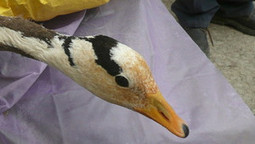
HANOI, Vietnam — Thought bird flu was gone? Recent human deaths in Asia and Egypt are a reminder that the H5N1 virus is still alive and dangerous, and Vietnam is grappling with a new strain that has outsmarted vaccines used to protect poultry flocks. And they sit in Geneva and argue....
|
|
Scooped by
Ed Rybicki
February 18, 2012 7:18 AM
|
WebMD shows you cold symptoms and signs of flu virus. Learn what fever, cough, runny nose, and sore throat may mean, and treatment and prevention options. I have a morbid fascination with this just now, having had sinusitis, rhinitis, headache AND fever. Damn viruses....
|
|
Scooped by
Ed Rybicki
February 17, 2012 2:07 AM
|
...we find that Ded1p and glyceraldehyde-3-phosphate dehydrogenase (GAPDH), which is another host factor for TBSV, play non-overlapping functions to enhance (+)-strand synthesis. ... two small RNA viruses, which do not code for their own helicases, seems to recruit a host RNA helicase to aid their replication in infected cells. Both ss(-)RNA and ss(+)RNA viruses need to bias their replication machinery towards over-production of the genomic strand - and this paper goes a long way to explaining how that happens for two unrelated ss(+)RNA viruses infecting very different hosts.
|