


Click here to edit the content...

Video Breakthroughs
247.9K views |
+1 today
Monitoring innovations in post-production, head-end, streaming, OTT, second-screen, UHDTV, multiscreen strategies & tools
Curated by
Nicolas Weil
 Your new post is loading...
 Scoop.it! 
The introduction of caption transmuxing simplifies deployment by minimizing the number of source files required, though the process is slightly different for live vs. on-demand in Wowza Media Server 3.5.

Scoop.it!
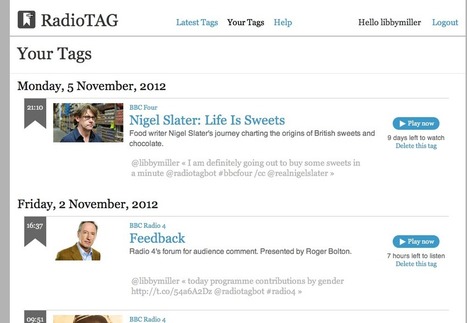
Radiotagbot is a way to bookmark the current point in a programme that you're listening to (or watching) live, by using twitter. To create a bookmark, you send a message to @radiotagbot with the name of a BBC radio or TV station in in it (e.g. "radio 4" or "r1x" or "BBC1") and it will tweet back to you with the title of the programme and a link to the point in time on iPlayer at which it will (usually) appear. If it's on Radio 1, 1x, 2, 3 or 6 Music, it will also attempt to reply with the music track playing.
Scoop.it!
Originally presented in London at Screen Digest’s “The Future of Digital Media” event, this is Alan Wolk’s latest salvo in his attempt to bring common sense to the discussion around second screen.
Scoop.it!

DENIVIP Media has been creating video platforms since 2008 (usually in conjunction with services, portals and applications). Over the 4 years of developing ad-hoc video platforms for different projects, we have accumulated a decent expertise and information on many hindrances that are almost inevitable in video projects. In this post, I would like to brief you on how we design video platforms and what drivers have to be taken into account when creating a new or upgrading an old video platform. Also, I would like to note major forthcoming trends in the development of video platforms foreeable for the near future.
Scoop.it!

The future is live. The future is real-time. The future is now. That's the hype anyway. And as it has a habit of doing, the hype is slowly becoming reality. We are seeing live searches, live tweets, live location, live reality augmentation, live crab (fresh and local), and live event publishing. One of the most challenging of all live technologies is that of live video broadcasting. Imagine a world in which everyone becomes a broadcaster and a consumer of video streams, all in real-time (< 250 msec latency), all so you can talk and interact directly without feeling like you are in the middle of a time shift war. The resources and the engineering needed to make this happened must be substantial. How do you do that?
Scoop.it!

The BBC Olympics sports broadcast service is one of the largest media events of 2012. It has brought the video service industry to a totally new level, earning for the 2012 Olympics the popularity of "truly digital games". In this context, it is critical to acknowledge the importance of expertise gained and leverage it in further growth. In this post, we are going to dwell into the project, its implementation, and valuable experience that you can apply to your own projects.
Scoop.it!

If you want some additional information on a product you’ve seen on an advertisement or in-store, you’re increasingly likely to obtain it a QR code, that ubiquitous two-dimensional rectangle. Some brands are even trying out QR codes in TV advertising. Insurance giant Axa is one such company. If you’re watching Axa’s advertisement and want to see how the story unfolds, you can scan the QR code on the door of the house that you see on your TV screen. With this approach, making the QR code visible to the audience is part and parcel of the communication and engagement process. However, if it’s just a matter of rounding out the information given in the advertisement – providing additional details or enabling the user to make a purchase – then there’s no need to show the little black-and-white chequered rectangle. Fujitsu Laboratories has developed technology to replace the QR code with a code system that’s imperceptibleto the human eye, and which works on the basis of changes in brightness of points of light so that it can be discreetly embedded in a TV advertisement.
Scoop.it!

Adaptive streaming protocols need to be integrated with content protection schemes. PlayReady was originally designed to work with Smooth Streaming. It has also been integrated with HLS, which is probably the most popular of the proprietary adaptive streaming schemes. Integration of PlayReady with MPEG-DASH is likely to be viewed as a safe choice, in line with the way the industry is going. That solution came into view this month as BuyDRM and Fraunhofer IIS announced an integration of MPEG-DASH with PlayReady for the HBO GO service in Europe. HBO GO is HBO’s “over the top” service for subscribers.
Scoop.it!

Whether you're required by law to offer closed captions or not, there's good reason to add them to your online video workflow. Here's how.
Though relatively few websites are required to provide closed captions for their videos, any website with significant video content should consider captioning. Not only does it provide access for deaf and hard-of-hearing viewers, but captions and the associated metadata can dramatically improve video search engine optimization. In this introduction to closed captions, you’ll learn about who needs to caption and who doesn’t (and why you may want to anyway), the available workflows for captioning live events and on-demand files, and a bit about web caption formats and how to marry them to your streaming files.
Let’s jump in.
Scoop.it!

This article is the fourth in a series on webcast video production and discusses video switchers, including the cost and features that differentiate several popular models.
Scoop.it!

The world of sports-video contribution, backhaul, and distribution looks to be on the brink of a major leap forward. New technologies like HEVC (high-efficiency video coding) are set to enter the market, and others, particularly JPEG 2000, continue to carve out a larger share of it. Compression standards and formats like these hold the promise of paving the way for the delivery of next-gen formats like 1080p, 4K, and 8K.
An afternoon session moderated by CBS Director of Broadcast Distribution Chris Ehrenbard at SVG’s TranSPORT in New York on Tuesday focused on the evolution of these bleeding-edge technologies and their place in the sports-video landscape.
Scoop.it!

Some benefits of the Primetime Media Player include: - High-quality Multiple Bit Rate (MBR) video playback support.
The Primetime Media Player also offers fully compliant Communications and Video Accessibility Act (CVAA) features: - Render in-stream closed captioning with built-in support for user-based rendering overrides
MORE ON SAME TOPIC : http://www.streamingmedia.com/Articles/ReadArticle.aspx?ArticleID=86180 http://mashable.com/2012/11/15/adobe-project-primetime/
|
Scoop.it!

Service providers deploying IPTV have tended to use constant bit rate (CBR) as opposed to variable bit rate (VBR) encoding. Several emerging use cases, however, could bring VBR back into play. It also is playing a surreptitious role in making adaptive bit rate (ABR) streaming even more efficient.
Scoop.it!

Coincident Create and ITVML make it possible to build interactive video experiences for the web, HTML5, and mobile apps with unparalleled ease and efficiency.
Coincident Create is also capable of building ITVML for 2nd screen apps on mobile devices. For 2nd screen apps, the tool is used to build an interactive interface and logic that goes along with a television program. ITVML is then built into an application framework that handles the synchronization with broadcast.
Scoop.it!

Through interviews with the BBC, Blip TV and ThinkAnalytics we look at four approaches to providing great content discovery and recommendations tools to your users.
Nicolas Weil's insight:
See also a short list of recommendation engines on my blog here : http://goo.gl/C6XQe
Scoop.it!

Netflix, it seems, is to cloud computing what Google and Facebook are to distributed systems, generally. Today, Netflix has open sourced its latest technology for keeping its cloud-hosted applications running — a set of libraries, called Hystrix, that is designed to manage interactions between the myriad services that comprise the company’s distributed architecture. If you’re building service-oriented architectures in the Amazon Web Services cloud, it might be worth a look.
Hystrix actually stems from earlier work to add resilience to the Netflix API, the means by which many customer-facing applications access the services they need to run. As Christensen explained in a February 2012 blog post, services are distributed across thousands of instances in AWS, and if there are problems with those services — such as high latency or failed connections between them — it can wreak havoc on the Netflix API and seriously affect the performance of all the applications that depend on it.

JerryJung's curator insight,
June 4, 2013 8:34 AM
Hystrix, that is designed to manage interactions between the myriad services that comprise the company’s distributed architecture. If you’re building service-oriented architectures in the Amazon Web Services cloud
Scoop.it!

As a teaser for my upcoming blog post (“OTT distribution optimization technologies”), here is a bonus study for you, dear readers…
It aims at isolating the main OTT Video Services trends (End-user driven & Production driven) and at pointing out relevant technologies with their maturity estimation and corresponding Vendor + Technology offer tuples.
Enjoy and share your thoughts/technology suggestions in comments either here or on the blog !
NW
Scoop.it!

There is an industry consensus that HEVC (High Efficiency Video Coding), the draft compression standard, will have a dramatic impact on the industry thanks to its ability to eventually halve bit rates compared to MPEG-4 AVC (H.264), the current encoding Gold Standard that it will complement but ultimately succeed. And as with all encoding, if you create sufficient extra coding efficiency to halve bit rates then you can also choose to leave bit rates the same but double picture quality, or turn the bandwidth/quality dial to any point in between. Encoder vendors are working towards deployments of the new codec as early as next year, probably starting with multi-screen TV services and fixed line IPTV.
Scoop.it!

Veveo, a provider of search solutions for connected devices, has debuted a new voice and natural language-based, "conversational interface" technology for video search. Available for trial currently and for release in Q1 '13 in its Reveal 3.0 product, the new voice capability is targeted to pay-TV operators, connected device manufacturers and set-top box providers eager to give users more flexibility in how they navigate the ever-increasing array of video choices.
Underlying Veveo's conversational interface is its SmartRelevance Conversational Platform, based on 32 issued patents and 65 patent applications. The platform consists of a "Knowledge Graph" (reference set of named entities, with algorithms to make use of them), "Content Graph" (actual content assets mapped to the Knowledge Graph), "Personal Graph" (contextual learning engine for user's behaviors and interests) and a "Conversational Query Engine" (front end that binds together other elements and allows natural language processing).
Scoop.it!

BitTorrent has just posted a call for broadcast engineers to help with the building of BitTorrent Live.
“Built with users, from scratch, it’s designed to take the principles of the BitTorrent protocol, and apply them to streaming,” according to BitTorrent’s call to broadcasters, “That means: no barriers to broadcast. That means: the more people who tune in, the more resilient your stream. That means: you can share video with a massive audience, in realtime – without bandwidth costs or infrastructure requirements.
Scoop.it!

VidiGo Toolbox PRO now offers the unique new VLC Media Player plugin. The new plugin is the ultimate application to playback VLC supported codecs and streams natively to SDI. The new version of Toolbox PRO bridges the gap between content with all various codecs, and broadcasters who want to use content quickly in their daily shows.
Scoop.it!

Digital TV Labs, which provides independent, specialised receiver conformance products and services, has today announced that it is the first HbbTV test centre officially registered by the HbbTV Consortium. The Consortium announced the release of the official HbbTV 1.1.1 Test Suite in August this year, key to HbbTV certification.
Digital TV Labs is the first lab officially licensed to certify compliance with the HbbTV 1.1.1 test suite for the large number of HbbTV-enabled iDTVs and set-top boxes being launched to support the fast-growing HbbTV services. Digital TV Labs can provide test reports in hours rather than days using the highly automated Ligada iSuite test harness.
Additionally using the company’s HbbTV 1.5 test suite incorporating DASH support, compliance testing can be provided for the HbbTV requirements of UK D-Book 7B, and for the French TNT2.0 HbbTV platform. Digital TV Labs has been very closely involved with the development of the official HbbTV Test Suite against the v1.1.1 specification from within the HbbTV Consortium and has authored nearly 50 per cent of its tests.
Scoop.it!
This paper describes capture and web delivery of free-viewpoint video (FVV). FVV allows the viewer to freely change the viewpoint. This is particularly attractive to view and analyse sport incidents. Based on previous work on the capture and replay of sport events for TV programme making we present a FVV player based on the WebGL API, which is part of HTML 5. The player implements a streaming mode over IP and an image-based rendering using view-dependent texture mapping.
This paper was presented at the NEM Summit, Istanbul, 16-18th October 2012, and was given the Best Paper award. The slides shown during the presentation are included as an appendix.
Scoop.it!

For years, LongTail Video has offered its open source JW Player as a free alternative for businesses that don’t want to put their videos on YouTube or pay SaaS-based content management players like Brightcove or Ooyala. But it doesn’t have all the features and functionality they might like — for instance, built in support for Apple’s HTTP Live Streaming (HLS) adaptive bit-rate protocol. The new version of the JW Player — JW6 — seeks to correct that, while also improving the UI and speeding up playback.
MORE DETAILS HERE : http://goo.gl/DHH8c
|




