Your new post is loading...

|
Scooped by
Nicolas Weil
December 22, 2012 5:49 AM
|
In today’s file-based, software-orientated world, a MAM system must offer services for content processing and manipulation.
For a media asset management (MAM) system to be truly valuable, it must offer much more than a repository for content with associated metadata and storage services. In today’s file-based, software-orientated world, a MAM system must offer services for content processing and manipulation. In doing so, it orchestrates people and wider enterprise resources. Media processing is key to putting content to work in the world of post production, broadcast and distribution. Such processing can happen outside a MAM system or inside as an integrated system. Either way, processing high volumes of large media files requires careful thought.
|
|
Scooped by
Nicolas Weil
December 21, 2012 10:50 AM
|
In January 2012, I started the year with a post on multi-screen applications developed with PhoneGap. In that post, I describe an approach for creating mobile applications that extend the app experience onto a second screen – where the mobile device drives the content on that second screen… essentially having an “external monitor” capability on a mobile device. Now, I’m going to turn things around… I’ve been experimenting with a few ideas of connected secondary-experience applications, and I figured this would be a great way to come full circle and end 2012.
|
|
Scooped by
Nicolas Weil
December 19, 2012 1:36 PM
|
Consumers have grown to expect rich online media experiences because the most successful players have set the bar for high quality interactions. As a result, media companies are under pressure to quickly and cost-effectively deliver content that is also engaged through interactive and personalized experiences. Most media companies have invested heavily in infrastructure that can deliver video across many platforms, while looking to integrate social media and more. To deliver the best experience, media companies and content distributors must focus on designing application architectures that are ever more scalable, reliable and high-performing in order to enable user experience innovation.
|
|
Scooped by
Nicolas Weil
December 19, 2012 1:22 PM
|
|
|
Scooped by
Nicolas Weil
December 15, 2012 5:05 AM
|
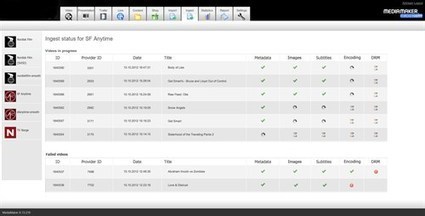
One of the biggest challenges within the OTT and TV Everywhere space today is how to ensure a simple ingest workflow when importing media assets from various content providers. For many service providers with a large media assets library, the ingest workflow can be a major headache with different processes for dealing with multiple video input formats, metadata formats, subtitle formats, applying DRM encryption and transcoding for multiple platforms.
In order to meet these challenges Xstream is now launching a new 'Ingest Service' that greatly simplifies the ingest of media assets and offers a completely transparent process to fit into any media rollout. Additionally, the Ingest Service collects content from multiple sources with ease with a minimum of human resources needed, enabling customers to reduce time spent on setting up ingest workflows, decrease time to market and scale their offerings faster, better and wider than ever before.
|
|
Scooped by
Nicolas Weil
December 14, 2012 10:58 PM
|
A tremendous amount of activity in 2012 also has taken place within video display devices. In a report released in mid-December, Multimedia Research Group (MRG) estimated that the number of shipped units capable—with a software upgrade when available—of HEVC decoding reached 1 billion in 2012. For so many devices to be ready and waiting for HEVC is no mean feat.
|
|
Scooped by
Nicolas Weil
December 14, 2012 10:41 PM
|
This presentation was made at the MPEG meeting in Shanghai, China, in October 2012, related to the input contribution M26906. It gives the details about the dem
|
|
Scooped by
Nicolas Weil
December 8, 2012 4:01 AM
|
Chelsio Communications, a leading provider of 10Gb Ethernet Unified Wire Adapters, ASICs and Unified Storage software solutions, today announced a media streaming enhancement to its T4 Unified Wire adapters targeted at high performance content delivery applications. The Chelsio StreamEngin adds video segmentation offload and per-stream rate limiting functionality to the TCP and UDP offload capabilities of the T4 Unified Wire adapters to significantly reduce CPU utilization, increase video and content delivery capacity and improve service quality. -- Video Segmentation Offload --
Tailored for video content, the StreamEngine segmentation offload technology moves the processing required to packetize video data and control its transmission rate from the server to the network adapter. Video Segmentation Offload (VSO) increases performance and dramatically reduces CPU overhead, allowing significantly higher capacity using the same server hardware. Without VSO support, video server software needs to packetize payload into frames, process each frame individually through the network stack and schedule individual frame transmission, resulting in millions of system calls and packet traversal through all protocol layers in the operating system to the network adapter. -- Rate Shaping --
Rate Shaping within the StreamEngine allows Content Delivery Networks/Video On Demand providers to avoid receive buffer overflows, smooth out network traffic, and enforce Service Level Agreements (SLAs). Without dedicated hardware-based rate shaping or limiting support, the video server must perform rate limiting in software, a CPU intensive task that can be prohibitive at 10Gb and higher rates. READ StreamEngine Product Brief : http://goo.gl/IEqyz
|
|
Scooped by
Nicolas Weil
December 5, 2012 6:06 AM
|
Octoshape, an industry leader in cloud-based streaming technology, has developed an integrated technology showcase with Juniper Networks to provide a foundation for Broadband TV with the scale, quality and cost efficiency of broadcast TV. The showcase is being hosted from Juniper Networks New Jersey-based OpenLab, the Junos® Center for Innovation, which facilitates a collaborative environment for Juniper’s customers, partners and academia to learn about and develop new network integrated software applications.
The showcase integrates Octoshape’s Infinite HD-M Federated Multicast platform with Juniper Networks® MX Series 3D Universal Edge Routers for both Native Multicast, and Automatic Multicast Tunneling (AMT). The HD-M solution for high definition Internet video has been in production since April 2012, and now utilizes the first commercially available AMT relay from Juniper.
|
|
Scooped by
Nicolas Weil
December 5, 2012 2:22 AM
|
Ensequence signed a deal with Sony Electronics that could help ESPN, Turner Broadcasting, AMC and other networks deliver interactive advertising and programming to connected TVs.
Sony said it will embed Ensequence's interactive TV platform in all new TVs, beginning in the first quarter. Viewers that have purchased a 2011 or 2012 model from Sony can receive the platform through a software update, the companies said.
Ensequence and Sony will rely on automatic content recognition (ACR) technology to trigger interactive overlays in programming and advertising.
|
|
Scooped by
Nicolas Weil
December 4, 2012 4:05 AM
|
The new project provides a real-time API for closed captions, making it possible to code against what’s being said on TV right now — and enabling a broad range of applications.
|
|
Scooped by
Nicolas Weil
December 3, 2012 1:43 PM
|
UK Pay TV provider BSkyB will deploy addressable advertising for linear television next summer, starting with a large selection of its owned channels including Sky 1 HD, Sky Living HD and Sky Atlantic HD, but not covering live events, including sports, during Phase One of the roll-out. At launch over 7 million Sky homes will be enabled with the ability to combine sophisticated household profiles with real-time decisions on which home should see which advertisements and the dynamic ad insertion technology that serves pre-placed ads from the PVR hard drive into the linear advertising spots.
|
|
Scooped by
Nicolas Weil
December 3, 2012 4:01 AM
|
The video server is one of the key enabling technologies behind the move from videotape recording to file-based production. The server provides the bridge between content in the digital domain and real-time video. The device has come a long way from its early days as a VTR replacement, and it now forms an essential component in the carriage of video from acquisition to air.
|
|
|
Scooped by
Nicolas Weil
December 22, 2012 4:41 AM
|
With Mozilla considering H.264 and Google refusing to drop it from Chrome, it seems unlikely that WebM will play a significant role in general-purpose streaming going forward. On a positive note, WebM did accomplish two useful functions. First, it wasn’t until after Google released WebM that MPEG-LA announced that free internet distribution of H.264 video would be royalty-free, and I doubt that would have happened absent the viable alternative that WebM promised. Second, WebM quieted all those annoying Ogg Theora promoters who fervently (and incorrectly) believed that Ogg was the future of HTML5 video. Beyond those two achievements, however, WebM is truly forgotten, though not quite gone.
|
|
Scooped by
Nicolas Weil
December 20, 2012 4:59 AM
|
Most people are aware that their TVs, their gaming consoles, their Blu-Ray players and an assortment of other devices are now able to deliver content from a widening array of services such as Netflix, Hulu or Amazon. From a practical standpoint, this means consumers may find their entertainment centers less cluttered with Rokus, Boxee Boxes or maybe even a dedicated Blu-Ray player. This means consumers can get rid of myriad boxes, but the question is whether or not they will ever see the end of the set top box provided by their cable provider.
|
|
Scooped by
Nicolas Weil
December 19, 2012 1:26 PM
|
Here is a How to, the objective is to demonstrate the setup of a PHLS live stream. PHLS means Protected HLS : the custom format of HLS by Adobe. The protection is realized with a AES-128 encryption on the content. To make this configuration, you need a streaming server which will push content via RTMP. Some live transcoders are available from ElementalLive to ffmpeg. And you need too a Adobe Media Server installed to complete this how to. All I write in this post is available via the AMS documentation.
|
|
Scooped by
Nicolas Weil
December 19, 2012 12:51 PM
|
EuroMedia Magazine in their recent "TEST AND MONITOR SEGMENT SURVEY 2012" have asked the following question: A number of players are trialling MPEG-DASH. Is this likely to become standard, and will it help address interoperability issues?
|
|
Scooped by
Nicolas Weil
December 14, 2012 11:01 PM
|
For Netflix vice-president of digital supply chain Kevin McEntee, the US-based video streaming company's shift to using the cloud for transcoding its massive content library comes down to a modern take on the fable of the tortoise and the hare. Or, as he told the audience at the AWS re:Invent conference in Las Vegas last week, it's like a choice between moving a room full of people to another city by using expensive high-performance Ferraris or a fleet of somewhat more humble Toyota Priuses.
|
|
Scooped by
Nicolas Weil
December 14, 2012 10:55 PM
|
A new kind of app is emerging that could change the way Pay TV operators deliver their services via connected TV devices. Until now, the typical Pay TV connected TV app sits in the CE vendor app store, the consumer opens it, enjoys access to the Pay TV services, then closes the app and returns to the general television user interface. The app that TeliaSonera has developed with Samsung for its Nordic markets takes the telco’s customers directly to their TV experience, without having to access the app store.
|
|
Scooped by
Nicolas Weil
December 10, 2012 8:55 AM
|
Mistserver is a open-source multimedia streaming server developed by DDVTech a company based in Netherlands. This server will support some technologies : HLS, HDS, Smooth Streaming, RTMP, …
For the moment, HDS, RTMP and progressive download are available. You can push too livestream via RMTP. The company have two others solutions : MistSteward, MistCenter.
DDVTech positions his solution in a competitive market with some actors : Adobe Media Server, Wowza, Red5, Apache, …
|
|
Scooped by
Nicolas Weil
December 5, 2012 4:28 PM
|
All video services are the same in two important aspects. Even with a small number of concurrent viewers the load becomes substantial, and the users may abandon the service in case of faulty video delivery. The issues with video delivery are often relating to high load and suboptimal use of resources. To address such challenges in our projects, we used a special video load balancer module. In this post, we are going to provide you with details on the balancer and building of efficient video platform by optimal load distribution.
|
|
Scooped by
Nicolas Weil
December 5, 2012 2:53 AM
|
Digital Rights Management (DRM), at its most basic level, has traditionally been considered as the strategic use of technology to monitor and enforce intellectual property licensing agreements by controlling access to digital content as it is being distributed, protecting it from unauthorized use or downright theft. In the modern world, however, the notion of "broadcasting video" now includes over-the-air terrestrial signal distribution, along with cable, satellite, Internet, and mobile/data network broadcasting of content to, seemingly, an unlimited number of viewing devices. In that universe, the DRM label represents a constantly evolving, often proprietary, network of technologies and protocols used by broadcasters to secure the links of a content chain wherever those links are heading.
|
|
Scooped by
Nicolas Weil
December 4, 2012 6:18 PM
|
The newly released JW Player 6 brings HLS support to the desktop. We talk with Wijering about how he did it and what the future holds for MPEG DASH.
LongTail Video recently announced the release of JW Player 6, a major upgrade to the company's popular free and low-cost video player. One key new feature is support for Apple HTTP Live Streaming (HLS), which enables desktop computers to play HLS streams, and for video publishers to support desktop and mobile viewers with one set of adaptive files. It also raises questions about the importance of the Dynamic Adaptive Streaming over HTTP (DASH) spec, which was supposed to deliver the same capability, but is not yet available in the marketplace.
|
|
Scooped by
Nicolas Weil
December 3, 2012 6:12 PM
|
With a lot of conversations evolving around MPEG-DASH during NAB this year, including the joint Adobe / Akamai MPEG-DASH streaming demo, the question prevails: is MPEG-DASH more than a science project, and has true potential to become a future streaming standard?
What appears to be clear is the consensus that HLS has deficiencies, but are the differences important enough to motivate the industry to migrate from established HLS support on devices to MPEG-DASH?
Mike Downey, Principal Evangelist, Media Platform at Microsoft, provided some interesting comments on HLS on my previous PHDS blog post, with a different perspective – potential HLS licensing complications.
|
|
Scooped by
Nicolas Weil
December 3, 2012 4:15 AM
|
Get an advance peek at the online video trends that will shape 2013 and how you can capitalize on the disruption to come.
You will learn:
• What service providers can do to profit from the rise of OTT video
• How the migration to longer-form video content will effect OTT providers and existing Pay TV operators
• How the combination of CDNs and Transparent Caching can be a dynamic duo for service providers
|