Your new post is loading...

|
Scooped by
Nicolas Weil
November 15, 2012 5:00 AM
|
Second-screen application developers generally write to the device. With SmartGlass, Microsoft is asking app developers to do something slightly different, namely: write to a platform. But Microsoft is not asking just anyone to write this way; only those partners to its game developer network who have permission to do so. The larger point may be that SmartGlass, which the Seattle software giant made generally available three weeks ago, at about the same time it released Windows 8, is itself both an app and a platform. That is one of several complicated aspects of this Xbox-related software. Another is its genesis as an app on the Windows Phone.
|
|
Rescooped by
Nicolas Weil
from Video ecosystem
November 13, 2012 9:21 AM
|
Taking their cue from the world of television and the likes of Zeebox, a Dutch film company called 2CFILM has developed what it claims to be the world’s first synchronised second-screen application for use in the cinema.
App – the first film in a series of titles on 2CFILM’s development slate – will be supported by content available through an application for iPhone and Android devices, which delivers a parallel storyline via the app content, bringing the big screen and the mobile device together throughout the film.
The project uses technology based on SyncNow digital watermarking by Dutch firm Civolution and the cross-app development capabilities of another Dutch firm called Service2Media.
ON THE SAME TOPIC : http://www.televisual.com/news-detail/The-first-motion-picture-with-synched-2nd-screen-app_nid-2208.html
Via Olivier NOEL
|
|
Scooped by
Nicolas Weil
November 9, 2012 12:14 PM
|
Broadpeak was demonstrating its nanoCDN technology at the OTT TV World Summit this week, outlining how the innovative solution can dramatically reduce bandwidth requirements and also reduce costs for streaming video. The use of multicast, rather than unicast, for the streaming is at the heart of the solution. Broadband service providers with multicast networks (like telcos where they have a classic IPTV footprint) can harness this approach. A video stream is duplicated (multicast) within the local CDN and client software on the home gateway is then used to convert a multicast stream back to unicast. This means that once in the home, there is no change to how the video is delivered from the gateway to the various multi-screen devices, whether these are laptops, tablets or mobile phones.
|
|
Scooped by
Nicolas Weil
November 9, 2012 11:10 AM
|
castLabs, a leading mobile video technologies and services company, today announces that the Digital Entertainment Content Ecosystem (DECE) has selected the castLabs UltraViolet Download Service Provider (DSP) for use in the UltraViolet Compliance Verification Programme (CVP). As implementations of UltraViolet-licensed devices and media players (“UltraViolet Players”) become ready, DECE will use castLabs’ reference DSP to verify UltraViolet Players’ specification compliance.
|
|
Scooped by
Nicolas Weil
November 9, 2012 11:02 AM
|
The latest release of the zeebox television companion app adds a remote control feature. Virgin Media subscribers in the United Kingdom will be able to use the zeebox app on an Android smartphone as a remote control, while zeebox will automatically recognise which channel they are watching. Similar features will be coming to Sky+ subscribers and users with an Apple iPhone or iPad. Anthony Rose, the co-founder and chief technology officer of zeebox, told informitv that zeebox connects over a local wi-fi network and uses DLNA Digital Living Networking Alliance and UPnP Universal Plug and Play protocols to query what is playing on the device and can control any number of set-top boxes on the same network, collectively or individually.
|
|
Scooped by
Nicolas Weil
November 9, 2012 10:37 AM
|
Farncombe and Intertrust Technologies have implemented a common encryption system for IP multicast. The move potentially enables IPTV companies to adopt a ‘Simulcrypt’ model over their networks combining both Conditional Access (CA) and Digital Rights Management (DRM) technologies, thereby enabling seamless secure content distribution to a variety of devices using different content security solutions. The implementation is the result of a joint development between the two companies. Farncombe carried out the architecture design and integration while Intertrust provided its Content Packaging Tools and Marlin content protection solution. Farncombe says the move will help to remove the barriers dividing the DRM domain, generally used to protect on-demand services, and the CA one, usually limited to securing broadcast services. Intertrust’s Content Packaging Tools are part of a suite of easy-to-use technologies that provide Marlin DRM functionality for services and devices. They allow existing video content to be packaged into the Simulcrypt-compatible Marlin Broadband Transport Stream (BBTS) format.
|
|
Scooped by
Nicolas Weil
November 8, 2012 11:16 AM
|
AmberFin has introduced of group of new file-based media ingest and transcode products that support the Digital Production Partnership (DPP) initiative. The iCR-300-DPP media ingest workstation and iCR-100-DPP transcoder are both designed specifically to create high-quality MXF-wrapped AVC-Intra or D10 assets compliant with the AMWA AS-11 specification and DPP guidelines from tape or line sources. Both systems are available as standalone workstations or scalable enterprise solutions. The workstations offer clearly defined, documented and extensible APIs. They benefit from AmberFin’s Unified QC (UQC) approach, providing automated and manual quality control operation.
|
|
Scooped by
Nicolas Weil
November 8, 2012 10:28 AM
|
It is possible to overstate the complexity of multi-screen video, but the absolute number and types of display devices are indeed increasing, which means that efforts to promote standards and greater simplicity address a live concern. A current initiative, playing out within the MPEG-DASH Industry Forum, among other places, to enable digital rights management (DRM) interoperability is a case in point. Building his case for a common downloadable DRM framework that is independent of but compatible with CE devices of all shapes and sizes, Tranter (VP at NDS, now part of Cisco) names three standards that could play a foundational role, namely: * Simulcrypt—the long-standing DVB protocol published by ETSI used to enable multiple key management systems;
* MPEG-DASH—Dynamic Adaptive Streaming over HTTP (DASH), which became an ISO standard in late 2011; and
* UltraViolet—an authentication and cloud-based rights system deployed over the past few years by a consortium of studios, manufacturers and service providers.
|
|
Scooped by
Nicolas Weil
November 7, 2012 7:19 AM
|
Fraunhofer IIS, the world’s renowned source for audio and multimedia technologies and BuyDRM, the premiere provider of multiscreen media technologies collaborated with HBO Europe's HBO GO broadband SVOD service to showcase the full potential of the new MPEG-DASH ISO standard. As part of the showcase viewers experienced scenes from HBO’s Boardwalk Empire via an Android phone utilizing built-in AAC surround sound technology from Fraunhofer using BuyDRM’s secure video playback client. In combination with MPEG DASH, Android devices become true and trusted consumer platforms allowing HBO Europe to easily offer content in the most efficient, highest-quality way using the AAC Multichannel solution from Fraunhofer. Subscribers to HBO GO on Android can benefit from foolproof surround sound delivered as easy and convenient as watching a BluRay or DVD. Using a variety of KeyOS technologies, BuyDRM’s MPEG-DASH client implementation provides stutter-free streaming as network conditions change. BuyDRM integrated MPEG-DASH support and Microsoft’s PlayReady DRM in the showcase using MPEG video and audio codecs that ship natively with the new Android 4.1 operating system.
|
|
Scooped by
Nicolas Weil
November 6, 2012 10:12 AM
|
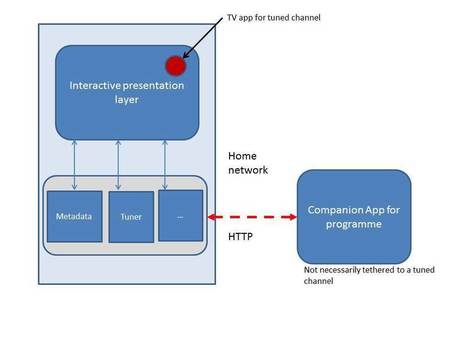
It's been a long time since the last series of blogs on Orchestrated Media. Time for a catch-up. Firstly, we've stopped using the term orchestrated media, and instead talk about dual-screen and companionscreen. Dual-screen reflects where things stand currently: the companion service can synchronise against the broadcast content using various technologies. See Steve's blog about that. The BBC's launch of dual screen for Antiques Roadshow is imminent. Looking ahead, we see the next generation of services allowing a wider set of companion services, where the TV, the companion, and the Web, are inter-communicating, allowing a web site or a companion app to both monitor and control the TV. This gives TV -awareness on web-sites, and web-awareness of TV services. Each of these three domains could be the launch-point for companion screen services, and enage the other two domains as needed. Companion screen pertains to this wider role for the companion device, compared to today.
|
|
Scooped by
Nicolas Weil
November 2, 2012 4:48 PM
|
Slides from Streaming Media West Presentation, "How to Create A DASH-264 player for Adobe Flash" by Jeff Tapper and Michael Labriola of Digital Primates.
|
|
Scooped by
Nicolas Weil
October 30, 2012 9:41 AM
|
The actual OTT market uses Adaptive Bit Rate video format over HTTP (Smooth Streaming, HTTP Dynamic Streaming, HTTP Live Streaming and MPEG-DASH soon) to deliver the content. Although it excludes the DRMs system which is a big topic in itself, here is an overview of the different formats available for each platform and of the different solutions (self-hosted, CDN, Cloud) to handle it.
|
|
Scooped by
Nicolas Weil
October 30, 2012 6:18 AM
|
A tutorial from Marius Preda, MPEG 3DG chair, at the Web3D conference in August 2012. MPEG's application format dealing with augmented reality reached DIS status and is only one step away from becoming in international standard. In a nutshell, the MPEG ARAF enables to augment 2D/3D regions of scene by combining multiple/existing standards within a specific application format addressing certain industry needs. In particular, ARAF comprises three components referred to as scene, sensor/actuator, and media. The scene component is represented using a subset of MPEG-4 Part 11 (BIFS), the sensor/actuator component is defined within MPEG-V, and the media component may comprise various type of compressed (multi)media assets using different sorts of modalities and codecs.
|
|
|
Scooped by
Nicolas Weil
November 15, 2012 4:32 AM
|
As keen observers of the ongoing changes in the CDN solutions and services ecosystem, we sense that the content delivery is at a tipping point where new models are slowly gaining traction and old ones are quickly fading away.
|
|
Scooped by
Nicolas Weil
November 13, 2012 6:03 AM
|
The living room's been something like a holy grail for electronics manufacturers for decades. It's the place where we spend hours every day sitting in front of our TVs, passively flipping channels and watching ads. Even as our smartphones and tablets vie for our attention, TV dominates: Americans still spend an average of 4 hours, 38 minutes a day watching the boob tube. Netflix, on the other hand, which is so popular as to command as much as half the US’s internet bandwidth, only commands 11 hours of our attention per month. Set top box creators have come from every angle, vying for a piece of this lucrative pie. Roku, Boxee, Western Digital, Apple, Netflix, Hulu, Vudu, TuneIn — on and on the list goes, companies looking to get onto your TV. But these devices create as many problems as they solve, though, adding new remotes, inputs, and interfaces into a viewing experience that's supposed to be simple. Theoretically, that puts TV manufacturers at an enormous advantage: if Samsung can design the whole interface, from Netflix to your DVR, it should be able to create a seamless experience that improves upon the disjointed universe of set-top boxes. Sony or Vizio could overlay content on top of your TV, so you can watch a show while reading tweets about it; Samsung already has a great ESPN app that just runs a ticker below whatever you're watching. Your set-top box can't do that, since it's on its own input and takes over the whole screen. Just about every manufacturer bought into this logic, and over the last couple of years store shelves have flooded with internet-connected, content-streaming "Smart TVs." But each of these companies has tried to develop its own interface, its own style, and every attempt has fallen flat. Smart TV interfaces are almost universally slow, clunky, and unnecessarily complex.
|
|
Scooped by
Nicolas Weil
November 9, 2012 11:32 AM
|
Livestream Studio HD500 features 5 HD/SD SDI Inputs and 5 Live Video Outputs (HD/SD SDI, HDMI, Component, S-Video, Composite) in the most compact production suite available today. Built to television broadcast standards, Livestream Studio gives you real-time multiview, cut & fade, graphics overlay, video clip playback & recording (DDR) plus a full audio mixer with cross fade support.
|
|
Scooped by
Nicolas Weil
November 9, 2012 11:08 AM
|
InStream Mobile brings high quality, low latency HD video to iPads, iPhones, and Android devices, with playback of unicast and multicast video. InStream Mobile takes advantage of transport stream multicast to deliver the highest performance media experience to many simultaneous mobile viewers throughout a facility or campus without a dedicated streaming server. It is designed for H.264 video / AAC-LC audio / MPEG transport stream and features multiple preset channels, instant channel tune-in/channel change, and gesture-based fast channel changes.
|
|
Scooped by
Nicolas Weil
November 9, 2012 10:48 AM
|
First things first – What is a Mezzanine format? A mezzanine format is a mid-rez working copy of your video asset which is of sufficient quality to generate your highest output, but small enough to move around, archive, and work with. The goal is to free up resources once all major edits and processing are completed. The source of your mezzanine format can come from many places. When encoding from a tape with a fully completed asset, the encode can be the mezzanine file. When exporting from a non-linear editor such as Final Cut or Avid, the format chosen as the output can be a mezzanine. The point is, all major editing and processing is completed in the highest format available and this smaller asset can take it from here.
|
|
Scooped by
Nicolas Weil
November 8, 2012 1:50 PM
|
Ever since Xbox SmartGlass was announced at E3 2012, I’ve been intrigued at how it works behind the scenes – across games, apps and device platforms. Thanks to a session on the last day of Microsoft BUILD 2012, it turns out to be quite an interesting developer platform, if you can get your hands on it. As Microsoft Xbox Live’s Neil Black explained, the goal of SmartGlass is to simplify the trend of second-screen experiences for both end-users and developers. The games, TV and movies market is fragmented with companion-like apps from publishers, networks, devices and special once-off apps like the Olympics.
|
|
Scooped by
Nicolas Weil
November 8, 2012 10:49 AM
|
The new HbbTV-Requirements Group is dedicated to specifying requirements for version 2.0 of the standard. IRT contributed a document with feature proposals for HbbTV 2.0, including several features from the HBB-NEXT project by IRT and TNO: identity management, second screen / multi-screen and several aspects of media synchronisation. Based on these contributions, IRT and TNO received mandates to work out more detailed feature descriptions in HbbTV feature templates. These will be used to discuss and decide which features will be supported by HbbTV 2.0.
|
|
Scooped by
Nicolas Weil
November 8, 2012 9:57 AM
|
How do broadcasters and VOD services schedule video content to appear on different platforms? We look at the four main methods : #1. Use Excel Spreadsheets #2. Build your own VOD Scheduling system #3. Use Specialist Software #4. Use Media Management Services from Existing Partners
|
|
Scooped by
Nicolas Weil
November 7, 2012 1:50 AM
|
A new cloud-based approach from Signiant offers the promise of consistent validation of file-based content throughout the content distribution ecosystem. Instead of doing what the majority of content players do now – validating and correcting file compliance AFTER the transfer occurs – this new approach helps ensure that the right media format gets delivered for the right platform BEFORE the transfer occurs – saving everyone time and money. Working with standards from the Advanced Media Workflow Association (AMWA) and the Digital Production Partnership (DPP), Signiant demonstrated this new file format compliance technology at SMPTE and IBC, and will be rolling it into the company’s intelligent file movement solutions in early 2013. The asset compliance tool, when integrated into the workflow, allows the broadcaster to define and reference specifications to which any file they receive must conform before it is sent. Signiant solutions then verify the file before it is delivered. Further, the software will not allow the file to be transferred if it doesn’t reach the technical standard required.
|
|
Scooped by
Nicolas Weil
November 6, 2012 9:52 AM
|
Digital Workflow isn’t the most gripping of subjects I’ll admit, but as tapes finally disappear from our production process it’s important to recognise that files can be troublesome things that require careful management. Fortunately the market has spotted the opportunity and there are now a significant number of products available that will manage your workflows - anything from a drop folder into your favourite transcoder, to a multi-stage system with many components doing hundreds of transactions every minute. The one thing all the systems have in common is that they package bits of kit made by other vendors and present them to you as part of a co-ordinated workflow. To make this happen each of the applications or bits of kit – transcoders, QC boxes, loudness normalisers, that sort of thing – provide a software interface to the workflow system that allows them to talk to each other. The problem is that all of these interfaces are proprietary and different, so every time you need to add a new box, or a new feature to an existing box, code in your system needs to be rewritten. As the systems get more complex – as they will for many of us - so the problem gets worse.
|
|
Rescooped by
Nicolas Weil
from Video ecosystem
November 5, 2012 11:03 AM
|
Internet telephony and multimedia communication protocols have matured over the last fifteen years. Recently, the web is evolving as a popular platform for everything we do on the Internet including email, text chat, voice calls, discussions, enterprise apps and multi-party collaboration. Unfortunately, there is a disconnect between web and traditional Internet telephony protocols as they have ignored the constraints and requirements of each other.
Consequently, the Flash Player is being used as a web browser plugin by many developers for web-based voice and video calls. We describe the challenges of video communication using a web browser, present a simple API using a Flash Player application, show how it supports wide range of web communication scenarios in the cloud, and describe how it can interoperate with Session Initiation Protocol (SIP)-based systems. We describe both the advantages and challenges of Flash Player based communication applications. The presented API could guide future work on communication-related web protocol extensions.
Via Olivier NOEL
|
|
Scooped by
Nicolas Weil
October 30, 2012 6:21 AM
|
Netrounds today announced the availability of Netrounds Free, a feature-limited yet fully functional version of its cloud-based IPTV testing and monitoring service. As a forever-free offering, Netrounds Free is targeted to IPTV providers as a much more user-friendly and powerful alternative than traditional open source command line tools, often used during initial IPTV introductions. Netrounds Free includes support for IPTV testing and is automatically provisioned anywhere in the world by downloading and deploying up to two measurements probes. Results from the probes, such as MPEG loss, jitter and invalid stream, are retrieved from the cloud-based servers through an easy-to-use web interface.
|