Your new post is loading...

|
Scooped by
Nicolas Weil
January 9, 2013 5:41 PM
|
Netflix Open Connect, the single purpose video content delivery network launched last year, is now delivering the majority of Netflix international traffic and is growing at a rapid pace in the domestic market.
Netflix Open Connect is now widely deployed around the world, serving the vast majority of Netflix video in Europe, Canada and Latin America, and a growing proportion in the US, where Netflix has over 25 million streaming members.
Now available through Open Connect partners, Netflix Super HD is the highest quality video format offered by Netflix, providing an even better picture on 1080p HDTVs. In the US, Netflix is also for the first time offering a small number of titles streaming in 3D through Open Connect partners.
|
|
Scooped by
Nicolas Weil
January 8, 2013 6:01 AM
|
Eutelsat is launching a dedicated demonstration Ultra HD channel for Europe on the Eutelsat 10A satellite. The first transmissions of content filmed in 4K will start on Tuesday, January 8. Delivering a resolution of eight million pixels, four times the resolution of HDTV, Ultra HD (4K) is poised to mark the next big leap forward in the immersive viewing experience.
|
|
Scooped by
Nicolas Weil
January 7, 2013 4:32 PM
|
Samsung Electronics announced that it will be releasing the Smart TV SDK (Software Development Kit) 4.0 at the 2013 International Consumer Electronics Show (CES) from January 8th to 11th, 2013. The Smart TV SDK will allow Smart TV software development on Linux and Mac, in addition to Windows O/S. By expanding and supporting HTML5 in the Smart TV SDK 4.0, a standard programming language, Samsung has laid the foundation for many software developers to easily take part in development of Smart TV applications which will also help reduce some of the fragmentation for developers and make is easier for cross development from the Opera TV SDK which is largely consolidating the rest of the TV market in terms of rendering engines.
|
|
Scooped by
Nicolas Weil
January 7, 2013 4:26 PM
|
Rovi Corp.’s DivX streaming format has been approved by the Digital Entertainment Content Ecosystem (DECE) for streaming use with UltraViolet. DECE is the industry-wide consortium behind the digital locker service. The approval allows DivX Plus Streaming to be used by UltraViolet retailers to deliver over-the-top video streaming video that adjusts itself based on available bandwidth, and supports 1080p, subtitles and multiple language tracks.
|
|
Scooped by
Nicolas Weil
January 4, 2013 3:53 PM
|
Japanese public broadcaster NHK will present the latest iteration of its 8K Super Hi-Vision system at the 2013 NAB Show. The demo will be a highlight of the NAB’s 2013 Futures Park area of the show. It will feature a presentation theater for viewing the system’s 8k video and 22.2-multichannel sound, including content recorded at the London 2012 Olympic Games.
The system’s 7680x4320 video format provides 16 times more pixels than HDTV. Its multichannel audio system produces a 3D sound space for viewers located anywhere within a large viewing area. Besides the presentation in the theater, NHK will also show for the first time outside Japan the real-time, over-the-air transmission and reception of Super Hi-Vision broadcasts, using two UHF television channels.
|
|
Scooped by
Nicolas Weil
January 3, 2013 5:39 PM
|
EyeIO said its next generation of H.264 software encodes video 45 percent faster and reduces bit rates by an additional 26 percent using studio-level profiles that improve video data on several fronts by more than 50 percent. A company called EyeIO, based in Palo Alto, CA, has announced new technology that enables delivery of ultra-low-bandwidth Internet video in full HD, 3-D, StudioHD and UltraHD (4K Video) formats.
|
|
Scooped by
Nicolas Weil
January 3, 2013 4:32 PM
|
It seems that technology triggers are often accompanied by the hype of future potential benefits, while the real value is elusive and slower to appear than industry journalists, analysts, or pundits would like, but I am going to lay out 10 scenarios that will develop in this still nascent industry during 2013 : 1. The "digital land grab" continues, marked by consolidation, failure, and improved user experiences. 2. Social feeds will be a feature, not the experience. 3. "Discovery" will become a household word. 4. Tablet and smartphone usage reports will become about activities related to the TV. 5. Studios and networks save money, apps grow in 2 directions. 6. Gamification will begin to lose favor with the press and consumers, only to begin to add value again towards the end of 2013. 7. Amazon and Ebay will engage in a battle for the Second Screener's M-Commerce. 8. Cloud-based digital lockers will finally be taken seriously by consumers and the rest of the ecosystem. 9. Device makers will jump into second screen with both feet. 10. ACR and the battle of the digital video ecosystems.
|
|
Scooped by
Nicolas Weil
December 30, 2012 5:39 PM
|
So I started doing some research to compile what I could on making apps for the connected TV platform. I tried to find all the API guides and docs I could find as well as some basic tips on creating a good user experience for the platform. I figured some of you could really use a single location to get all of this information and now you've got it. First off, this is not about connected TV ad platforms, I already wrote that up. This is more about creating video + data experiences for consumers to view through their TV.
|
|
Scooped by
Nicolas Weil
December 28, 2012 6:50 PM
|
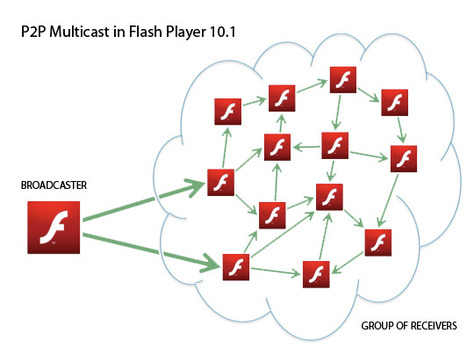
Today Michael Thornburgh, Sr. Computer Scientist at Adobe, submitted a specification for Adobe’s Secure Real-Time Media Flow Protocol (RTMFP) to the Internet Engineering Task Force (IETF) Internet-Drafts repository ( http://tools.ietf.org/html/draft-thornburgh-adobe-rtmfp ;) along with a disclosure of and grant of essential intellectual property rights under royalty-free terms ( https://datatracker.ietf.org/ipr/1942/ ;). RTMFP is a low-level endpoint-to-endpoint data transport protocol designed for real-time and peer-to-peer (P2P) communication. It presents a unified and holistic solution to a number of Internet communication problems, including security, NAT traversal, congestion control and prioritization of parallel media and data flows, variable transmission reliability for messages, and IP address mobility.
|
|
Scooped by
Nicolas Weil
December 28, 2012 4:53 PM
|
Researchers have pushed the boundaries of High Dynamic Range (HDR) video to match our own eyes’ ability to cope with the real world's ever rapidly changing light intensity, such as sun simply going behind clouds. Now researchers at WMG at the University of Warwick (U.K.), have found a way to compress and stream HDR video directly to monitors and mobile devices, such as an iPad.
|
|
Scooped by
Nicolas Weil
December 27, 2012 4:54 AM
|
New product suite achieves new levels for ultra-low-bandwidth Internet video – enabling delivery of full HD 3D, StudioHD, and UltraHD (4K Video) : • eyeIO StudioRes. Built to Hollywood's 4K requirements, eyeIO StudioRes delivers UltraHD, studio-grade H.264 videos (10 bit, 4:2:2 video, xvYCC). eyeIO StudioRes is available for both package media and Internet streaming delivery to bring no-compromise pictures to the next generation of 85" and larger UltraHD/4K screens.
• eyeIO.265. Brings eyeIO technology to the coming H.265 HEVC ITU standard and long-term industry efforts.
• eyeOS. The eyeIO video operating system. A superior, true UNIX™ Operating System featuring advanced kernel enhancements achieving ultra-stability, bare-metal virtualization performance, automatic load-balancing transcoding, closed-environment security, elastic scalability, and advanced 4K video processing including native support for the forthcoming Interoperable Master Format (IMF). eyeOS will be available in beta form for larger enterprises in the spring of 2013.
|
|
Scooped by
Nicolas Weil
December 22, 2012 6:06 AM
|
Unlike Apple's iOS platform, Google has yet to provide an easy way to get live video to Android devices. Worse yet, it hasn't offered a strategy for fixing the situation. Many content owners who want to get their live event-based streaming content on mobile phones and tablets quickly find out that getting it to Android devices is extremely challenging. Unlike Apple’s iOS platform, Google has yet to provide an easy way to get live video to Android devices, and to date, it hasn’t detailed any strategy for fixing the situation. Many content owners I have spoken with, as well as those who help these content owners encode and distribute their video, are now questioning why they should even continue to go through all the trouble of trying to support Android-based devices at all.
|
|
Scooped by
Nicolas Weil
December 22, 2012 5:53 AM
|
Microsoft launches a preview Smooth Streaming plug-in for Adobe's Strobe player; shared use of H.264, AAC, and fragmented MP4 makes it possible. Microsoft today announced that it is launching a preview version of a Smooth Streaming plugin for the Open Source Media Framework (OSMF) player. Developers can use Smooth Streaming capabilities in any OSMF-compliant player, as well as Adobe's own Strobe player.
|
|
|
Scooped by
Nicolas Weil
January 8, 2013 6:08 AM
|
1. Second Screen
2. ACR / Automatic Content Recognition Audio ACR“OS-level” ACRStream capture (NOC) ACRVideo ACRClose Caption ACR 3. API
4. Catch-up TV
5. Companion Experiences
6. Content Source
7. Dual Screening / Second Screening
8. Gamification
9. Grid Guide / Electronic Programming Guide/ EPG
10. Multi-screen / Screen-Shifting
11. OTT (Over-The-Top)
12. Recommendation Engine
13. Search
14. Social Feeds
15. Curated Social Feeds
16. Time-code Synchronized / Spoiler-Proof Social Feeds
17. Social TV
18. Sync-to-Broadcast / Synchronized Experience
19. Transmedia, or Transmedia Storytelling
20. TV Everywhere
21. Simple (Universal Remote Control)
22. Social
23. Seamless (Universal Search and Access)
24. Stimulating (Enhanced Viewing Experience)
25. Discovery
|
|
Scooped by
Nicolas Weil
January 7, 2013 4:42 PM
|
We’ve been talking about ACR (automatic content recognition) in blogs and at conferences for quite some time now (most recently, the 10th prediction for second screen trends in 2013). For many players in the ecosystem (including consumers), the ability to trigger an event on the second screen based on what is happening on the first screen is somewhat of a holy grail of enabling technology capabilities. But as we discussed at NAB in April and at IBC in September, this has so far remained elusive in terms of real scale for consumers reached because of the challenges inherent in each of the various approaches.
|
|
Scooped by
Nicolas Weil
January 7, 2013 4:30 PM
|
New Smart TV Alliance members include manufacturers Panasonic, ABOX42 and TechniSat, and solution providers IBM and Specific Media. The upcoming SDK captures the latest trends and features available to app developers so they will be able to deliver the most current and exciting apps for 2013 Smart TVs from LG, TP Vision and Toshiba. The new SDK features include: Richer applications available from upgraded HTML5, CSS3 and JavaScript specifications3D videoMPEG-DASH support with more reliable audio and video quality with less stuttering and freezingMore and better content choices with updated digital rights management (DRM) features that reflect DRM requirements from content owners
|
|
Scooped by
Nicolas Weil
January 7, 2013 3:34 PM
|
|
|
Scooped by
Nicolas Weil
January 4, 2013 3:07 AM
|
A lot of people think that ASP.NET Web API is basically a fancy framework for building APIs – which couldn’t be further from the truth. Web API is mainly about the new .NET HTTP programming modelit brings to the table – embracing HTTP to perform a whole magnitude of web related tasks; and APIs are just a small portion of that. Hopefully if you follow this blog, you have seen examples of that already, as we often wander in the unkown areas of ASP.NET Web API, beyond building “traditional” APIs. Today, let’s go back to the HTTP programming model and use Web API to asynchronously stream videos.
|
|
Scooped by
Nicolas Weil
January 3, 2013 4:48 PM
|
DASH-264 is almost here, and it will bring the specifics needed for interoperability and widespread use of MPEG DASH. MPEG DASH has been a hot topic in the streaming media world for the past year, but so far the talk has been about future possibilities. At the recent Streaming Media West conference in Los Angeles, Alex Zambelli, senior technical evangelist for the Microsoft Media Platform, explained why DASH will take off in 2013.
|
|
Scooped by
Nicolas Weil
December 30, 2012 6:15 PM
|
The Open Source Media Framework (OSMF) is an Adobe-led, open-source ActionScript 3 coding framework for loading, playing and displaying media. Just as Adobe created the Flex Framework to standardize and expedite the creation of applications on the Flash Platform, OSMF is a means to standardize media handling in your Flash Platform experiences. With video, audio, and image playback handled so differently in AS3, OSMF succeeds at creating a simplified, standard way to work with all media inside Flash. In this DZone Refcard you will learn about Strobe Media Playback, Flash Media, key events, streaming, composite elements, and more.
|
|
Scooped by
Nicolas Weil
December 30, 2012 2:21 AM
|
|
|
Scooped by
Nicolas Weil
December 28, 2012 4:56 PM
|
The older VP8 hasn't taken the world by storm, but VP9 could give Google a fresh start in its attempt to popularize royalty-free video streaming.
VP9, the successor to Google's VP8 video compression technology at the center of a techno-political controversy, has made its first appearance outside Google's walls. Google has built VP9 support into Chrome, though only in an early-stage version of the browser for developers. In another change, it also added support for the new Opus audio compression technology that's got the potential to improve voice communications and music streaming on the Internet.
|
|
Scooped by
Nicolas Weil
December 27, 2012 5:18 AM
|
Hot of the presses, RED has just announced — as they said they would — their REDRAY 4K playback system, a 6-pound, DVD Player-sized playback device for $1,450. It has built-in 3D capabilities, offers 802.11N wireless connectivity/playback, is DCI-compliant, and debuts with it new security and file formats to make 4K distribution a reality — along with a brand new delivery network to debut at Sundance in January. The player itself is scheduled to ship in early 2013.
|
|
Scooped by
Nicolas Weil
December 25, 2012 4:02 PM
|
There are HTML5 apps and games that rival and even outperform native applications. The biggest brands such as Google, YouTube, LinkedIn and OpenTable (among others) are championing HTML5 — and delivering the goods. The only thing holding back HTML5 from killing native apps is DRM. Let’s be honest, production studios are in business to make money from the content they produce. Right now, native apps provide the protections studios require, but the ironic thing is that every video delivered through native apps is not Flash-based. Publishers have already done the heavy lifting for HTML5 delivery. They want to deliver videos in a mobile app that works across all devices — phone, tablet, laptop, and connected TVs. They want to build once, deliver everywhere. Publishers will then be able to get out of the dev shop business, and premium content will flourish online. HTML5 DRM enables this to happen — opening the floodgates.
|
|
Scooped by
Nicolas Weil
December 22, 2012 5:59 AM
|
Many broadcasters have begun offering personalized services or creating social media platforms for their audiences, in particular taking advantage of the possibilities of hybrid broadcast/broadband approaches. This generally means that the listener/viewer has to create an account on the broadcaster website where their personal settings and preferences are stored. This new way of operating represents a small revolution in the usually anonymous broadcast world and it has many legal and technical implications: what information can be stored about the audience? How can it be used? What can be shared with partners? Where is the data stored? For how long? And so on. The legal aspects will need to be addressed, but in this post I’ll focus on the technical aspects.
|