Your new post is loading...

|
Scooped by
Nicolas Weil
January 25, 2013 12:25 AM
|
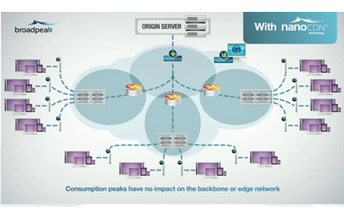
Broadpeak’s nanoCDN solution will be launched commercially early this year, giving telcos and cable operators the opportunity to reduce bandwidth consumption and simultaneously increase the QoE for customers watching live streaming video on multiscreen devices. This product has the potential to change the economics of streaming but until now there have been only limited details available about how it works and what it can achieve. Broadpeak has just started releasing more details.
|
|
Scooped by
Nicolas Weil
January 25, 2013 12:15 AM
|
|
|
Scooped by
Nicolas Weil
January 23, 2013 6:19 PM
|
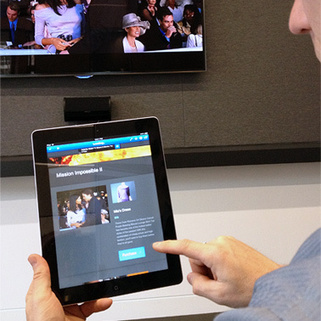
The aim, the company says, is to take today’s fast-growing but chaotic landscape of TV “companion” apps – such as ones delivering athlete stats to people watching the Olympics, or crime-fighting details to CSI junkies—and make it easier to create and see such additional content. The Akamai proof of concept—shown for the first time to MIT Technology Review last week—consists of a few parts. The first is a piece of software that would reside on whatever device you use, whether it’s a television set fed by a cable or satellite service, a set-top box delivering content over the Internet, or even a DVR playing a recorded show. A one-time authentication process links your tablet or smartphone to the device. Real-time information on what show you’re watching—even as you change the channel—gets sent to Akamai’s servers. Relevant secondary information then gets streamed directly back to your smartphone or tablet in near real-time.
|
|
Scooped by
Nicolas Weil
January 23, 2013 6:12 PM
|
Microsoft announces the general availability (GA) release of Windows Azure Media Services. This release is now live in production, supported by a new media services dev center, backed by an enterprise SLA, and is ready to be used for all media projects.
|
|
Scooped by
Nicolas Weil
January 20, 2013 4:27 AM
|
|
|
Scooped by
Nicolas Weil
January 18, 2013 9:55 AM
|
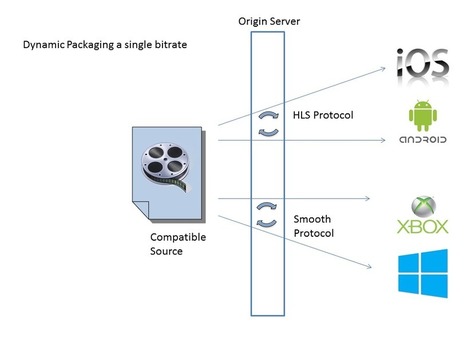
Does anyone have any information on the new ‘on the fly converting’ for media services?
Yes, that feature is shipping in the coming days, we refer to it as dynamic packaging, you could also call it just-in-time packaging, dynamic muxing, etc. Specifically, it will offer the ability to: Transmux from a single source format into two different streaming formats.
|
|
Scooped by
Nicolas Weil
January 18, 2013 6:33 AM
|
UltraHD and 4K have been the big talk at CES this year and it seems the terms has been getting some mix up.
|
|
Scooped by
Nicolas Weil
January 16, 2013 3:46 PM
|
The DASH264 Implementation Guidelines defines an interoperability point for the video distribution over the top. The guidelines cover both live and on-demand services and includes MPEG-DASH profiles, audio and video codecs, close caption format and common encryption constants.
For this version of guidelines, the client is expected to support presentation of high-definition video up to 720p (based on H.264/AVC Progressive High Profile)presentation of stereo audiosupport of basic subtitlesbasic support for encryption/DRM
|
|
Scooped by
Nicolas Weil
January 14, 2013 4:05 PM
|
As video untethers itself and increasingly finds consumers and their mobile devices, a priority for cable operators is finding the most efficient way to support the different platforms. The focus is on adaptive bitrate streaming (ABS), which is the way in which the right amount of data is sent to devices based on their configuration and conditions on the wireless network they are on. The problem is that three main platforms are vying for supremacy: Apple’s HTTP Live Streaming (HLS), Microsoft’s Smooth Streaming (part of Silverlight) and Adobe’s Dynamic Streaming for Flash.
|
|
Scooped by
Nicolas Weil
January 13, 2013 2:32 PM
|
Vanguard Video announces the availability of V.265, a new professional encoder based on the next-generation HEVC (H.265) International Draft Standard. Vanguard Video first demonstrated its HEVC encoder technology at IBC 2012, and now releases V.265 for evaluation by companies involved in high-demand video applications. V.265 can deliver up to 50% reduction in bandwidth and improved video quality compared to that of the existing H.264 standard.
V.265 allows OEMs to determine HEVC's improvements in quality and performance and can take advantage of Vanguard Video's patented video compression technology yielding high-quality video while maintaining real-time operation. In addition, V.265 provides a powerful toolset for offline encoding especially suited for Cloud-based encoding implementations.
|
|
Scooped by
Nicolas Weil
January 11, 2013 3:27 PM
|
|
|
Scooped by
Nicolas Weil
January 11, 2013 6:20 AM
|
Un seul écran ne suffit plus à notre nouvelle consommation télévisuelle. Et les deux phénomènes à la mode du moment, TV connectée et Social TV, ont au moins un grand point en commun : leur dépendance croissante vis-à-vis d'un écran compagnon, appelé "le second écran", qui --dans les faits-- devient de plus en plus le premier ! Réunis en marge du CES à Las Vegas, les professionnels du secteur, qui continuent de tâtonner, ont fait le point hier sur un nouveau format et un écosystème naissant et prometteur, à l'occasion d'un "Sommet du 2nd écran" qui a fait salle comble. Compte-rendu.
|
|
Scooped by
Nicolas Weil
January 11, 2013 6:05 AM
|
The Society of Motion Picture and Television Engineers (SMPTE) and the Video Services Forum (VSF) on Dec. 10 announced the latest two standards in a series that creates a standardized framework for the transport of video-over-Internet-Protocol (IP) networks. The documents, including the latest additions known officially as SMPTE ST 2022-5:2012 “Forward Error Correction for High Bit Rate Media Transport Over IP Networks” and SMPTE ST 2022-6:2012 “Transport of High Bit Rate Media Signals over IP Networks (HBRMT),” are now available via the SMPTE digital library. SMPTE ST 2022-5:2012 defines a methodology that can be used to provide forward error correction for the recovery from network transmission errors. SMPTE ST 2022-6:2012 defines a uniform data mapping format that supports a wide variety of HD-SDI and 3G-SDI video signal formats.
|
|
|
Scooped by
Nicolas Weil
January 25, 2013 12:21 AM
|
London-based Monterosa Productions has announced the commercial launch of its LViS tools for creating second-screen applications for television. Having supported over a thousand hours of primetime programming with second-screen services, Monterosa has already used its framework to deliver a range of sports, entertainment and advertising applications.
The LVis platform includes a suite of re-usable elements to power interactive experiences, such as play-along gaming, prediction gaming, secure and compliant voting and competitions, opinion polling, advertising and coupons. It allows broadcasters, producers or brands to customise template apps, or make their own from scratch, and deploy the resulting HTML5 experience across multiple platforms. It also integrates with industry standard systems to drive on-screen graphics.
|
|
Scooped by
Nicolas Weil
January 23, 2013 6:22 PM
|
Netflix and YouTube have teamed up to launch DIAL, a protocol that helps developers of second-screen apps to discover and launch applications on smart TVs and connected devices. The effort is already getting support from a number of notable players, including Samsung, Sony, Hulu and the BBC. DIAL could become a key piece in efforts to establish an open alternative to Apple’s AirPlay. YouTube and Netflix have been collaborating quietly on these efforts for months. Word first got out when some inquisitive users discovered traces of DIAL back in December. The DIAL website publicly launched with little fanfare and a brief mention on Engadget earlier this month, and now, Netflix is for the first time sharing some key details of the project with GigaOM. DIAL stands for “discovery and launch,” which pretty much sums up what the protocol is meant to do. DIAL-enabled second screen apps will be able to discover DIAL-ready first-screen devices in the same network and launch apps on them. That may sound trivial, but it’s actually solving a big problem for second screen app developers.
|
|
Scooped by
Nicolas Weil
January 23, 2013 6:16 PM
|
The guidelines, published as Version 0.9, specify support for both live and on-demand services, and crucially give detail of how different encoding profiles are linked to interoperability points needed for conformance testing. One main area of clarification concerns end to end content security around the DRM and encryption. DASH unifies encryption around the Common Encryption (‘cenc’) protection scheme, to enable interoperability and avoid having to support multiple encryption methods, which would increase device processing costs. But all along DASH has avoided specifying an end to end end-to-end DRM so that vendors and service providers can choose their own. So DASH 264 provides a framework for multiple DRMs to protect a content file by adding instructions or relevant proprietary information in predetermined locations to a file that is encrypted with Common Encryption. This then specifies encryption parameters that can be applied by a scrambling system and key mapping methods based on a common key identification scheme. The point of this single key identification scheme is that it enables the same encrypted version of a file to be used by different DRMs. The new guidelines reduce the encryption parameters and associated metadata to specific use cases for VOD and live content, simplifying the overall system and again improving prospects for interoperability.
|
|
Scooped by
Nicolas Weil
January 21, 2013 4:18 PM
|
The C++ library provides interfaces for the DASH Streaming Control and the Media Player to access MPDs and downloadable media segments. The download order of such media segments will not be handled by the library this is left to the DASH Streaming Control, which is an own component in this architecture but it could also be included in the Media Player. In a typical deployment, a DASH server provides segments in several bitrates and resolutions. The client initially receives the MPD through libdash which provides a convenient object orient interface to that MPD. The MPD contains the temporal relationships for the various qualities and segments. Based on that information the client can download individual media segments through libdash at any point in time. Therefore varying bandwidth conditions can be handled by switching to the corresponding quality level at segment boundaries in order to provide a smooth streaming experience. This adaptation is not part of libdash and the MPEG-DASH standard and will be left to the application which is using libdash.
|
|
Scooped by
Nicolas Weil
January 18, 2013 1:18 PM
|
While today’s price tag for most Ultra High Definition (UHD) televisions are around $10,000, Strategy Analytics expects prices to fall to the sub-$2000 range within the next five years, a factor that will help drive global sales to over 50 million units per year by 2020. The company made these forecasts on the eve of CES 2013 and set the scene for UltraHD to take its bow as possibly the next big thing in TV.
|
|
Scooped by
Nicolas Weil
January 18, 2013 9:51 AM
|
Aspera has integrated IRT’s MXF Analyser into Aspera Orchestrator (pictured), Aspera’s web-based application and SDK platform for automating and managing high-speed file transfers. With MXF rapidly gaining acceptance as a mandatory industry standard, Aspera claims Orchestrator is the first solution to comply with public broadcaster demands for MXF file validation with special focus on file transfer applications.
|
|
Scooped by
Nicolas Weil
January 16, 2013 3:48 PM
|
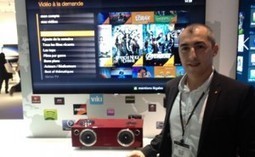
Orange will introduce what could be the world’s first HEVC-based service this spring, delivering HD movies to 2013 models of Samsung Smart TVs in France. The innovation coincides with the launch of a new Orange VOD Connected TV service in partnership with Samsung, covering pre-2013 models as well. The company revealed the partnership with Samsung at CES last week and was demonstrating the VOD service on the Samsung booth. A Full HD movie (1080p, 1920×1080 at 24/25 fps) was being played at 3Mbps thanks to the new video codec, which is due to become a standard imminently.
|
|
Scooped by
Nicolas Weil
January 16, 2013 3:43 PM
|
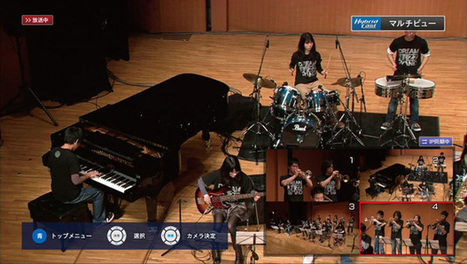
By the end of the year, Japanese audiences will be able to interact with some of their favorite TV programs in ways never before possible.Japan Broadcasting Corp., the country’s public broadcaster (better known as NHK), is putting the finishing touches on a technology dubbed Hybridcast. The system will enable Internet-based content to be tightly integrated with broadcast digital television, similar to what is promised for the Advanced Television Systems Committee 2.0 technology in the United State
|
|
Scooped by
Nicolas Weil
January 14, 2013 3:34 PM
|
The next step change in video displays will be a move to a resolution four times that of high-definition television. That is the message from the International CES trade show in Las Vegas, which provides an annual high-pressure barometer check for the winds of change blowing through the consumer electronics industry. If the manufacturers have their way it will be only a matter of time before we all want even higher-definition television. So-called 4K displays, with a resolution of around 4,000 pixels across, were a prominent theme of the show, displacing the emphasis of previous years on smart and 3D-capable televisions, although these are still prevalent. So is this just another fad, in an attempt to create premium products as high-definition displays become commoditised, or does this represent the next natural evolution in television?
|
|
Scooped by
Nicolas Weil
January 11, 2013 3:30 PM
|
Perhaps this week or next, DASH-264, the long-awaited MPEG DASH interoperability specification will go public. This is the needed document that will at last spell out codecs and DRM schemes for DASH.Fraunhofer, now showing in the South Hall of International CES, is a member of the DASH industry forum (DASH-IF), and is giving visitors an audio sample of what they can expect. Stereo audio in DASH will use the HE-AAC codec, an MPEG standard developed by multiple companies. For multichannel audio, however, the spec will offer three possible solutions: DTS-HD, one from the Dolby family, and HE-AAC multichannel, Fraunhofer's baby.
|
|
Scooped by
Nicolas Weil
January 11, 2013 1:48 PM
|
The big focus for 2013 at Cisco Service Provider Video Technology Group is ‘unity in video experiences’. What that means in practice is taking multi-screen TV to the next level, ensuring that Pay TV services are available on every device around the home and beyond and that the service feels like a unified whole, just delivered to different screens. Cisco has combined its existing cloud and network capabilities with the client-side software products and knowledge acquired through NDS to enable ‘unity in video experiences’. Those two companies were married last summer and the result of that union, after a five month gestation period, is Videoscape Unity, which was introduced at CES this week. This platform is the basis upon which Cisco service provider customers can build their next-generation offers.
|
|
Scooped by
Nicolas Weil
January 11, 2013 6:16 AM
|
Just in case anyone was in doubt that the 4K revolution is happening, Nvidia has just announced that its much anticipated Tegra 4 mobile chipset will include "4K Ultra-High-Def video support"
The Tegra 4 is significant because it has six times the GPU horsepower of the Tegra 3, and also incorporates ARM's most advanced CPU core, the Cortex A15. Just a few days ago, we predicted that ARM was going to be a technology to watch this year. The new chipset will obviously be used in mobile platforms, from phones to tablets, and quite possibly games controllers and consoles, and the raw video processing power is unmatched in what is already a feverishly active area for technical innovation.
|