




Not sure what to make of the new format on the block? Read this to get up to speed on how HEVC was created, the challenges it now faces, and when it will go into everyday use.

 Your new post is loading...
 Scoop.it! Not sure what to make of the new format on the block? Read this to get up to speed on how HEVC was created, the challenges it now faces, and when it will go into everyday use. 
No comment yet.
Sign up to comment
Scoop.it!

Designed to support next-generation GPU and CPU architectures, release 2.0 is now available for Elemental’s suite of products for video processing, packaging and streaming live and on-demand video. The release brings together a host of features for multiscreen video delivery to create a unified platform providing substantial benefit to Elemental customers:
•Increased performance – With next-generation processor architectures and an optimized video pipeline, Elemental systems offerdouble the performance and density of previous generation solutions in asingle RU footprint. Increased throughput allows customers tobring multiscreen assets to market more quickly and in a smaller footprint than ever before.
•Comprehensive codec support – Support for multiple codecs running simultaneously on a single platform provides customers with aseamless migration path from existing video delivery standards tofuture compression technologies. Elemental solutions offer MPEG-2,H.264, VC-1 and HEVC / H.265 encoding with patented compression technology as well as support for JPEG 2000 and ProRes mezzanineassets.
•Current and future standards – In addition to support for common video streaming protocols such as Adobe RTMP and HTTP DynamicStreaming (HDS), Microsoft Smooth Streaming and Apple HTTP LiveStreaming (HLS), Elemental software supports newly emergingtechnologies including MPEG-DASH, Ultraviolet and 4K Ultra HD.
•Advanced encryption and protection – Secure content with a variety of integrated technologies including Civolution forensic watermarkingfor both live and VOD content, Adobe Flash Access, Apple Sample-AES and Microsoft PlayReady as well as DRM solutions from NDS, Verimatrix and Widevine.
•Increased monetization – Support for ESAM dynamic ad insertion and Nielsen ID3 tagging give pay TV operators a path to multiscreenvideo delivery and a way to deepen audience engagement andinteraction. Media companies can also take advantage of the Adobe Primetime ecosystem for ad insertion as well as ad integration solutions from BlackArrow and mDialog.
•Augmented audio options – With release 2.0, robust support for audio encoding is available across the Elemental product line, includingsupport for DTS Express, Dolby Digital, Dolby E and Dolby DigitalPlus. In addition, release 2.0 features support for Dolby Digital Plus inApple HLS and Microsoft Smooth Streaming, raising the bar for audio fidelity in the streaming market.
•Accessibility features – Audio loudness management lets broadcasters adhere to the CALM Act and new captioning features, includingcaption burn-in, SMPTE-TT and SCC file creation let content creatorsadhere to captioning requirements coming into effect later this year.Elemental makes it easy to caption content originally aired on television and destined for delivery over the Internet.
Scoop.it!

NTT DOCOMO, INC., Japan’s leading mobile operator and provider of integrated services centered on mobility, announced today that it will license a software for decoding HEVC, the new international standard for video coding, in March. DOCOMO’s HEVC decoding software is the world’s first of its kind for Full HD playback on smartphones.
DOCOMO played a leading role in the new standard’s development beginning in 2007, including proposing the concept and technical requirements of using HEVC for mobile video services. Beginning in late 2011, DOCOMO verified feasibility by demonstrating some of the world’s first and most advanced real-time HEVC software decoding on tablets and smartphones. DOCOMO’s achievement of Full HD video on smartphones and real-time decoding of UHDTV video at 60 frames per second on PCs were key milestones in the standard’s eventual realization.
Nicolas Weil's insight:
See product page : http://goo.gl/8cwU2
Scoop.it!
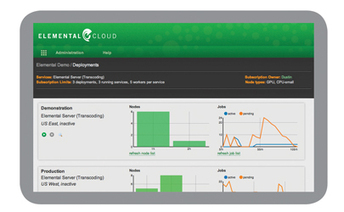
One company that is pioneering cloud transcoding is Elemental Technologies. In September it introduced its Elemental Cloud, a Platform as a Service (PaaS) that utilizes the hardware capacity of Amazon Web Services (AWS) to give video providers the chance to expand capacity or enhance their disaster recovery options. Several media companies have tested the solution and the first (unnamed) customers signed up late last year. “They are all extremely well known in the media industry and they are global in scope,” is all the vendor can say at this point.
Scoop.it!
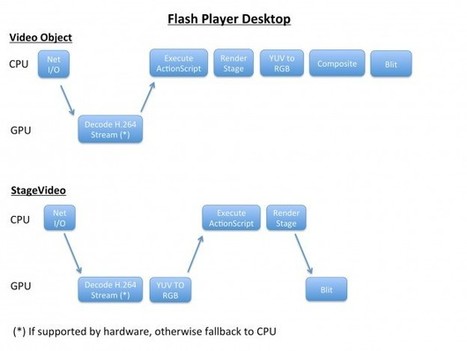
Color transformation and compositing can be securely performed by the hardware. This is different with H.264 decoding, since it opens room for driver vulnerabilities. As a result, H.264 Video decode is not available for DRM-protected content on the desktop.
Scoop.it!

There is a lot of buzz today in the online video community about Amazon’s recent entry into the cloud video transcoding space. Of course, this is nothing entirely new for Amazon Web Services; popular cloud encoding services have run on Amazon EC2 infrastructure for years now. With Elastic Transcode, Amazon takes a step up the cloud stack, offering a Software-as-a-Service that competes directly with GridVid.me, Zencoder, and other popular cloud video encoding services.
Competition is great for customers and the industry in general, and we welcome Amazon to the market. We are also glad to see that Amazon followed our lead and introduced their product with pricing almost as low as ours. The message to customers is clear: You don’t have to spend a lot of money on encoding.
With this blog post, I want to take a finer look at Amazon’s Elastic Transcode service and how a few key features compare to other cloud video encoding services, like GridVid.me.

Nicolas Weil's comment,
January 31, 2013 5:42 AM
Amazon Elastic Transcoder features : http://goo.gl/xJZCs
Nicolas Weil's comment,
January 31, 2013 5:46 AM
Amazon Focuses On Cloud Video With Elastic Transcoder Services, Price-Busting + Available Everywhere : http://goo.gl/7hVDp
Scoop.it!
The FP7 HBB-Next project (http://hbb-next.eu) presents a proof-of-concept of mutli-source multimedia synchronisation. The demo shows content from four sources.
Scoop.it!
Elemental Technologies, the leading supplier of video solutions for multiscreen content delivery, today announced support for the next-generation HEVC (high-efficiency video coding) H.265 codec. With a flexible software-based architecture, video processing solutions from Elemental offer support for the new codec via a seamless software upgrade. The bandwidth efficiency associated with the adoption of HEVC promises to greatly expand delivery of high-quality, high-resolution video over bandwidth-constrained networks.
Elemental H.265 encoding exhibits bandwidth reductions of up to 50% compared to H.264. Elemental software is format agnostic and enables interoperability with applications and standards vital to multiscreen infrastructures, such as the integration of H.265 into MPEG-DASH workflows featuring H.265-decoding-capable DASH players. H.265 support will be commercially available in Q2’13 on Elemental flagship platforms, including Elemental® Live and Elemental® Server, which deliver high-quality, high-efficiency video processing required for streaming live and on-demand video to any device. H.265 reference streams are available from Elemental today.
Elemental will demonstrate concurrent H.264, MPEG-2, and H.265 encoding on a single Elemental® Live system at NAB in April. Elemental will also present a webinar on the topic of HEVC for multiscreen video on February 7. To register for the webinar, click here. To learn more, please click here to visit Elemental’s H.265 microsite anddownload the Elemental H.265 whitepaper.
Scoop.it!

Japan just announced that in July 2014 they would begin transmission of their first ever 4K broadcast. The 4K services will be transmitted directly from Japanese satellites, then onto the broadcasters on the ground. The Japanese government is hoping the announcement will spur sales of super HD television sets, which will in turn boost sales of Japanese electronics makers.
Super HD 4K televisions have approximately four times the regular resolution of the currently sold HD TVs. Many South Korean electronic producers have begun sales on their 4K TVs along with some of Japan’s big brands such as Panasonic, Sharp and Sony.
The Ministry of Internal Affairs and Communications previously announced that the TV service would start sometime in 2016.
Scoop.it!

By multicasting popular content over cellular networks, carriers figure they can conserve valuable 4G capacity. But as consumers use their smartphones and tablets to personalize their multimedia consumption, the ship may have already sailed on multicast’s potential.
Scoop.it!

The ITU has approved a new video formatthat could bring 4k video to future broadband networks, while also making streaming HD video available even on bandwidth-constrained mobile networks. The H.265 standard, also informally known as High Efficiency Video Coding (HEVC), is designed to provide high-quality streaming video, even on low-bandwidth networks.
The hope is that, through improved compression techniques, H.265 will enable publishers to stream 1080p video with about half as many bits as required today. That should make true streaming HD video available not just in broadband households, but on mobile and tablet devices, using networks that are a lot more bandwidth-constrained. Doing so could make online video more widely available in markets with poor connectivity or mostly mobile connections.
Scoop.it!

At CES, the pundits worried over the super-high cost of super-high resolution televisions. And then there was the lack of Ultra HD content. But a forthcoming compression standard appears to be the fix and Apple is already in the thick of it.
Scoop.it!

The new HEVC (High Efficiency Video Coding) compression standard will give Pay TV operators like Danish cable operator Stofa the opportunity to increase the quality of multi-screen video and that could have important implications for Connected TV. According to Thomas Helbo, CTO at Stofa, “It is an interesting idea to have high quality TV provided as a multi-screen solution to the big screen TV in the living room. Over the next 5-10 years we will see more services change from DVB-C (classic cable television) to IP and at the same time see an increase in the quality requirements for IP video streams.”

Valery's curator insight,
January 25, 2013 5:55 AM
Funny how you can read opposite things within the same week. To summarize : HEVC will improve quality but is no miracle. |
Scoop.it!

With Intel Media: 10-20 year leap in television this year [Feb 16, 2013] and Microsoft entertainment as an affordable premium offering to be built on the basis of the Xbox console and Xbox LIVE services [Feb 13, 2013] this is a highly probable assumption.
Scoop.it!

A practical approach to standardization requires more than object models and interface definitions to gain serious traction. Consequently, the FIMS Technical Board recognized the need for a tool to help FIMS implementers validate their implementations. Signiant did as well, given the test-driven development methodology we use to develop software. Using such an approach, developers create and code tests to validate an implementation before coding it. This leads to higher quality products that can be evolved quickly.
Signiant initiated the FIMS Test Harness Project within the FIMS Technical Board and helped design and build a test harness for contribution to the FIMS effort. The ultimate goal of the test harness is to remove barriers to FIMS adoption and promote implementation of FIMS-compliant interfaces.
Scoop.it!

If you've been watching streaming video for as many years as I have, then no doubt you agree that one of the most remarkable changes has been the quality of video delivered. It wasn't that long ago when postage stamp sized windows with audio and video out of synch were the norm, whereas today, we can watch on big screen TVs, with buffering a random occurrence.
Scoop.it!

CES 2013 is officially concluded. With over 150,000 people in attendance and almost 2 million square feet of exhibit space, the CEA has stated that it was their largest convention since its founding over 45 years ago.
I journeyed to Sin City to get an up-close look at the Ultra HD offerings from some of the biggest display manufacturers in the world, including Sharp, LG, Samsung, ViewSonic, Toshiba, Sony, Westinghouse, and Vizio. I will share my impressions of each in a few moments. There appears to be plenty of cynicism regarding the future of Ultra High Definition technology. Many believe that price, lack of content, insufficient bandwidth, and enormous screen size will inevitably lead to its failure. While some of these limitations are apparent, one cannot simply dismiss the adoption of new technology because it sounds impossible or impractical. Technology is always evolving, and sometimes rapid changes in infrastructure allow for further adoption of new technology. Remember the incredible doubt when flat panel TV’s first debuted? These display companies know that their Ultra HD products are very expensive, and many of them intend to bring manufacturing costs down over the next few years. So why should we doubt progression? Ok, moving on to the summary…
Scoop.it!

This proposal extends HTMLMediaElement providing APIs to control playback of protected content.
The API supports use cases ranging from simple clear key decryption to high value video (given an appropriate user agent implementation). License/key exchange is controlled by the application, facilitating the development of robust playback applications supporting a range of content decryption and protection technologies.
This specification does not define a content protection or Digital Rights Management system. Rather, it defines a common API that may be used to discover, select and interact with such systems as well as with simpler content encryption systems. Implementation of Digital Rights Management is not required for compliance with this specification: only the simple clear key system is required to be implemented as a common baseline.
The common API supports a simple set of content encryption capabilities, leaving application functions such as authentication and authorization to page authors. This is achieved by requiring content protection system-specific messaging to be mediated by the page rather than assuming out-of-band communication between the encryption system and a license or other server.
Scoop.it!

High Efficiency Video Coding (HEVC), also referred to as H.265, is a video standard that is being developed through an ISO/IEC collaboration. HEVC planning was begun way back in 2004, shortly after H.264 was finalized and the topic has been getting a lot of exposure in the industry over the past few months. Many questions remain about HEVC including how quickly it can be implemented into the current video ecosystem and when content owners will adopt it.
Scoop.it!

The transport of HEVC using DASH seems to be a hot topic in media, see for example here, here, here, andhere. In this blog post I'd like to highlight technical changes in order to support HEVC over DASH. The immediate response would be that no updates of DASH are required to support HEVC as DASH is coding format agonistic but the devil is in the detail. In fact, the core DASH specification [ISO/IEC 23009-1:2012] doesn't require any updates but the file format and transport stream standards are currently amended. This may impact DASH as its segment formats are based on the file format and transport stream.
Scoop.it!

VideoPipe is an application that allows a user to visually connect and manipulate videoprocessing modules to create a realtime procedural and configurable processing pipeline for video streams. It allows the user to experiment in an intuitive way with processing modules and tweak their parameters while the system is running, making the development and prototyping of video processing pipelines faster and easier.
Scoop.it!

A few days ago, a new proposal was put forward in the HTML Working Group (HTML WG) by Microsoft, Netflix, and Google to take DRM in HTML5 to the next stage of standardization at W3C. This triggered another uproar about the morality and ethics behind DRM and building it into the Web. There are good arguments about morality/ethics on both sides of the debate but ultimately, the HTML WG will decide whether or not to pursue the specification based on technical merit. I am a member of the HTML WG. I was also the founder of a start-up that focused on building a legal, peer-to-peer, content distribution network for music and movies. It employed DRM much like the current DRM in HTML5 proposal. During the course of 8 years of technical development, we had talks with many of the major record labels. I have first-hand knowledge of the problem, and building a technical solution to address the problem.
The Encrypted Media Extensions (DRM in HTML5) specification does not solve the problem the authors are attempting to solve, which is the protection of content from opportunistic or professional piracy. The HTML WG should not publish First Public Working Drafts that do not effectively address the primary goal of a specification.
Scoop.it!

Netflix and YouTube have led the development of a simple protocol known as DIAL to allow second screen apps to talk to server applications on network-connected devices and displays. Consumer electronics companies including Samsung and Sony have contributed to the development. YouTube, Dailymotion, Hulu, Disney and the BBC are among those interested in developing applications. It offers a simple open alternative to Apple AirPlay or other solutions such as Miracast and could change the way apps work with network connected televisions.
Valery's curator insight,
January 28, 2013 7:13 AM
If it could not end up with a split of the protocol in 10 differents proprietary version, that would be great.
Scoop.it!

H.264, we hardly knew ye — except we did and that now veteran format has become part of the foundation for the delivery of high-quality video over the Web. This changes later this year as a new format hits our virtual town,HEVC (High Efficiency Video Coding), which requires even less storage and bandwidth.
Scoop.it!

In a real deployment scenario, playback should be as robust as possible in the face of server-side problems. As our architecture stands today, playback can suffer from two problems regardless of the amount of backend redundancy that is deployed. Those problems are liveness, where a packager advertises a stale view of live, and dropout, where a packager has gaps in its fragment list.
HDS/HLS fail-over is the server side solution to solve the live-ness and dropout problems in HDS/HLS respectively.
This article describes a basic failover setup with redundant packagers and Varnish as a reverse proxy. The article further provides users a step-by-step guide to writing a basic varnish configuration script to configure Varnish for the failover solution.
|




