
Video Breakthroughs
247.9K views |
+10 today


Monitoring innovations in post-production, head-end, streaming, OTT, second-screen, UHDTV, multiscreen strategies & tools
Curated by
Nicolas Weil
 Your new post is loading...
 Scoop.it! 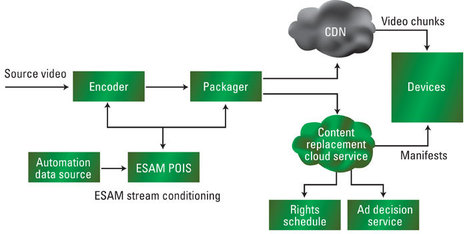
What is significant about all ABR formats is that they separate the control aspects of the protocol from the video data. They share the general concept that video data is encoded into chunks and placed onto an origin server or a CDN. To start a streaming session, client devices load a manifest file from that server that tells them what chunks to load and in what order. The infrastructure that serves the manifest can be completely separate from the infrastructure that serves the chunks.
The separation of these concerns provides a basis for dynamic content replacement, as it is possible to dynamically manipulate the manifest file to point the client device at an alternative sequence of video chunks that have been pre-encoded and placed on the CDN. The ability to swap chunks out in this way relies on the encoding workflow generating video chunks whose boundaries match possible replacement events.
Nicolas Weil's insight:
On the same topic, see "Live & On Demand Targeted Ad Insertion" from Seawell Spectrum http://goo.gl/wefuJ 
Scoop.it!

Bridge Technologies has launched PocketProbe, an iPhone app that enables objective analysis of real network performance of streaming media, in a simple to use, easy to understand tool that technical staff can carry anywhere.
PocketProbe contains the same OTT Engine found in the company’s VB1, VB2 and 10G VB3 series digital media monitoring probes, enabling confidence validation and analysis of http variable bit-rate streams from any location. PocketProbe is available in two versions: the free application can validate five HLS streams in round-robin mode, provide analysis and manifest consistency alarms, play back media in the various profile bit-rates, and graphically display the actual chunk download patterns and bit-rates. The full version also offers the ability to validate HDS and SmoothStream manifest files and store twenty-five streams with all profiles.
Nicolas Weil's insight:
Wicked ! Only DASH is missing :-(
Scoop.it!

Ultra-HD 4K broadcasting may be all the rage at NAB, but the implementation of the HEVC codec that makes it all possible is happening first for streaming video over-the-top. At NAB, virtually every video processing developer is highlighting adoption of HEVC/H.265 into their products; here we'll take a look at a few of the most notable who were willing to talk about their NAB plans in advance.
Scoop.it!

Just in time for NAB, VisualOn and Discretix are announcing the release of SecurePlayer 2.0, which provides publishers with iOS and Android playback protected with Microsoft PlayReady DRM (digital rights management).
The player works with MPEG-DASH, HLS, and Smooth Streaming content. SecurePlayer 2.0 combines VisualOn's OnStream MediaPlayer+ with Discretix's DRM security.
Scoop.it!

The ViBE VS7000 multi-screen video encoding/transcoding system from Thomson Video Networks now provides support for the High Efficiency Video Coding (HEVC) compression standard for live and offline applications. The company says the ViBE VS7000 will lower operator OPEX for delivery of a wide range of convergent TV services including OTT as well as traditional IPTV and cable applications, thanks to the use of HEVC. During NAB Thomson Video Networks will demonstrate its new live and file-based HEVC encoding solution up to Ultra HD format, working with various HEVC players. One such device is a player from Japanese mobile operator NTT DOCOMO, which has just announced that it will license video decoding software for HEVC to enable full HD video streaming on smartphones and other devices.
The ViBE VS7000 will also be demonstrated with VisualOn’s OnStream MediaPlayer+ running HEVC decoding on Nexus tablets. OnStream MediaPlayer+ enables high-quality playback across multiple platforms, including iOS, Android, Mac OS and Windows Desktop.
Scoop.it!

From
ht

With over-the-top content delivery, HEVC and 4K becoming hot topics for this year's NAB Show, Harmonic is unveiling significant enhancements to its ProMedia suite of adaptive bit rate (ABR) solutions for multiscreen processing and delivery that include support for HEVC and Ultra HD.
Scoop.it!

Our open source tool suite consists of several components. On the client-side we provide libdash and the DASH plugin for the VLC media player (also available on Android). Additionally, our suite also includes a JavaScript-based client that utilizes the HTML5 media source extensions of the Google Chrome browser to enable DASH playback.
Furthermore, we provide several server-side tools such as our DASH dataset, consisting of different movie sequences available in different segment lengths as well as bitrates and resolutions. Additionally, we provide a distributed dataset mirrored at different locations across Europe. Our datasets have been encoded using our DASHEncoder, which is a wrapper tool for x264 and MP4Box.
Finally, a DASH online MPD validation service and a DASH implementation over CCN completes our open source tool suite.
Nicolas Weil's insight:
Very nice suite of tools. Kudos to all the Alpen-Adria-Universität team !
Scoop.it!

Encoding specialist Telestream couldn't contain itself to just one piece of news for this week's NAB conference. On Friday, it announced that Vantage, it's video transcoding and workflow solution, is going to the cloud. A new product, Vantage Cloud, runs on a cloud-based infrastructure, and connects with local workflows. That gives customers the flexibility to turn to Telestream's cloud encoder when they have a temporary spike in processing needs, or when they need outside help working with new regulations or formats. Combining local and cloud solutions, Telestream says, creates a unified hybrid workflow where users can get jobs done quickly without large investments in hardware. Telestream is partnering with Amazon Web Services (AWS) on the cloud solution.
Scoop.it!

The IAB’s Video Ad Serving Template, or VAST, was developed to provide publishers and advertisers with a common language for video player technology. In parallel, the Digital Video Multiple Ad Playlist, or VMAP, was created to detail ad insertion possibilities in instances where a programmer doesn’t control the video player or end-point distribution channel for content it owns.
The purpose of these two standards is to make video advertising more scalable and straightforward for industry participants, and Adobe is happy to announce that our Adobe Primetime Ad Serving is fully VAST 3.0 and VMAP 1.0 compliant. It is capable of both generating and reading VAST 3.0 ad calls, and allowing for inventory rights sharing among programmers and distributors with VMAP 1.0.
Scoop.it!

Things become more complicated when trying to extend the physical model to an online streaming world that includes HTTP-based streaming protocols such as HLS. HLS is based on many fragments of a video file linked together by a text file called a manifest. When implementing HLS, the most straightforward method is to simply add a URL that links to the manifest, or m3u8 file. This has the benefit of being extremely easy, basically fitting into the existing model.
The drawbacks are that HLS is not really like a static media item. For example, an MP4 is very much like a video track on a DVD; it’s a single video at a single resolution and bitrate. The HLS manifest consists, most likely, of multiple bitrates, resolutions, and thousands of fragmented pieces of video. HLS has the capacity to do so much more than an MP4, so why treat it the same?
Nicolas Weil's insight:
Dynamic or static manifests : HLS is still a "dirty" technology which we hope DASH to make disappear on the long run...

Nicolas Weil's comment,
April 9, 2013 12:30 AM
Read also "Video Concatenation? HLS to the Rescue!" http://blog.zencoder.com/2013/01/18/concatenation-hls-to-the-rescue/
Scoop.it!

Saffron Digital, which recently joined Akamai’s NetAlliance Partner Program, has leveraged its relationship with the leading cloud platform provider to launch a comprehensive end-to-end UltraViolet (UV) solution. The new solution will enable retailers, content owners, operators and device manufacturers to take advantage of the business opportunities presented by UV. Using a common file format (CFF), UV aims to engage consumers with the ultimate value proposition for premium video content: buy it anywhere and play it on any device you own.
Saffron Digital, which has been offering UV-like digital locker services since 2009, has integrated its secure online video platform with Akamai’s Sola Media Solutions and global CDN to create an “out-of-the-box” UV solution that simplifies and shortens time to market. As part of the relationship, Saffron Digital will develop UV storefronts that have its proprietary CFF player at their core.
|
Scoop.it!
Adobe's plans for Primetime highlight both the strengths and limitations of HLS and DASH, as well as the fact that Flash isn't going away anytime soon.
From a technology perspective, the Primetime player will support multiple existing streaming technologies, depending upon the platform. Not surprisingly, the iOS and Android SDKs support HTTP Live Streaming (HLS), with Android support provided by a full HLS (v4) video stack that will extend HLS compatibility back to Android 2.3, and avoid many of the problems reported with Google’s own HLS implementation.
The recent big news is that Adobe will add HLS support to the Primetime Player by this summer (2013), but not to the Flash Player itself. Though on the desktop, Primetime licensees could also use HTTP-based Dynamic Streaming (HDS), the only single technology that could address all platforms will be HLS.
Adobe plans to add DASH to Primetime (but not the Flash Player) by the end of 2013, but this will only extend to the desktop and Android versions of Primetime, not iOS--the Primetime SDK for iOS will only support HLS. According to Ashley Still, Adobe’s director of product management for video solutions, Adobe made this decision because DASH support on iOS would require client-side transmuxing from DASH to HLS, which could cause performance issues during some playback scenarios.
Nicolas Weil's insight:
"DASH to HLS transmuxing on iOS could cause performance issues" : isn't it the way everybody does right now or is Adobe searching for an excuse ?
Scoop.it!

European-based satellite bandwidth provider SES has succesful tested an end-to-end file transmsission solution for UltraHD content using the H.265 coding scheme. The compressed 3840×2160 pixel (4K) signal was broadcast from an Astra satellite at 19.2 degrees East in DVB-S2 using a data rate of 20 Mbps. According to those that saw it, the live transmission provided significant improvements in file size and image quality when compared to H.264 (MPEG-4 AVC) compression.
The company used technology from Harmonic and Broadcom Corp. to show that it can be done at the SES Industry Days in Luxembourg (April 18-19), using Harmonic’s ProMedia Xpress and a HEVC decoder reference-design system based on Broadcom’s BCM7445 Home Gateway Chip for receiving and displaying HEVC encoded UltraHD television transmissions.
Nicolas Weil's insight:
Well done !
Scoop.it!

Fraunhofer IIS and Unified Streaming (USP) have begun a collaboratin designed to extend the ecosystem for HE-AAC MPEG-DASH streaming, enabling broadcasters and service providers to deliver the best possible MPEG-DASH (dynamic adaptive streaming over HTTP) streaming experience for video and audio-only services.
The two parties say that HE-AAC has emerged as the global standard for broadcasting and streaming multimedia content, including Internet radio or Web TV, digital radio and digital television. It is natively supported by Android Jelly Bean, iOS, Windows 7/8, Mac OS, the leading HTML5 browsers. Therefore, says Fraunhofer and USP, service providers in many cases only need to encode their content in a single audio format, HE-AAC Multichannel.
Nicolas Weil's insight:
Interesting partnership - one more for the pushy USP !
Scoop.it!
Nicolas Weil's insight:
Full NAB presentation here : http://nvidia.fullviewmedia.com/gtc2013/0320-210B-S3099.html
Scoop.it!

At this year’s NAB show in Las Vegas, Motorola moves beyond basic technology demonstrations and will exhibit a practical implementation of HEVC with its first HEVC encoding and decoding in real-time. One demo will feature a real-time HEVC encoder delivering streaming content to a Google Nexus 10 tablet for real-time decoding and playback. A second demo will showcase real-time HEVC HTTP livestreaming to an Apple iPad (4th generation). A third demo will show an IP set-top box decoding HEVC. Motorola’s demonstrations will highlight how the compression efficiency of HEVC enables high-quality video delivery over bandwidth constrained networks to multiple platforms.
Scoop.it!
ATEME has announced what it says is the industry’s first open source implementation of a software media player supporting High Efficiency Video Coding (HEVC). The implementation is available immediately. Service providers and broadcasters are able to accelerate experimentation of the new HEVC Codec standard in the field thanks to this development, the company says.
GPAC is an open source media player that can be used to playback live or file-based audio and video content and also to encapsulate and transmit such content as a stream. Those functionalities are now extended to files or streams encoded with HEVC, the latest video compression format standardized by ITU as H.265. GPAC has been validated with a 1080p High Definition content delivery chain. Work is now ongoing to extend the use cases to Ultra High Definition.
Scoop.it!

World’s first subtitling technology that uses “Automatic Contents Recognition” to Identify, Sync and Service your subtitles or captions - efficiently and effectively... To any device, in any workflow.
Nicolas Weil's insight:
Interesting approach...

Jinil KO's comment,
April 12, 2013 2:44 PM
Most advanced technology on subtitle / captioning I think : ) with ACR!
Scoop.it!
Akamai Technologies showed a second screen proof of concept that syncs up complimentary smartphone and tablet content with what's happening on the main television screen.
Nicolas Weil's insight:
More info here : http://goo.gl/Mf1Dx
Nicolas Weil's comment,
April 11, 2013 6:52 PM
More on same topic : http://www.engadget.com/2013/04/09/akamai-hyperconnected-living-concept/

Benoit Derive's comment,
April 12, 2013 5:33 AM
Interesting... using a technology such as watermarking ?
Nicolas Weil's comment,
April 12, 2013 1:59 PM
It seems to be more like video fingerprinting of a visually displayed QR code but the demo videos don't show (!) this part of the process...
Scoop.it!
StreamingMedia.com readers first heard about Adobe Primetime in February 2012, when Adobe announced the project and made the first parts of it available at that year's Mobile World Congress. Fourteen months later, Adobe is announcing the general availability of Primetime at the NAB conference. Primetime is a comprehensive modular tool for broadcasters streaming content online, and it includes components for distribution, ad insertion, DRM (digital rights management), and analytics. Because the platform is modular, broadcasters are free to choose the elements they need. They can also connect Primetime to other ad servers or analytics tools, if they prefer.
Adobe's goal in creating Primetime was to help broadcasters further their reach, keep viewers engaged for longer, and help them monetize that reach and engagement. Adobe aims to keep distribution simple by letting one player and one workflow deliver video to all platforms. Primetime streams HLS video, which plays in a Flash player on the desktop. For now, Primetime supports live, linear, and on-demand video on Windows and Mac desktops, as well as iOS and Android mobile devices. Adobe announced that later this year it will expand support to include HTML5 on mobile devices, Roku, Xbox, and connected TVs. With this release, Adobe has also announced that Adobe Analytics (the new name for SiteCatalyst) is integrated with Primetime and offers granular data on individual viewer experiences right down to the 10-second level. Adobe Analytics is integrated into Primetime's media player.
Scoop.it!

To simplify delivery workflows, we are enhancing our protocol support with Adobe Primetime: Adobe Primetime Player will support HTTP Live Streaming (HLS), in addition to the existing HTTP Dynamic Streaming (HDS) on the desktopHLS will be available on all Adobe Primetime Player mobile platformsSupport of MPEG-Dash in the future
Nicolas Weil's insight:
HLS everywhere, DASH nowhere : is it a good sign for DASH support which is taking ages to come to life inside Adobe's product range ? Their first announcement for this upcoming support was more than one year ago now (http://goo.gl/EvqHK). Please, Adobe, help us get rid of HLS instead of pushing it as a standard of the future - it's a dead-end technology...
Scoop.it!
Rovi Corporation has unveiled DivX Video Service, an end-to-end video solution for multi-screen video delivery that is designed to integrate with and enhance TV Everywhere and OTT entertainment services. Building upon core DivX video technologies and DRM, as well as MainConcept professional encoders, DivX Video Service offers components for managing the video distribution chain from creation and secure delivery to multi-screen playback.
DivX Video Service is available now and supports a range of entertainment distribution models including digital downloads and connected-device streaming. Rovi plans to update DivX Video Service to support HEVC/H.265 later this year.
Nicolas Weil's insight:
Interesting alternative. Unfortunately, no Apple device is supported : http://www.divx.com/en/devices/browse So the question is : is it really TV/OTT everywhere ?
Scoop.it!

There is also the performance element in that state-of-the-art cloud transcoding platforms can be best for live streaming where latency must be kept to a minimum. Elemental Technologies, exhibiting at NAB, has scored heavily with leading broadcasters by touting high transcoding performance based on massively parallel processing within the cloud. By using clusters of off the shelf graphical processing units, Elemental keeps costs down while being able to boast that it can transcode both SD and HD content “faster than real time”, which is not quite as magic as it sounds. It merely means that transcoding is not on the critical time path and is executed more quickly than some of the other functions involved in end to end content delivery. Transcoding then does not add to the latency budget.
Nicolas Weil's insight:
NAB news from Elemental, Zencoder, Haivision & Media Excel.
|







Nothing is too much to get the MPAA certification. A must-read.