 Your new post is loading...

|
Scooped by
Nicolas Weil
April 1, 2013 5:44 PM
|
Nothing was more welcome after day 1 of EBU BroadThinking 2013 than a good night of sleep, in order to reset the tech hype counters and make some mental room for two new sessions on broadcasters’ CDNs and the latest advances of hybrid platforms. What would be the best broadcasters’ CDN architectures today, what would be their smartest (green) evolutions, would CDN-Federation standards finally bring interop reality over hopes, what would be the most advanced deployments and future of HbbTV, how it compares with YouView in the UK : day 2 agenda was looking quite attractive – and indeed the presentations were packed with valuable informations and experience feedbacks. So here is the recap of the most interesting DAY 2 presentations and a short report on some insightful demos that were playing on the EBU floor right to the conference.
|
|
Scooped by
Nicolas Weil
March 28, 2013 1:02 AM
|
Building for Connected TV is complicated
The TV Application Layer originated from our ambition to run BBC iPlayer, News and Sport applications for Connected TVs on as many different devices as possible. There are hundreds of different devices in the marketplace and they all use slightly different technology to achieve the same result. Having figured out how to build an application on a specific device we want to use this knowledge to build additional applications for that device. Our answer to this challenge is the TV Application Layer (TAL). By abstracting the differences between devices and creating a number of TV-specific graphical building blocks (like carousels, data grids and lists), we provide a platform upon which we can build our applications.
|
|
Scooped by
Nicolas Weil
March 28, 2013 1:15 AM
|
In our previous posts about Netflix personalization, we highlighted the importance of using both data and algorithms to create the best possible experience for Netflix members. We also talked about the importance of enriching the interaction and engaging the user with the recommendation system. Today we're exploring another important piece of the puzzle: how to create a software architecture that can deliver this experience and support rapid innovation. Coming up with a software architecture that handles large volumes of existing data, is responsive to user interactions, and makes it easy to experiment with new recommendation approaches is not a trivial task. In this post we will describe how we address some of these challenges at Netflix.
|
|
Scooped by
Nicolas Weil
March 26, 2013 6:07 AM
|
4K/HD HEVC CODEC for Video Streaming : We exhibit some types of our HEVC Encoder. These achieve UHD Video Streaming, HD mobile video streaming, and live streaming also, because of high compression efficiency and stable CBR of our HEVC encoders. - High Quality and Stable CBR Software HEVC Encoder SDK responded up to 4K - HD Real-time Software HEVC Encoder - Real-time FPGA HEVC Encoder, this is the first step to the ASIC Encoder
|
|
Scooped by
Nicolas Weil
March 21, 2013 3:52 PM
|
Ericsson recently demonstrated how live UHDTV could be enabled via a next-generation delivery system during the European Broadcasting Union (EBU) Production Technology Seminar in Geneva, Switzerland. The demo, focused on interoperability and using Ericsson technology to receive an off-air feed of a 4:2:0 file-based system and receive and decode as 4K UHDTV, showed how high quality fast moving images can be captured for sports and live action broadcasting, which are seen as a key driver for the uptake of UHDTV. Central to both parts of the 4K UHDTV demo was the ‘Simulsync' synchronisation technique, the technology used by Ericsson to accurately synchronise the left and right channels of 3D contribution feeds. In this case, the UHDTV 4Kp25 content feed was split into four 1080p25 quadrants, synchronously encoded into MPEG-4 AVC and transmitted. Four receivers, in phase lock, decoded the received bitstream to reproduce the 4Kp25 content feed.
|
|
Scooped by
Nicolas Weil
March 21, 2013 2:19 PM
|
2009 Master’s Thesis by Muhammad Rizwan Asghar
|
|
Scooped by
Nicolas Weil
March 20, 2013 4:38 PM
|
Further reinforcing the digital content ecosystem’s roster of technology support, Motorola Mobility’s SecureMedia content protection has been approved by the Digital Entertainment Content Ecosystem (DECE) for streaming UltraViolet content. Now, service providers using SecureMedia can offer subscribers ready access to their UltraViolet digital entertainment collections anytime, anywhere and on any device.
SecureMedia is extending the purchasing, collecting and sharing content in the cloud experience to consumers’ favourite connected devices by giving service providers a way to encrypt and process UltraViolet content in compliance with DECE’s specifications for streaming content protection.
|
|
Scooped by
Nicolas Weil
March 20, 2013 3:21 PM
|
It’s rare that moviegoers are encouraged to fiddle with their smartphones during a film, but that’s the case with App, the new Dutch movie directed by Bobby Boermans. Before going to see the film, moviegoers are asked to download a free app (available for Android and iPhone) to enhance the plot, which involves a 21-year-old psychology student who becomes addicted to her smartphone following a tragic accident. The App app uses SyncNow, a digital audio watermarking technology originally developed by Civolution to prevent illegal downloads.
|
|
Scooped by
Nicolas Weil
March 18, 2013 4:03 AM
|
Our presentation from the media web symposium 2013 in Berlin on the open source landscape around MPEG-DASH as well as on cloud-based services for MPEG-DASH
|
|
Scooped by
Nicolas Weil
March 15, 2013 1:55 PM
|
Deluxe Digital Distribution is expanding its video catalog service, which encodes videos to enable viewing across multiple devices, to cover the needs of over-the-top (OTT) video providers and to enable use with UltraViolet. Deluxe On Demand provides access to tens of thousands of pre-encoded and pre-encrypted movie and TV titles in more than 50 formats, allowing users to access content on set-tops, PCs, Apple and Android devices, gaming consoles and connected HDTVs.
|
|
Rescooped by
Nicolas Weil
from CDN Breakthroughs
March 12, 2013 1:57 PM
|
Because content delivery networks (CDNs) are at the heart of next-generation IP video infrastructure, they are the logical place to add personalization. With the right approach, service providers can take advantage of the CDN replication model while delivering personalized content. At the same time, they can ensure the network scales to achieve quality expectations. There are many good reasons to personalize content, including : - Targeted ads - Emergency alerts - Blackouts - Quality adjustments To take control of the delivery mechanism, service providers must build a server-side version of the client-based adaptive streaming concept. Introducing two new components will bring more intelligence and processing power into the CDN to improve overall HTTP behavior and performance: A session manager retrieves the contextual information needed to customize the content and tell the cache in the CDN which changes to apply to the content.A video processor in the cache generates the new content to be sent to end users based on the original content and the information delivered by the session manager.
|
|
Scooped by
Nicolas Weil
March 12, 2013 5:36 AM
|
The Open Source Media Framework (OSMF) doesn’t respond well when you pass it a local F4M file path for playback. Playing back local HDS fragments is an edge case, but enough people have encountered this problem that I think it deserves a little attention.
|
|
Scooped by
Nicolas Weil
March 11, 2013 6:15 PM
|
Google's licensing agreement with MPEG LA, and while the impact on streaming is likely to be small, the implications may be significant for other technologies like WebRTC. [...] As always, Google’s profit motive for WebRTC is opaque. The best contender for an actual motive was proposed by Tsahi Levent-Levi in the VisionMobile blog, who opined, “The real value for Google lies in allowing them to serve more ads and mine more insights out of people’s browser behavior – these are things that Google treasures.” Whatever the motive, WebM certainly has a greater chance of succeeding in a nascent market like WebRTC than in existing markets that have already embraced other technologies.
|
|
|
Scooped by
Nicolas Weil
March 30, 2013 2:15 PM
|
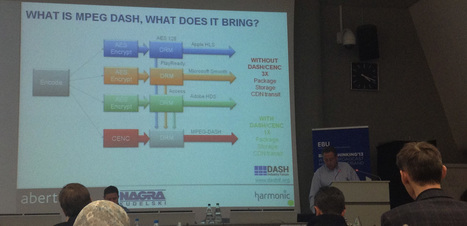
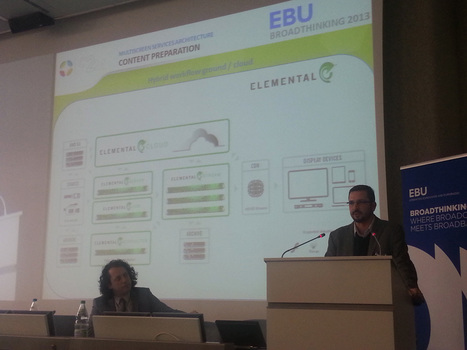
Geneva in late March doesn’t feel as wild as a Las Vegas boulevard, but still there was a reasonable amount of gaming excitement at the EBU headquarters, where several events were following each other, beginning with a DASH Interoperability Forum meeting which was closely followed by the BroadThinking event, where industry actors and broadcasters come to show off their latest implementations advances and/or share the results of their real-life deployments or research studies. A good way of managing the transition between TV Connect and NAB… Where Broadcast meets Broadband : that’s the promise of the EBU’s hybrid event which flies between industry competition, standardization efforts and broadcasters’ realpolitik – all wrapped in a warm and funny ambiance provided by the various speakers and the EBU team gently lead by Bram Tullemans whom I’d like to thanks personnally here for the presentation invitation (kudos also to Filka, Peter and Eoghan for the organization!). Actually the 2013 edition was a major success because it allowed the participants to get a rather good idea of the general trends of the industry, and at the same time to go deep in technology when needed, while having opportunities to discover edge tech demos on the lobby attending the conference room. It’s virtually impossible to render a complete report of everything that has been said or shown there during two days by so many quality speakers (including OnlineVideoFrenchSquad group distinguished members Lionel Bringuier [Elemental Technologies], Martin Boronski [M6 Web], Thierry Fautier [Harmonic] and Nicolas Weil[Challenge2Media] – Les 4 Mousquetaires /poke @sfaure ), but I’ll nevertheless try to provide you here a selection of relevant informations that will help you grasp the trends and prepare the upcoming tradeshows efficiently… So let’s start with DAY 1 recap !
|
|
Scooped by
Nicolas Weil
March 28, 2013 1:30 AM
|
At NAB, taking place in Las Vegas April 8-11, Envivio will introduce
new products and showcase new developments in next-generation
software-based video processing that optimize the convergence of
traditional TV and multi-screen services : - An Ultra HD 4K technology demonstration
- HEVC HDTV video compression, enabling up to 50 percent bit-rate savings while preserving video quality
- HEVC video streamed to a tablet in MPEG-DASH format
- TV Anytime capabilities including applications such as Catch-up and Start-over TV, highlights creation, ad insertion and nPVR
- Introduction of a new product that further personalizes the multi-screen user experience
- High efficiency MPEG-2 and MPEG-4 AVC (H.264) statistical multiplexing
- Envivio True Motion Experience, a new technology for high-quality streaming in MPEG-4 AVC format to connected TVs
- Video packaged by Envivio Halo(TM) network media processor in the Adobe HTTP Dynamic Streaming (HDS) format, protected by Adobe Access
|
|
Scooped by
Nicolas Weil
March 26, 2013 6:42 AM
|
In one of the first significant pre-NAB announcements, cloud encoding companyZencoder is releasing the Zencoder Live Cloud Transcoding service, an open API that offers simple and scalable encoding for live video. Using the API, publishers upload an RTMP stream from a lightweight encoder on a laptop. Once uploaded, Zencoder creates adaptive bitrate HLS and RTMP streams for viewers.
|
|
Scooped by
Nicolas Weil
March 21, 2013 7:16 PM
|
ACCESS and Verimatrix announced at TV Connect that they have jointly produced a new product, Verimatrix Gateway to address security concerns around the adoption of multiscreen media sharing. The new product combines NetFront Living Connect, the Digital Living Network Alliance (DLNA) component from ACCESS, with the ViewRight Gateway security solution by Verimatrix to provide an integrated security and in-home media sharing solution. The at-show demo sees ViewRight Gateway enable translation between incoming content streams from a managed distribution network, or stored recordings, and corresponding stream formats that are optimized for in-home distribution using NetFront Living Connect. The demonstrated and trusted secure formats are DTCP-IP and enhanced security HLS.
|
|
Scooped by
Nicolas Weil
March 21, 2013 3:42 PM
|
The BBC has called for technology standardisation for second screen services in order to help move the the broadcast sector forwards. Speaking at TV Connect yesterday, BBC senior technologist for mobile and dual screen, Jeremy Kramskoy, said that common standards were important in terms of bringing down development and technology licensing costs. He also said that in the future connected home, when synchronisation will increasingly result in different web-powered devices talking to each other, “standardisation has to happen, otherwise it’s going to be a complete nightmare.”
|
|
Scooped by
Nicolas Weil
March 20, 2013 5:13 PM
|
Vidmind, a pioneering End-to-end Cloud TV technology provider for operators, broadcasters and retailers, announced today its partnership with Media Excel, an innovator of adaptive bitrate, multi-device transcoding for multiscreen video delivery. Media Excel was chosen by Vidmind not only because of its powerful transcoding solution which produces superior quality video in multiple formats but also because of the adaptability of the Media Excel platform. Media Excel’s HERO product can be operated as a local service or on a Cloud service. This allows Vidmind to run the encoding process at the customer’s headend but manage all services through the Cloud.
|
|
Scooped by
Nicolas Weil
March 20, 2013 3:29 PM
|
Agama Technologies, the video service quality assurance expert, is introducing the next generation of its Analyzer OTT for adaptive bitrate (ABR) streaming services at TV Connect 2013. The Analyzer OTT supports continuous 24/7 monitoring as well as testing and troubleshooting applications, making it ideal in all phases of deployment, operation and expansion. Both Microsoft Smooth Streaming services and Apple HTTP Live Streaming services can be analyzed in any combination. Sophisticated multi-dimensional presentation of QoE and QoS with timeline analytics provide a solid understanding of relevant technical quality parameters and how they affect the viewing experience.
|
|
Scooped by
Nicolas Weil
March 19, 2013 10:23 AM
|
Video infrastructure company Harmonic launched a major new product today, ProMedia Carbon MP, a professional cloud-based transcoding service available from the Amazon Web Services Marketplace. Harmonic is targeting a range of professional users with this release, including media professionals with only occasional transcoding needs, content owners and service providers that need a hand with occasional transcoding spikes, and service providers that want to create cloud-based transcoding farms.
|
|
Scooped by
Nicolas Weil
March 15, 2013 2:00 PM
|
Neil Hunt is likely the most important Netflix executive that nobody's ever heard of. While everyone in tech media knows CEO Reed Hastings and Chief Content Officer Ted Sarandos, Hunt's kept a low profile despite the pivotal position he holds as the company's chief product officer. Hunt looks after the video service's technology, including the streaming platform, as well as the tech behind the new feature announced yesterday, which will enable subscribers to share what they watch with their Facebook friends. Hunt also oversees the unprecedented amount of user data that Netflix sits on. The data helps his team create the algorithms that support Netflix's recommendation features. At a time when the cost of licensing content is spiking, Hunt said in an exclusive interview withThe Verge that these recommendations help Netflix and its subscribers get the most out of Netflix's video library by suggesting titles that customers are more likely to enjoy. Hunt also talked about those nasty holiday site outages, why Hollywood and Web movie distributors need better supply-chain technology, and why he thinks the film industry places too much emphasis on pixel counts when the sweet spot for improving viewing quality is higher frame rates.
|
|
Scooped by
Nicolas Weil
March 13, 2013 11:03 AM
|
"TV CONNECTÉE & SECOND ÉCRAN.LE DESIGN PARADOXAL" de NURUN + INFOPRESSE 06 MARS 2013
|
|
Scooped by
Nicolas Weil
March 12, 2013 5:38 AM
|
I’ve always been curious about what is contained in the bootstrap data for HDS content. Recently, I had the chance to find out and do some fun development with Node.js. We’ve been kicking around the idea of building a tool set for Adobe Media Server using Node.js and possibly socket.io. Last weekend we got some of the ideas going and one of those was parsing the hds bootstrap data created when content is packages for HDS delivery. The bootstrap data can live in a couple of places: In the <metadata> node of an F4M fileIn an external .bootstrap file The .bootstap file contains binary data and the F4M file contains the same binary data that has been Base64 encoded. So, getting to the data is pretty trivial – either read in the .bootstrap file or un-encode the string in that is in the F4M. Getting to the data contained in the bootstrap binary data is the fun part.
|
|
Scooped by
Nicolas Weil
March 12, 2013 5:34 AM
|
MPEG-DASH, and particularly the DASH264 spec, will help standardize and unify online video delivery, but the move to embrace has been slower going than the hype might suggest. It may be early days for MPEG-DASH, the format intended to unify the various adaptive bit-rate (ABR) specifications, but there are already concerns of slower than expected take-up. “There are several trials and lots of noise about MPEG-DASH, but we’ve yet to see concrete demand that point to DASH being the great unifier,” warns Bruce Devlin, CTO of AmberFin. “In fact, unless there is some operational agreement on how to use the standard between different platform operators, then it might become yet another format to support.” MPEG-DASH was ratified as an international standard in November 2011 and published as by ISO a year ago. If 2012 was a proving-in year for the technology, with a number of proof-of-concept trials, the coming year may prove critical for widespread adoption.
|




















Final part of the report : have a good reading & don't forget to attend the event next year !