 Your new post is loading...

|
Scooped by
Nicolas Weil
June 5, 2013 4:11 PM
|
Rovi Claims to achieve transcoding conversion time savings via software using a single decoded stream and offering up to 10 simultaneous re-encodes for any given stream.
With today's announcement that it is releasing version 1.0 of the MainConcept software development kit (SDK) for H.265, Rovi Corporation hopes to jumpstart usage of High Efficiency Video Coding (HEVC) in existing digital media workflows. "The new MainConcept HEVC SDK 1.0 not only enables developers to increase the ease with which high-quality video content is delivered through existing cable, internet and wireless channels," stated a company press release, "but it also features innovative new technology to significantly reduce content conversion times." The new SDK offers an Application Programming Interface (API) and is based on the MainConcept library of codecs. The intent of the SDK and integrated API, according to Rovi, is to "ease the process of adding HEVC support to new or in-market solutions." The SDK also includes an HEVC encoder and decoder. It is available for Windows, Mac OS, and Linux, in both 32- and 64-bit version with a low-level C++ API and DirectShow filters.

|
Suggested by
SmilingAnny
May 29, 2013 11:53 PM
|
Recently Flash players were extremely popular, but now they are going with the times. More often users choose HTML5 solutions. Choose your very best HTML5 video player!
|
|
Scooped by
Nicolas Weil
May 25, 2013 9:34 AM
|
At last, IPTV is getting a standard framework for interoperability of rights information as a result of cooperation between the International Electrotechnical Commission (IEC) and ITU. The two bodies have come up with a new metadata standard to ensure that that multimedia content can be shared legally across different platforms by exchanging the relevant rights details. The two agencies have been working on the standard for some years and have aligned their content technically so that the two combined effectively provide a super standard covering all the relevant bases. IEC 62698 recognizes that as consumers become increasingly mobile, IPTV services need to operate flexibly across multiple platforms while protecting content producers rights.
|
|
Scooped by
Nicolas Weil
May 22, 2013 5:43 PM
|
Having been involved in the Together project, I was assigned a task to enable Apple HLS video playback on the Flash platform. Video content delivery in a single format (HLS in this case) is usually very easy and offers many benefits. To process video, Flash has an open source OSMF framework that can be easily enhanced with various plugins. But there is one problem: the framework is absolutely HLS-agnostic. Adobe promoted RTMP first, and only then offered HTTP Dynamic Streaming (HDS) as an alternative to Apple HLS. In this post, we’ll cover a free HLS plugin that we have developed to run HLS in OSMF-enabled video players. Github page : https://github.com/denivip/osmf-hls-plugin
|
|
Scooped by
Nicolas Weil
May 16, 2013 6:34 PM
|
my presentation from cf.objective 2013 on building a DASH-264 player in HTML/JavaScript
|
|
Scooped by
Nicolas Weil
May 16, 2013 5:04 PM
|
In a panel discussion, Akamai considers why DASH-264 makes sense for the industry and tells the audience how to join those already working on it. DASH was a hot topic at the recent Streaming Media West conference, and one of the most-attended sessions was on the subset called DASH-264. During the talk, Will Law, Akamai's principal architect for the media division, explained why DASH-264 was beneficial. "The one positive driving people to a convergent solution is it's genuinely mutually beneficial," Law said. "It reduces the friction in your ecosystem when you're using something that is interoperable with other people in the delivery chain. So there's a natural incentive for people. It's the easier way to deploy DASH is to deploy something that a lot of other people are deploying. DASH-264 is a vehicle for doing that."
|
|
Scooped by
Nicolas Weil
May 12, 2013 7:06 PM
|
Seven Network is working on plans to deliver an ad-free subscription TV service via the Internet using HbbTV according to recent press in Australia. And it's not just the Seven Network, Australia's Freeview has officially selected HbbTV and it's already written in its technical specifications - which is a major win for HbbTV and it's aspirations to go global. Freeview is the free digital television service in Australia. It comprises all the channels from Australia's free-to-view broadcasters, including the ABC, SBS, Seven Network, Nine Network, Network ten, PRIME7, WIN and Southern Cross.
|
|
Scooped by
Nicolas Weil
May 11, 2013 6:03 AM
|
One of the biggest video sites on the Net will use Google's next-generation video compression technology after it's fully defined on June 17. The VP9 bitstream definition, which describes how video is compressed into a stream of data so it can be transmitted efficiently over a network, has been in beta testing for a week, said Matt Frost, senior business product manager for the WebM Project. Paul Wilkins, a Google codec engineer, detailed the final schedule for the VP9 bitstream definition Thursday in a mailing list post. WebM will be updated to accommodate the new video codec and a new audio codec called Opus, too, said another Google employee, Lou Quillio.
|
|
Scooped by
Nicolas Weil
May 6, 2013 6:28 PM
|
Linux-based solution is intended to secure media files in Oracle databases throughout workflow cycle. Steve Guilford, president of Database Plugins, LLC, is a man on a mission: over the course of the last few months, Guilford has been informing Streaming Mediaeditors of the progress of his new Oracle 11g-centric media transcoding solution. Recently, Guilford announced completion of a secure transcoding product, called dbObscura, as part of the overall DB Plugins lineup. "You may recall that I stuck my neck out and said I could transcode securely at the data-layer by sourcing from tables in the database," said Guilford in a recent email. "Well, I've figured out how to make FFMPeg seamlessy operate in a secure 'data-layer' environment whereby the media never has to exist as a 'normal' file, in a manner that allows any 'file' based transcoding engine and use it as a secure data-layer transcoder." Guilford currently focuses on Oracle Database 11g, saying that his solution picks up where the Oracle Multimedia framework leaves off, but building on the benefits found within Oracle's secure file infrastructure.
|
|
Scooped by
Nicolas Weil
May 5, 2013 12:12 PM
|
DashCast is an application which allows users to : - transcode a live/non-live stream in multiple qualities (eg. bitrate and resolution) - segment a continuous stream in small chunks and packetize them for delivery via Dynamic Adaptive Streaming over HTTP (DASH) standard.
|
|
Scooped by
Nicolas Weil
May 5, 2013 11:54 AM
|
Contribution presented during the 104th MPEG meeting and related to the delivery of timeline for external data in MPEG-2 Transport Stream. Read the contribution here : http://goo.gl/jOlMq
|
|
Scooped by
Nicolas Weil
May 1, 2013 2:56 PM
|
What’s clear at this point is that multiple companies have patents relating to HEVC technology, and they plan to ask for royalties from those who use their technology. This was the case with H.264 as well, and though many in the streaming industry grumbled about the royalties, this disgruntlement certainly didn’t limit H.264’s success. Two things are different with HEVC. First, where H.264 involved a single group of patent holders administered by MPEG LA, it appears that some HEVC patent holders want to pursue royalties outside of a patent group, which will make it more challenging for HEVC users to license the technologies. According to “Patent Snafus Could Delay New Video Codec,” Mediatek and Qualcomm do not want to join the HEVC group formulated by MPEG LA, and Samsung hasn’t decided either way. Our contact at MPEG LA reported that while the HEVC group had met three times as of February 2013, there was still no guarantee that a group would be formed or that all patent holders would join the group. So it appears that HEVC early adopters will have to decide to implement the technology without knowing the cost. For large companies such as Adobe, Apple, Google, and Microsoft, that might be tenable; the H.264 license was capped, and it’s reasonable to assume that the HEVC license will also be capped. All four companies can amortize that cost over millions of product units shipped, and I think it’s highly likely that one or more of these companies will announce HEVC integration by NAB.
|
|
Scooped by
Nicolas Weil
May 1, 2013 2:43 PM
|
|
|
|
Scooped by
Nicolas Weil
June 3, 2013 6:43 PM
|
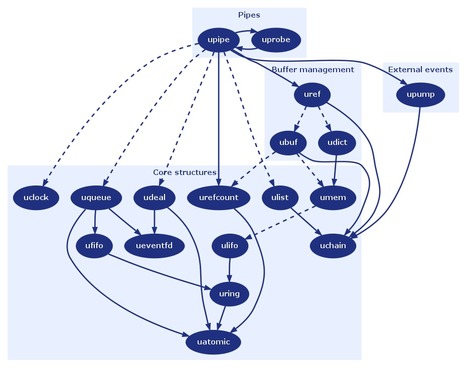
Upipe is a flexible dataflow framework. It is primarily designed to be the core of a multimedia player, transcoder or streamer. The framework organizes the processing of incoming data buffer inside a pipeline of modules. It exposes core types for buffers and modules (called "pipes"), and the API of communication between pipes and between the application and pipes. Unlike most multimedia frameworks, Upipe was specified bottom-up. It implies that an application using Upipe is not restricted to a single high-level API, but can also implement and use any of the lower-level programming interfaces. It is also always possible to build higher-level interfaces. Its core data structures are expected to work efficiently without needlessly depending on each other, and are independantly unit-tested. The concept was completely designed and created in 2012, with today's computing architectures in mind. In particular, all platforms are nowadays more or less super-scalar (even your cell phone), and Upipe has been written to take advantage of several cores when needed. It may at first be surprising to notice that none of the core modules of Upipe deal with threads. However, the basic data structures have been implemented with lock-less or wait-less algorithms and therefore do not depend on the number of threads. Upipe's philosophy is to let the application (or higher-level APIs) create FIFOs and threads when it is necessary, not when the developer of the framework found it fancy to put a thread there, that would end up using 0.01% of a core and add unwanted latency. Since it doesn't require its own thread architecture, it also doesn't require a specific event loop manager. It can therefore be incorporated quite easily into event loops coming from other projects, like glib, Qt or Ecore. By default it comes with an optional libev support.
|
|
Scooped by
Nicolas Weil
May 29, 2013 11:50 PM
|
Earlier this month the Web standards body, W3C, announced the first draft of the Encrypted Media Extensions (EME) specification, which will allow content providers to add content protection to HTML5 videos for the first time. While EME will not handle the encryption process or Digital Rights Management (DRM) system, it will provide a standard for third-party plug-ins to support DRM in the web browser. The news elicited a mixed response from web platform commentators but there is no doubting its significance for the digital TV community. Right now, the appetite for HTML5 video is strong, as a platform for a consistent, cross-device viewing experience. Developed with the new breed of mobile and OTT-capable devices in mind, HTML5 makes it possible, in theory, to standardise playback on any device, via the browser, and eliminates the need for plug-ins to create rich video playback experiences. While ideal for basic video playback, HTML5 has a way to go before it becomes a fully-fledged solution for the most demanding use cases of online video delivery. In the interim, workaround tools, and online video platforms have emerged to help content producers and developers deliver on the multi-platform promise.
|
|
Scooped by
Nicolas Weil
May 22, 2013 5:48 PM
|
In this post, we are going to dwell on the process of video platform design for ourTogether project. From the technical viewpoint, this project is remarkable by containing the entire content lifecycle, from its creation on mobile devices to distribution and viewing. While designing the platform, we sought to attain solution flexibility and cost-efficiency. With the new video platform you can receive, store and share videos. All video management tasks were implemented on Apple HLS. Problem statement Design a video platform to enable online broadcast. The platform can:
1) Record content from a variety of mobile devices (iOS/Android smartphones and tablets)
2) View content from a variety of devices (MultiScreening) – iOS / Android / PC. An important feature is to enable publishing via a wonky mobile connection, broadcast fault recovery, and broadcast pause. Also great is that in case of a connection failure the content shot is never lost, with broadcasting fully resumed after recovery. Here it is important to ensure that "It just works", regardless of unstable connection issues. In other words, this is a common video camera that can publish your recordings online whatever the bandwidth or connection quality.
|
|
Scooped by
Nicolas Weil
May 22, 2013 5:19 PM
|
DASH-IF introduces a leaner, meaner H.264/fMP4 approach, officially called DASH-AVC/264. DASH-IF has identified what it calls "interoperability points" that use AAC as the audio codec, AVC as the video codec (also known as H.264 or MPEG-4 Part 10), and fMP4 as the base container format. The latter is better known as the ISO Base Media File Format (ISOBMFF). The primary interoperability point is designed around high-definition (HD) video up to 720p at the AVC Progressive High Profile.
|
|
Scooped by
Nicolas Weil
May 16, 2013 5:26 PM
|
Google plans to release the VP9 codec in less than a month. While it sounds promising, deep-pocketed companies will want to hold off on adoption. In a series of blog posts last week, Google detailed the final release schedule for VP9 and a few other implementation details. These posts also indicated that YouTube plans to start using VP9 once it’s available in Chrome. Unfortunately for Google, recent patent infringement claims from Nokia seriously muddy the waters regarding whether or not VP8 and VP9 will ultimately be royalty free.
|
|
Scooped by
Nicolas Weil
May 16, 2013 4:45 PM
|
As more Pay TV content is delivered as streaming video to the television, so the requirements for improved audio become more obvious. If operators want consumers to move seamlessly between their broadcast and IP services within their UI environment, like when they are watching VOD on hybrid STBs, they need to avoid a sudden loss of quality from, for example, 5.1 Surround Sound to simple stereo. Raising the streaming Quality of Experience (QoE) to match that of broadcast delivery encompasses many challenges. We need subtitling and audio description to become the norm, and trick-play functions to match a local PVR for content delivered from the cloud. There are high hopes that improved compression and CDN technologies will deliver broadcast-standard picture quality and reliability at some point.
|
|
Scooped by
Nicolas Weil
May 12, 2013 11:01 AM
|
NHK's 8K Super Hi-Vision is an extremely bandwidth-heavy format -- so much so that earlier tests used gigabit-class internet links rather than traditional TV broadcasting methods. Thankfully, both the broadcaster and Mitsubishi have developed an encoder that could keep data rates down to Earth. The unassuming metal box (above) is the first to squeeze 8K video into the extra-dense H.265(HEVC) format, cutting the bandwidth usage in half versus H.264. Its parallel processing is quick enough to encode video in real time, too, which should please NHK and other networks producing live TV. We'll still need faster-than-usual connections (and gigantic TVs) to make 8K an everyday reality, but that goal should now be more realistic.
|
|
Scooped by
Nicolas Weil
May 11, 2013 5:54 AM
|
The Web standards group is going ahead with its Encrypted Media Extensions technology despite some opposition, arguing it's a step in the right direction. The World Wide Web Consortium has decided to go ahead with a technology that will let companies like Netflix stream encrypted video using Web sites -- against the wishes of the Free Software Foundation, Electronic Frontier Foundation, and 25,600 petition signatories. The Web standards group announced the move Thursday, to nobody's surprise. Entertainment-industry players had approached the group three years ago to discuss the technology, Microsoft has been helping develop it, and Google already has built the specification, called Encrypted Media Extensions (EME) into Chrome. The standard doesn't actually handle encryption and digital rights management (DRM) to govern who gets to see or copy video. Instead, it provides a standard mechanism that lets a browser call upon a plug-in that handles the work. In other words, it enables encryption but doesn't do the encryption itself.
|
|
Scooped by
Nicolas Weil
May 5, 2013 12:24 PM
|
Over the last year, we've been collaborating with other industry leaders on three W3C initiatives which are positioned to solve this problem of playing premium video content directly in the browser without the need for browser plugins such as Silverlight. We call these, collectively, the "HTML5 Premium Video Extensions"
|
|
Scooped by
Nicolas Weil
May 5, 2013 12:07 PM
|
|
|
Scooped by
Nicolas Weil
May 5, 2013 11:39 AM
|
Now that virtually all major players support Apple's HLS, the shortcomings of that de facto standard may lead to more widespread implementation of MPEG-DASH.
Adobe made news several weeks ago, when it announced the impending inclusion of Apple's HTTP Live Streaming (HLS) in the Primetime player, part of Adobe's video publishing ecosystem for big media companies. Yes, we all agree, it's a big deal for HLS, both from the standpoint of players—all major players, except the standalone Flash Player without the Primetime SDK on top, now have plans to include HLS—as well as a win for Apple in creating ade facto standard out of a proprietary solution. But it may be too much too late, and could spell the beginning of the end of HLS as we know it. Wait, don't I mean too little too late? No, in this instance, I think HLS's popularity, as it is thrust out on to the global broadcast stage without yet fully putting on its costume (stabilized "recommendation" spec) may be its undoing.
|
|
Scooped by
Nicolas Weil
May 1, 2013 2:44 PM
|
|
















Interesting part is the conclusion : "Rovi says it expects to see additional gains for the HEVC SDK, doubling efficiencies from the current 20 percent gains, as it further optimizes its HEVC codec."
It's interesting to see how companies are ready to trade off maturity and performance over time to market. Let's remember that the initial HEVC promise confirmed by all industry actors as a target for VOD gain is 50%...